
Modified gabor transform with gaussian compression and bi-orthogonal dirichlet gaussian decompression
a gabor transform and gaussian decompression technology, applied in the field ofsignal processing, can solve the problems of inefficiency of local basis functions that yield efficiency, inefficiency of storing data in time-based representations, and inefficiency of global basis functions, and achieves high density of gaussian functions, simple calculation, and fast compression.
Patent Information
- Authority / Receiving Office
- US · United States
- Patent Type
- Applications(United States)
- Current Assignee / Owner
- Publication Date
- 2013-07-18
- Estimated Expiration
- Not applicable · inactive patent
Smart Images
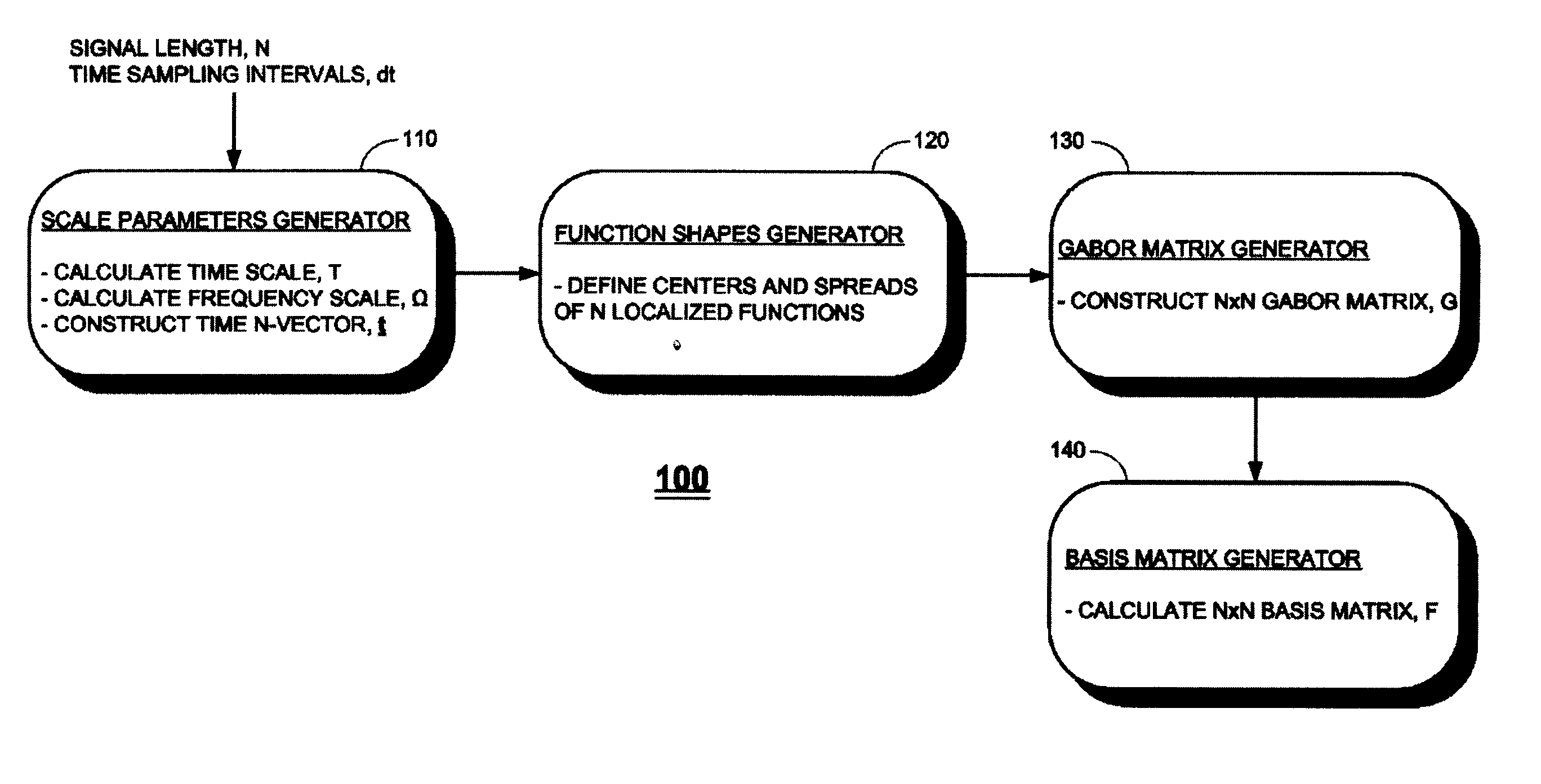
Figure 1 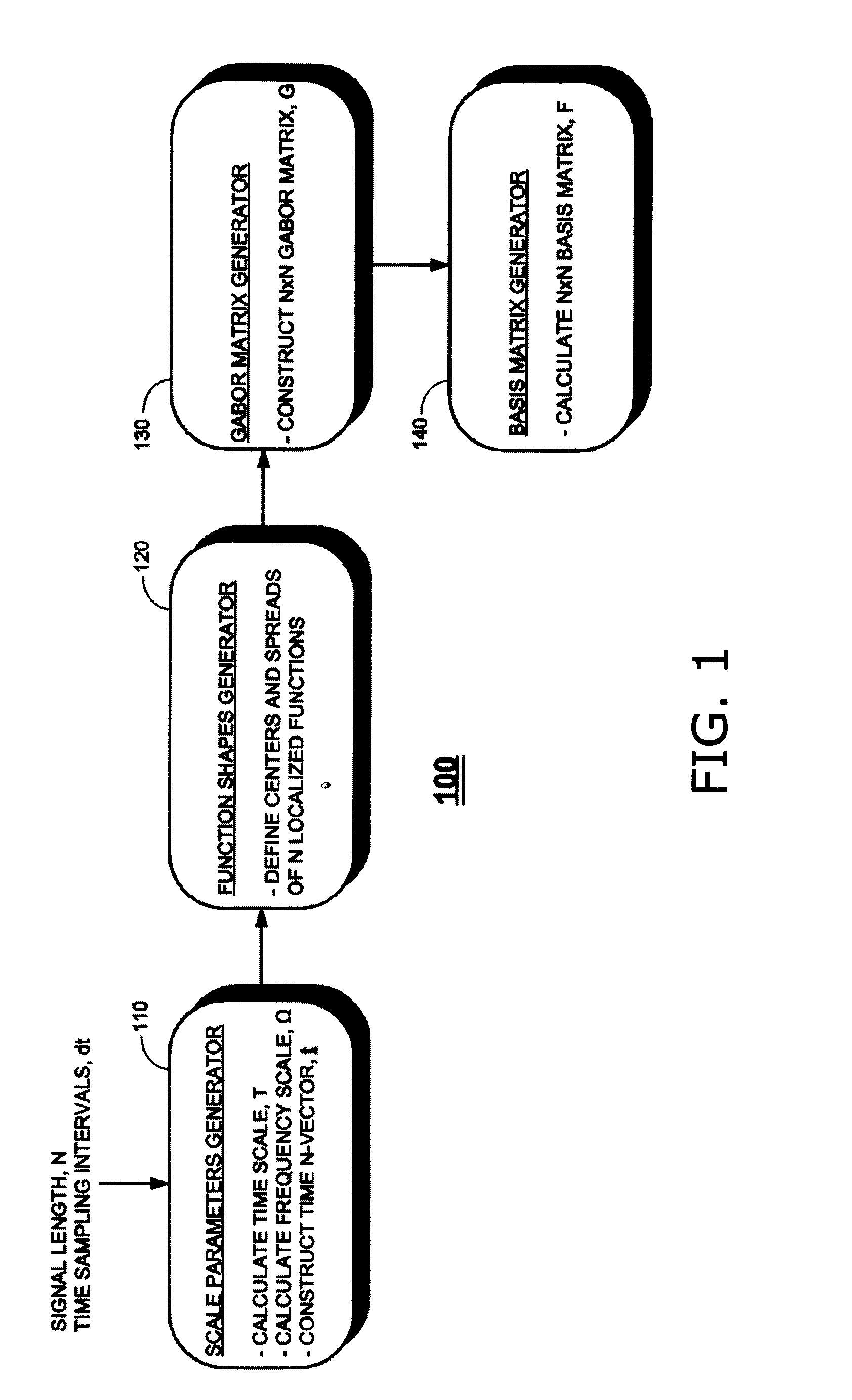
Figure 2 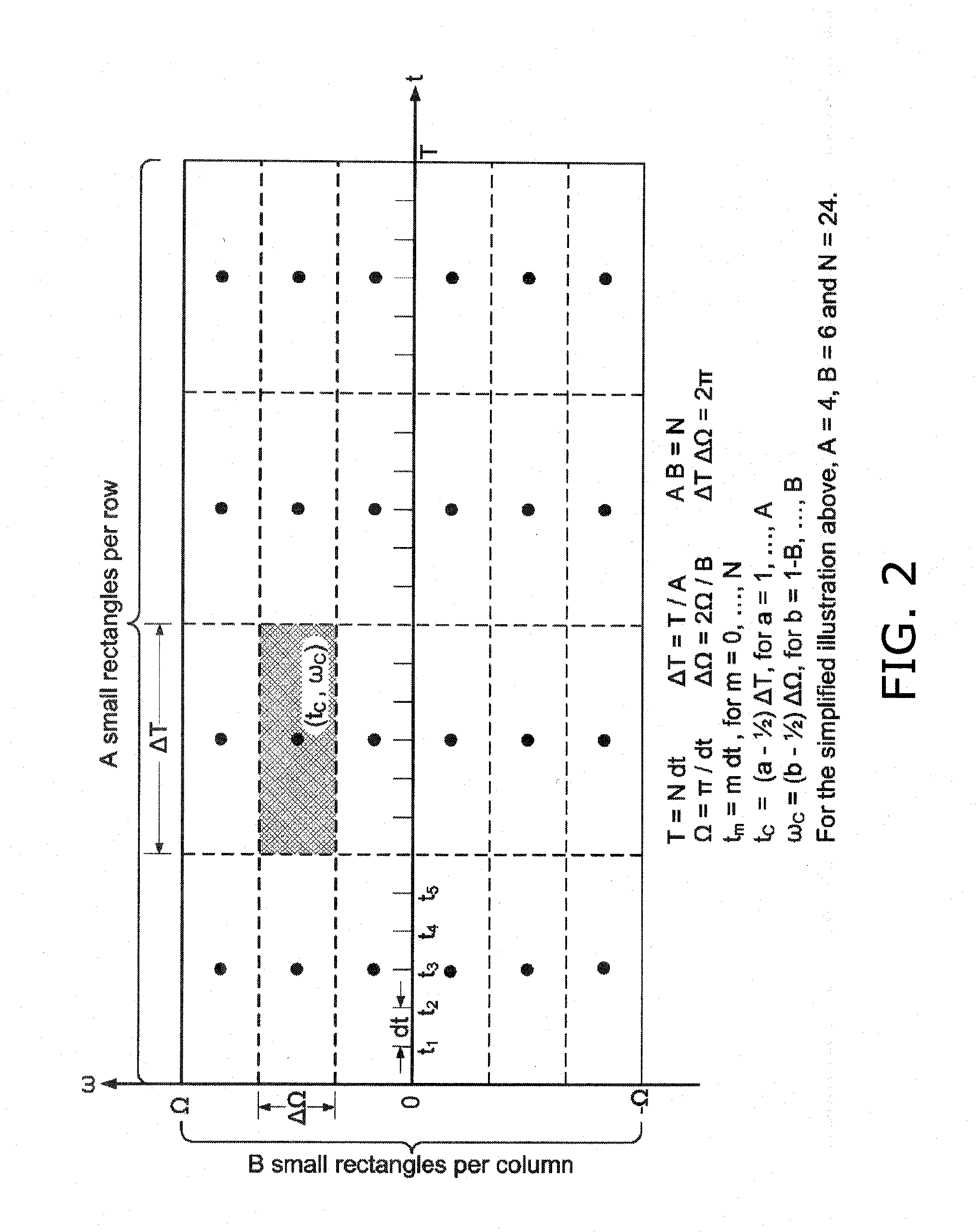
Figure 3
Abstract
Description
RELATED APPLICATIONS
[0001] This application claims priority benefit of U.S. Provisional Application No. 61 / 390,228, entitled MODIFIED GABOR TRANSFORM WITH GAUSSIAN COMPRESSION AND BI-ORTHOGONAL DIRICHLET GAUSSIAN DECOMPRESSION, filed on Oct. 6, 2010 by inventors David J. Tannor and Asaf Shimshovitz.FIELD OF THE INVENTION
[0002] The field of the present invention is signal processing. More specifically, the present invention relates to signal compression, image compression, numerical quantum mechanics and to numerical analysis in general.BACKGROUND OF THE INVENTION
[0003] Many conventional signal processing techniques represent signals in terms of basis functions, such as the familiar Fourier transform. Ideally, a good choice of basis functions should provide accuracy and efficiency—accuracy in providing reliable results, and efficiency in requiring only a relatively small number of basis functions. However, global basis functions, such as sinusoidals, that yield global accuracy generally...
Examples
Embodiment Construction
[0035]Aspects of the present invention relate to a novel transform in which a signal is represented in terms of coefficients that are calculated by overlapping the signal with a set of Gaussian basis functions. The coefficients are used to compress the signal, and the basis functions, in a modified form as described below, are used to reconstruct the signal by decompression.
[0036]In one embodiment of the present invention, referred to herein as the G-transform, the overlaps are computed with the Gabor basis functions. In another embodiment of the present invention, referred to herein as the w-transform, the overlaps are computed with a wavelet basis of Gaussians; i.e., Gaussians that are shifted and scaled in width. The overlaps determine the coefficients that provide the compressed representation of the signal.
[0037]As such, the coefficients are simple to calculate, being just the overlap of the signal with a discrete set of Gaussians. As a result, compression is performed very fas...