
Binocular visual experience enrichment system
a visual experience and binocular technology, applied in image enhancement, instruments, computing, etc., can solve the problems of avoiding viewing discomfort, unable to achieve good balance, so as to enhance the image content, avoid viewing discomfort, and improve the visual content. human perception
Patent Information
- Authority / Receiving Office
- US · United States
- Patent Type
- Applications(United States)
- Current Assignee / Owner
- Publication Date
- 2014-02-27
Smart Images
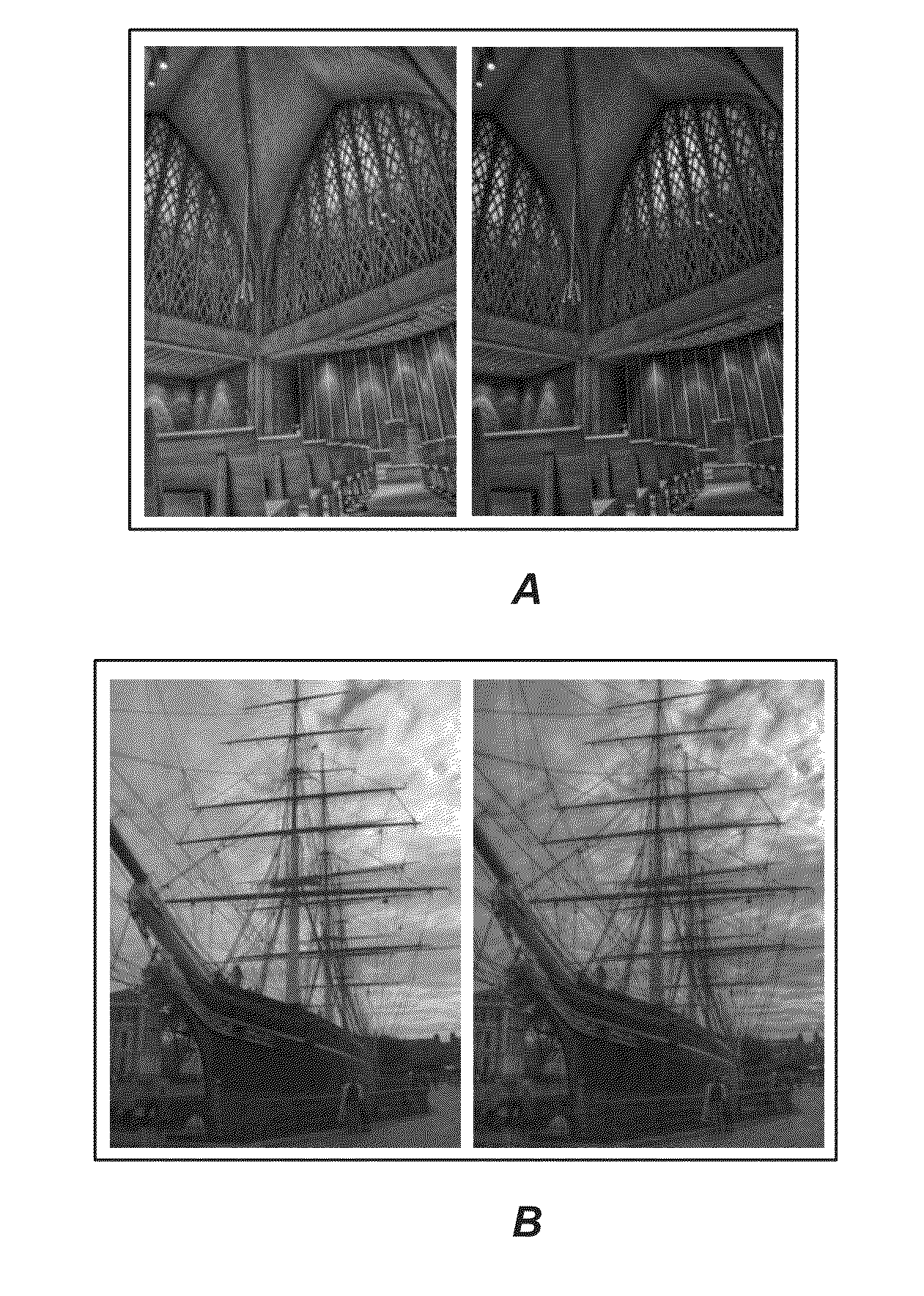
Figure 1 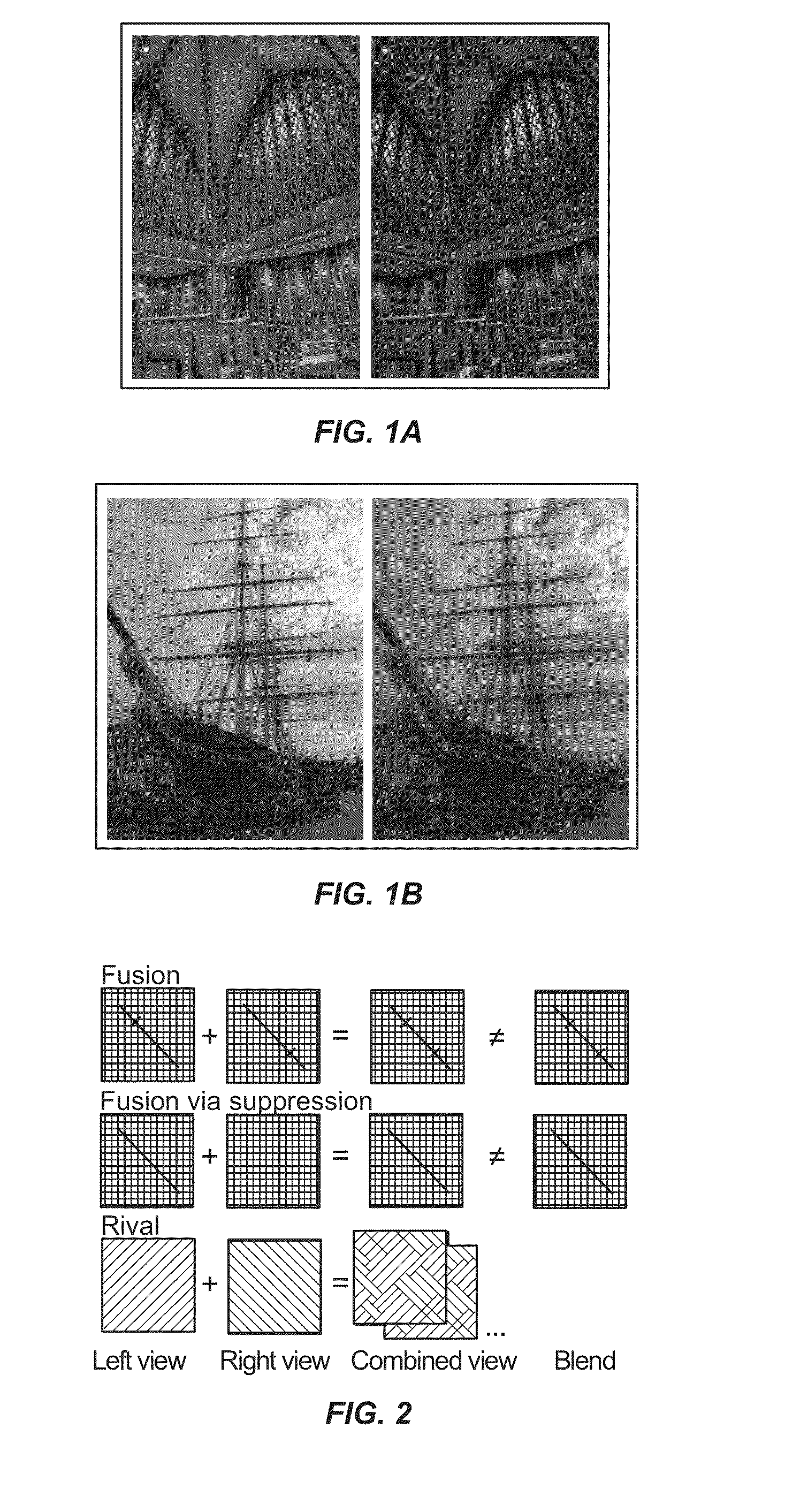
Figure 2 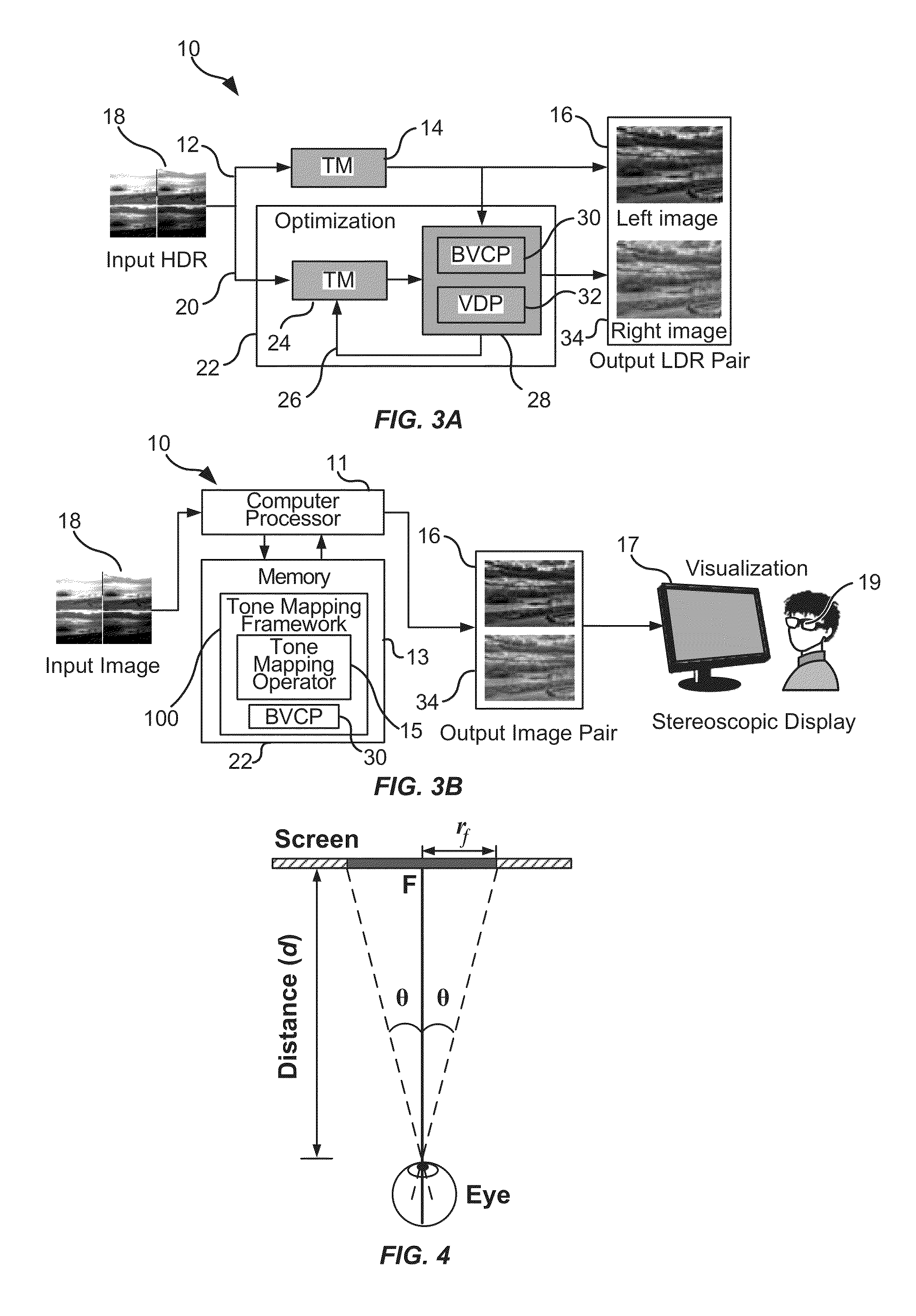
Figure 3
Abstract
Description
CROSS-REFERENCES TO RELATED APPLICATIONS
[0001] This application claims benefit under 35 USC §119 of U.S. Provisional Patent Application Ser. No. 61 / 678,732 filed Aug. 2, 2012.BACKGROUND OF THE INVENTION
[0002] This invention relates to computer-aided synthesis of visual images. More particularly, this invention relates to a system and method for synthesizing image pairs from a single high dynamic range image used to produce a single percept.
[0003] An additional image domain is introduced when extending from monocular display to binocular display. Existing binocular display systems only utilize this additional image domain for stereopsis. Human vision is not only able to fuse two displaced images, but also fuse two images with difference in detail, contrast and luminance, up to a certain limit. This phenomenon is known as binocular single vision. Humans can perceive more visual content via binocular fusion than just a linear blending of two views.
[0004] The popularity of 3D movies leads t...
Examples
Embodiment Construction
[0076]According to an embodiment of the invention, a novel technique in computer graphics utilizes a human vision phenomenon and proposes a binocular tone mapping framework. The proposed framework generates a binocular low-dynamic range (LDR) image pair that preserves more human-perceivable visual content than a single LDR image using the additional image domain. Given a tone-mapped LDR image (left, without loss of generality), the inventive framework optimally synthesizes its counterpart (right) in the image pair from the same source HDR image. The two LDR images are different, so that they can aggregate to present more human-perceivable visual richness than a single arbitrary LDR image without triggering visual discomfort. For example, in FIGS. 1A and 1B, one image within each pair presents more global contrast (the left image of each pair) while the other presents more local details (the right image of each pair). To achieve this, a novel binocular viewing comfort predictor (BVCP...