
Low-density high-strength concrete and related methods
a high-strength, concrete technology, applied in the direction of ceramicware, solid waste management, sustainable waste treatment, etc., can solve the problems of poor tensile strength, poor ductility, limited use or value of concrete as a building material, etc., to achieve high strength-to-weight ratio, low density, and good segregation resistance
Patent Information
- Authority / Receiving Office
- US · United States
- Patent Type
- Applications(United States)
- Current Assignee / Owner
- Publication Date
- 2016-03-03
Smart Images
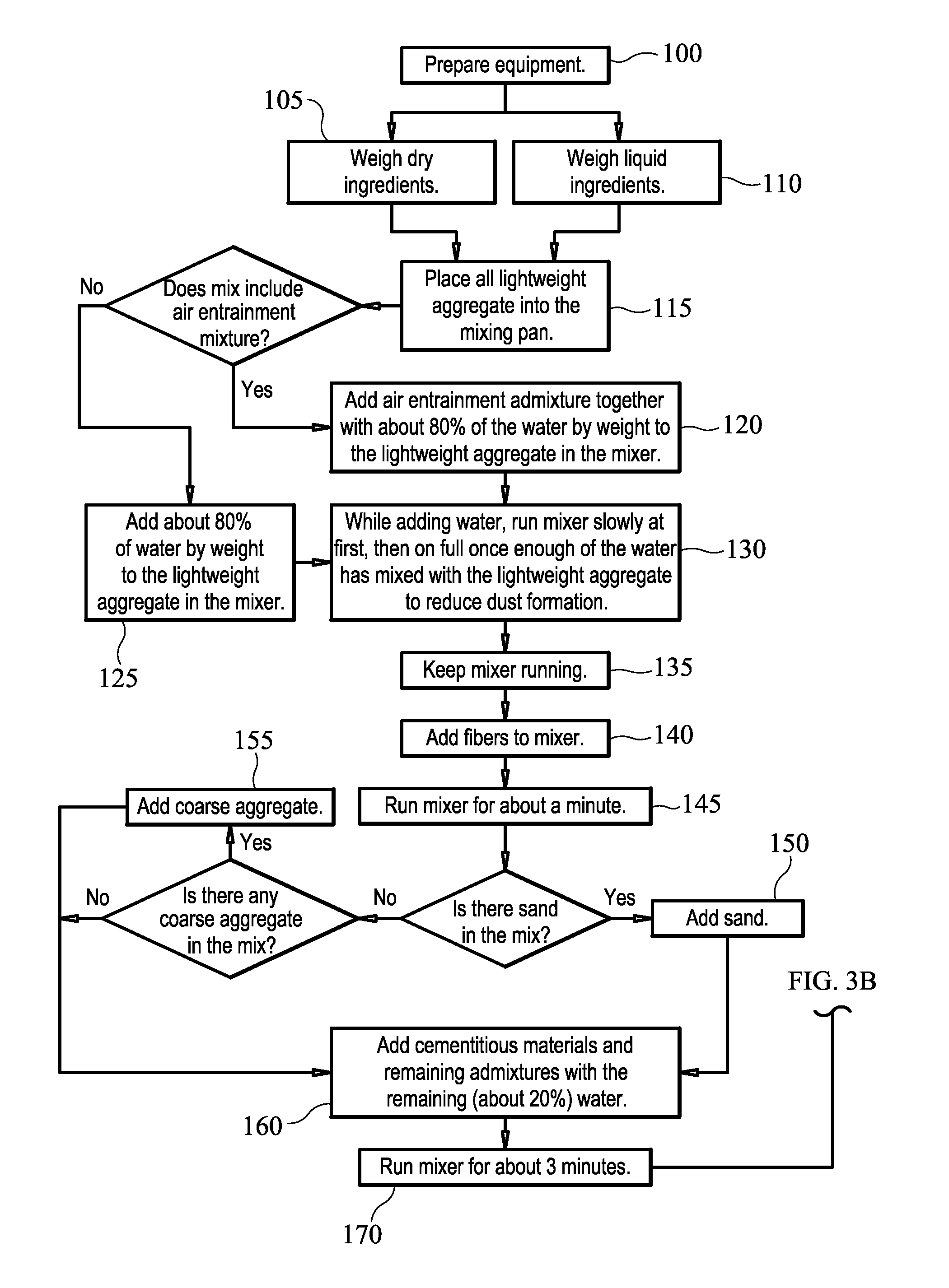
Figure 1 
Figure 2 
Figure 3
Abstract
Description
RELATED APPLICATIONS
[0001] The present application claims priority to: U.S. Provisional Application Ser. No. 62 / 216,255, filed Sep. 9, 2015; to pending U.S. patent application Ser. No. 14 / 642,141, filed Mar. 9, 2015; and to pending International Application No. PCT / US15 / 019510, filed Mar. 9, 2015. U.S. patent application Ser. No. 14 / 642,141 and International Application No. PCT / US15 / 019510 each claim priority to U.S. Provisional Application Ser. No. 61 / 950,202, filed Mar. 9, 2014. Each of these applications are incorporated by reference in their entirety.FIELD OF INVENTION
[0002] In general, this invention relates to low-density, high-strength concrete that is lightweight, and to related concrete mixes that may be self-compacting and that, among the many multiple uses thereof, may be used for walls, building structures, architectural panels, concrete blocks, insulation (including pipe insulation), poles and beams, roofing, fencing, shotcrete, floating structures, concrete backfill, fir...
Examples
examples 1-7
Aggregate: SG 0.35 Microspheres
[0116]Concrete preparation and mixing was done in accordance with ASTM C192. The process is described in reference to FIGS. 3A-3B. First, all necessary equipment was prepared in step 100. Then the dry ingredients were weighed and thereafter the liquid ingredients (steps 105 and 110). All weights for Examples 1-7 are shown below in Table III (by weight) and Table IV (by weight percent). Paste content for Example 7 was estimated. Admixture amounts are fluid ounces per 100 lbs. of cementitious material. Then in step 115, all of the LWA was placed into the mixing pan 7 of a Hobart type pan mixer 6 (see FIG. 5B). This LWA was composed of 3M brand S35 glass microspheres having a SG of about 0.35, a median size of about 40 microns and a microsphere size distribution such that about 80% are between about 10-75 microns, and with about a crushing strength 90% survival rate at about 3000 psi. Then, if the mix included an air entrainment admixture, the air entrain...
examples 8-12
Aggregate: SG 0.15 Microspheres
[0119]Concrete preparation and mixing was done in accordance with ASTM C192. The process is described in reference to FIGS. 3A-3B. First, all necessary equipment was prepared in step 100. Then the dry ingredients were weighed and thereafter, the liquid ingredients (steps 105 and 110). All weights for Examples 8-12 are shown below in Table VIII (by weight) and Table IX (by weight percent). Admixture amounts are fluid ounces per 100 lbs. of cementitious material. Then in step 115 all of the LWA was placed into mixing pan 7 of a Hobart type pan mixer 6 (see FIG. 5B). This LWA was composed of 3M brand S15 glass microspheres having a SG of about 0.15, a median size of about 55 microns and a microsphere size distribution such that about 80% are between about 25-90 microns, and with about a crushing strength 90% survival rate at about 300 psi. Then, if the mix included an air entrainment admixture, the air entrainment admixture was added in step 120 together ...
examples 13-17
Aggregate: SG 0.35 / SG 0.15 Microspheres and Sand
[0122]Concrete preparation and mixing was done in accordance with ASTM C192. The process is described in reference to FIGS. 3A-3B. First, all necessary equipment was prepared in step 100. Then the dry ingredients were weighed and thereafter the liquid ingredients (steps 105 and 110). All weights for Examples 13-17 are shown below in Table XIII (by weight) and Table XIV (by weight percent). Admixture amounts are fluid ounces per 100 lbs. of cementitious material. Then, in step 115, all of the LWA was placed into mixing pan 7 of a Hobart type pan mixer 6 (see FIG. 5B). For Example 13, this LWA was composed of 3M brand S15 glass microspheres having a SG of about 0.15, a median size of about 55 microns and a microsphere size distribution such that about 80% are between about 25-90 microns, and with about a 90% crushing strength survival rate at about 300 psi. For the remaining examples, this LWA was composed of 3M brand S35 glass microsphe...