
Display apparatus, display method, and program
a display method and display apparatus technology, applied in the field of display apparatus, can solve the problems of difficult patient concentration on training, inability to effectively train, and paralysis of limbs in some cases, and achieve the effect of efficient training
Patent Information
- Authority / Receiving Office
- US · United States
- Patent Type
- Applications(United States)
- Current Assignee / Owner
- Publication Date
- 2016-08-25
Smart Images
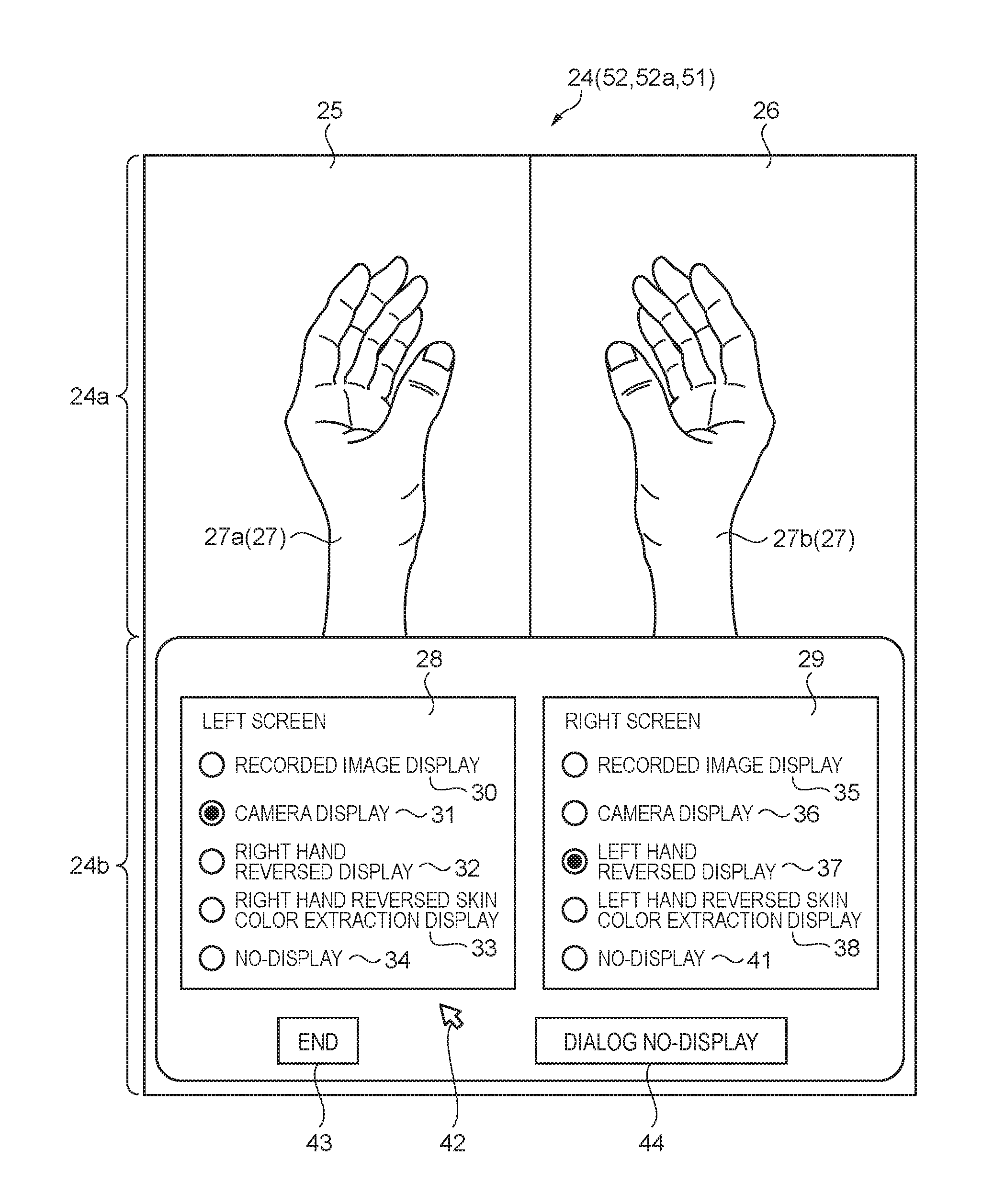
Figure 1 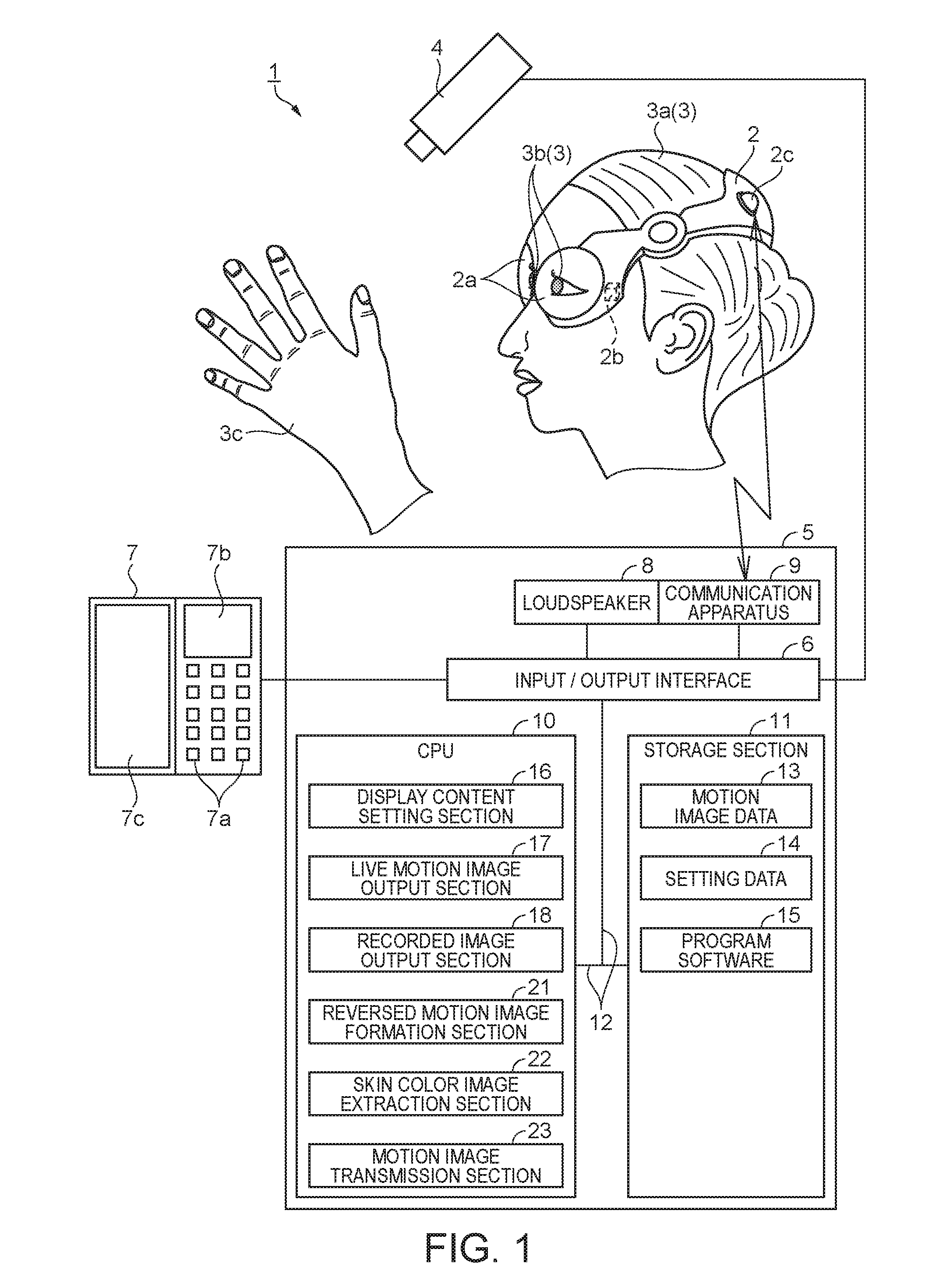
Figure 2 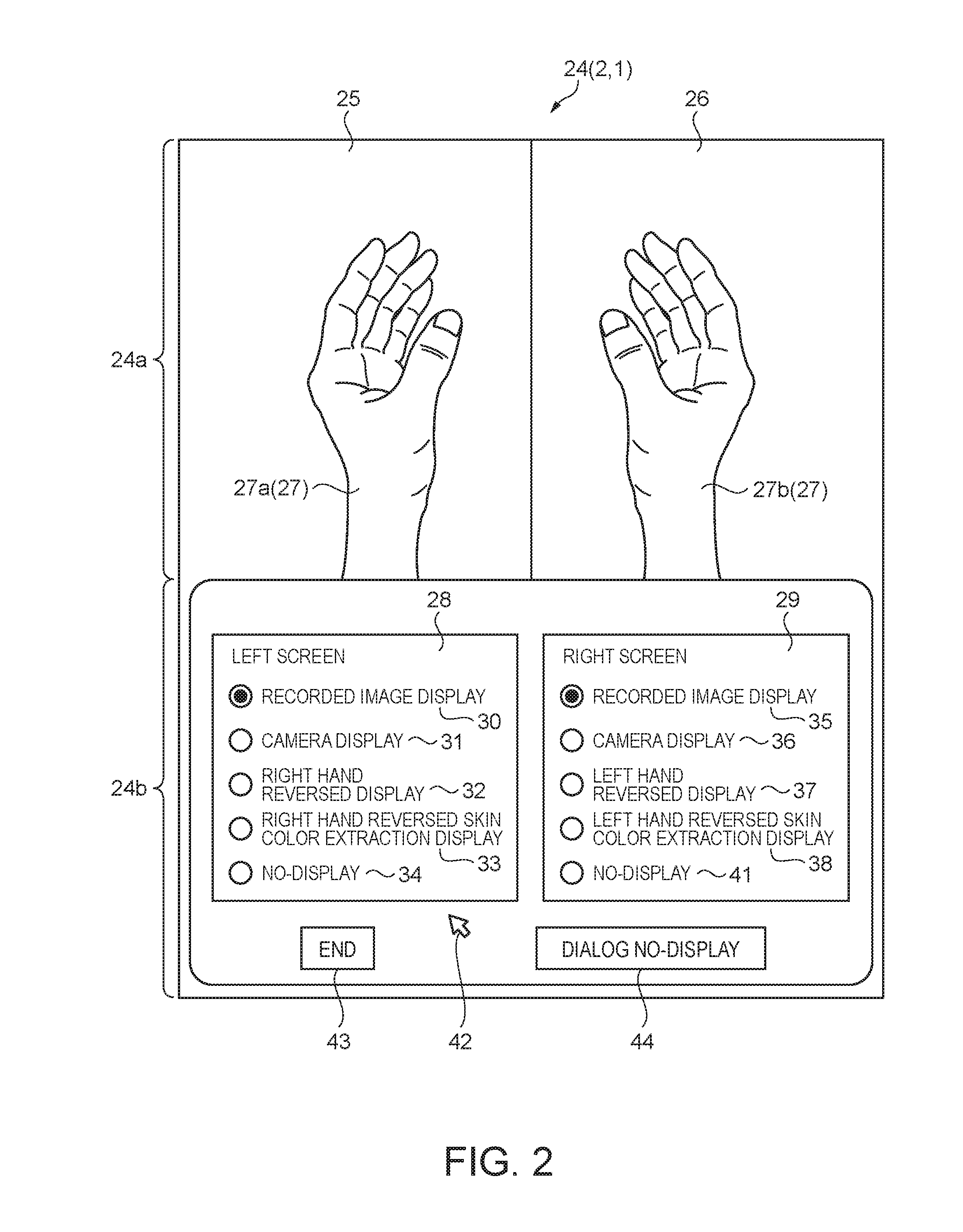
Figure 3
Abstract
Description
BACKGROUND
[0001] 1. Technical Field
[0002] The present invention relates to a display apparatus, a display method, and a program.
[0003] 2. Related Art
[0004] When the neural circuit in the brain is damaged due to a stroke, limbs are paralyzed in some cases. Methods that allow such a patient to undergo rehabilitation have been invented. One of the methods causes the patient to think that the patient should attempt moving a paralyzed limb and shows the patient images in which the paralyzed limb is moving so that the patient has a feeling as if the limb were moving.
[0005] A patient whose limb has been lost due, for example, to an accident sometimes has a painful sensation in the limb. The phenomenon is called a phantom pain. A method similar to the method described above has been proved to be effective for such a patient. In the method, an image that causes the patient to have a feeling as if the lost limb existed is shown to the patient. The method allows appropriate recognition of the lost ...
Examples
first embodiment
[0052]A rehabilitation assistance apparatus according to a first embodiment will be described with reference to FIGS. 1 and 2. FIG. 1 is a block diagram showing the configuration of the rehabilitation assistance apparatus. A rehabilitation assistance apparatus 1 as a display apparatus includes a head-mounted display 2 as a motion image display section and a light transmissive head-mounted display, and the head-mounted display 2 is mounted on a head 3a of a patient 3, as shown in FIG. 1. The head-mounted display 2 has mirror sections 2a so located as to face eyes 3b of the patient 3. The head-mounted display 2 includes projection sections 2b, and the projection sections 2b output light toward the mirror sections 2a. The light is reflected off the mirror sections 2a and incident on the eyes 3b. The patient 3 can view virtual motion images on the basis of the light incident on the eyes 3b. The head-mounted display 2 allows the right eye and the left eye to see motion images different f...
second embodiment
[0097]An embodiment of the rehabilitation assistance apparatus will next be described with reference to a block diagram showing the configuration of a rehabilitation assistance apparatus shown in FIG. 7. The present embodiment differs from the first embodiment in that the head-mounted display 2 is provided with a camera. The same points as those in the first embodiment will not be described.
[0098]That is, in a rehabilitation assistance apparatus 46 of the present embodiment, the head-mounted display 2 is provided with a camera 47, as shown in FIG. 7. Live motion images captured with the camera 47 are transmitted by the communication section 2c to the communication apparatus 9. The camera 47 has the same function as that of the camera 4 in the first embodiment.
[0099]Since the head-mounted display 2 is provided with the camera 47, motion images captured with the camera 47 are synchronized with motion of the head 3a of the patient 3. The direction in which the camera 47 captures motion...
third embodiment
[0100]An embodiment of the rehabilitation assistance apparatus will next be described with reference to FIGS. 8 to 11. FIG. 8 is a block diagram showing the configuration of the rehabilitation assistance apparatus. FIGS. 9 to 11 are diagrammatic views for describing a rehabilitation method. The present embodiment differs from the first embodiment in that the head-mounted display 2 is replaced with a panel-shaped display. The same points as those in the first embodiment will not be described.
[0101]That is, in the present embodiment, a rehabilitation assistance apparatus 51 includes a display 52, as shown in FIG. 8. The display 52 includes a display section 52a, a stand 52b, and a communication section 52c. The display 52 can be a liquid crystal display, an organic electroluminescence display, a plasma display, a field emission display, or any other display. The display 52 is preferably capable of color representation because color representation allows representation closer to the ac...