
Apparatus and methods for removing emboli during a surgical procedure
a surgical procedure and applicator technology, applied in the field of applicator, can solve the problems of ischemic stroke and less than optimal solutions to problems, and achieve the effect of reducing the risk of emboli being carried
Patent Information
- Authority / Receiving Office
- US · United States
- Current Assignee / Owner
- Publication Date
- 2005-08-30
- Estimated Expiration
- Not applicable · inactive patent
Smart Images
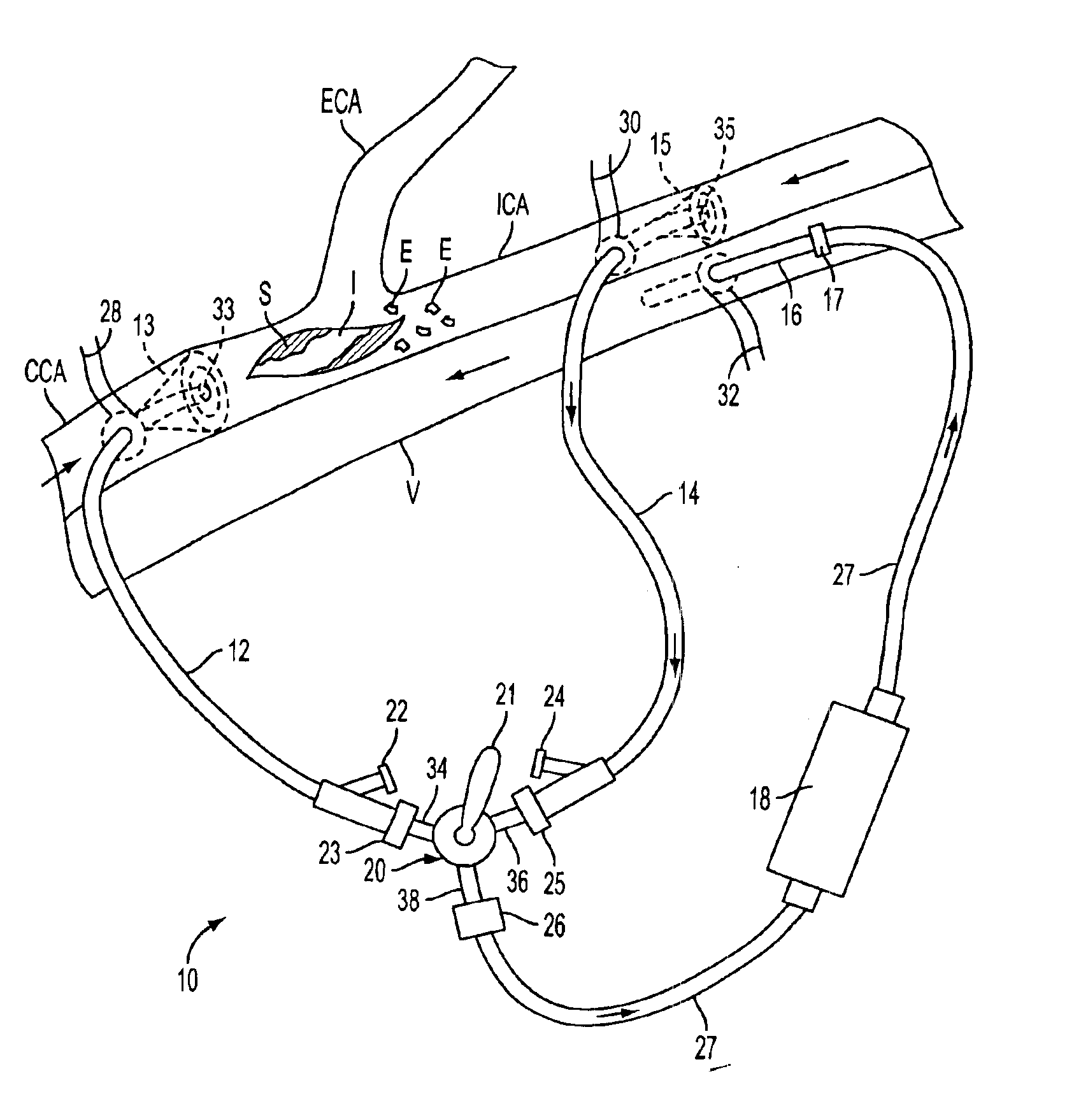
Figure 1 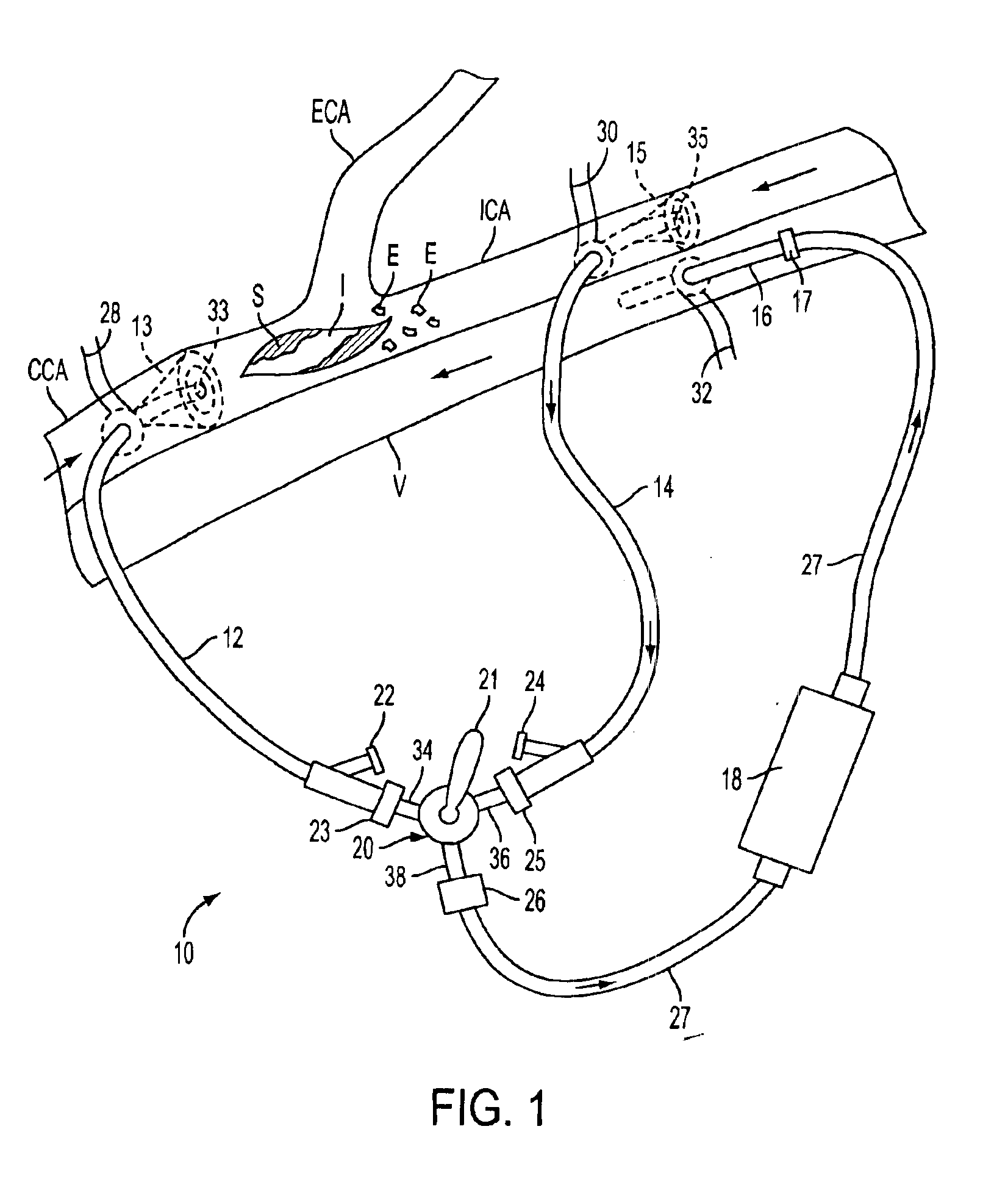
Figure 2 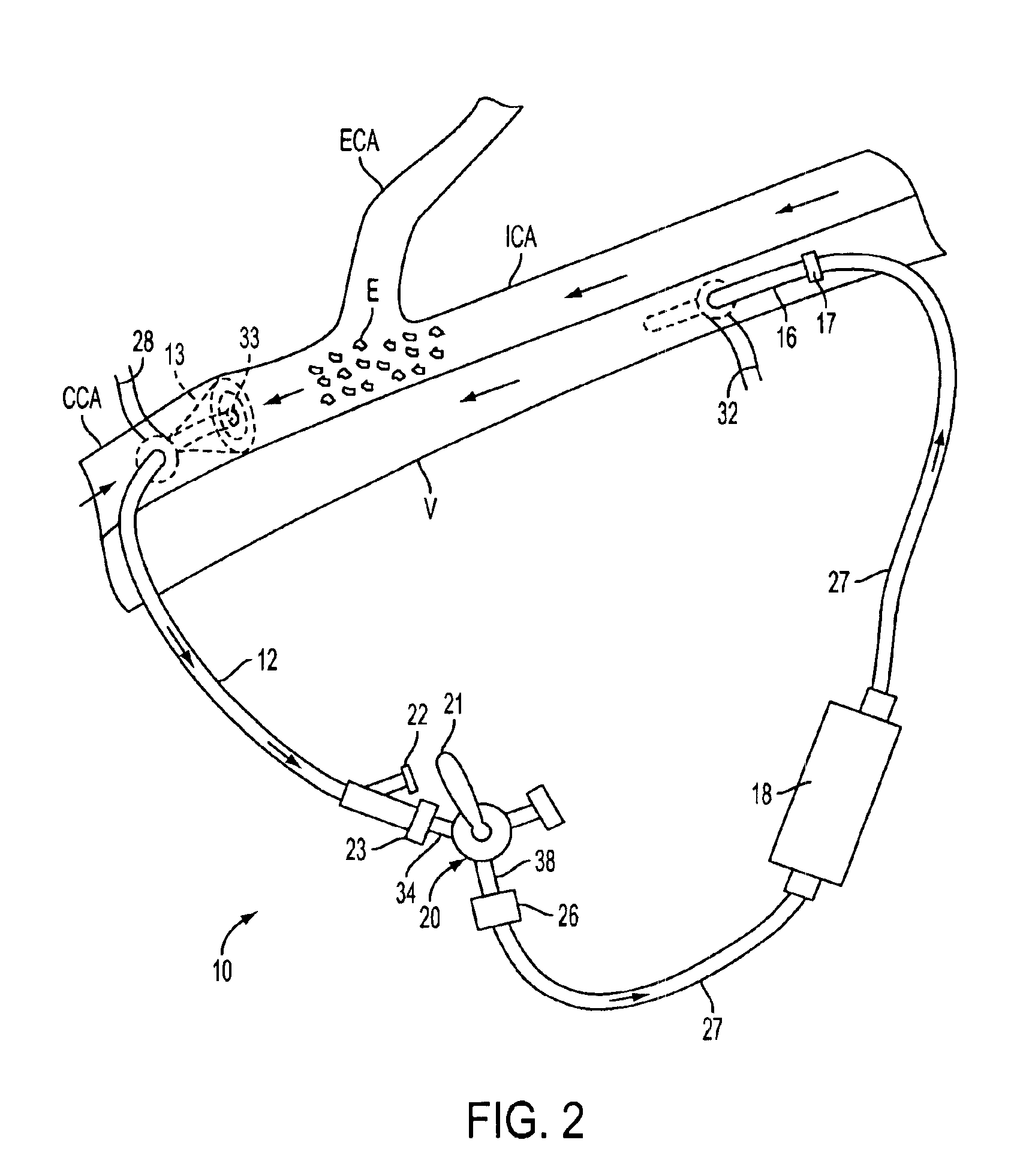
Figure 3
Abstract
Description
REFERENCE TO RELATED APPLICATIONS
[0001] The present application is a continuation-in-part of U.S. patent application Ser. No. 09 / 418,727, filed Oct. 15, 1999 now U.S. Pat. No. 6,423,032, which is a continuation-in-part of U.S. patent application Ser. No. 09 / 333,074, filed Jun. 14, 1999, now U.S. Pat. No. 6,206,868, which is a continuation-in-part of International Application PCT / US99 / 05469, filed Mar. 12, 1999, which is a continuation-in-part of U.S. patent application Ser. No. 09 / 078,263, filed May 13, 1998 now U.S. Pat. No. 6,413,235.FIELD OF THE INVENTION
[0002] This invention relates to apparatus and methods to protect against embolization during vascular interventions, such as endarterectomy. More particularly, the present invention reperfuses blood into a patient's venous vasculature and removes emboli using natural aspirational techniques.BACKGROUND OF THE INVENTION
[0003] Carotid artery stenoses typically manifest in the common carotid artery, internal carotid artery or external ...
Examples
Embodiment Construction
[0021]Referring to FIG. 1, a schematic view of the emboli removal system of the present invention is described. Emboli removal apparatus 10 comprises proximal catheter 12, distal catheter 14 and venous return catheter 27. In accordance with principles of the present invention, proximal and distal catheters 12 and 14 selectively may communicate with venous return catheter 27, for example, using manifold 20 having multi-position valve 21.
[0022]Proximal catheter 12 has proximal and distal ends, and aspiration lumen 33 extending therethrough. Proximal catheter 12 further comprises occlusion element 13, e.g., a balloon, disposed at the distal end, and inflation port 22 disposed at the proximal end that communicates with occlusion element 13 via an inflation lumen of catheter 12, details of which are described with respect to FIG. 3D hereinbelow. Proximal catheter 12 further comprises blood outlet port 23 at the proximal end that communicates with aspiration lumen 33 and is coupled to fir...