
Radio frequency tuner
a radio frequency tuner and frequency technology, applied in the field of radio frequency tuners, can solve the problems of reducing the noise figure achievable, insertion loss, and generally not well controlled channel power range, so as to achieve acceptable isolation, reduce the cost, and avoid degradation of performance with time. the effect of relay degradation
Patent Information
- Authority / Receiving Office
- US · United States
- Patent Type
- Patents(United States)
- Current Assignee / Owner
- Publication Date
- 2009-10-27
- Estimated Expiration
- Not applicable · inactive patent
Smart Images
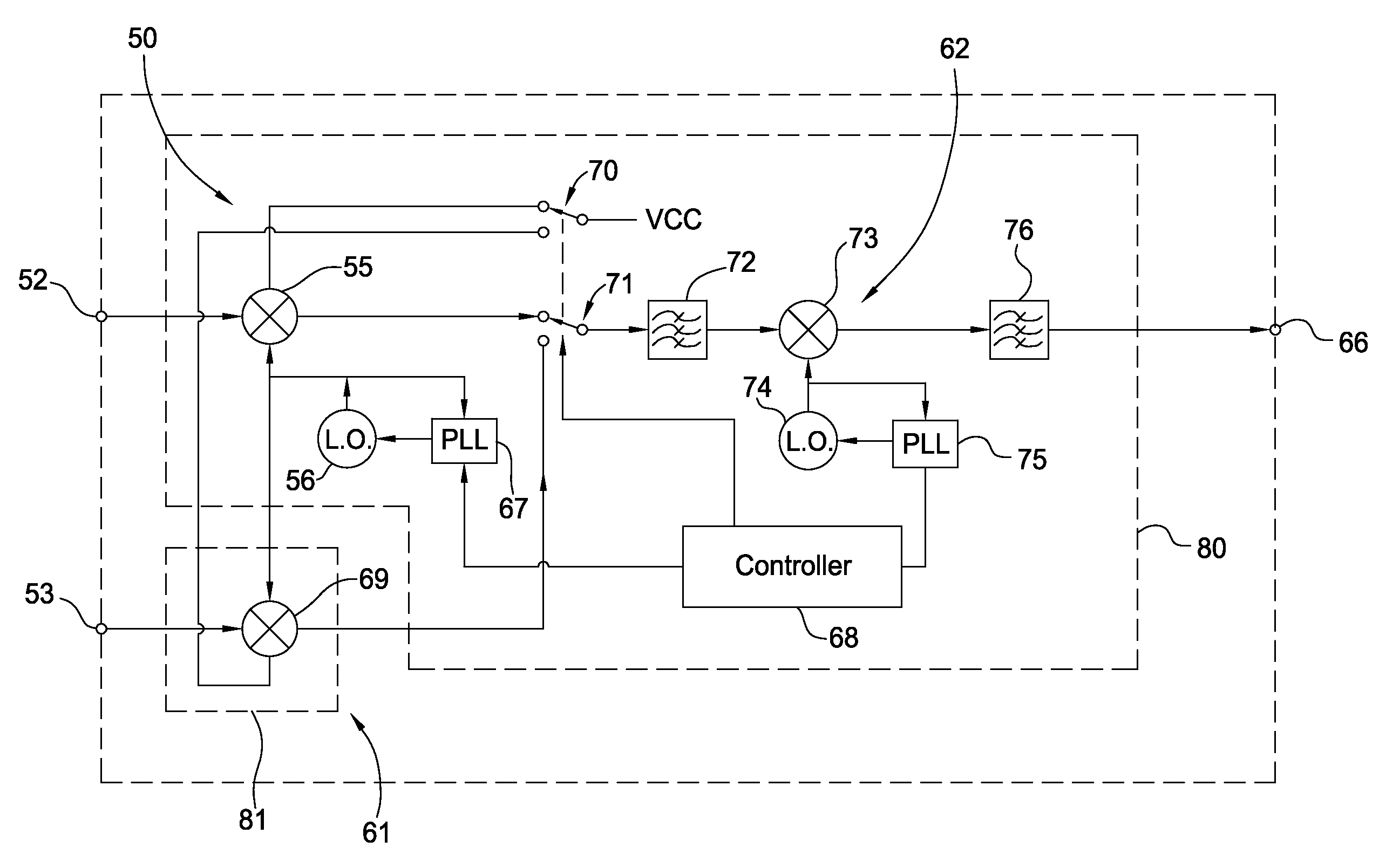
Figure 1 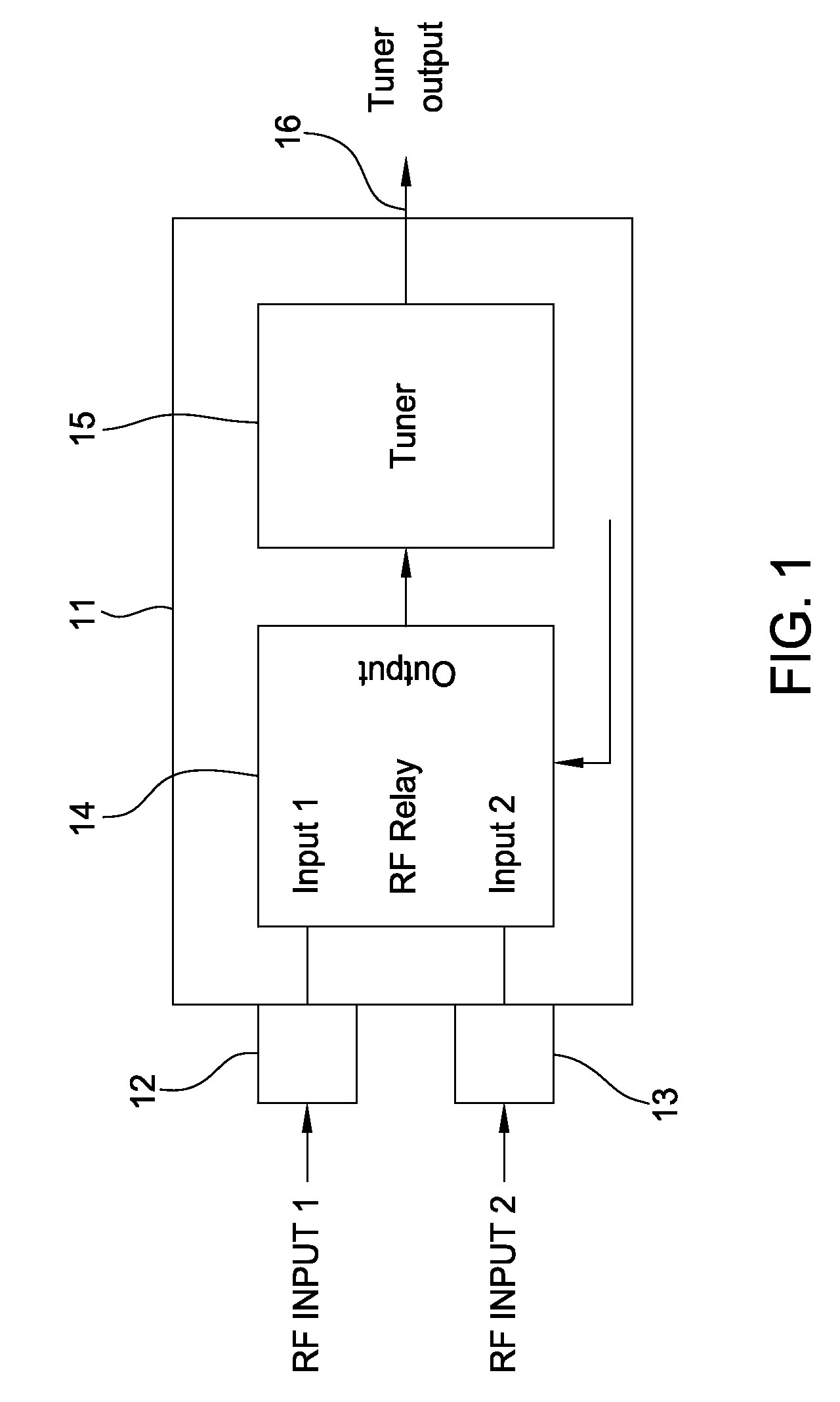
Figure 2 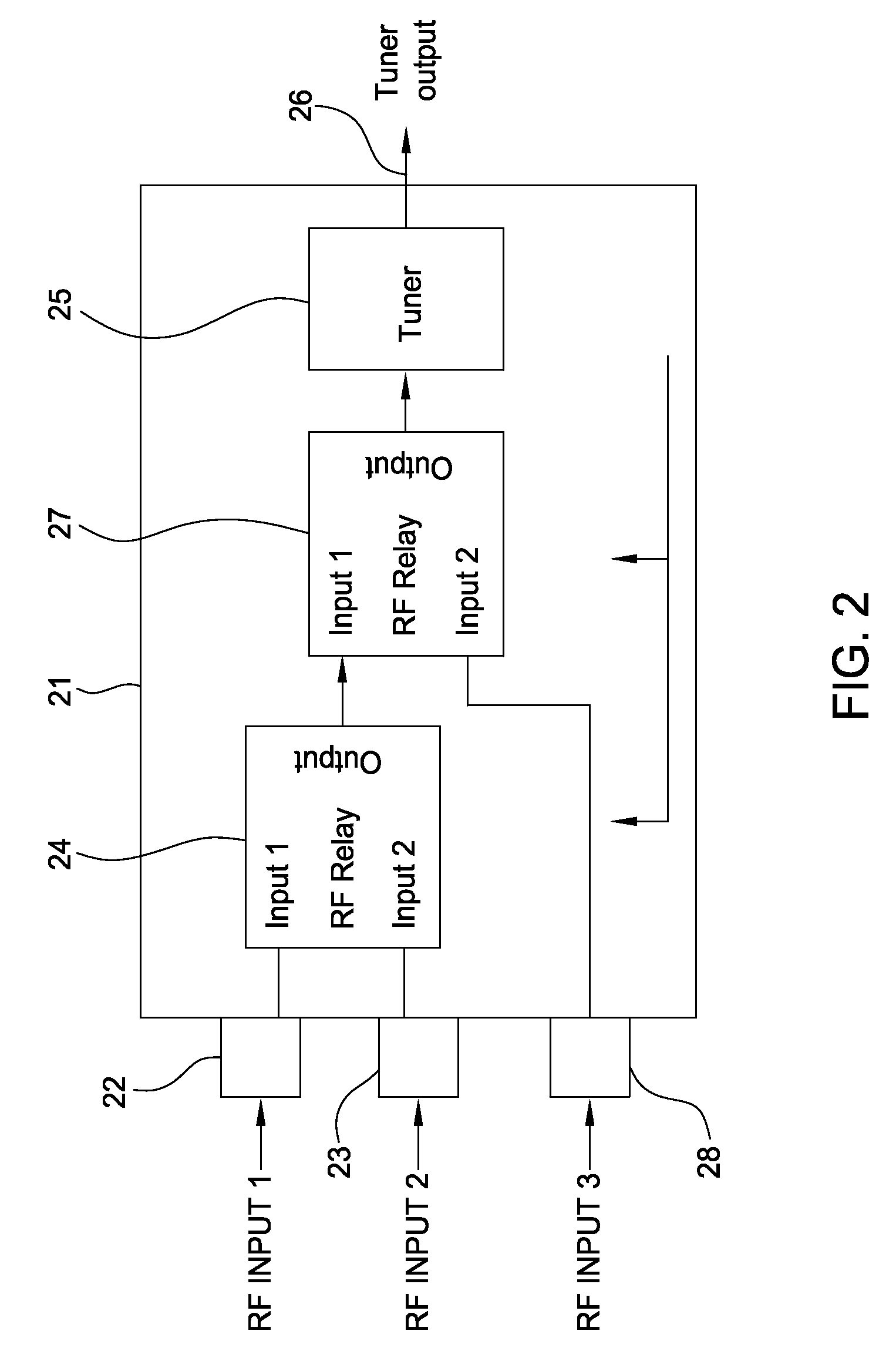
Figure 3
Abstract
Description
BACKGROUND OF THE INVENTION
[0001] 1. Field of the Invention
[0002] The present invention relates to a radio frequency tuner. Such a tuner may be used, for example, to receive and select signals from two or more radio frequency sources.
[0003] 2. Description of the Related Art
[0004] FIG. 1 of the accompanying drawings illustrates a tuner for receiving signals from a cable transmission network and a terrestrial transmission network and for selecting a channel from either network for reception. Tuners of this type are known as “Plug and Play”. Such a tuner is connected to two (or more) networks at the same time. Both networks contain channels within a frequency range which is typically from approximately 47 MHz to approximately 1100 MHz. It is also typical for the channel frequency allocation to be substantially identical between the networks such that the channels of one network occupy the same frequencies as the channels of the other network.
[0005] In the case of a cable distribution networ...
Examples
Embodiment Construction
[0031]The tuner shown in FIG. 3 comprises an enclosure 31, two radio frequency inputs 32 and 33, and a tuner output 36 as described hereinbefore with reference to FIG. 1. The tuner of FIG. 3 further comprises first frequency changers or converters 40 and 41 whose inputs are connected to the RF inputs 32 and 33, respectively. The outputs of the converters 40 and 41 are connected to respective inputs of a second frequency changer or converter 42, whose output is connected to the tuner output 36.
[0032]Although the tuner shown in FIG. 3 is intended for connection to two distribution networks, such a tuner may be arranged to receive signals from any number of distribution networks. In particular, each network requires an RF input connected to a respective frequency changer or converter, whose output is connected to a respective input of the single second converter 42.
[0033]As illustrated in FIG. 4, the first frequency changer or converter 50 comprises a mixer or multiplier 55 having a fi...