
Method for manufacturing an ultrahigh strength hot dip galvanized steel sheet having martensitic structure as matrix
a technology of martenitic structure and hot dip galvanized steel, which is applied in the direction of manufacturing tools, heat treatment equipment, transportation and packaging, etc., can solve the problems of insufficient strength of the above-mentioned steels to protect the occupants from a broadside collision or overturning, and achieve excellent strength, excellent corrosion resistance, and the effect of improving the strength of the outer components
Patent Information
- Authority / Receiving Office
- US · United States
- Patent Type
- Patents(United States)
- Current Assignee / Owner
- Publication Date
- 2014-06-03
- Estimated Expiration
- Not applicable · inactive patent
Smart Images
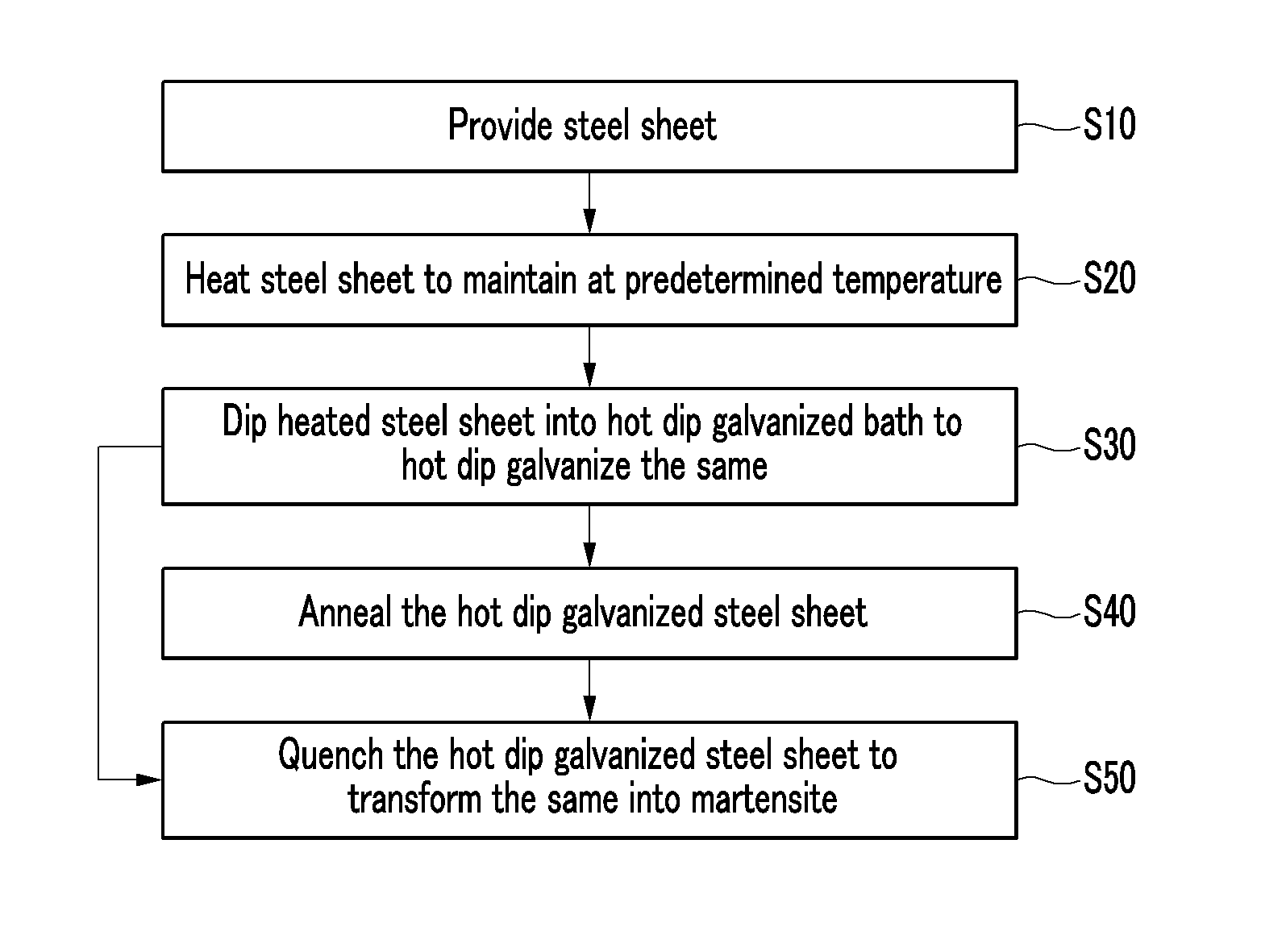
Figure 1 
Figure 2 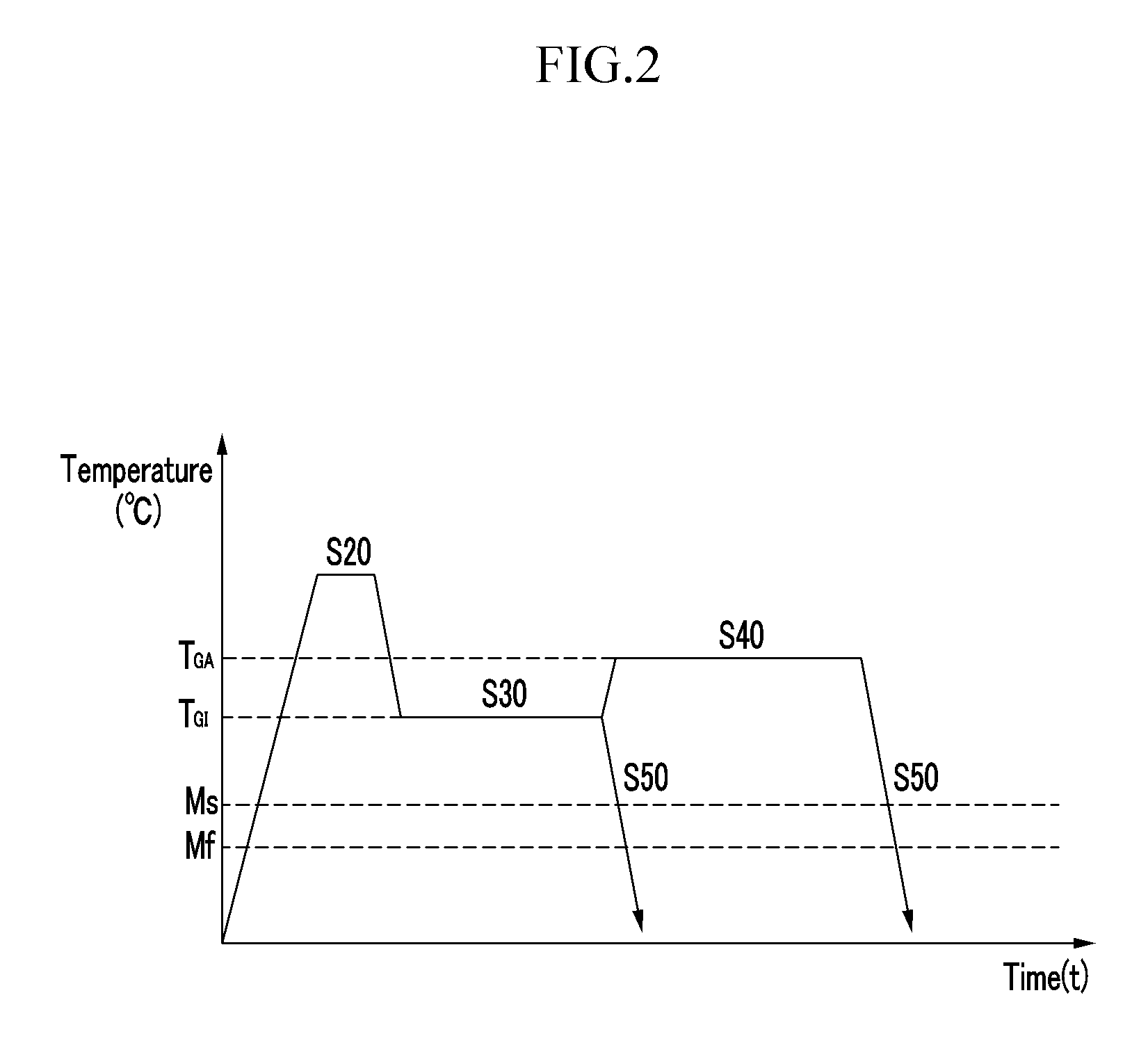
Figure 3
Abstract
Description
CROSS-REFERENCE TO RELATED APPLICATION
[0001] This application claims priority to and the benefit of Korean Patent Application No. 10-2008-0093085 filed in the Korean Intellectual Property Office on Sep. 23, 2008, the entire contents of which are incorporated herein by reference.BACKGROUND OF THE INVENTION
[0002] (a) Field of the Invention
[0003] The present invention relates to a hot dip galvanized steel sheet and a manufacturing method thereof. In detail, the present invention relates to a hot dip galvanized steel sheet having ultrahigh strength by using steel including a martensitic structure as a base material, and a manufacturing method thereof.
[0004] (b) Description of the Related Art
[0005] A hot dip galvanized steel sheet is inexpensive and has excellent corrosion resistance, so it is widely used for exterior parts of vehicles. A component of the vehicle such as a side impact beam uses the hot dip galvanized steel sheet since it requires corrosion resistance while maintaining strengt...
Examples
experimental examples
[0068]The hot dip galvanization process is simulated by using steel having the above-noted composition range. In Experimental Examples 1 to 4, the hot dip galvanizing process is simulated by using a salt bath. In Experimental Examples 5 and 6, the hot dip galvanizing process is simulated by using the multi-purpose annealing simulator (MultiPAS) testing device by Vatron. Also, in Experimental Examples 7 and 8, the hot dip galvanizing process is simulated by using the Rhesca galvanizing simulator.
experimental example 1
[0069]A sample including C of 0.15 wt %, MN of 2.0 wt %, Si of 0.3 wt %, Al of 0.03 wt %, Cr of 0.3 wt %, Mo of 0.3 wt %, N of 30 ppm, B of 30 ppm, an impurity, and the remainder of Fe is prepared. The sample is dipped into a salt bath heated at 870° C. for one minute. The sample heated at 870° C. is dipped into a salt bath heated at 460° C. for 10 seconds. The dipped sample is drawn out, cooled with water, and then quenched. That is, the GI process is simulated in Experimental Example 1. Other detailed process conditions will not be described since they are easily understood by a skilled person in the art.
experimental example 2
[0070]A sample having the same composition as Experimental Example 1 is prepared. The sample is dipped into a salt bath heated at 870° C. and left in it for one minute. The sample heated at 870° C. is dipped into a salt bath at 460° C. for 10 seconds. The dipped sample is drawn out, dipped 20 seconds into a salt bath at 500° C., is drawn out a, and is cooled with water to reach room temperature. That is, the GA process is simulated in Experimental Example 1. Detailed process conditions will not be described since they are easily understood by a skilled person in the art.