
Pneumatic tire
a technology of pneumatic tires and blocks, applied in the field of pneumatic tires, can solve the problems of increasing the deformation amount of blocks, reducing rigidity, and increasing the probability of cracks in the bottom portions of sipes, so as to achieve high bending rigidity of blocks as a whole, improve durability, and improve the effect of on-ice performan
Patent Information
- Authority / Receiving Office
- US · United States
- Patent Type
- Patents(United States)
- Current Assignee / Owner
- Publication Date
- 2014-08-26
Smart Images
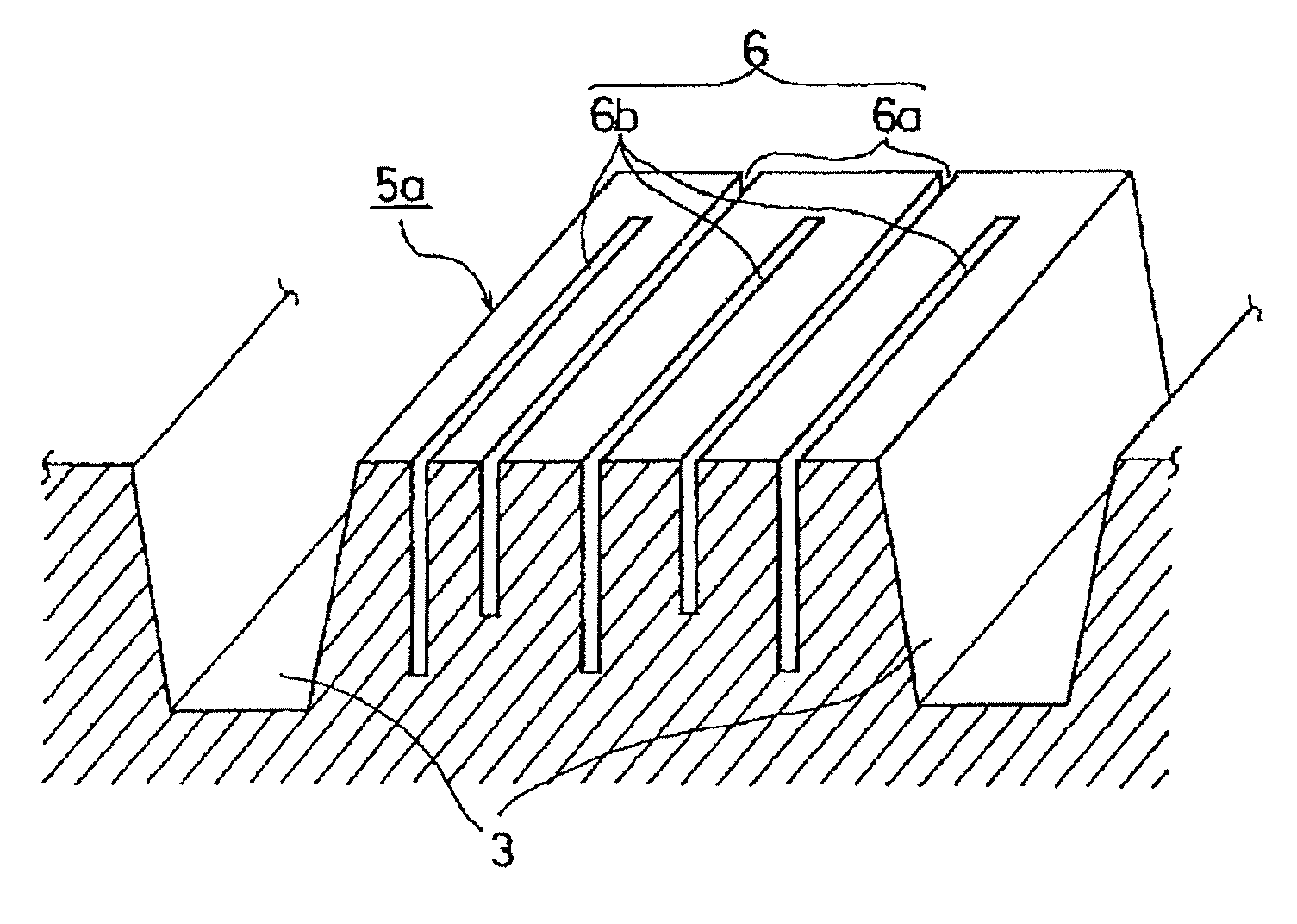
Figure 1 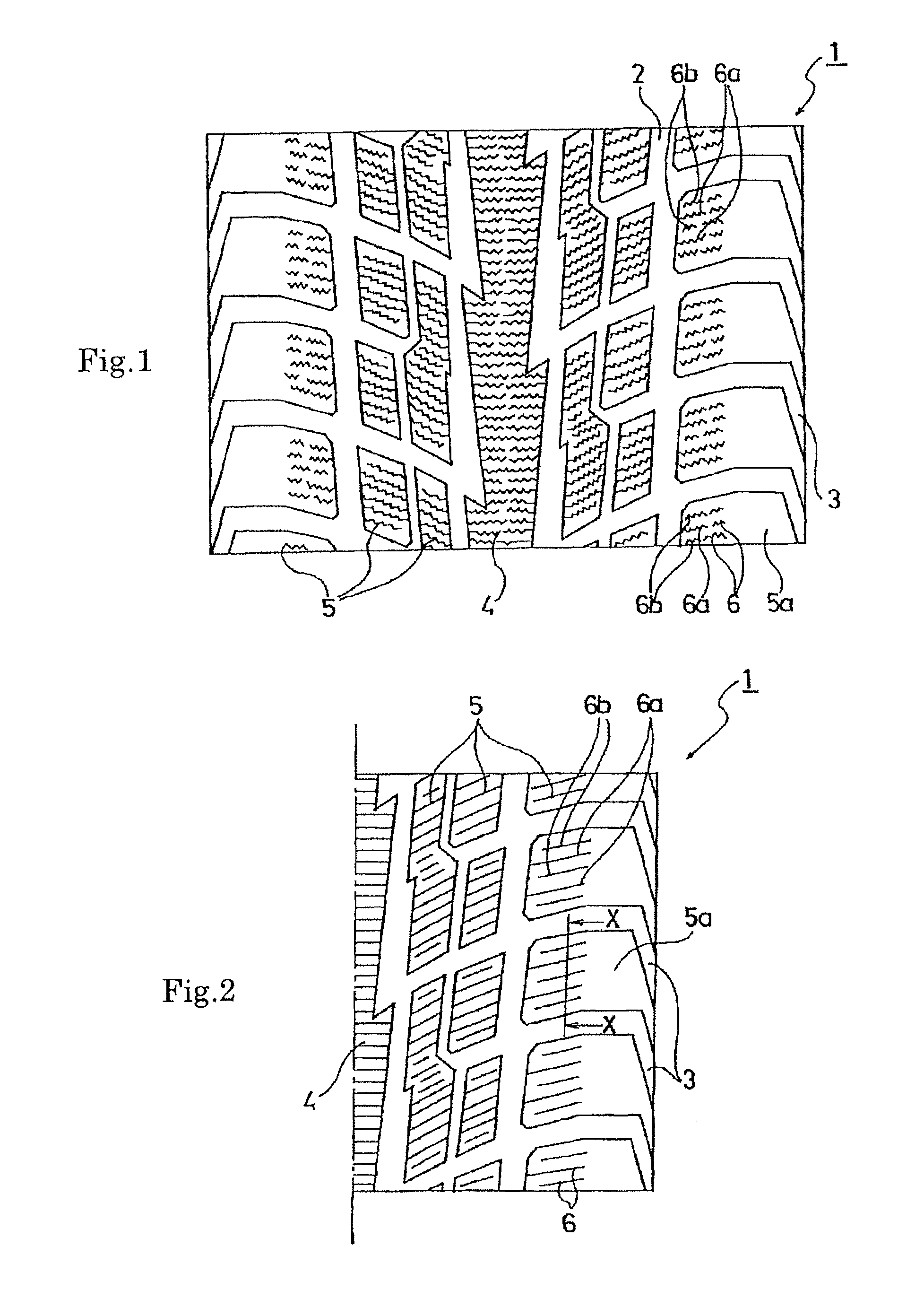
Figure 2 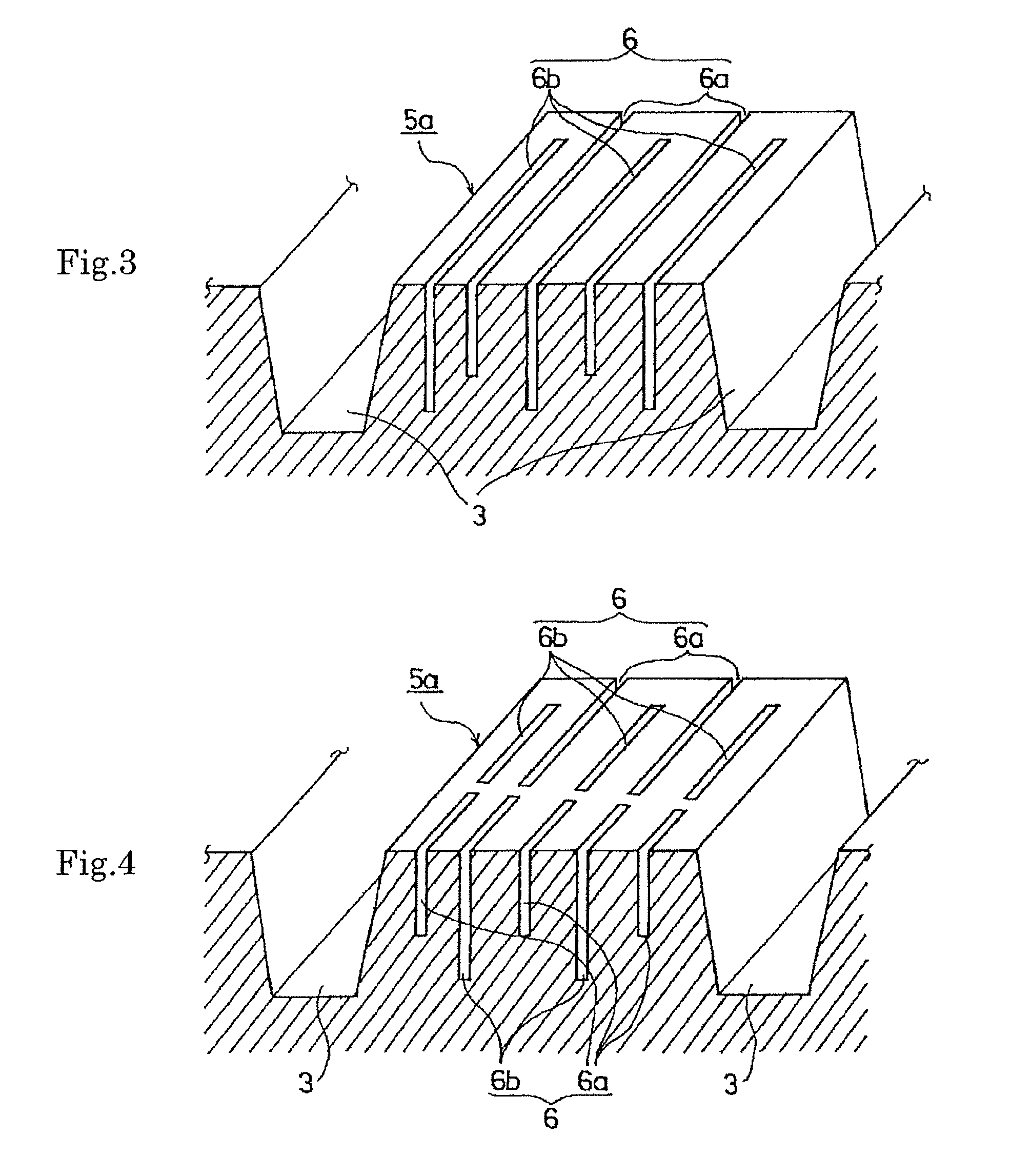
Figure 3
Abstract
Description
CROSS-REFERENCE TO RELATED APPLICATIONS
[0001] This U.S. National stage application claims priority under 35 U.S.C. §119(a) to Japanese Patent Application No. 2008-235017, filed in Japan on Sept. 12, 2008, the entire contents of which are hereby incorporated herein by reference.TECHNICAL FIELD
[0002] The present invention relates to a pneumatic tire, and more specifically to a pneumatic tire having a block row at least in a shoulder portion and multiple sipes which are provided in blocks of the block row and which extend in the width direction of the tire, the pneumatic tire having enhanced durability without impairing on-ice performance.BACKGROUND ART
[0003] Generally, a block pattern is employed as the tread pattern of a winter tire (a studless tire). The block pattern enhances on-snow performance by facilitating biting of blocks into snow which is to be fitted into a space between blocks adjacent to each other in the circumferential direction of the tire. In addition, braking and drivi...
Examples
Embodiment Construction
, sipe depths were uniform, all sipes were open sipes, the sipes were not divided, and each block was made of a single layer rubber composition alone. In Conventional Example 2, sipes were open sipes whose sipe depths were offset, but which were not divided, and each block was made of a single layer rubber composition alone. Example 1 is an example in which open sipes and closed sipes were alternately arranged, and the open sipes were offset so as to be shallower than the closed sipes, and corresponds to FIG. 3. Example 2 is a modified example of Example 1 where the sipes were divided, and corresponds to FIG. 4. Example 3 is a modified example of Example 2 where each block had a double layer structure, and a rubber composition having a higher rubber hardness was disposed in the lower layer side, and corresponds to FIG. 5.
[0034]These five kinds of tires were measured for on-ice braking, crack formation resistance, crack growth resistance by the following measurement methods, and were...