
Doctor blade
a blade and blade technology, applied in the field of blades, can solve the problems of uncontrollable release of printing ink on the printing carrier, unevenness or irregularities, corresponding wear, etc., and achieve the effect of improving wear resistance and precise scraping
Patent Information
- Authority / Receiving Office
- US · United States
- Patent Type
- Patents(United States)
- Current Assignee / Owner
- Publication Date
- 2015-09-15
Smart Images
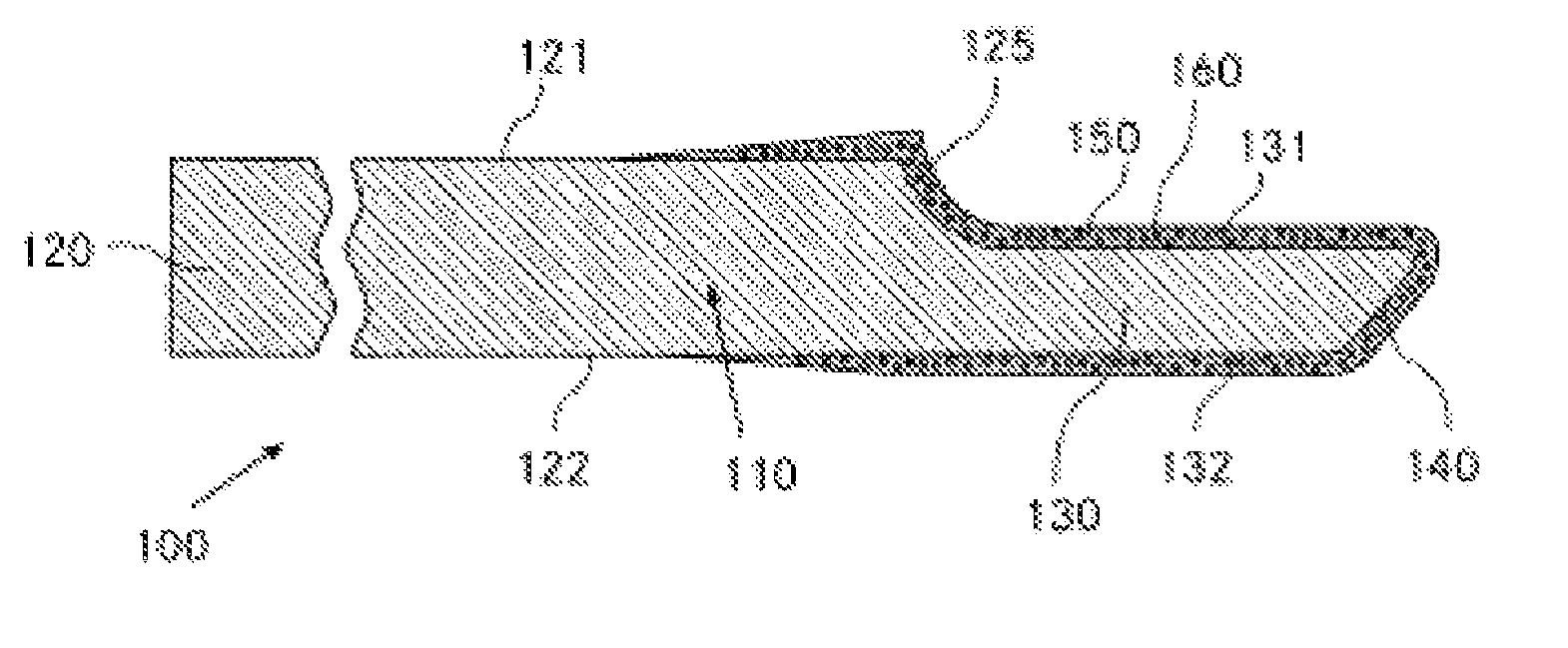
Figure 1 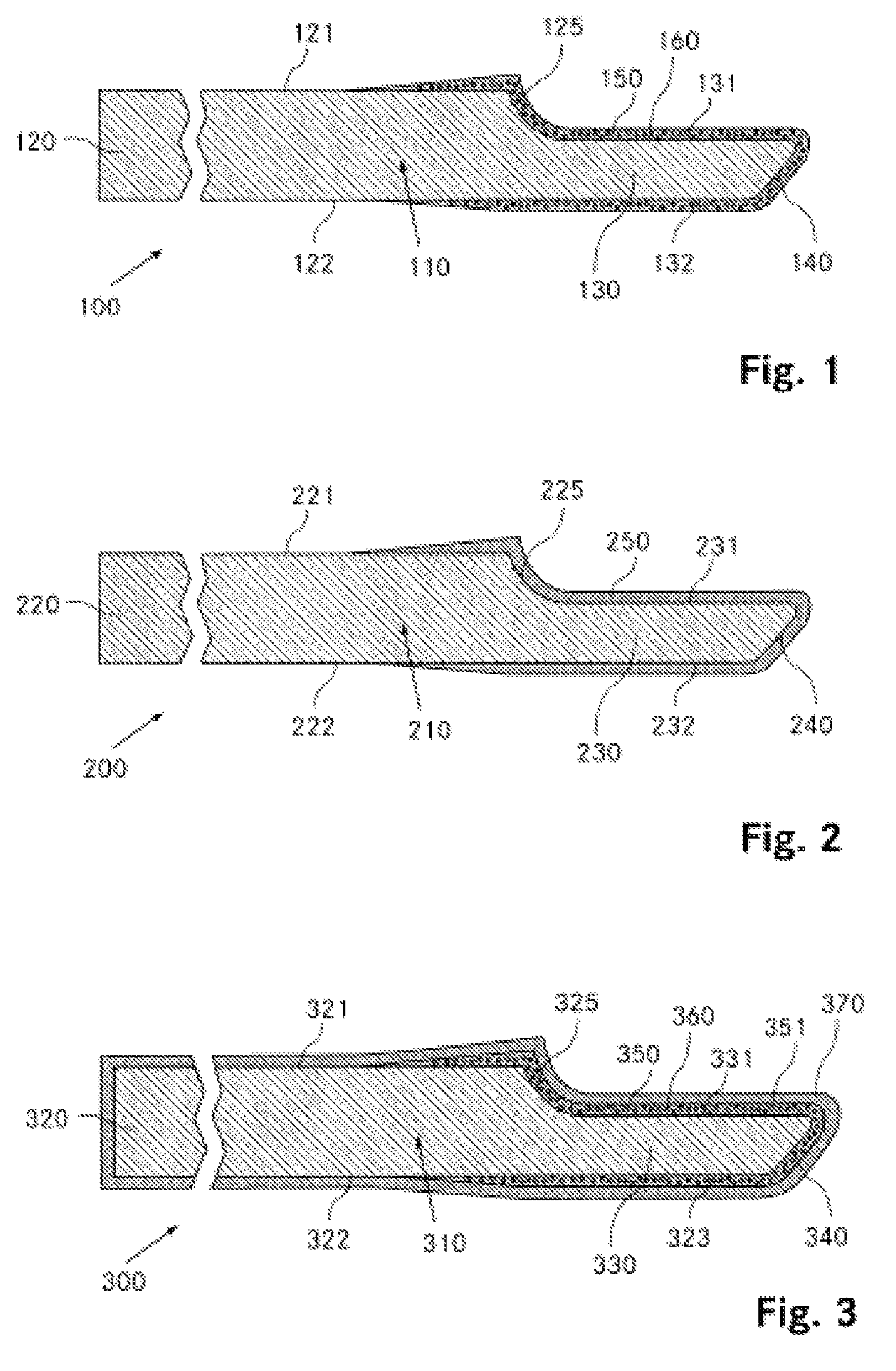
Figure 2 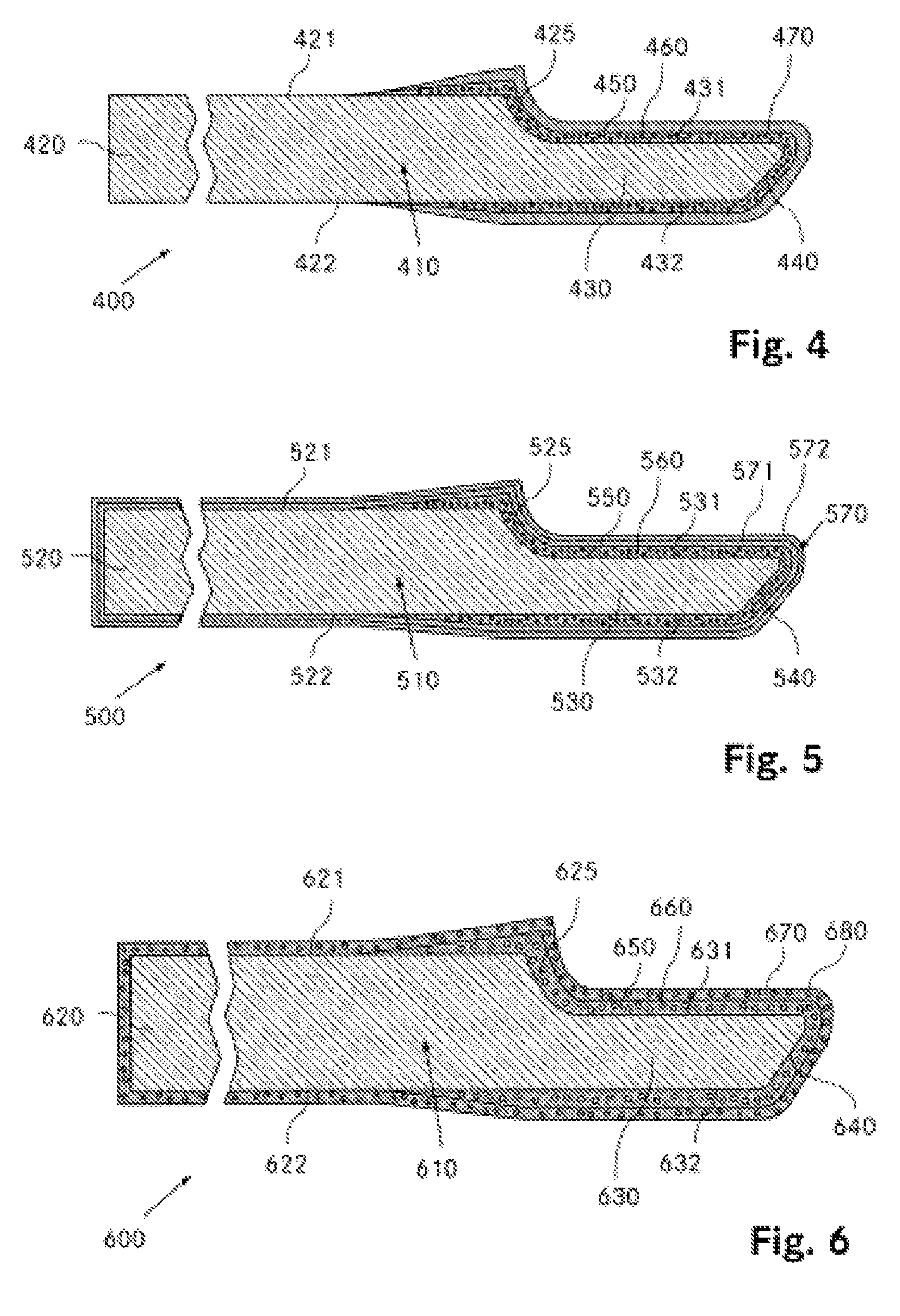
Figure 3
Abstract
Description
CROSS-REFERENCE TO RELATED APPLICATIONS
[0001] This application claims priority to PCT Application No. PCT / CH2010 / 000014 filed Jan. 20, 2010, which application is incorporated herein by reference and made a part hereof.BACKGROUND OF THE INVENTION
[0002] 1. Field of the Invention
[0003] The invention relates to a doctor blade, in particular for scraping printing ink from a surface of a printing plate, which comprises a flat and elongated base element having a working edge region formed in a longitudinal direction, where the working edge region is coated with at least a first coating based on a nickel-phosphorus alloy. The invention further relates to a process for producing a doctor blade.
[0004] 2. Description of the Related Art
[0005] Doctor blades are used in the printing industry, especially for scraping excess printing ink from the surfaces of printing cylinders or printing rollers. Particularly in the case of gravure printing and flexographic printing, the quality of the doctor blade has...
Examples
Embodiment Construction
[0125]FIG. 1 depicts a lamellar doctor blade 100 according to the invention in cross section. The lamellar doctor blade 100 comprises a base element 110 made of steel which on the left-hand side in FIG. 1 has a rear region 120 having an essentially rectangular cross section. The rear region 120 is provided as a fastening region in order to hold the lamellar doctor blade in, for example, an appropriate holding device of a printing machine. The doctor blade thickness measured from the upper side 121 to the under side 122 of the rear region is about 0.2 mm. The length of the base element 110 or the lamellar doctor blade 100 measured perpendicular to the plane of the plate is, for example, 1000 mm.
[0126]On the right-hand side in FIG. 1, the base element 110 is tapered stepwise from the upper side 121 of the rear region 120 to form a working edge 130. An upper side 131 of the working edge 130 lies on a plane below the plane of the upper side 121 of the rear region 120 but is essentially ...