
Methods for producing stable therapeutic formulations in aprotic polar solvents
a technology of aprotic polar solvent and stable formulation, which is applied in the direction of peptide/protein ingredients, inorganic non-active ingredients, metabolic disorders, etc., can solve the problems of complex scaling up of drying steps, high cost, and development of drying methods, and achieve optimal or beneficial ionization profiles of therapeutic molecules, prolonging stability
Patent Information
- Authority / Receiving Office
- US · United States
- Patent Type
- Patents(United States)
- Current Assignee / Owner
- Publication Date
- 2017-05-16
Smart Images
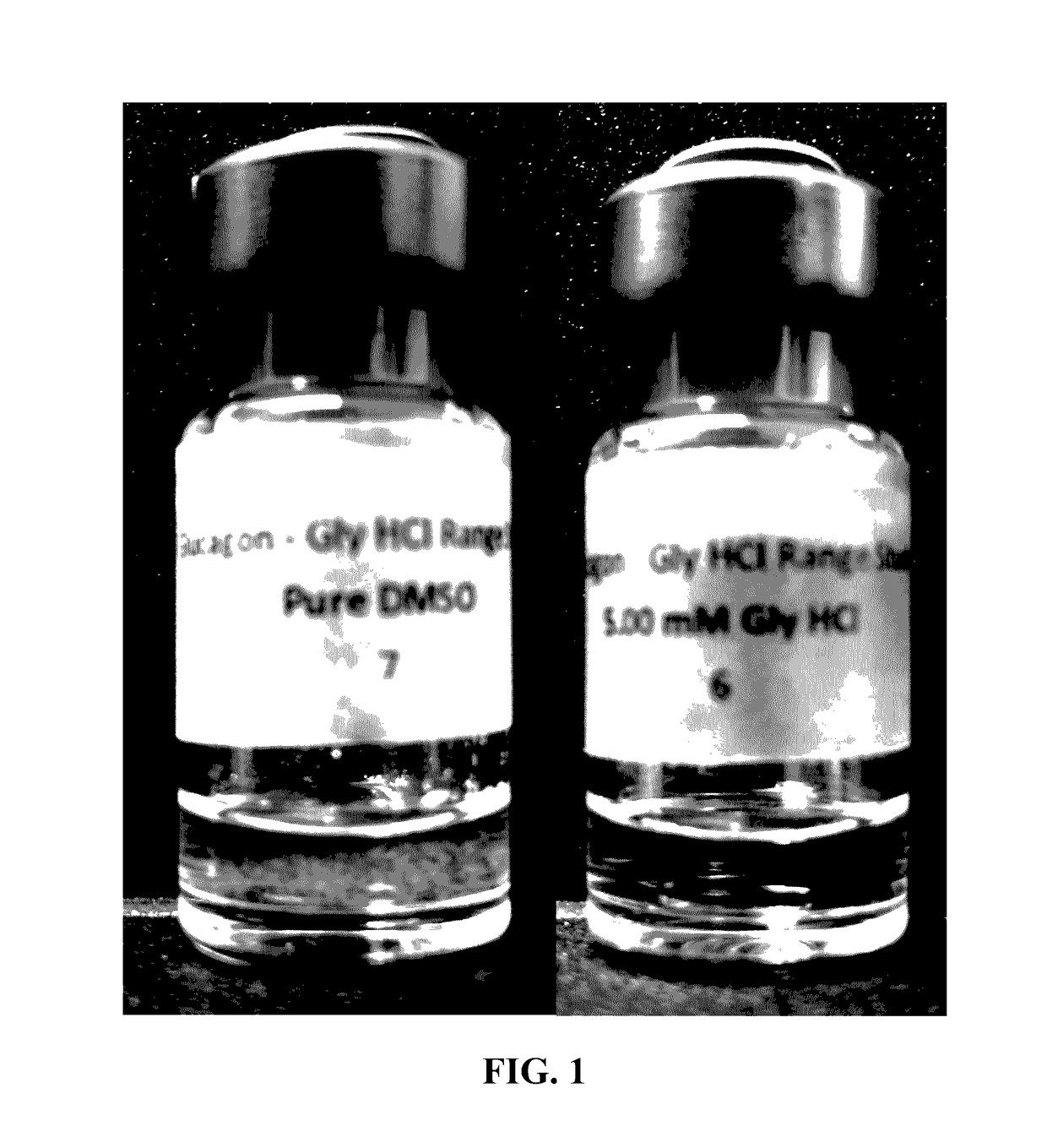
Figure 1 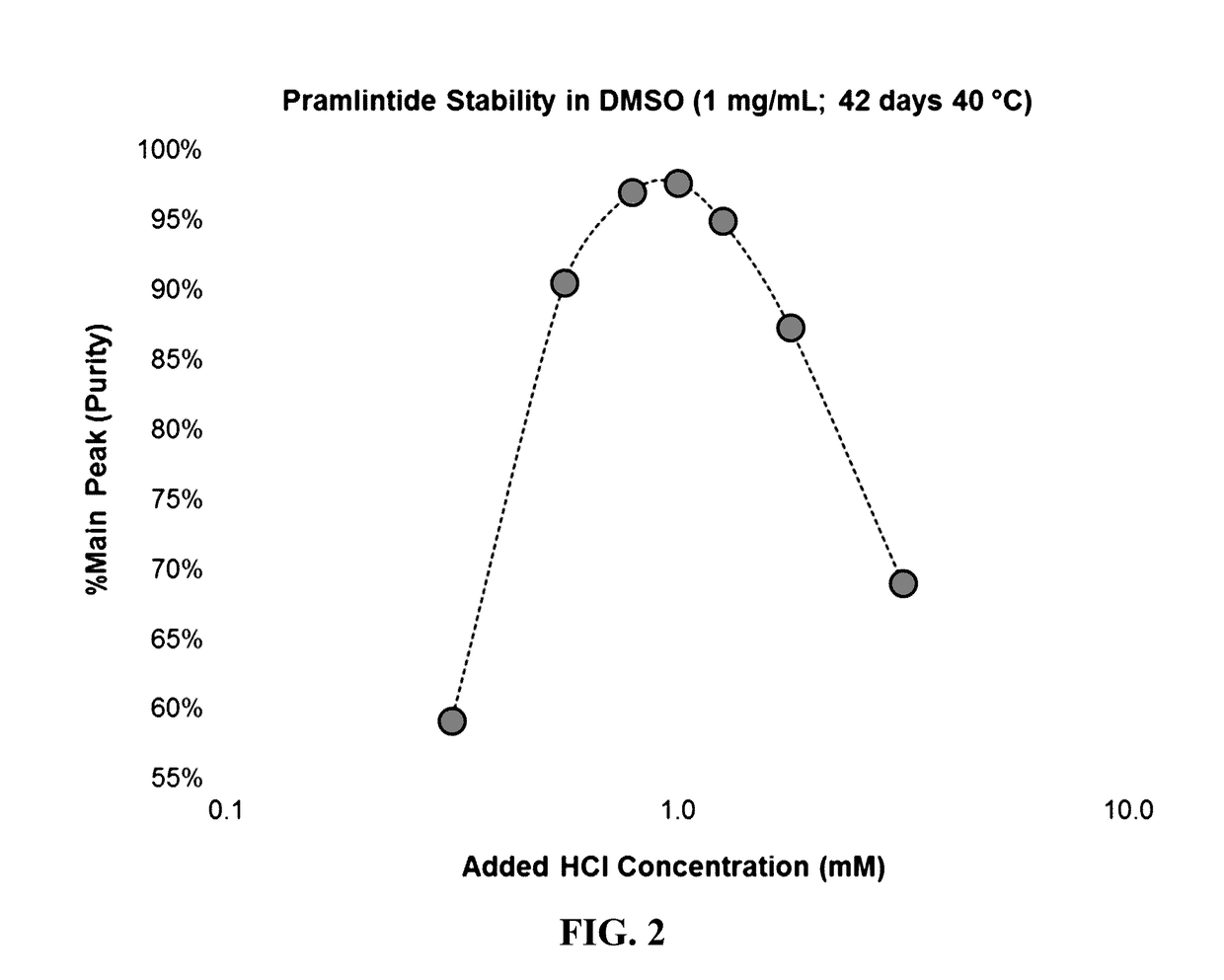
Figure 2
Abstract
Description
[0001] This application claims priority to U.S. Provisional Patent Application Ser. No. 62 / 233,032 filed Sep. 25, 2015, which is incorporated herein by reference in its entirety.BACKGROUND OF THE INVENTION
[0002] A. Field of the Invention
[0003] The present invention relates generally to therapeutic formulations for parenteral administration. In particular, the invention concerns the use of aprotic polar solvents to prepare stable therapeutic formulations by dissolving a therapeutic agent (active ingredient) in an aprotic polar solvent system without the need for drying the peptide from a buffered aqueous solution prior to dissolution in the aprotic polar solvent system. In addition to the active ingredient, a stabilizing excipient(s) may also be included in the formulation, in particular an ionization stabilizing excipient.
[0004] B. Description of Related Art
[0005] Peptides dissolved in aprotic polar solvents can exhibit enhanced stability and solubility relative to aqueous solutions (see...
Examples
example 1
[0094]In this example, glucagon solutions were prepared by dissolving glycine hydrochloride (CAS No. 6000-43-7) directly in DMSO (CAS No. 67-68-5) at 5 mM, 10 mM, and 20 mM concentrations, followed by dissolution of glucagon powder (MW=3483 g / mol; purchased from Bachem AG) to a peptide concentration of 5 mg / mL. The prepared sample solutions are shown in Table 1:
[0095]
TABLE 1Glucagon sample solutions prepared by dissolving bothglycine hydrochloride and glucagon powder directly inDMSO.Glucagon ConcentrationSolventAdded Excipient5 mg / mLDMSO 5 mM Glycine Hydrochloride5 mg / mLDMSO10 mM Glycine Hydrochloride5 mg / mLDMSO20 mM Glycine Hydrochloride
[0096]The reversed-phase high performance liquid chromatography (RP-HPLC) method used to assess chemical stability was a gradient method with mobile phases A and B respectively consisting of 0.1% (v / v) TFA (trifluoroacetic acid) in water and 0.1% (v / v) TFA in acetonitrile. A C8 column (BioBasic™-8; ThermoScientific) (4.6 mm I.D.×250 mm length, 5 mic...
example 2
[0102]In this example glucagon solutions were prepared at a concentration of 5 mg / mL by dissolving glucagon powder in DMSO that included different concentrations of added hydrochloric acid, ranging from 0.001 M (1 mM) to 0.01 M (10 mM). To minimize the amount of water added to the formulation, 5 N HCl was utilized to prepare 10 mM and 5.6 mM HCl in DMSO solutions, while 1 N HCl was used to prepare the 3.2 mM, 1.8 mM, and 1.0 mM solutions. As an example, the 10 mM HCl in DMSO solution was prepared by adding 20 μL of 5 N HCl to 9.98 mL of DMSO (neat), while the 1.0 mM HCl in DMSO solution was prepared by adding 10 μL of 1 N HCl to 9.99 mL of DMSO (neat). Samples of each formulation were stored in CZ vials and incubated at 40° C.
[0103]Following both 28 and 58 days of storage the chemical stability of the peptide was assessed by RP-HPLC and the purity reported in Table 3. The addition of 1.0 mM HCl was insufficient to prevent the formation of insoluble aggregates in the 5 mg / mL glucagon...
example 3
[0105]Sample solutions were prepared by dissolving glucagon powder to a concentration of 5 mg / mL in DMSO which contained various added concentrations of glycine hydrochloride (CAS No. 6000-43-7), betaine hydrochloride (CAS No. 590-46-5), or hydrochloric acid (1 N; CAS No. 7647-01-0). The various concentrations of each ionization stabilizing excipient used to prepare the sample formulations are listed in Table 4. Samples of each formulation were stored in CZ vials and incubated at 40° C. Following 28 days of storage the chemical stability of the glucagon peptide was assessed by RP-HPLC and the purity reported in Table 4. This example demonstrates that the proton-donating ability of the added ionization stabilizing excipient (i.e. its ‘strength’) may influence the concentration required to stabilize the therapeutic molecule. Glucagon was selected as a model peptide due to its tendency to gel (i.e. form insoluble aggregates) when the molecule is insufficiently protonated. A concentrati...