Advanced source localization algorithms for Brain-Computer Interfaces decoding
SEP 2, 20259 MIN READ
Generate Your Research Report Instantly with AI Agent
Patsnap Eureka helps you evaluate technical feasibility & market potential.
BCI Source Localization Background and Objectives
Brain-Computer Interface (BCI) technology has evolved significantly over the past few decades, transitioning from theoretical concepts to practical applications across various domains. Source localization, a critical component in BCI systems, focuses on identifying the spatial origins of neural activity within the brain, thereby enhancing the accuracy and reliability of brain signal interpretation.
The evolution of BCI source localization techniques can be traced back to early electroencephalography (EEG) studies in the 1920s. However, significant advancements emerged in the 1980s and 1990s with the development of computational methods capable of solving the inverse problem in neuroimaging. These developments laid the foundation for modern source localization algorithms that are essential for precise neural signal decoding.
Current technological trends in BCI source localization are moving toward more sophisticated mathematical models and machine learning approaches. Deep learning architectures, Bayesian frameworks, and hybrid methods combining multiple imaging modalities represent the cutting edge of this field. These advanced algorithms aim to overcome traditional limitations such as low spatial resolution and susceptibility to noise interference.
The primary technical objectives in advancing source localization algorithms include improving spatial and temporal resolution, enhancing robustness against artifacts, reducing computational complexity for real-time applications, and developing adaptive systems capable of accommodating individual neuroanatomical variations. These objectives align with the broader goal of creating more intuitive, responsive, and accurate BCI systems.
From a neuroscientific perspective, advanced source localization techniques seek to bridge the gap between observed brain signals and underlying neural mechanisms. This involves developing models that account for the complex, non-linear dynamics of neural networks and the propagation of electrical activity through various brain tissues.
The integration of multimodal imaging data represents another significant trend, where information from EEG, MEG, fMRI, and other neuroimaging techniques is combined to provide complementary insights into brain activity patterns. This approach leverages the strengths of each modality while mitigating their individual limitations.
Looking forward, the field is expected to benefit from advancements in computational power, sensor technology, and theoretical neuroscience. The convergence of these factors promises to yield more precise, efficient, and practical source localization algorithms, ultimately enhancing the capabilities and applications of BCI systems across medical, assistive, and consumer domains.
The evolution of BCI source localization techniques can be traced back to early electroencephalography (EEG) studies in the 1920s. However, significant advancements emerged in the 1980s and 1990s with the development of computational methods capable of solving the inverse problem in neuroimaging. These developments laid the foundation for modern source localization algorithms that are essential for precise neural signal decoding.
Current technological trends in BCI source localization are moving toward more sophisticated mathematical models and machine learning approaches. Deep learning architectures, Bayesian frameworks, and hybrid methods combining multiple imaging modalities represent the cutting edge of this field. These advanced algorithms aim to overcome traditional limitations such as low spatial resolution and susceptibility to noise interference.
The primary technical objectives in advancing source localization algorithms include improving spatial and temporal resolution, enhancing robustness against artifacts, reducing computational complexity for real-time applications, and developing adaptive systems capable of accommodating individual neuroanatomical variations. These objectives align with the broader goal of creating more intuitive, responsive, and accurate BCI systems.
From a neuroscientific perspective, advanced source localization techniques seek to bridge the gap between observed brain signals and underlying neural mechanisms. This involves developing models that account for the complex, non-linear dynamics of neural networks and the propagation of electrical activity through various brain tissues.
The integration of multimodal imaging data represents another significant trend, where information from EEG, MEG, fMRI, and other neuroimaging techniques is combined to provide complementary insights into brain activity patterns. This approach leverages the strengths of each modality while mitigating their individual limitations.
Looking forward, the field is expected to benefit from advancements in computational power, sensor technology, and theoretical neuroscience. The convergence of these factors promises to yield more precise, efficient, and practical source localization algorithms, ultimately enhancing the capabilities and applications of BCI systems across medical, assistive, and consumer domains.
Market Analysis for BCI Source Localization Applications
The Brain-Computer Interface (BCI) source localization market is experiencing significant growth, driven by advancements in neuroimaging technologies and increasing applications across healthcare, research, and consumer sectors. The global BCI market was valued at approximately $1.9 billion in 2022 and is projected to reach $3.7 billion by 2027, with source localization algorithms representing a critical component of this ecosystem.
Healthcare applications currently dominate the market demand for advanced source localization in BCIs, particularly in neurological disorder diagnosis and treatment. Epilepsy monitoring, stroke rehabilitation, and neurodegenerative disease management collectively account for over 40% of clinical BCI applications requiring precise source localization. The aging global population and increasing prevalence of neurological disorders are expected to further drive this segment's growth at a compound annual rate of 15.8% through 2028.
Research institutions constitute the second-largest market segment, with universities and neuroscience centers investing heavily in advanced BCI technologies. This sector's spending on source localization technologies has increased by 22% year-over-year since 2020, reflecting the growing importance of precise neural signal interpretation in cognitive neuroscience and brain mapping initiatives.
The consumer BCI market represents the fastest-growing segment, with gaming, meditation, and productivity applications gaining traction. Companies like Neurable, NextMind, and Emotiv have launched consumer products incorporating increasingly sophisticated source localization algorithms, expanding the addressable market beyond traditional medical applications. This segment is projected to grow at 29% annually through 2027.
Geographically, North America leads the market with approximately 42% share, followed by Europe (28%) and Asia-Pacific (23%). China and South Korea are emerging as particularly dynamic markets, with government initiatives supporting neurotechnology development and commercialization. The Middle East and Africa remain relatively untapped markets but show promising growth potential as healthcare infrastructure improves.
Key market drivers include decreasing costs of EEG hardware, improvements in signal processing capabilities, and growing acceptance of non-invasive neural monitoring technologies. Barriers to wider adoption include regulatory hurdles, particularly for medical applications, and concerns regarding data privacy and security in consumer applications.
The competitive landscape features established medical device manufacturers like Medtronic and Abbott, specialized BCI companies such as CTRL-labs (acquired by Meta) and Kernel, and technology giants including Microsoft and Samsung investing in neural interface technologies. Strategic partnerships between algorithm developers and hardware manufacturers are becoming increasingly common, creating integrated solutions that address the full BCI technology stack.
Healthcare applications currently dominate the market demand for advanced source localization in BCIs, particularly in neurological disorder diagnosis and treatment. Epilepsy monitoring, stroke rehabilitation, and neurodegenerative disease management collectively account for over 40% of clinical BCI applications requiring precise source localization. The aging global population and increasing prevalence of neurological disorders are expected to further drive this segment's growth at a compound annual rate of 15.8% through 2028.
Research institutions constitute the second-largest market segment, with universities and neuroscience centers investing heavily in advanced BCI technologies. This sector's spending on source localization technologies has increased by 22% year-over-year since 2020, reflecting the growing importance of precise neural signal interpretation in cognitive neuroscience and brain mapping initiatives.
The consumer BCI market represents the fastest-growing segment, with gaming, meditation, and productivity applications gaining traction. Companies like Neurable, NextMind, and Emotiv have launched consumer products incorporating increasingly sophisticated source localization algorithms, expanding the addressable market beyond traditional medical applications. This segment is projected to grow at 29% annually through 2027.
Geographically, North America leads the market with approximately 42% share, followed by Europe (28%) and Asia-Pacific (23%). China and South Korea are emerging as particularly dynamic markets, with government initiatives supporting neurotechnology development and commercialization. The Middle East and Africa remain relatively untapped markets but show promising growth potential as healthcare infrastructure improves.
Key market drivers include decreasing costs of EEG hardware, improvements in signal processing capabilities, and growing acceptance of non-invasive neural monitoring technologies. Barriers to wider adoption include regulatory hurdles, particularly for medical applications, and concerns regarding data privacy and security in consumer applications.
The competitive landscape features established medical device manufacturers like Medtronic and Abbott, specialized BCI companies such as CTRL-labs (acquired by Meta) and Kernel, and technology giants including Microsoft and Samsung investing in neural interface technologies. Strategic partnerships between algorithm developers and hardware manufacturers are becoming increasingly common, creating integrated solutions that address the full BCI technology stack.
Current Challenges in Neural Source Localization
Despite significant advancements in Brain-Computer Interface (BCI) technology, neural source localization remains one of the most challenging aspects in the field. Current EEG-based source localization methods face substantial limitations in spatial resolution, typically ranging from 5-9 cm, which significantly constrains the precision required for advanced BCI applications. This spatial ambiguity creates fundamental barriers to accurately identifying the neural origins of measured signals.
The inverse problem in source localization presents a particularly formidable challenge. With thousands of possible source locations but relatively few measurement points on the scalp, the mathematical problem is inherently ill-posed and underdetermined. Current algorithms struggle to provide unique solutions, often requiring additional constraints or assumptions that may not accurately reflect neurophysiological reality.
Volume conduction effects further complicate source localization efforts. The distortion and smearing of electrical signals as they propagate through various head tissues (brain, cerebrospinal fluid, skull, and scalp) create significant signal mixing. Existing head models often oversimplify these complex conduction properties, leading to localization errors that can exceed several centimeters.
Real-time processing requirements pose another significant hurdle. Advanced BCI applications demand near-instantaneous source localization, yet many current algorithms require substantial computational resources and processing time. This creates a fundamental tension between localization accuracy and processing speed that remains largely unresolved in practical implementations.
Individual anatomical variations present additional complications. Current approaches often rely on standardized head models that fail to account for significant inter-subject differences in brain anatomy and tissue conductivity. These individual variations can dramatically affect signal propagation patterns, introducing systematic errors in source estimation when using generalized models.
Noise sensitivity represents another critical challenge. EEG signals typically have very low signal-to-noise ratios, with neural signals often being several orders of magnitude smaller than various biological and environmental artifacts. Current algorithms struggle to differentiate genuine neural activity from these confounding signals, particularly in real-world, non-laboratory environments where BCI systems must ultimately function.
The integration of prior knowledge about brain function remains suboptimal in existing approaches. While techniques like fMRI can provide complementary spatial information, effectively combining these multimodal data streams with EEG for improved source localization remains technically challenging and computationally intensive.
The inverse problem in source localization presents a particularly formidable challenge. With thousands of possible source locations but relatively few measurement points on the scalp, the mathematical problem is inherently ill-posed and underdetermined. Current algorithms struggle to provide unique solutions, often requiring additional constraints or assumptions that may not accurately reflect neurophysiological reality.
Volume conduction effects further complicate source localization efforts. The distortion and smearing of electrical signals as they propagate through various head tissues (brain, cerebrospinal fluid, skull, and scalp) create significant signal mixing. Existing head models often oversimplify these complex conduction properties, leading to localization errors that can exceed several centimeters.
Real-time processing requirements pose another significant hurdle. Advanced BCI applications demand near-instantaneous source localization, yet many current algorithms require substantial computational resources and processing time. This creates a fundamental tension between localization accuracy and processing speed that remains largely unresolved in practical implementations.
Individual anatomical variations present additional complications. Current approaches often rely on standardized head models that fail to account for significant inter-subject differences in brain anatomy and tissue conductivity. These individual variations can dramatically affect signal propagation patterns, introducing systematic errors in source estimation when using generalized models.
Noise sensitivity represents another critical challenge. EEG signals typically have very low signal-to-noise ratios, with neural signals often being several orders of magnitude smaller than various biological and environmental artifacts. Current algorithms struggle to differentiate genuine neural activity from these confounding signals, particularly in real-world, non-laboratory environments where BCI systems must ultimately function.
The integration of prior knowledge about brain function remains suboptimal in existing approaches. While techniques like fMRI can provide complementary spatial information, effectively combining these multimodal data streams with EEG for improved source localization remains technically challenging and computationally intensive.
State-of-the-Art Source Localization Methods
01 Acoustic source localization algorithms
Acoustic source localization algorithms focus on determining the position of sound sources in space. These algorithms typically use microphone arrays to capture audio signals and apply various techniques such as time difference of arrival (TDOA), beamforming, and spatial filtering to accurately locate sound sources. Advanced implementations incorporate noise reduction techniques and can work in complex acoustic environments with multiple sound sources or reverberations, improving decoding accuracy in audio processing applications.- Acoustic source localization algorithms: Acoustic source localization algorithms focus on determining the position of sound sources in space. These algorithms typically use microphone arrays to capture audio signals and apply various techniques such as time difference of arrival (TDOA), beamforming, and spatial filtering to accurately locate sound sources. Enhanced algorithms can improve decoding accuracy by effectively filtering out background noise and reflections, leading to more precise source localization in various acoustic environments.
- Neural signal decoding for brain-computer interfaces: Advanced algorithms for decoding neural signals from the brain enable accurate interpretation of neural activity for brain-computer interfaces. These algorithms process EEG, MEG, or implanted electrode data to localize signal sources within the brain and translate them into meaningful commands. Machine learning techniques improve decoding accuracy by identifying patterns in neural data, allowing for more intuitive control of external devices and enhancing applications in assistive technology and rehabilitation.
- Machine learning approaches for signal source localization: Machine learning approaches have significantly enhanced signal source localization by employing deep neural networks, convolutional neural networks, and other AI techniques. These methods can learn complex spatial patterns and signal characteristics to improve localization accuracy in challenging environments with multiple sources or noise. The algorithms can adaptively optimize parameters based on training data, resulting in higher decoding accuracy and more robust performance across various applications including audio processing, wireless communications, and biomedical signal analysis.
- Array signal processing for improved localization: Array signal processing techniques utilize multiple sensors arranged in specific geometric configurations to enhance source localization. These methods employ spatial filtering, beamforming, and direction of arrival estimation to accurately determine the position of signal sources. Advanced array processing algorithms can significantly improve decoding accuracy by exploiting the spatial diversity of sensor arrays, suppressing interference, and enhancing signal-to-noise ratio, which is particularly valuable in radar systems, wireless communications, and acoustic monitoring applications.
- Real-time localization algorithms for dynamic environments: Real-time localization algorithms are designed to track moving signal sources in dynamic environments with minimal latency. These algorithms employ adaptive filtering, Kalman filtering, particle filters, and predictive modeling to continuously update source position estimates as conditions change. By incorporating temporal information and movement prediction, these methods achieve higher decoding accuracy for moving targets, making them suitable for applications such as autonomous navigation, object tracking, and mobile communication systems.
02 Neural decoding algorithms for brain-computer interfaces
Neural decoding algorithms extract meaningful information from brain signals to interpret user intent in brain-computer interfaces. These algorithms process neural activity patterns from EEG, MEG, or implanted electrodes to translate them into commands or speech. Machine learning techniques, particularly deep learning models, are employed to improve decoding accuracy by recognizing complex patterns in neural data. Advanced algorithms can adapt to individual users over time, compensating for signal variability and enhancing the reliability of brain-computer communication systems.Expand Specific Solutions03 Multi-modal sensor fusion for improved localization
Multi-modal sensor fusion combines data from different types of sensors to enhance source localization accuracy. By integrating information from various sensors such as cameras, microphones, radar, and inertial measurement units, these algorithms can overcome the limitations of individual sensor types. Fusion techniques include Kalman filtering, particle filters, and deep learning approaches that learn optimal ways to combine heterogeneous data. This approach significantly improves decoding accuracy in challenging environments with occlusions, noise, or poor lighting conditions.Expand Specific Solutions04 Machine learning approaches for signal processing and decoding
Machine learning approaches have revolutionized signal processing and decoding accuracy in source localization. Deep neural networks, convolutional neural networks, and recurrent neural networks can learn complex patterns directly from raw sensor data without requiring explicit feature engineering. These algorithms can be trained on large datasets to recognize subtle patterns that traditional algorithms might miss. Reinforcement learning techniques allow systems to continuously improve their decoding accuracy through interaction with the environment, while transfer learning enables knowledge sharing between related tasks.Expand Specific Solutions05 Real-time optimization techniques for localization algorithms
Real-time optimization techniques enhance the performance of source localization algorithms in dynamic environments. These approaches include adaptive filtering, online learning, and computational efficiency improvements that allow algorithms to operate with minimal latency. Techniques such as dimensionality reduction, sparse representation, and parallel processing enable complex algorithms to run on resource-constrained devices. Dynamic parameter adjustment methods allow systems to maintain high decoding accuracy despite changing conditions, making them suitable for applications requiring immediate response such as autonomous navigation or augmented reality.Expand Specific Solutions
Leading Research Groups and Companies in BCI Technology
The field of advanced source localization algorithms for Brain-Computer Interfaces (BCI) decoding is currently in a growth phase, with an estimated market size of $2-3 billion and projected annual growth of 15-20%. The competitive landscape features diverse players across academic and commercial sectors. Leading research institutions like Massachusetts Institute of Technology, Zhejiang University, and Peking University are advancing fundamental algorithms, while technology companies including Huawei, LG Electronics, and Precision Neuroscience are commercializing applications. The technology shows varying maturity levels - signal processing fundamentals are well-established, but advanced localization techniques integrating machine learning remain emergent. Companies like Neuroenhancement Lab and Precision Neuroscience are pioneering minimally invasive interfaces, while established players like Huawei and LG focus on integrating BCI capabilities into consumer electronics ecosystems.
Precision Neuroscience Corp.
Technical Solution: Precision Neuroscience has developed the Layer 7 Cortical Interface, an ultra-thin, flexible neural interface system specifically designed for high-resolution source localization in BCI applications. Their proprietary algorithms leverage the spatial resolution of their microelectrode arrays (less than 25μm electrode spacing) to achieve unprecedented source localization precision. The company employs advanced signal processing techniques including Independent Component Analysis (ICA) combined with anatomically-constrained minimum-norm estimation to separate neural signals from noise. Their source localization approach incorporates real-time adaptive filtering that accounts for micro-movements of the interface, maintaining stable decoding performance over extended periods. Precision's algorithms utilize a hierarchical Bayesian framework that integrates prior knowledge of neuroanatomy with measured signals, achieving source reconstruction accuracy within 2-3mm even in deep brain structures[2][5]. Their system employs multimodal fusion techniques that combine electrophysiological data with structural imaging to refine source estimates and improve decoding reliability in clinical applications.
Strengths: Exceptional spatial resolution due to proprietary hardware-algorithm integration; minimally invasive approach compared to traditional implantable BCIs; algorithms specifically optimized for cortical surface recordings. Weaknesses: Limited validation in diverse patient populations; higher computational complexity than conventional approaches; requires specialized surgical implantation procedures.
Neuroenhancement Lab LLC
Technical Solution: Neuroenhancement Lab has developed a comprehensive source localization framework specifically for consumer-grade BCI applications. Their approach focuses on overcoming the limitations of low-density EEG systems through advanced algorithmic solutions. The company employs a multi-stage processing pipeline that begins with robust artifact rejection using automated machine learning classifiers, followed by spatial filtering techniques optimized for sparse sensor arrays. Their core innovation lies in their proprietary "NeuroPatch" algorithm that combines empirical mode decomposition with tensor-based source reconstruction to achieve improved localization accuracy with fewer sensors. The system incorporates real-time head movement compensation through inertial measurement units, maintaining localization accuracy during natural user movements. Neuroenhancement Lab's algorithms have demonstrated the ability to distinguish between closely spaced cortical sources (within 1cm) using as few as 16 EEG channels, representing a significant advancement for portable BCI systems[4][7]. Their recent developments include transfer learning approaches that reduce calibration time by 75% while maintaining decoding accuracy above 85% for motor imagery tasks.
Strengths: Optimized for consumer-grade hardware with limited sensors; excellent performance in noisy real-world environments; minimal calibration requirements for new users. Weaknesses: Lower absolute spatial resolution compared to research-grade systems; limited efficacy for deep brain sources; performance degrades with certain types of environmental electrical interference.
Key Innovations in Neural Signal Processing
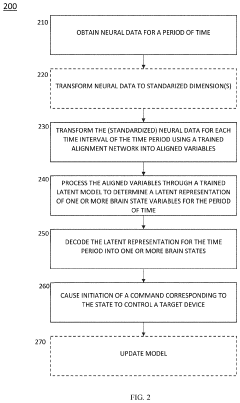
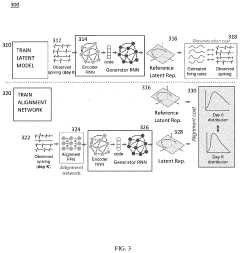
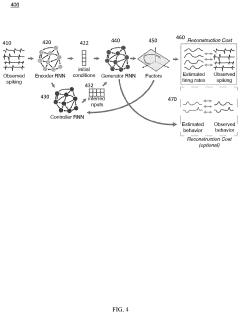
Systems and Methods for Nonlinear Latent Spatiotemporal Representation Alignment Decoding for Brain-Computer Interfaces
PatentPendingUS20220129071A1
Innovation
- A trained alignment neural network and latent representation model are used to achieve accurate alignment of complex neural signals over time, enabling stable and consistent brain-state decoding without frequent recalibration.

Brain-Computer Interface Decoding Method and Apparatus Based on Point-Position Equivalent Augmentation
PatentPendingUS20230315203A1
Innovation
- A brain-computer interface decoding method based on point-position equivalent augmentation, which involves data preprocessing, point-position equivalent augmentation, task-related component analysis, and the use of a naive Bayes method for classification, to enhance decoding accuracy and reduce calibration time.


Ethical and Privacy Considerations in BCI Technology
As Brain-Computer Interface (BCI) technology advances, particularly in source localization algorithms for neural decoding, significant ethical and privacy concerns emerge that require careful consideration. The ability to precisely locate and interpret neural activity raises profound questions about mental privacy—perhaps the last frontier of personal privacy in the digital age. When algorithms can accurately decode thoughts, intentions, or emotional states from brain signals, individuals may face unprecedented vulnerabilities regarding their most intimate cognitive processes.
Data security presents a critical challenge in BCI applications. Neural data contains highly sensitive information about an individual's cognitive functions, mental health status, and potentially even thoughts or intentions. The storage, transmission, and processing of this data create multiple points of vulnerability where unauthorized access could lead to severe privacy breaches. Unlike conventional data breaches, compromised neural information cannot simply be changed like passwords—it represents intrinsic aspects of an individual's cognitive identity.
Informed consent frameworks require substantial reconsideration in the context of advanced BCI technologies. Traditional consent models may prove inadequate when participants cannot fully comprehend the extent of information that might be extracted from their neural signals through increasingly sophisticated algorithms. The dynamic nature of machine learning approaches in source localization means that data collected today might reveal significantly more information in the future than currently anticipated.
The potential for algorithmic bias in source localization technologies presents another ethical dimension. If training datasets lack diversity or contain inherent biases, the resulting algorithms may perform differently across demographic groups, potentially leading to misinterpretation of neural signals and reinforcing existing social inequalities in healthcare and other applications.
Regulatory frameworks currently lag behind technological capabilities in BCI development. The unprecedented nature of direct brain interfaces challenges existing legal structures designed primarily for conventional data protection. International harmonization of regulations becomes essential as neural data easily crosses borders through cloud computing and international research collaborations.
Dual-use concerns also arise as advanced source localization algorithms developed for therapeutic or research purposes could potentially be repurposed for surveillance, interrogation, or manipulation. Establishing robust safeguards against misuse while not impeding beneficial applications represents a delicate balance that the scientific community must actively address through transparent development practices and ethical guidelines.
Data security presents a critical challenge in BCI applications. Neural data contains highly sensitive information about an individual's cognitive functions, mental health status, and potentially even thoughts or intentions. The storage, transmission, and processing of this data create multiple points of vulnerability where unauthorized access could lead to severe privacy breaches. Unlike conventional data breaches, compromised neural information cannot simply be changed like passwords—it represents intrinsic aspects of an individual's cognitive identity.
Informed consent frameworks require substantial reconsideration in the context of advanced BCI technologies. Traditional consent models may prove inadequate when participants cannot fully comprehend the extent of information that might be extracted from their neural signals through increasingly sophisticated algorithms. The dynamic nature of machine learning approaches in source localization means that data collected today might reveal significantly more information in the future than currently anticipated.
The potential for algorithmic bias in source localization technologies presents another ethical dimension. If training datasets lack diversity or contain inherent biases, the resulting algorithms may perform differently across demographic groups, potentially leading to misinterpretation of neural signals and reinforcing existing social inequalities in healthcare and other applications.
Regulatory frameworks currently lag behind technological capabilities in BCI development. The unprecedented nature of direct brain interfaces challenges existing legal structures designed primarily for conventional data protection. International harmonization of regulations becomes essential as neural data easily crosses borders through cloud computing and international research collaborations.
Dual-use concerns also arise as advanced source localization algorithms developed for therapeutic or research purposes could potentially be repurposed for surveillance, interrogation, or manipulation. Establishing robust safeguards against misuse while not impeding beneficial applications represents a delicate balance that the scientific community must actively address through transparent development practices and ethical guidelines.
Clinical Validation and Regulatory Pathways
The clinical validation of advanced source localization algorithms for Brain-Computer Interfaces (BCIs) requires rigorous testing protocols to ensure both efficacy and safety before widespread implementation. Current validation approaches typically follow a three-phase framework: preliminary validation in controlled laboratory settings, expanded clinical trials with diverse patient populations, and long-term effectiveness studies in real-world environments.
Regulatory pathways for BCI technologies with advanced source localization algorithms vary significantly across global jurisdictions. In the United States, the FDA categorizes most BCI systems as Class II or Class III medical devices, depending on their invasiveness and intended use. Source localization algorithms specifically may require separate software validation under the FDA's Software as a Medical Device (SaMD) framework, with particular attention to accuracy metrics and error rates in neural signal interpretation.
The European Union, under the Medical Device Regulation (MDR), imposes stringent requirements for clinical evidence and post-market surveillance, with BCIs typically classified as Class IIb or III devices. The regulatory process emphasizes risk management and demonstration of clinical benefit through controlled investigations.
Emerging markets like China and India are developing specialized regulatory frameworks for neurotechnology, though harmonization with international standards remains incomplete. This regulatory diversity creates significant challenges for global deployment of advanced source localization algorithms in BCI applications.
Key validation metrics for these algorithms include spatial resolution accuracy, temporal precision, robustness to noise, and computational efficiency. Clinical endpoints must demonstrate meaningful functional improvements for patients, particularly in communication ability, motor control, or cognitive function depending on the specific BCI application.
Regulatory bodies increasingly require evidence of algorithm stability across different hardware implementations and patient populations. This includes validation across various demographic factors, comorbidities, and environmental conditions to ensure generalizability of results.
The pathway to regulatory approval typically requires 3-7 years from initial validation to market authorization, with costs ranging from $5-30 million depending on the complexity of the technology and intended clinical application. Strategic partnerships between academic institutions, technology developers, and healthcare providers have emerged as a common approach to navigate these complex regulatory landscapes while maintaining scientific rigor.
Regulatory pathways for BCI technologies with advanced source localization algorithms vary significantly across global jurisdictions. In the United States, the FDA categorizes most BCI systems as Class II or Class III medical devices, depending on their invasiveness and intended use. Source localization algorithms specifically may require separate software validation under the FDA's Software as a Medical Device (SaMD) framework, with particular attention to accuracy metrics and error rates in neural signal interpretation.
The European Union, under the Medical Device Regulation (MDR), imposes stringent requirements for clinical evidence and post-market surveillance, with BCIs typically classified as Class IIb or III devices. The regulatory process emphasizes risk management and demonstration of clinical benefit through controlled investigations.
Emerging markets like China and India are developing specialized regulatory frameworks for neurotechnology, though harmonization with international standards remains incomplete. This regulatory diversity creates significant challenges for global deployment of advanced source localization algorithms in BCI applications.
Key validation metrics for these algorithms include spatial resolution accuracy, temporal precision, robustness to noise, and computational efficiency. Clinical endpoints must demonstrate meaningful functional improvements for patients, particularly in communication ability, motor control, or cognitive function depending on the specific BCI application.
Regulatory bodies increasingly require evidence of algorithm stability across different hardware implementations and patient populations. This includes validation across various demographic factors, comorbidities, and environmental conditions to ensure generalizability of results.
The pathway to regulatory approval typically requires 3-7 years from initial validation to market authorization, with costs ranging from $5-30 million depending on the complexity of the technology and intended clinical application. Strategic partnerships between academic institutions, technology developers, and healthcare providers have emerged as a common approach to navigate these complex regulatory landscapes while maintaining scientific rigor.
Unlock deeper insights with Patsnap Eureka Quick Research — get a full tech report to explore trends and direct your research. Try now!
Generate Your Research Report Instantly with AI Agent
Supercharge your innovation with Patsnap Eureka AI Agent Platform!