

Compare Spintronics Materials: Conductivity vs Stability
APR 16, 20269 MIN READ
Generate Your Research Report Instantly with AI Agent
Patsnap Eureka helps you evaluate technical feasibility & market potential.
Spintronics Materials Background and Research Objectives
Spintronics, or spin electronics, represents a revolutionary paradigm in electronic device technology that exploits the intrinsic spin property of electrons alongside their charge. This field emerged from the discovery of giant magnetoresistance (GMR) in the late 1980s, which demonstrated that electron spin could be manipulated to create significant changes in electrical resistance. The fundamental principle underlying spintronics involves controlling and utilizing electron spin states to store, process, and transmit information, offering potential advantages over conventional charge-based electronics.
The evolution of spintronics has been driven by the quest for devices that combine non-volatility, high speed, low power consumption, and enhanced functionality. Traditional semiconductor devices rely solely on electron charge manipulation, which inherently leads to energy dissipation and volatility issues. Spintronics addresses these limitations by incorporating spin degrees of freedom, enabling the development of devices that can maintain their state without continuous power supply while potentially operating at higher speeds and lower energy consumption.
Current technological trends in spintronics focus on developing materials that can efficiently generate, transport, manipulate, and detect spin-polarized currents. The field has progressed from simple GMR structures to complex multilayer systems, spin valves, magnetic tunnel junctions, and emerging topological materials. Recent advances include the exploration of two-dimensional materials, Weyl semimetals, and quantum materials that exhibit novel spin-dependent transport properties.
The critical challenge in spintronics materials development lies in achieving an optimal balance between electrical conductivity and structural stability. High conductivity is essential for efficient spin transport and device performance, while stability ensures reliable operation under various environmental conditions and extended operational lifetimes. This trade-off becomes particularly complex when considering factors such as temperature variations, magnetic field exposure, and mechanical stress.
Research objectives in this domain encompass several key areas: identifying materials that maintain high spin polarization while exhibiting excellent electrical conductivity, developing synthesis methods for producing stable spintronic materials with controlled properties, understanding the fundamental mechanisms governing spin transport in different material systems, and establishing design principles for optimizing the conductivity-stability relationship. Additionally, there is growing emphasis on exploring novel material classes including organic semiconductors, hybrid perovskites, and quantum materials that could potentially overcome traditional limitations.
The ultimate goal is to enable practical spintronic devices that can compete with or surpass conventional electronics in terms of performance, reliability, and energy efficiency, thereby facilitating the next generation of computing, memory, and sensing technologies.
The evolution of spintronics has been driven by the quest for devices that combine non-volatility, high speed, low power consumption, and enhanced functionality. Traditional semiconductor devices rely solely on electron charge manipulation, which inherently leads to energy dissipation and volatility issues. Spintronics addresses these limitations by incorporating spin degrees of freedom, enabling the development of devices that can maintain their state without continuous power supply while potentially operating at higher speeds and lower energy consumption.
Current technological trends in spintronics focus on developing materials that can efficiently generate, transport, manipulate, and detect spin-polarized currents. The field has progressed from simple GMR structures to complex multilayer systems, spin valves, magnetic tunnel junctions, and emerging topological materials. Recent advances include the exploration of two-dimensional materials, Weyl semimetals, and quantum materials that exhibit novel spin-dependent transport properties.
The critical challenge in spintronics materials development lies in achieving an optimal balance between electrical conductivity and structural stability. High conductivity is essential for efficient spin transport and device performance, while stability ensures reliable operation under various environmental conditions and extended operational lifetimes. This trade-off becomes particularly complex when considering factors such as temperature variations, magnetic field exposure, and mechanical stress.
Research objectives in this domain encompass several key areas: identifying materials that maintain high spin polarization while exhibiting excellent electrical conductivity, developing synthesis methods for producing stable spintronic materials with controlled properties, understanding the fundamental mechanisms governing spin transport in different material systems, and establishing design principles for optimizing the conductivity-stability relationship. Additionally, there is growing emphasis on exploring novel material classes including organic semiconductors, hybrid perovskites, and quantum materials that could potentially overcome traditional limitations.
The ultimate goal is to enable practical spintronic devices that can compete with or surpass conventional electronics in terms of performance, reliability, and energy efficiency, thereby facilitating the next generation of computing, memory, and sensing technologies.
Market Demand for Advanced Spintronic Devices
The global spintronics market is experiencing unprecedented growth driven by the increasing demand for energy-efficient computing solutions and next-generation memory technologies. Traditional semiconductor devices face fundamental limitations in power consumption and processing speed, creating substantial market opportunities for spintronic alternatives that leverage electron spin properties alongside charge characteristics.
Data storage applications represent the largest market segment for spintronic devices, with magnetic random-access memory (MRAM) leading commercial adoption. Enterprise storage systems and automotive electronics are driving significant demand for non-volatile memory solutions that offer superior endurance and instant-on capabilities compared to conventional flash memory. The automotive sector particularly values spintronic devices for their radiation resistance and operational reliability in harsh environments.
Computing applications are emerging as a transformative market opportunity, with neuromorphic computing and quantum processing systems requiring materials that can maintain coherent spin states while providing adequate electrical conductivity. The artificial intelligence boom has intensified demand for specialized processors that can perform parallel computations with minimal energy consumption, positioning spintronic devices as critical enablers for edge computing and IoT applications.
Telecommunications infrastructure presents another substantial market driver, as 5G and future 6G networks require high-frequency components with exceptional signal integrity. Spintronic materials that balance conductivity with magnetic stability are essential for developing advanced filters, oscillators, and signal processing components that can operate at terahertz frequencies while maintaining low power consumption.
The healthcare and sensing markets are increasingly adopting spintronic technologies for magnetic field detection and biomedical imaging applications. These sectors demand materials with precise magnetic properties and long-term stability, creating specialized market niches for advanced spintronic compounds that can maintain performance over extended operational periods.
Market growth is further accelerated by government initiatives promoting quantum technologies and sustainable computing solutions. Research institutions and technology companies are investing heavily in spintronic device development, creating a robust ecosystem that supports continued market expansion and technological advancement across multiple application domains.
Data storage applications represent the largest market segment for spintronic devices, with magnetic random-access memory (MRAM) leading commercial adoption. Enterprise storage systems and automotive electronics are driving significant demand for non-volatile memory solutions that offer superior endurance and instant-on capabilities compared to conventional flash memory. The automotive sector particularly values spintronic devices for their radiation resistance and operational reliability in harsh environments.
Computing applications are emerging as a transformative market opportunity, with neuromorphic computing and quantum processing systems requiring materials that can maintain coherent spin states while providing adequate electrical conductivity. The artificial intelligence boom has intensified demand for specialized processors that can perform parallel computations with minimal energy consumption, positioning spintronic devices as critical enablers for edge computing and IoT applications.
Telecommunications infrastructure presents another substantial market driver, as 5G and future 6G networks require high-frequency components with exceptional signal integrity. Spintronic materials that balance conductivity with magnetic stability are essential for developing advanced filters, oscillators, and signal processing components that can operate at terahertz frequencies while maintaining low power consumption.
The healthcare and sensing markets are increasingly adopting spintronic technologies for magnetic field detection and biomedical imaging applications. These sectors demand materials with precise magnetic properties and long-term stability, creating specialized market niches for advanced spintronic compounds that can maintain performance over extended operational periods.
Market growth is further accelerated by government initiatives promoting quantum technologies and sustainable computing solutions. Research institutions and technology companies are investing heavily in spintronic device development, creating a robust ecosystem that supports continued market expansion and technological advancement across multiple application domains.
Current Conductivity vs Stability Trade-offs in Spintronics
The fundamental challenge in spintronics materials development lies in the inherent tension between achieving high electrical conductivity and maintaining long-term structural stability. This trade-off represents one of the most significant barriers to widespread commercial adoption of spintronic devices, as materials that excel in one property often compromise the other.
Metallic ferromagnets such as iron, cobalt, and nickel demonstrate excellent electrical conductivity due to their high density of free electrons. However, these materials suffer from rapid spin coherence decay and are susceptible to oxidation and thermal degradation. The spin diffusion length in these metals typically ranges from 2-10 nanometers, severely limiting their effectiveness in practical spintronic applications where longer spin transport distances are required.
Half-metallic materials like Heusler alloys present a promising middle ground, offering theoretical 100% spin polarization while maintaining reasonable conductivity. Yet experimental results consistently show degraded performance due to interface roughness, atomic disorder, and sensitivity to processing conditions. The predicted half-metallic behavior often disappears at room temperature, creating a significant gap between theoretical potential and practical implementation.
Diluted magnetic semiconductors represent another approach to balance conductivity and stability. Materials such as gallium manganese arsenide can be engineered to provide tunable magnetic properties while maintaining semiconductor-like stability. However, their relatively low conductivity compared to metals limits their application in high-speed devices, and the Curie temperatures often remain below room temperature for practical concentrations.
Topological insulators have emerged as potential solutions to this trade-off, offering protected surface states that could provide both high spin-polarized conductivity and inherent stability against certain types of disorder. Materials like bismuth selenide and bismuth telluride show promise, but their bulk conductivity and surface state preservation under ambient conditions remain challenging issues.
The stability-conductivity trade-off is further complicated by interface effects in multilayer spintronic devices. High-conductivity materials often require protective layers that introduce additional resistance, while stable materials may not provide sufficient spin injection efficiency. This creates a complex optimization problem where device-level performance depends on carefully balancing material properties across multiple layers and interfaces.
Metallic ferromagnets such as iron, cobalt, and nickel demonstrate excellent electrical conductivity due to their high density of free electrons. However, these materials suffer from rapid spin coherence decay and are susceptible to oxidation and thermal degradation. The spin diffusion length in these metals typically ranges from 2-10 nanometers, severely limiting their effectiveness in practical spintronic applications where longer spin transport distances are required.
Half-metallic materials like Heusler alloys present a promising middle ground, offering theoretical 100% spin polarization while maintaining reasonable conductivity. Yet experimental results consistently show degraded performance due to interface roughness, atomic disorder, and sensitivity to processing conditions. The predicted half-metallic behavior often disappears at room temperature, creating a significant gap between theoretical potential and practical implementation.
Diluted magnetic semiconductors represent another approach to balance conductivity and stability. Materials such as gallium manganese arsenide can be engineered to provide tunable magnetic properties while maintaining semiconductor-like stability. However, their relatively low conductivity compared to metals limits their application in high-speed devices, and the Curie temperatures often remain below room temperature for practical concentrations.
Topological insulators have emerged as potential solutions to this trade-off, offering protected surface states that could provide both high spin-polarized conductivity and inherent stability against certain types of disorder. Materials like bismuth selenide and bismuth telluride show promise, but their bulk conductivity and surface state preservation under ambient conditions remain challenging issues.
The stability-conductivity trade-off is further complicated by interface effects in multilayer spintronic devices. High-conductivity materials often require protective layers that introduce additional resistance, while stable materials may not provide sufficient spin injection efficiency. This creates a complex optimization problem where device-level performance depends on carefully balancing material properties across multiple layers and interfaces.
Existing Material Solutions for Spintronic Applications
01 Use of graphene-based materials for enhanced conductivity
Graphene and graphene-based composite materials can be utilized in spintronic devices to achieve superior electrical conductivity. These materials exhibit excellent electron mobility and can maintain stable spin polarization at room temperature. The incorporation of graphene layers or graphene oxide derivatives enables efficient spin transport while maintaining structural integrity. Various doping methods and functionalization techniques can further optimize the conductivity properties for specific spintronic applications.- Use of graphene-based materials for enhanced conductivity: Graphene and graphene-based composite materials can be utilized in spintronic devices to achieve superior electrical conductivity. These materials exhibit excellent electron mobility and can maintain stable spin transport properties. The incorporation of graphene layers or graphene derivatives into spintronic structures enables efficient charge and spin current flow, which is essential for device performance. Various doping methods and structural modifications can further optimize the conductivity characteristics.
- Transition metal dichalcogenides for stable spin transport: Transition metal dichalcogenides represent a class of two-dimensional materials that demonstrate robust spin-orbit coupling and stable electronic properties. These materials can maintain their spintronic functionality under various environmental conditions and temperatures. The layered structure provides inherent stability while allowing for tunable electronic properties through composition control and layer engineering. Such materials are particularly suitable for applications requiring long-term operational stability.
- Magnetic tunnel junction structures with improved stability: Advanced magnetic tunnel junction architectures can be designed to enhance both the magnetoresistance ratio and thermal stability of spintronic devices. These structures typically involve carefully selected ferromagnetic layers, barrier materials, and interface engineering to minimize degradation over time. The optimization of layer thickness, composition gradients, and crystalline orientation contributes to maintaining stable spin-dependent tunneling characteristics. Protective capping layers and annealing processes further improve the long-term stability.
- Topological insulators for spin-polarized conduction: Topological insulator materials exhibit unique surface states that enable highly efficient spin-polarized electrical conduction while maintaining insulating bulk properties. These materials demonstrate remarkable stability against perturbations and defects due to their topologically protected surface states. The spin-momentum locking characteristic of topological insulators provides a robust mechanism for spin current generation and manipulation. Material engineering approaches can optimize both the conductivity of surface channels and the overall device stability.
- Oxide-based spintronic materials with enhanced thermal stability: Complex oxide materials and perovskite structures offer excellent thermal stability and tunable magnetic and electronic properties for spintronic applications. These materials can withstand elevated operating temperatures while maintaining their spin transport characteristics. The ability to engineer oxygen vacancies, doping levels, and crystalline phases allows for optimization of both conductivity and stability. Interface effects between different oxide layers can be exploited to create novel spintronic functionalities with improved reliability.
02 Transition metal dichalcogenides for stable spin transport
Two-dimensional transition metal dichalcogenides provide excellent stability and controllable spin-orbit coupling for spintronic applications. These materials demonstrate robust performance under various environmental conditions and can maintain their spintronic properties over extended periods. The layered structure allows for precise control of electronic properties through thickness modulation and heterostructure formation. These materials show promise in maintaining both thermal and chemical stability in device operations.Expand Specific Solutions03 Magnetic tunnel junction structures with improved stability
Advanced magnetic tunnel junction configurations enhance both the magnetoresistance ratio and long-term stability of spintronic devices. These structures incorporate carefully selected barrier materials and electrode compositions to minimize degradation over time. The optimization of interface quality and crystalline orientation contributes to stable spin-dependent tunneling characteristics. Various annealing processes and protective layer implementations further improve the operational stability under different temperature and voltage conditions.Expand Specific Solutions04 Topological insulators for spin-polarized current generation
Topological insulator materials enable highly efficient spin-polarized current generation with minimal energy dissipation. These materials feature surface states that are protected by time-reversal symmetry, providing exceptional stability against perturbations and defects. The bulk insulating properties combined with conducting surface states allow for robust spin transport with reduced scattering. Material engineering approaches can optimize both the conductivity of surface states and the overall device stability.Expand Specific Solutions05 Organic spintronic materials with tunable properties
Organic and hybrid organic-inorganic materials offer flexibility in tailoring both conductivity and stability for spintronic applications. These materials can be processed at lower temperatures and provide opportunities for flexible device fabrication. The spin relaxation times and charge transport properties can be adjusted through molecular design and chemical modification. Encapsulation techniques and barrier layers help maintain stability against oxidation and moisture, extending the operational lifetime of organic spintronic devices.Expand Specific Solutions
Key Players in Spintronics Research and Industry
The spintronics materials sector is experiencing rapid evolution as the industry transitions from early research phases to commercial viability, driven by growing demand for next-generation computing and memory technologies. The market demonstrates significant growth potential, with applications spanning quantum computing, neuromorphic processors, and ultra-low power electronics. Technology maturity varies considerably across the competitive landscape, with established semiconductor giants like Intel Corp. and Hitachi Ltd. leveraging their manufacturing expertise to advance spintronic device integration, while specialized materials companies such as TDK Corp. and BASF Corp. focus on developing novel magnetic and conductive materials. Leading research institutions including MIT, Tohoku University, and Nanyang Technological University are pioneering breakthrough discoveries in material synthesis and characterization. Technology transfer organizations like Yissum Research Development and Cambridge Enterprise Ltd. are actively bridging the gap between academic research and commercial applications, indicating strong innovation momentum in addressing the fundamental trade-offs between electrical conductivity and thermal stability in spintronic materials.
Intel Corp.
Technical Solution: Intel has developed advanced spintronic materials focusing on spin-transfer torque magnetic random access memory (STT-MRAM) technology. Their approach utilizes perpendicular magnetic anisotropy materials like CoFeB/MgO heterostructures to achieve high thermal stability while maintaining reasonable conductivity. The company has implemented tunnel magnetoresistance ratios exceeding 200% at room temperature, enabling fast switching speeds below 10ns. Intel's spintronic solutions integrate voltage-controlled magnetic anisotropy techniques to reduce power consumption during write operations, making their materials suitable for both embedded and standalone memory applications.
Strengths: High integration capability with CMOS technology, excellent thermal stability up to 400°C, low power consumption. Weaknesses: Limited scalability below 10nm nodes, relatively high manufacturing costs.
TDK Corp.
Technical Solution: TDK has developed comprehensive spintronic material solutions focusing on magnetic tunnel junctions with enhanced conductivity-stability balance. Their proprietary CoFeB-based free layers combined with crystalline MgO barriers achieve tunnel magnetoresistance ratios above 300% while maintaining thermal stability up to 350°C. The company's materials feature optimized interfacial engineering that reduces critical switching current density to below 10^6 A/cm². TDK's spintronic materials incorporate dual-interface designs and synthetic antiferromagnetic reference layers to improve retention characteristics exceeding 10 years at operating temperatures, making them suitable for automotive and industrial applications requiring high reliability.
Strengths: Superior thermal stability, high TMR ratios, excellent retention characteristics for harsh environments. Weaknesses: Complex manufacturing process, higher material costs compared to conventional alternatives.
Core Innovations in High-Performance Spintronic Materials
Spintronic materials and spintronic devices including the spintronic materials
PatentInactiveUS20160222039A1
Innovation
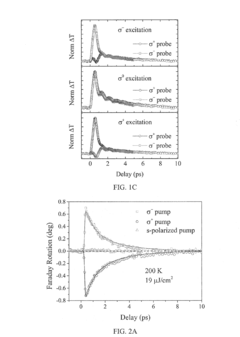
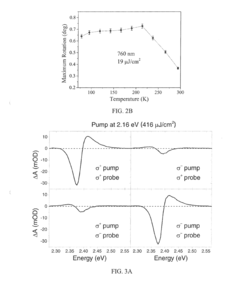
- The development of halide perovskite materials, which are formed by dissolving RX and MX2 in a solvent, deposited onto a substrate, and then heated to form a film, allowing for spintronic devices that can be driven by both photons and electrons, with strong spin-orbit coupling and tunable properties.


Spin transport device
PatentInactiveUS8269294B2
Innovation
- A spin transport device is designed with specific regions within the semiconductor channel having higher carrier densities than the average, allowing for adjusted electric resistance and reduced spin scattering, along with the use of insulating layers and electrodes to facilitate efficient spin injection and transport.


Material Characterization Standards and Testing Protocols
The establishment of standardized material characterization protocols for spintronics materials represents a critical foundation for advancing the field's commercial viability. Current industry practices lack unified testing methodologies, creating significant challenges in comparing conductivity and stability metrics across different research institutions and manufacturing facilities. The absence of standardized protocols has led to inconsistent data reporting and difficulties in establishing reliable material performance benchmarks.
International standardization organizations, including ISO and ASTM, are actively developing comprehensive testing frameworks specifically tailored for spintronic materials. These emerging standards address key measurement parameters such as spin polarization efficiency, magnetoresistance ratios, and thermal stability coefficients. The protocols emphasize reproducible testing conditions, including controlled temperature environments, standardized sample preparation techniques, and calibrated measurement equipment specifications.
Conductivity characterization standards focus on establishing uniform methodologies for measuring spin-dependent transport properties. The protocols define specific sample geometries, contact configurations, and measurement frequencies to ensure consistent results across different testing facilities. Critical parameters include four-point probe measurements for bulk conductivity, van der Pauw configurations for thin films, and specialized techniques for measuring spin diffusion lengths and spin lifetimes.
Stability assessment protocols encompass both short-term operational stability and long-term degradation mechanisms. Testing standards specify accelerated aging procedures under controlled atmospheric conditions, thermal cycling protocols, and exposure to electromagnetic fields. These methodologies enable systematic evaluation of material degradation rates, interface stability, and performance retention under various operational stresses.
Quality assurance frameworks integrate statistical analysis requirements, measurement uncertainty quantification, and inter-laboratory comparison protocols. The standards mandate specific documentation procedures, traceability requirements, and certification processes to ensure data reliability and reproducibility across the global spintronics research community.
International standardization organizations, including ISO and ASTM, are actively developing comprehensive testing frameworks specifically tailored for spintronic materials. These emerging standards address key measurement parameters such as spin polarization efficiency, magnetoresistance ratios, and thermal stability coefficients. The protocols emphasize reproducible testing conditions, including controlled temperature environments, standardized sample preparation techniques, and calibrated measurement equipment specifications.
Conductivity characterization standards focus on establishing uniform methodologies for measuring spin-dependent transport properties. The protocols define specific sample geometries, contact configurations, and measurement frequencies to ensure consistent results across different testing facilities. Critical parameters include four-point probe measurements for bulk conductivity, van der Pauw configurations for thin films, and specialized techniques for measuring spin diffusion lengths and spin lifetimes.
Stability assessment protocols encompass both short-term operational stability and long-term degradation mechanisms. Testing standards specify accelerated aging procedures under controlled atmospheric conditions, thermal cycling protocols, and exposure to electromagnetic fields. These methodologies enable systematic evaluation of material degradation rates, interface stability, and performance retention under various operational stresses.
Quality assurance frameworks integrate statistical analysis requirements, measurement uncertainty quantification, and inter-laboratory comparison protocols. The standards mandate specific documentation procedures, traceability requirements, and certification processes to ensure data reliability and reproducibility across the global spintronics research community.
Manufacturing Scalability Challenges for Spintronic Materials
The transition from laboratory-scale synthesis to industrial-scale production represents one of the most significant hurdles in spintronic materials development. Current fabrication methods for high-performance spintronic materials, including molecular beam epitaxy and atomic layer deposition, operate effectively at research scales but face substantial challenges when scaled to commercial volumes. These precision techniques require ultra-high vacuum conditions and atomic-level control, making them inherently expensive and time-intensive for large-scale manufacturing.
Material uniformity emerges as a critical bottleneck during scaling processes. Spintronic devices demand exceptional consistency in magnetic properties, spin coherence lengths, and interfacial quality across entire wafer surfaces. Achieving this uniformity becomes exponentially more challenging as substrate sizes increase from research-grade samples to industry-standard 300mm wafers. Variations in thickness, composition, and crystalline structure that are negligible at small scales can severely compromise device performance when multiplied across large production runs.
Cost considerations present another formidable obstacle to commercial viability. Many promising spintronic materials rely on rare earth elements or require sophisticated processing equipment that significantly increases production costs. The economic feasibility of spintronic devices depends heavily on developing alternative material systems or innovative processing techniques that maintain performance while reducing manufacturing expenses. Current cost projections for scaled production often exceed market acceptance thresholds by substantial margins.
Quality control and yield optimization pose additional manufacturing challenges specific to spintronic materials. Traditional semiconductor quality assurance methods prove inadequate for characterizing spin-dependent properties at production scales. New metrology techniques must be developed to rapidly assess magnetic anisotropy, spin injection efficiency, and thermal stability across large batches. Furthermore, the sensitivity of spintronic materials to processing conditions means that minor variations in temperature, atmosphere, or timing can result in significant yield losses.
Integration compatibility with existing semiconductor manufacturing infrastructure represents a strategic consideration for industry adoption. Spintronic materials often require processing conditions or materials that are incompatible with standard CMOS fabrication lines, necessitating dedicated production facilities or extensive equipment modifications. This infrastructure requirement creates substantial barriers to entry and limits the number of potential manufacturing partners capable of producing spintronic devices at scale.
Material uniformity emerges as a critical bottleneck during scaling processes. Spintronic devices demand exceptional consistency in magnetic properties, spin coherence lengths, and interfacial quality across entire wafer surfaces. Achieving this uniformity becomes exponentially more challenging as substrate sizes increase from research-grade samples to industry-standard 300mm wafers. Variations in thickness, composition, and crystalline structure that are negligible at small scales can severely compromise device performance when multiplied across large production runs.
Cost considerations present another formidable obstacle to commercial viability. Many promising spintronic materials rely on rare earth elements or require sophisticated processing equipment that significantly increases production costs. The economic feasibility of spintronic devices depends heavily on developing alternative material systems or innovative processing techniques that maintain performance while reducing manufacturing expenses. Current cost projections for scaled production often exceed market acceptance thresholds by substantial margins.
Quality control and yield optimization pose additional manufacturing challenges specific to spintronic materials. Traditional semiconductor quality assurance methods prove inadequate for characterizing spin-dependent properties at production scales. New metrology techniques must be developed to rapidly assess magnetic anisotropy, spin injection efficiency, and thermal stability across large batches. Furthermore, the sensitivity of spintronic materials to processing conditions means that minor variations in temperature, atmosphere, or timing can result in significant yield losses.
Integration compatibility with existing semiconductor manufacturing infrastructure represents a strategic consideration for industry adoption. Spintronic materials often require processing conditions or materials that are incompatible with standard CMOS fabrication lines, necessitating dedicated production facilities or extensive equipment modifications. This infrastructure requirement creates substantial barriers to entry and limits the number of potential manufacturing partners capable of producing spintronic devices at scale.
Unlock deeper insights with Patsnap Eureka Quick Research — get a full tech report to explore trends and direct your research. Try now!
Generate Your Research Report Instantly with AI Agent
Supercharge your innovation with Patsnap Eureka AI Agent Platform!