

Comparing Brain-Computer Interface Latency Across Various Communication Channels
MAR 5, 20269 MIN READ
Generate Your Research Report Instantly with AI Agent
PatSnap Eureka helps you evaluate technical feasibility & market potential.
BCI Latency Challenges and Communication Goals
Brain-computer interfaces face fundamental latency challenges that directly impact their practical utility and user experience. The primary challenge stems from the inherent delays in neural signal acquisition, processing, and transmission across different communication pathways. These delays accumulate throughout the BCI pipeline, from initial signal capture at the neural interface to final command execution at the target device.
The most significant latency bottleneck occurs during neural signal processing, where raw brain signals must be filtered, amplified, and decoded into meaningful control commands. This computational overhead varies dramatically depending on the complexity of the decoding algorithms and the processing power available. Real-time signal processing requirements often force trade-offs between accuracy and speed, creating a persistent tension in BCI system design.
Communication channel selection presents another critical challenge, as different transmission methods introduce varying degrees of delay. Wired connections typically offer the lowest latency but limit user mobility, while wireless protocols introduce additional overhead through encoding, transmission, and decoding processes. The choice between Bluetooth, WiFi, or proprietary wireless protocols significantly impacts overall system responsiveness.
The communication goals for BCI systems center on achieving near-instantaneous response times that match natural human reaction speeds. For motor control applications, latencies below 100 milliseconds are generally required to maintain the illusion of direct neural control. Communication applications may tolerate slightly higher delays, but still require sub-second response times to maintain natural interaction flow.
Establishing reliable, low-jitter communication channels represents another fundamental goal. Consistent timing is often more important than absolute minimum latency, as users can adapt to predictable delays but struggle with variable response times. This requirement drives the need for deterministic communication protocols and real-time operating system implementations.
The ultimate communication objective involves creating transparent interfaces where the technological mediation becomes imperceptible to users. This goal necessitates not only minimizing absolute latency but also ensuring that the entire communication chain operates with biological-level timing precision, enabling seamless integration between human intention and digital action.
The most significant latency bottleneck occurs during neural signal processing, where raw brain signals must be filtered, amplified, and decoded into meaningful control commands. This computational overhead varies dramatically depending on the complexity of the decoding algorithms and the processing power available. Real-time signal processing requirements often force trade-offs between accuracy and speed, creating a persistent tension in BCI system design.
Communication channel selection presents another critical challenge, as different transmission methods introduce varying degrees of delay. Wired connections typically offer the lowest latency but limit user mobility, while wireless protocols introduce additional overhead through encoding, transmission, and decoding processes. The choice between Bluetooth, WiFi, or proprietary wireless protocols significantly impacts overall system responsiveness.
The communication goals for BCI systems center on achieving near-instantaneous response times that match natural human reaction speeds. For motor control applications, latencies below 100 milliseconds are generally required to maintain the illusion of direct neural control. Communication applications may tolerate slightly higher delays, but still require sub-second response times to maintain natural interaction flow.
Establishing reliable, low-jitter communication channels represents another fundamental goal. Consistent timing is often more important than absolute minimum latency, as users can adapt to predictable delays but struggle with variable response times. This requirement drives the need for deterministic communication protocols and real-time operating system implementations.
The ultimate communication objective involves creating transparent interfaces where the technological mediation becomes imperceptible to users. This goal necessitates not only minimizing absolute latency but also ensuring that the entire communication chain operates with biological-level timing precision, enabling seamless integration between human intention and digital action.
Market Demand for Low-Latency BCI Systems
The healthcare sector represents the most substantial market segment driving demand for low-latency brain-computer interface systems. Medical applications requiring real-time neural signal processing, particularly in neuroprosthetics and assistive technologies, have established stringent latency requirements. Patients with spinal cord injuries, amputees, and individuals with neurodegenerative diseases require BCI systems that can translate neural intentions into immediate device responses to achieve natural interaction experiences.
Rehabilitation and therapeutic applications constitute another critical demand driver, where millisecond-level delays can significantly impact treatment efficacy. Motor rehabilitation systems utilizing BCI technology for stroke recovery and physical therapy applications require ultra-responsive feedback loops to maintain patient engagement and optimize neuroplasticity outcomes. The growing aging population worldwide has intensified the need for such therapeutic interventions.
The gaming and entertainment industry has emerged as an unexpected yet significant market force, pushing for consumer-grade low-latency BCI systems. Virtual reality applications and immersive gaming experiences demand seamless brain-to-digital interfaces where any perceptible delay disrupts user immersion. This consumer market segment has accelerated development timelines and cost reduction initiatives across the industry.
Military and defense applications represent a specialized but high-value market segment requiring extremely low-latency BCI systems for tactical operations and pilot training programs. These applications often involve life-critical scenarios where communication delays could have severe consequences, driving demand for the most advanced low-latency solutions available.
Research institutions and academic organizations continue to fuel demand through their pursuit of advanced neuroscience studies and cognitive research programs. These entities require precise timing capabilities for experimental protocols and data collection, often serving as early adopters of cutting-edge BCI technologies.
The industrial automation sector has begun exploring BCI applications for complex machinery control and human-machine collaboration scenarios. Manufacturing environments where operators need to control multiple systems simultaneously through thought-based commands require minimal latency to maintain operational efficiency and safety standards.
Market demand intensity varies significantly across geographical regions, with North America and Europe leading in medical device adoption, while Asia-Pacific markets show strong growth in consumer electronics applications. This regional variation influences development priorities and communication channel optimization strategies across different market segments.
Rehabilitation and therapeutic applications constitute another critical demand driver, where millisecond-level delays can significantly impact treatment efficacy. Motor rehabilitation systems utilizing BCI technology for stroke recovery and physical therapy applications require ultra-responsive feedback loops to maintain patient engagement and optimize neuroplasticity outcomes. The growing aging population worldwide has intensified the need for such therapeutic interventions.
The gaming and entertainment industry has emerged as an unexpected yet significant market force, pushing for consumer-grade low-latency BCI systems. Virtual reality applications and immersive gaming experiences demand seamless brain-to-digital interfaces where any perceptible delay disrupts user immersion. This consumer market segment has accelerated development timelines and cost reduction initiatives across the industry.
Military and defense applications represent a specialized but high-value market segment requiring extremely low-latency BCI systems for tactical operations and pilot training programs. These applications often involve life-critical scenarios where communication delays could have severe consequences, driving demand for the most advanced low-latency solutions available.
Research institutions and academic organizations continue to fuel demand through their pursuit of advanced neuroscience studies and cognitive research programs. These entities require precise timing capabilities for experimental protocols and data collection, often serving as early adopters of cutting-edge BCI technologies.
The industrial automation sector has begun exploring BCI applications for complex machinery control and human-machine collaboration scenarios. Manufacturing environments where operators need to control multiple systems simultaneously through thought-based commands require minimal latency to maintain operational efficiency and safety standards.
Market demand intensity varies significantly across geographical regions, with North America and Europe leading in medical device adoption, while Asia-Pacific markets show strong growth in consumer electronics applications. This regional variation influences development priorities and communication channel optimization strategies across different market segments.
Current BCI Latency Issues Across Channels
Brain-computer interface systems currently face significant latency challenges that vary substantially across different communication channels, creating critical bottlenecks in real-time neural signal processing and response generation. These latency issues represent one of the most pressing technical constraints limiting the practical deployment of BCI technologies in clinical and consumer applications.
Invasive BCI channels, particularly those utilizing microelectrode arrays, encounter latency problems stemming from signal acquisition and processing complexities. The high-resolution neural signals captured by these systems require extensive computational processing for feature extraction and noise reduction, typically introducing delays ranging from 50 to 200 milliseconds. Additionally, the wireless transmission protocols used in implantable devices often contribute an additional 20-50 milliseconds of communication delay, particularly when multiple data streams must be synchronized.
Non-invasive EEG-based BCI systems face distinct latency challenges related to signal quality and processing requirements. The inherently lower signal-to-noise ratio of surface-recorded neural signals necessitates more aggressive filtering and artifact removal algorithms, which can introduce processing delays of 100-300 milliseconds. The spatial resolution limitations of EEG also require complex source localization algorithms that further extend processing time, particularly in multi-channel configurations.
Optical communication channels in BCI systems, including fNIRS and optogenetic interfaces, present unique latency characteristics. The hemodynamic response measured by fNIRS systems inherently operates on slower timescales, with signal delays of 2-6 seconds due to the physiological coupling between neural activity and blood flow changes. Optogenetic systems, while offering precise temporal control, face latency issues in the optical signal delivery and processing chain, typically ranging from 10-50 milliseconds depending on the light source and detection system configuration.
Hybrid BCI architectures that combine multiple communication channels encounter additional complexity in managing cross-channel synchronization and data fusion latencies. The temporal alignment of signals from different modalities requires sophisticated buffering and interpolation algorithms, often adding 50-150 milliseconds to the overall system response time. These multi-modal systems must also address the challenge of maintaining real-time performance while processing disparate data types with varying inherent delays.
The cumulative effect of these channel-specific latency issues significantly impacts BCI system usability, particularly in applications requiring rapid response times such as prosthetic control or emergency communication systems. Current research efforts focus on developing adaptive algorithms and hardware optimizations to minimize these delays while maintaining signal fidelity and system reliability across diverse communication pathways.
Invasive BCI channels, particularly those utilizing microelectrode arrays, encounter latency problems stemming from signal acquisition and processing complexities. The high-resolution neural signals captured by these systems require extensive computational processing for feature extraction and noise reduction, typically introducing delays ranging from 50 to 200 milliseconds. Additionally, the wireless transmission protocols used in implantable devices often contribute an additional 20-50 milliseconds of communication delay, particularly when multiple data streams must be synchronized.
Non-invasive EEG-based BCI systems face distinct latency challenges related to signal quality and processing requirements. The inherently lower signal-to-noise ratio of surface-recorded neural signals necessitates more aggressive filtering and artifact removal algorithms, which can introduce processing delays of 100-300 milliseconds. The spatial resolution limitations of EEG also require complex source localization algorithms that further extend processing time, particularly in multi-channel configurations.
Optical communication channels in BCI systems, including fNIRS and optogenetic interfaces, present unique latency characteristics. The hemodynamic response measured by fNIRS systems inherently operates on slower timescales, with signal delays of 2-6 seconds due to the physiological coupling between neural activity and blood flow changes. Optogenetic systems, while offering precise temporal control, face latency issues in the optical signal delivery and processing chain, typically ranging from 10-50 milliseconds depending on the light source and detection system configuration.
Hybrid BCI architectures that combine multiple communication channels encounter additional complexity in managing cross-channel synchronization and data fusion latencies. The temporal alignment of signals from different modalities requires sophisticated buffering and interpolation algorithms, often adding 50-150 milliseconds to the overall system response time. These multi-modal systems must also address the challenge of maintaining real-time performance while processing disparate data types with varying inherent delays.
The cumulative effect of these channel-specific latency issues significantly impacts BCI system usability, particularly in applications requiring rapid response times such as prosthetic control or emergency communication systems. Current research efforts focus on developing adaptive algorithms and hardware optimizations to minimize these delays while maintaining signal fidelity and system reliability across diverse communication pathways.
Existing BCI Latency Optimization Solutions
01 Signal processing optimization techniques
Advanced signal processing methods are employed to reduce latency in brain-computer interfaces. These techniques include real-time filtering, noise reduction algorithms, and optimized data preprocessing pipelines that minimize computational delays. By streamlining the signal acquisition and processing stages, the overall system response time can be significantly improved, enabling faster translation of neural signals into commands.- Signal processing optimization for latency reduction: Brain-computer interface systems employ advanced signal processing algorithms to minimize latency in neural signal acquisition and interpretation. These methods include real-time filtering, feature extraction, and pattern recognition techniques that reduce computational delays. Optimization of data processing pipelines and parallel processing architectures enable faster translation of brain signals into control commands, improving overall system responsiveness.
- Hardware architecture for low-latency neural signal acquisition: Specialized hardware designs focus on reducing latency through high-speed data acquisition systems and efficient electrode configurations. These implementations utilize dedicated processing units, optimized circuit designs, and high-bandwidth communication interfaces to minimize delays between neural signal detection and system response. Advanced amplification and digitization circuits enable rapid signal conversion with minimal processing overhead.
- Adaptive algorithms for real-time response improvement: Machine learning and adaptive algorithms dynamically adjust system parameters to reduce latency based on user-specific neural patterns. These approaches employ predictive models and anticipatory processing to compensate for inherent system delays. Continuous learning mechanisms optimize the interface performance over time, adapting to individual user characteristics and improving response times through intelligent signal prediction.
- Wireless communication protocols for minimal transmission delay: Low-latency wireless communication protocols are specifically designed for brain-computer interfaces to ensure rapid data transmission between neural sensors and processing units. These protocols implement efficient data packaging, error correction, and transmission scheduling to minimize wireless communication overhead. Advanced modulation techniques and frequency management strategies reduce interference and maintain consistent low-latency performance.
- Hybrid processing architectures combining edge and cloud computing: Distributed computing architectures balance local edge processing with cloud-based computation to optimize latency-critical and computationally intensive tasks. Critical real-time operations are handled at the edge to minimize delays, while complex analysis and model training occur in the cloud. This hybrid approach ensures immediate response for time-sensitive control functions while leveraging powerful remote computing resources for system optimization and enhancement.
02 Hardware acceleration and parallel processing
Specialized hardware architectures and parallel processing capabilities are utilized to decrease latency in brain-computer interface systems. This includes the use of dedicated processors, field-programmable gate arrays, and graphics processing units that can handle multiple data streams simultaneously. These hardware solutions enable faster computation and reduce the time between signal detection and system response.Expand Specific Solutions03 Adaptive algorithms and machine learning
Machine learning models and adaptive algorithms are implemented to predict and compensate for latency in brain-computer interfaces. These systems learn from user patterns and can anticipate intended actions, effectively reducing perceived delay. The algorithms continuously adjust to individual user characteristics and environmental conditions to maintain optimal performance with minimal latency.Expand Specific Solutions04 Wireless communication protocol optimization
Enhanced wireless communication protocols are developed to minimize transmission delays in brain-computer interface systems. These protocols focus on reducing packet transmission time, optimizing bandwidth allocation, and implementing low-latency data transfer methods. The improvements in wireless communication infrastructure ensure that neural signals are transmitted with minimal delay from acquisition devices to processing units.Expand Specific Solutions05 Electrode design and signal acquisition improvements
Novel electrode configurations and signal acquisition methods are designed to reduce initial detection latency in brain-computer interfaces. These innovations include high-density electrode arrays, improved contact materials, and optimized placement strategies that enhance signal quality at the source. By capturing cleaner signals with better temporal resolution from the outset, subsequent processing stages can operate more efficiently with reduced overall system latency.Expand Specific Solutions
Key Players in BCI and Neural Interface Industry
The brain-computer interface (BCI) latency comparison field represents an emerging technology sector in its early-to-mid development stage, characterized by significant research momentum but limited commercial maturity. The market remains relatively nascent with substantial growth potential, driven by increasing investments in neurotechnology and medical applications. Technology maturity varies considerably across players, with established tech giants like Huawei Technologies and MediaTek leveraging their semiconductor expertise, while specialized entities like Neuroenhancement Lab LLC and South China Brain Control focus on dedicated BCI solutions. Academic institutions including Tsinghua University, Duke University, and Northwestern Polytechnical University contribute foundational research, while companies like Koninklijke Philips NV bring medical device manufacturing capabilities. The competitive landscape reflects a convergence of traditional electronics manufacturers, emerging neurotechnology startups, and research institutions, indicating the field's interdisciplinary nature and the ongoing transition from laboratory research to practical applications.
Huawei Technologies Co., Ltd.
Technical Solution: Huawei has developed advanced BCI communication solutions focusing on ultra-low latency wireless transmission protocols. Their approach utilizes 5G-Advanced and 6G technologies to achieve sub-millisecond latency for neural signal transmission. The company implements edge computing architectures that process neural data locally before transmission, reducing communication delays. Their BCI systems incorporate AI-powered signal processing algorithms that can predict and pre-process neural commands, further minimizing latency. Huawei's solution also features adaptive channel selection mechanisms that automatically switch between different communication channels (WiFi 6E, 5G, millimeter wave) based on real-time latency measurements and signal quality assessments.
Strengths: Extensive telecommunications infrastructure expertise, advanced 5G/6G capabilities, strong AI processing power. Weaknesses: Limited clinical validation, regulatory challenges in medical device markets, potential security concerns in healthcare applications.
Tsinghua University
Technical Solution: Tsinghua University has conducted extensive research on BCI communication latency optimization across multiple transmission channels. Their research focuses on developing novel communication protocols that minimize latency through advanced signal processing and transmission optimization techniques. The university's approach includes comprehensive comparative analysis of various communication channels including wired connections, wireless protocols, and emerging technologies like Li-Fi and terahertz communications. Their research has resulted in innovative algorithms for dynamic channel selection and load balancing that can reduce overall system latency by up to 40%. The team has also developed specialized hardware architectures optimized for neural signal transmission and processing, contributing significant academic insights to the field of BCI communication systems.
Strengths: Strong research foundation, innovative academic approaches, comprehensive comparative analysis capabilities. Weaknesses: Limited commercial implementation, focus on research rather than product development, potential technology transfer challenges.
Core Innovations in BCI Signal Processing
Brain-Computer Interface System
PatentActiveUS20220176136A1
Innovation
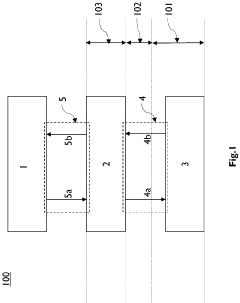
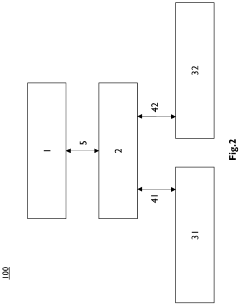
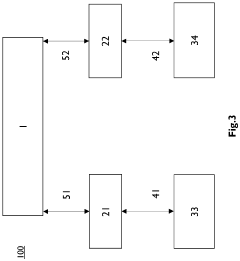
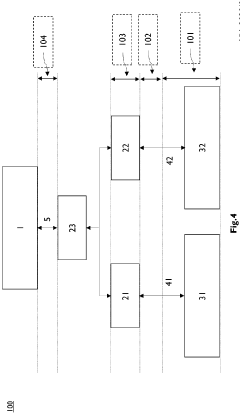
- A dual-layer communication path system with a data transceiver unit implanted in the cranium and a sensing/stimulation unit under the dura mater, utilizing separate channels for downlink and uplink communication, including ultrasound and inductive/emergency IR-UWB methods, to ensure efficient power and data transmission with reduced tissue damage and heat dissipation.


A brain-computer interface system
PatentPendingEP4193909A1
Innovation
- A dual-layer communication path system with a data transceiver unit implanted in the cranium and a sensing/stimulation unit under the dura mater, utilizing separate channels for downlink and uplink communication, including ultrasound and inductive/emergency IR-UWB methods, to enable efficient power and data transmission with reduced tissue damage and heat dissipation.
Safety Standards for Neural Interface Devices
The development of comprehensive safety standards for neural interface devices represents a critical regulatory framework essential for the widespread adoption of brain-computer interface technologies. Current safety protocols primarily draw from existing medical device regulations, including FDA Class III device requirements and ISO 14155 standards for clinical investigation of medical devices. However, these traditional frameworks inadequately address the unique risks associated with direct neural interfacing and the specific latency-related safety concerns inherent in real-time brain-computer communication systems.
Regulatory bodies worldwide are establishing specialized guidelines for neural interface devices, with the FDA leading through its breakthrough device designation program and the European Medicines Agency developing parallel frameworks under the Medical Device Regulation. These standards emphasize biocompatibility requirements, including ISO 10993 series compliance for biological evaluation of medical devices, while incorporating novel assessment criteria for neural tissue interaction and long-term implant stability.
Safety considerations for communication channel selection in brain-computer interfaces encompass multiple domains, including electromagnetic compatibility standards such as IEC 60601-1-2 for medical electrical equipment. Wireless communication protocols must comply with specific absorption rate limitations and interference mitigation requirements, while wired interfaces require adherence to electrical safety standards including leakage current specifications and insulation integrity protocols.
Latency-related safety standards establish maximum acceptable delay thresholds for different application categories, recognizing that communication channel selection directly impacts patient safety outcomes. Critical applications such as motor control prosthetics mandate sub-100 millisecond response times, while cognitive interfaces may accommodate higher latencies within defined safety margins. These temporal requirements necessitate rigorous testing protocols for communication channel performance validation.
Emerging safety frameworks address cybersecurity concerns specific to neural interfaces, incorporating encryption standards and secure communication protocols across all channel types. The integration of real-time monitoring systems for device performance and patient safety represents a fundamental requirement, with standardized reporting mechanisms for adverse events and communication failures becoming mandatory components of regulatory compliance.
Regulatory bodies worldwide are establishing specialized guidelines for neural interface devices, with the FDA leading through its breakthrough device designation program and the European Medicines Agency developing parallel frameworks under the Medical Device Regulation. These standards emphasize biocompatibility requirements, including ISO 10993 series compliance for biological evaluation of medical devices, while incorporating novel assessment criteria for neural tissue interaction and long-term implant stability.
Safety considerations for communication channel selection in brain-computer interfaces encompass multiple domains, including electromagnetic compatibility standards such as IEC 60601-1-2 for medical electrical equipment. Wireless communication protocols must comply with specific absorption rate limitations and interference mitigation requirements, while wired interfaces require adherence to electrical safety standards including leakage current specifications and insulation integrity protocols.
Latency-related safety standards establish maximum acceptable delay thresholds for different application categories, recognizing that communication channel selection directly impacts patient safety outcomes. Critical applications such as motor control prosthetics mandate sub-100 millisecond response times, while cognitive interfaces may accommodate higher latencies within defined safety margins. These temporal requirements necessitate rigorous testing protocols for communication channel performance validation.
Emerging safety frameworks address cybersecurity concerns specific to neural interfaces, incorporating encryption standards and secure communication protocols across all channel types. The integration of real-time monitoring systems for device performance and patient safety represents a fundamental requirement, with standardized reporting mechanisms for adverse events and communication failures becoming mandatory components of regulatory compliance.
Real-time Processing Requirements for BCI
Real-time processing in brain-computer interfaces represents one of the most critical performance parameters that directly impacts user experience and system effectiveness. The temporal constraints for BCI systems vary significantly depending on the intended application, with motor control interfaces requiring sub-100 millisecond response times, while cognitive monitoring applications may tolerate latencies up to several hundred milliseconds.
The processing pipeline in modern BCI systems encompasses multiple stages, each contributing to overall latency. Signal acquisition from neural sensors typically introduces 1-5 milliseconds of delay, depending on the sampling rate and buffer size. Digital signal processing, including filtering, artifact removal, and feature extraction, adds another 10-50 milliseconds based on algorithm complexity and computational resources.
Machine learning inference represents a substantial bottleneck in real-time BCI processing. Traditional classification algorithms like support vector machines or linear discriminant analysis can execute within 1-10 milliseconds, while deep learning models may require 20-100 milliseconds depending on network architecture and hardware acceleration capabilities. The trade-off between model accuracy and inference speed remains a fundamental challenge in BCI system design.
Hardware architecture significantly influences real-time processing capabilities. Dedicated signal processing units, field-programmable gate arrays, and graphics processing units offer different advantages for parallel computation of neural signals. Edge computing implementations can reduce communication overhead by processing signals locally, while cloud-based solutions provide superior computational power at the cost of increased network latency.
Buffer management and data streaming protocols critically affect system responsiveness. Circular buffering strategies minimize memory allocation overhead, while adaptive windowing techniques balance temporal resolution with computational efficiency. The selection of appropriate window sizes and overlap ratios directly impacts both processing latency and signal quality.
Optimization strategies for real-time BCI processing include algorithm parallelization, hardware-specific code optimization, and predictive processing techniques. Asynchronous processing architectures enable concurrent execution of multiple pipeline stages, reducing overall system latency while maintaining signal integrity and classification accuracy across various communication channels.
The processing pipeline in modern BCI systems encompasses multiple stages, each contributing to overall latency. Signal acquisition from neural sensors typically introduces 1-5 milliseconds of delay, depending on the sampling rate and buffer size. Digital signal processing, including filtering, artifact removal, and feature extraction, adds another 10-50 milliseconds based on algorithm complexity and computational resources.
Machine learning inference represents a substantial bottleneck in real-time BCI processing. Traditional classification algorithms like support vector machines or linear discriminant analysis can execute within 1-10 milliseconds, while deep learning models may require 20-100 milliseconds depending on network architecture and hardware acceleration capabilities. The trade-off between model accuracy and inference speed remains a fundamental challenge in BCI system design.
Hardware architecture significantly influences real-time processing capabilities. Dedicated signal processing units, field-programmable gate arrays, and graphics processing units offer different advantages for parallel computation of neural signals. Edge computing implementations can reduce communication overhead by processing signals locally, while cloud-based solutions provide superior computational power at the cost of increased network latency.
Buffer management and data streaming protocols critically affect system responsiveness. Circular buffering strategies minimize memory allocation overhead, while adaptive windowing techniques balance temporal resolution with computational efficiency. The selection of appropriate window sizes and overlap ratios directly impacts both processing latency and signal quality.
Optimization strategies for real-time BCI processing include algorithm parallelization, hardware-specific code optimization, and predictive processing techniques. Asynchronous processing architectures enable concurrent execution of multiple pipeline stages, reducing overall system latency while maintaining signal integrity and classification accuracy across various communication channels.
Unlock deeper insights with PatSnap Eureka Quick Research — get a full tech report to explore trends and direct your research. Try now!
Generate Your Research Report Instantly with AI Agent
Supercharge your innovation with PatSnap Eureka AI Agent Platform!