Conductive Polymer Composites: Critical Technical Parameters
OCT 23, 20259 MIN READ
Generate Your Research Report Instantly with AI Agent
Patsnap Eureka helps you evaluate technical feasibility & market potential.
Conductive Polymer Evolution and Research Objectives
Conductive polymer composites (CPCs) have evolved significantly since the discovery of conductive polymers in the 1970s, beginning with Alan Heeger, Alan MacDiarmid, and Hideki Shirakawa's groundbreaking work on polyacetylene. This discovery, which earned them the Nobel Prize in Chemistry in 2000, opened a new frontier in materials science by demonstrating that polymers could conduct electricity through appropriate doping processes.
The evolution of conductive polymers progressed through several distinct phases. The 1980s saw the development of polypyrrole, polyaniline, and polythiophene, which offered improved stability and processability compared to polyacetylene. During the 1990s, research shifted toward creating polymer blends and composites by incorporating conductive fillers into polymer matrices, significantly enhancing electrical conductivity while maintaining the mechanical properties of polymers.
The early 2000s marked a turning point with the emergence of nanocomposites, where nanoscale conductive fillers such as carbon nanotubes, graphene, and metal nanoparticles were integrated into polymer matrices. This approach dramatically improved the conductivity-to-filler ratio and enabled the development of materials with multifunctional properties.
Current research in conductive polymer composites focuses on addressing several critical challenges. These include achieving high conductivity at low filler content to maintain processability, ensuring uniform dispersion of conductive fillers throughout the polymer matrix, and developing composites with tunable conductivity for specific applications. Additionally, researchers are working to enhance the long-term stability of these materials under various environmental conditions.
The primary objectives of ongoing research in this field include developing CPCs with precisely controlled electrical properties, improving manufacturing scalability for industrial applications, and enhancing the sustainability profile of these materials. Researchers aim to create composites that can achieve conductivity values approaching those of metals (>10^4 S/cm) while maintaining the flexibility, lightweight nature, and processability of polymers.
Another significant research goal involves developing CPCs with self-healing capabilities and stimuli-responsive conductivity, which would enable smart materials that can adapt to changing environmental conditions or external stimuli. The integration of CPCs with other functional materials to create multifunctional composites represents another frontier, potentially enabling applications in energy storage, sensing, and biomedical devices.
The ultimate technical objective remains the development of a comprehensive understanding of structure-property relationships in CPCs, which would enable the rational design of materials with predictable electrical, mechanical, and thermal properties for targeted applications across industries ranging from electronics to healthcare.
The evolution of conductive polymers progressed through several distinct phases. The 1980s saw the development of polypyrrole, polyaniline, and polythiophene, which offered improved stability and processability compared to polyacetylene. During the 1990s, research shifted toward creating polymer blends and composites by incorporating conductive fillers into polymer matrices, significantly enhancing electrical conductivity while maintaining the mechanical properties of polymers.
The early 2000s marked a turning point with the emergence of nanocomposites, where nanoscale conductive fillers such as carbon nanotubes, graphene, and metal nanoparticles were integrated into polymer matrices. This approach dramatically improved the conductivity-to-filler ratio and enabled the development of materials with multifunctional properties.
Current research in conductive polymer composites focuses on addressing several critical challenges. These include achieving high conductivity at low filler content to maintain processability, ensuring uniform dispersion of conductive fillers throughout the polymer matrix, and developing composites with tunable conductivity for specific applications. Additionally, researchers are working to enhance the long-term stability of these materials under various environmental conditions.
The primary objectives of ongoing research in this field include developing CPCs with precisely controlled electrical properties, improving manufacturing scalability for industrial applications, and enhancing the sustainability profile of these materials. Researchers aim to create composites that can achieve conductivity values approaching those of metals (>10^4 S/cm) while maintaining the flexibility, lightweight nature, and processability of polymers.
Another significant research goal involves developing CPCs with self-healing capabilities and stimuli-responsive conductivity, which would enable smart materials that can adapt to changing environmental conditions or external stimuli. The integration of CPCs with other functional materials to create multifunctional composites represents another frontier, potentially enabling applications in energy storage, sensing, and biomedical devices.
The ultimate technical objective remains the development of a comprehensive understanding of structure-property relationships in CPCs, which would enable the rational design of materials with predictable electrical, mechanical, and thermal properties for targeted applications across industries ranging from electronics to healthcare.
Market Applications and Demand Analysis for Conductive Polymers
The conductive polymer composites market has witnessed substantial growth over the past decade, driven primarily by increasing demand for lightweight, flexible, and cost-effective alternatives to traditional metal conductors. The global market for conductive polymer composites was valued at approximately 3.9 billion USD in 2022 and is projected to reach 8.7 billion USD by 2028, representing a compound annual growth rate of 14.3% during the forecast period.
Electronics and semiconductor industries constitute the largest application segment, accounting for nearly 42% of the total market share. The miniaturization trend in electronic devices has created significant demand for conductive polymers that can provide reliable electrical performance while maintaining mechanical flexibility. Particularly, the consumer electronics sector has embraced these materials for touchscreens, flexible displays, and wearable technology applications.
Automotive sector represents another rapidly growing market for conductive polymer composites, driven by the transition toward electric vehicles and advanced driver-assistance systems. These materials are increasingly used in electromagnetic interference (EMI) shielding, sensors, and lightweight components that contribute to improved fuel efficiency. The automotive segment is expected to grow at a CAGR of 16.8% through 2028, outpacing most other application areas.
Healthcare applications have emerged as a promising frontier for conductive polymers, particularly in biosensors, drug delivery systems, and tissue engineering. The biocompatibility of certain conductive polymers, combined with their electrical properties, makes them ideal candidates for implantable medical devices and point-of-care diagnostic tools. This segment is projected to witness the highest growth rate of 18.2% over the next five years.
Regional analysis reveals that Asia-Pacific dominates the market with a 45% share, followed by North America (28%) and Europe (21%). China and South Korea lead manufacturing capacity, while significant R&D investments come from the United States, Germany, and Japan. The concentration of electronics manufacturing in Asia-Pacific continues to drive regional demand for conductive polymer composites.
Industry surveys indicate that end-users prioritize electrical conductivity, mechanical flexibility, and thermal stability as the most critical parameters when selecting conductive polymer composites. However, processing challenges and long-term reliability concerns remain barriers to wider adoption in certain high-reliability applications. Market research suggests that improvements in these areas could unlock an additional 2.1 billion USD in market potential by 2030.
Electronics and semiconductor industries constitute the largest application segment, accounting for nearly 42% of the total market share. The miniaturization trend in electronic devices has created significant demand for conductive polymers that can provide reliable electrical performance while maintaining mechanical flexibility. Particularly, the consumer electronics sector has embraced these materials for touchscreens, flexible displays, and wearable technology applications.
Automotive sector represents another rapidly growing market for conductive polymer composites, driven by the transition toward electric vehicles and advanced driver-assistance systems. These materials are increasingly used in electromagnetic interference (EMI) shielding, sensors, and lightweight components that contribute to improved fuel efficiency. The automotive segment is expected to grow at a CAGR of 16.8% through 2028, outpacing most other application areas.
Healthcare applications have emerged as a promising frontier for conductive polymers, particularly in biosensors, drug delivery systems, and tissue engineering. The biocompatibility of certain conductive polymers, combined with their electrical properties, makes them ideal candidates for implantable medical devices and point-of-care diagnostic tools. This segment is projected to witness the highest growth rate of 18.2% over the next five years.
Regional analysis reveals that Asia-Pacific dominates the market with a 45% share, followed by North America (28%) and Europe (21%). China and South Korea lead manufacturing capacity, while significant R&D investments come from the United States, Germany, and Japan. The concentration of electronics manufacturing in Asia-Pacific continues to drive regional demand for conductive polymer composites.
Industry surveys indicate that end-users prioritize electrical conductivity, mechanical flexibility, and thermal stability as the most critical parameters when selecting conductive polymer composites. However, processing challenges and long-term reliability concerns remain barriers to wider adoption in certain high-reliability applications. Market research suggests that improvements in these areas could unlock an additional 2.1 billion USD in market potential by 2030.
Technical Challenges and Global Development Status
Conductive polymer composites (CPCs) face several significant technical challenges that have hindered their widespread commercial adoption. The primary challenge lies in achieving consistent electrical conductivity while maintaining desirable mechanical properties. Traditional methods often result in a trade-off between conductivity and mechanical strength, as higher filler loadings that increase conductivity typically reduce flexibility and processability.
Percolation threshold optimization remains a critical challenge, with researchers struggling to achieve low thresholds that enable high conductivity at minimal filler concentrations. This is particularly difficult when using nanoscale fillers, where agglomeration issues frequently occur during processing, creating inconsistent conductive networks and property variations across the material.
Long-term stability presents another major hurdle, as many CPCs exhibit conductivity degradation over time due to environmental factors such as humidity, temperature fluctuations, and UV exposure. This instability limits their application in demanding environments where consistent performance is essential.
Manufacturing scalability continues to challenge the industry, with laboratory-scale successes often failing to translate to mass production. Processes that work well for small samples frequently encounter dispersion problems, increased defect rates, and property inconsistencies when scaled up to industrial volumes.
Globally, CPC development shows distinct regional patterns. North America leads in fundamental research and patent generation, with significant contributions from institutions like MIT and Stanford University focusing on novel filler materials and processing techniques. The United States maintains a strong position in aerospace and defense applications of CPCs.
Europe demonstrates strength in automotive and sustainable applications, with German and French research centers pioneering environmentally friendly conductive composites. The European Union's emphasis on circular economy principles has driven innovation in recyclable and biodegradable CPCs.
Asia, particularly China, Japan, and South Korea, dominates in electronics applications and mass production capabilities. China has rapidly expanded its research output in the past decade, becoming the largest producer of publications on CPCs, while Japan maintains leadership in high-precision electronic applications requiring exceptional reliability.
Recent global collaboration trends show increasing international research partnerships, particularly in addressing complex challenges like nanofiller dispersion and interface engineering. These collaborative efforts have accelerated progress in developing next-generation CPCs with enhanced property combinations and processing characteristics.
Percolation threshold optimization remains a critical challenge, with researchers struggling to achieve low thresholds that enable high conductivity at minimal filler concentrations. This is particularly difficult when using nanoscale fillers, where agglomeration issues frequently occur during processing, creating inconsistent conductive networks and property variations across the material.
Long-term stability presents another major hurdle, as many CPCs exhibit conductivity degradation over time due to environmental factors such as humidity, temperature fluctuations, and UV exposure. This instability limits their application in demanding environments where consistent performance is essential.
Manufacturing scalability continues to challenge the industry, with laboratory-scale successes often failing to translate to mass production. Processes that work well for small samples frequently encounter dispersion problems, increased defect rates, and property inconsistencies when scaled up to industrial volumes.
Globally, CPC development shows distinct regional patterns. North America leads in fundamental research and patent generation, with significant contributions from institutions like MIT and Stanford University focusing on novel filler materials and processing techniques. The United States maintains a strong position in aerospace and defense applications of CPCs.
Europe demonstrates strength in automotive and sustainable applications, with German and French research centers pioneering environmentally friendly conductive composites. The European Union's emphasis on circular economy principles has driven innovation in recyclable and biodegradable CPCs.
Asia, particularly China, Japan, and South Korea, dominates in electronics applications and mass production capabilities. China has rapidly expanded its research output in the past decade, becoming the largest producer of publications on CPCs, while Japan maintains leadership in high-precision electronic applications requiring exceptional reliability.
Recent global collaboration trends show increasing international research partnerships, particularly in addressing complex challenges like nanofiller dispersion and interface engineering. These collaborative efforts have accelerated progress in developing next-generation CPCs with enhanced property combinations and processing characteristics.
Current Formulation and Processing Methodologies
01 Carbon-based fillers for enhancing polymer conductivity
Carbon-based materials such as carbon nanotubes, graphene, and carbon black can be incorporated into polymer matrices to enhance electrical conductivity. These fillers create conductive pathways within the polymer structure, allowing for electron transfer. The concentration and dispersion of these carbon-based fillers significantly impact the overall conductivity of the composite material. These composites offer advantages such as lightweight properties and tunable conductivity based on filler loading.- Carbon-based fillers for enhancing polymer conductivity: Carbon-based materials such as carbon nanotubes, graphene, and carbon black can be incorporated into polymer matrices to enhance electrical conductivity. These fillers create conductive pathways within the polymer structure, allowing for electron transport. The concentration and dispersion of these carbon-based fillers significantly impact the overall conductivity of the composite. Proper dispersion techniques and surface functionalization of the fillers can improve their integration with the polymer matrix and enhance conductivity.
- Metal particle incorporation in conductive polymer composites: Metal particles, including nanoparticles of silver, copper, and gold, can be dispersed within polymer matrices to create conductive composites. These metal fillers provide excellent electrical conductivity at relatively low loading levels compared to other conductive fillers. The size, shape, and distribution of metal particles significantly affect the conductivity of the resulting composite. Surface treatment of metal particles can improve their compatibility with the polymer matrix and prevent aggregation, leading to more uniform conductivity throughout the composite.
- Processing techniques for improved conductivity: Various processing techniques can be employed to enhance the conductivity of polymer composites. These include melt blending, solution mixing, in-situ polymerization, and compression molding. The processing conditions, such as temperature, pressure, and mixing speed, significantly influence the dispersion of conductive fillers and the resulting electrical properties. Post-processing treatments like annealing can also improve the alignment of conductive fillers and enhance the overall conductivity of the composite. Specialized techniques such as layer-by-layer assembly can create highly ordered structures with improved conductive pathways.
- Intrinsically conductive polymers and their blends: Intrinsically conductive polymers such as polyaniline, polypyrrole, and polythiophene can be used either alone or in blends with conventional polymers to create conductive composites. These polymers contain conjugated double bonds that allow for electron movement along the polymer chain. Doping these polymers with appropriate agents can significantly enhance their conductivity. Blending intrinsically conductive polymers with conventional polymers can improve processability while maintaining adequate conductivity levels. The morphology of these blends plays a crucial role in determining the final electrical properties.
- Novel hybrid composites for tunable conductivity: Hybrid composites combining multiple types of conductive fillers (such as carbon nanotubes with metal particles) can achieve synergistic effects, resulting in enhanced conductivity at lower filler loadings. These hybrid systems often exhibit lower percolation thresholds and improved mechanical properties compared to single-filler systems. Additionally, stimuli-responsive conductive composites can be developed that change their conductivity in response to external factors such as temperature, pH, or mechanical stress. These advanced composites offer tunable electrical properties for specialized applications in sensors, actuators, and smart materials.
02 Metal particle incorporation in polymer composites
Metal particles, including silver, copper, and nickel, can be dispersed within polymer matrices to create conductive composites. These metal-filled polymer composites exhibit enhanced electrical conductivity due to the formation of conductive networks. The size, shape, and concentration of metal particles influence the electrical properties of the resulting composite. Processing techniques such as melt mixing and solution blending are commonly used to achieve uniform dispersion of metal particles within the polymer matrix.Expand Specific Solutions03 Intrinsically conductive polymers and their applications
Intrinsically conductive polymers such as polyaniline, polypyrrole, and polythiophene can be used alone or in blends to create conductive materials. These polymers contain conjugated double bonds that allow for electron movement along the polymer backbone. Doping these polymers with appropriate agents can significantly enhance their conductivity. Applications include sensors, electromagnetic shielding, antistatic coatings, and flexible electronics. The processing conditions and doping levels can be adjusted to achieve desired conductivity levels.Expand Specific Solutions04 Processing techniques for optimizing conductivity
Various processing techniques can be employed to optimize the conductivity of polymer composites. These include solution blending, melt mixing, in-situ polymerization, and layer-by-layer assembly. The processing method affects the dispersion of conductive fillers and the formation of conductive networks within the polymer matrix. Parameters such as mixing time, temperature, and shear rate significantly impact the final conductivity of the composite. Post-processing treatments like annealing can also enhance the electrical properties by promoting better contact between conductive particles.Expand Specific Solutions05 Novel hybrid composites for enhanced conductivity
Hybrid composites combining multiple types of conductive fillers (such as carbon nanotubes with metal particles) can achieve synergistic effects in electrical conductivity. These hybrid systems often require lower filler loadings to achieve the same conductivity as single-filler systems, which helps maintain the mechanical properties of the polymer matrix. Additionally, incorporating functionalized fillers with surface modifications can improve dispersion and interfacial interaction with the polymer matrix, leading to enhanced conductivity at lower filler concentrations. These hybrid approaches enable the development of multifunctional materials with tailored electrical, thermal, and mechanical properties.Expand Specific Solutions
Leading Manufacturers and Research Institutions Analysis
Conductive Polymer Composites (CPCs) are currently in a growth phase, with the market expected to reach significant expansion due to increasing applications in electronics, automotive, and energy sectors. The global CPC market demonstrates moderate technological maturity, with established players like DuPont, Dow, and SABIC leading commercial development while research institutions such as Sichuan University and Industrial Technology Research Institute drive innovation. Companies including TE Connectivity, Texas Instruments, and Johnson Matthey are advancing application-specific solutions, particularly in electronic components and sensing technologies. The competitive landscape features a mix of chemical conglomerates (Arkema, Shin-Etsu), electronics manufacturers (Xerox, Littelfuse), and specialized materials developers (Laird Technologies, Eamex Corp), indicating a diversifying market with opportunities for both established players and niche specialists.
SABIC Global Technologies BV
Technical Solution: SABIC has developed STAT-KON™ and STAT-LOY™ conductive polymer composite systems that incorporate carbon black, carbon nanotubes, and metallic fillers in various polymer matrices including polyethylene, polypropylene, and engineering thermoplastics. Their technology focuses on optimizing the percolation threshold through controlled filler morphology and distribution. SABIC's proprietary compounding process achieves volume resistivity ranges from 10^2 to 10^9 ohm-cm while maintaining mechanical properties within 80-90% of the unfilled polymer. Their multi-phase polymer blends create segregated network structures where conductive fillers preferentially locate at phase interfaces, reducing the overall filler loading required for conductivity. This approach has enabled SABIC to develop materials with surface resistivity as low as 10^3 ohm/sq while maintaining processability in conventional injection molding and extrusion equipment.
Strengths: Excellent balance between conductivity and mechanical properties; broad portfolio of base polymers allowing application-specific customization; global manufacturing capabilities ensuring consistent quality and supply. Weaknesses: Higher processing temperatures sometimes required compared to conventional polymers; potential for increased wear on processing equipment due to abrasive fillers; color limitations due to carbon-based fillers.
Laird Technologies, Inc.
Technical Solution: Laird Technologies has developed ECCOCOMP® conductive polymer composites specifically engineered for electromagnetic interference (EMI) shielding and thermal management applications. Their technology utilizes a multi-scale approach combining microscale metal flakes (typically silver, nickel or aluminum) with nanoscale carbon structures (carbon nanotubes and graphene) dispersed in thermoplastic and thermoset matrices. This hierarchical structure enables shielding effectiveness of 60-80 dB across frequencies from 1-10 GHz while maintaining thermal conductivity values of 1-5 W/m·K. Laird's proprietary surface treatment of conductive fillers improves polymer-filler interfacial adhesion, enhancing both electrical conductivity and mechanical durability. Their TCONTACT™ series achieves volume resistivity as low as 10^-3 ohm·cm while maintaining processability in injection molding. Laird has also pioneered anisotropic conductive composites where electrical and thermal conductivity can be directionally controlled through magnetic field alignment of fillers during processing.
Strengths: Exceptional EMI shielding performance; ability to simultaneously address electrical and thermal conductivity requirements; extensive application engineering support for customer-specific solutions. Weaknesses: Premium pricing compared to standard materials; some formulations require specialized processing equipment; potential for galvanic corrosion in certain environmental conditions when using metallic fillers.
Key Patents and Scientific Breakthroughs in Conductivity Enhancement
Highly conductive carbon/inherently conductive polymer composites
PatentInactiveUS20040232390A1
Innovation
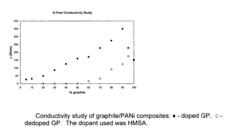
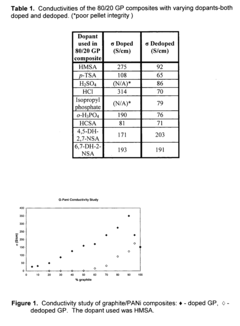
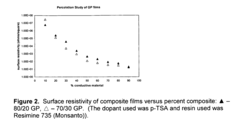
- The development of composites comprising graphite and doped polyaniline, polypyrrole, polythiophene, or polyethylenedioxythiophene with graphite, synthesized by oxidative polymerization in the presence of an acid dopant, resulting in higher conductivity and improved dispersibility in various solvents and resins.
Electrically conductive polymer composites
PatentInactiveUS8597547B2
Innovation
- A solution compounding process that mixes non-predispersed carbon with a polymer emulsion in a liquid solvent, followed by solvent removal, achieving a carbon-to-polymer weight ratio greater than 0.11, allowing for uniform carbon dispersion without pre-dispersion and surfactant use, resulting in improved electrical conductivity and EMI shielding.
Environmental Impact and Sustainability Considerations
The environmental footprint of conductive polymer composites (CPCs) represents a critical consideration in their development and application. Traditional conductive materials often involve energy-intensive extraction processes and toxic components, whereas CPCs offer potential advantages through reduced energy requirements during manufacturing and the possibility of incorporating renewable feedstocks. The carbon footprint of CPC production varies significantly depending on the specific polymer matrix and conductive fillers used, with carbon-based fillers generally demonstrating lower environmental impact compared to metallic alternatives.
Lifecycle assessment studies indicate that CPCs can reduce overall environmental impact by 30-45% compared to conventional metal-based conductors when considering the entire product lifecycle. However, challenges remain regarding end-of-life management, as the heterogeneous nature of these composites often complicates recycling processes. The intimate mixing of polymers with conductive fillers creates separation difficulties that current recycling technologies struggle to address efficiently.
Biodegradability presents another important dimension, particularly for applications in consumer electronics and temporary installations. Recent innovations have focused on developing partially biodegradable CPCs using bio-based polymers such as polylactic acid (PLA) and cellulose derivatives as matrices. These materials show promising degradation profiles while maintaining acceptable conductivity levels, though typically with shorter functional lifespans than their non-biodegradable counterparts.
Water consumption and chemical usage during CPC manufacturing also warrant attention. Solution-based processing methods can require significant solvent volumes, many of which pose environmental hazards. Emerging green chemistry approaches have demonstrated success in reducing harmful solvent usage by 60-70% through aqueous processing techniques and solvent recovery systems, though these methods often result in compromised electrical performance that must be addressed through formulation optimization.
Regulatory frameworks increasingly influence CPC development, with restrictions on hazardous substances driving innovation toward more environmentally benign alternatives. The European Union's RoHS and REACH regulations have accelerated the transition away from heavy metal-containing conductive fillers toward carbon-based options. This regulatory landscape continues to evolve, creating both challenges and opportunities for CPC manufacturers focused on sustainable innovation.
Energy efficiency during the operational phase represents another sustainability advantage of CPCs, particularly in applications such as heating elements and electromagnetic shielding, where their tailorable conductivity can optimize performance while minimizing energy consumption. This operational efficiency can offset initial environmental impacts, highlighting the importance of considering full lifecycle performance when evaluating sustainability credentials.
Lifecycle assessment studies indicate that CPCs can reduce overall environmental impact by 30-45% compared to conventional metal-based conductors when considering the entire product lifecycle. However, challenges remain regarding end-of-life management, as the heterogeneous nature of these composites often complicates recycling processes. The intimate mixing of polymers with conductive fillers creates separation difficulties that current recycling technologies struggle to address efficiently.
Biodegradability presents another important dimension, particularly for applications in consumer electronics and temporary installations. Recent innovations have focused on developing partially biodegradable CPCs using bio-based polymers such as polylactic acid (PLA) and cellulose derivatives as matrices. These materials show promising degradation profiles while maintaining acceptable conductivity levels, though typically with shorter functional lifespans than their non-biodegradable counterparts.
Water consumption and chemical usage during CPC manufacturing also warrant attention. Solution-based processing methods can require significant solvent volumes, many of which pose environmental hazards. Emerging green chemistry approaches have demonstrated success in reducing harmful solvent usage by 60-70% through aqueous processing techniques and solvent recovery systems, though these methods often result in compromised electrical performance that must be addressed through formulation optimization.
Regulatory frameworks increasingly influence CPC development, with restrictions on hazardous substances driving innovation toward more environmentally benign alternatives. The European Union's RoHS and REACH regulations have accelerated the transition away from heavy metal-containing conductive fillers toward carbon-based options. This regulatory landscape continues to evolve, creating both challenges and opportunities for CPC manufacturers focused on sustainable innovation.
Energy efficiency during the operational phase represents another sustainability advantage of CPCs, particularly in applications such as heating elements and electromagnetic shielding, where their tailorable conductivity can optimize performance while minimizing energy consumption. This operational efficiency can offset initial environmental impacts, highlighting the importance of considering full lifecycle performance when evaluating sustainability credentials.
Standardization and Quality Control Parameters
The standardization and quality control of Conductive Polymer Composites (CPCs) represents a critical aspect of their industrial application and commercial viability. Establishing robust standardization frameworks ensures consistency in performance across different manufacturing batches and suppliers, which is essential for widespread adoption in electronics, automotive, and aerospace industries.
Key quality control parameters for CPCs begin with electrical conductivity measurement protocols. These must account for the anisotropic nature of many composites, requiring multi-directional testing methodologies. Standard testing conditions including temperature, humidity, and pressure must be precisely defined, as these environmental factors significantly influence the electrical properties of polymer composites.
Mechanical property standardization presents another crucial dimension, encompassing tensile strength, elongation at break, and impact resistance. The challenge lies in developing testing protocols that simultaneously evaluate both electrical and mechanical properties, as these are often interdependent in CPCs. For instance, stretching or compressing a composite can dramatically alter its conductive network structure.
Thermal stability testing standards must address the unique behavior of conductive fillers within polymer matrices. Differential Scanning Calorimetry (DSC) and Thermogravimetric Analysis (TGA) protocols need modification to account for the presence of conductive particles that may catalyze degradation processes or alter phase transition temperatures.
Aging and weathering resistance standards represent perhaps the most underdeveloped area in CPC quality control. Accelerated aging tests must be calibrated to predict long-term performance under various environmental conditions, including UV exposure, temperature cycling, and chemical exposure relevant to specific applications.
Dispersion quality assessment methods constitute another critical parameter requiring standardization. Techniques such as optical microscopy, SEM, and TEM need standardized sample preparation and quantitative analysis protocols to objectively evaluate filler distribution. Statistical methods for characterizing dispersion uniformity are essential for meaningful quality control.
Manufacturing process validation parameters must be established to ensure batch-to-batch consistency. This includes standardized procedures for mixing time, temperature profiles during processing, cooling rates, and post-processing treatments. In-line monitoring techniques using spectroscopic or electrical measurements can provide real-time quality control during production.
Certification standards specifically tailored to CPCs remain largely fragmented across different industries and regions. Developing harmonized international standards would significantly accelerate market adoption by providing manufacturers and end-users with clear benchmarks for performance and reliability expectations.
Key quality control parameters for CPCs begin with electrical conductivity measurement protocols. These must account for the anisotropic nature of many composites, requiring multi-directional testing methodologies. Standard testing conditions including temperature, humidity, and pressure must be precisely defined, as these environmental factors significantly influence the electrical properties of polymer composites.
Mechanical property standardization presents another crucial dimension, encompassing tensile strength, elongation at break, and impact resistance. The challenge lies in developing testing protocols that simultaneously evaluate both electrical and mechanical properties, as these are often interdependent in CPCs. For instance, stretching or compressing a composite can dramatically alter its conductive network structure.
Thermal stability testing standards must address the unique behavior of conductive fillers within polymer matrices. Differential Scanning Calorimetry (DSC) and Thermogravimetric Analysis (TGA) protocols need modification to account for the presence of conductive particles that may catalyze degradation processes or alter phase transition temperatures.
Aging and weathering resistance standards represent perhaps the most underdeveloped area in CPC quality control. Accelerated aging tests must be calibrated to predict long-term performance under various environmental conditions, including UV exposure, temperature cycling, and chemical exposure relevant to specific applications.
Dispersion quality assessment methods constitute another critical parameter requiring standardization. Techniques such as optical microscopy, SEM, and TEM need standardized sample preparation and quantitative analysis protocols to objectively evaluate filler distribution. Statistical methods for characterizing dispersion uniformity are essential for meaningful quality control.
Manufacturing process validation parameters must be established to ensure batch-to-batch consistency. This includes standardized procedures for mixing time, temperature profiles during processing, cooling rates, and post-processing treatments. In-line monitoring techniques using spectroscopic or electrical measurements can provide real-time quality control during production.
Certification standards specifically tailored to CPCs remain largely fragmented across different industries and regions. Developing harmonized international standards would significantly accelerate market adoption by providing manufacturers and end-users with clear benchmarks for performance and reliability expectations.
Unlock deeper insights with Patsnap Eureka Quick Research — get a full tech report to explore trends and direct your research. Try now!
Generate Your Research Report Instantly with AI Agent
Supercharge your innovation with Patsnap Eureka AI Agent Platform!