Driving Forward: Technology Insights from HEV Deployments
AUG 14, 20259 MIN READ
Generate Your Research Report Instantly with AI Agent
Patsnap Eureka helps you evaluate technical feasibility & market potential.
HEV Technology Evolution and Objectives
Hybrid Electric Vehicle (HEV) technology has undergone significant evolution since its inception in the late 20th century. The primary objective of HEV development has been to reduce fuel consumption and emissions while maintaining or improving vehicle performance. This technological journey has been marked by continuous improvements in battery technology, power electronics, and energy management systems.
The early stages of HEV development focused on parallel hybrid systems, where both the internal combustion engine (ICE) and electric motor could directly power the wheels. Toyota's introduction of the Prius in 1997 marked a significant milestone, showcasing the potential of hybrid technology for mass-market vehicles. This was followed by the development of series hybrid systems, where the ICE acts primarily as a generator to charge the battery, which in turn powers the electric motor.
As HEV technology progressed, the industry saw the emergence of plug-in hybrid electric vehicles (PHEVs), which allowed for extended electric-only driving ranges and further reduced reliance on fossil fuels. This advancement was made possible by improvements in battery energy density and charging infrastructure.
The evolution of HEV technology has been driven by several key objectives. Firstly, increasing the overall system efficiency to maximize fuel economy and reduce emissions. This has led to the development of more sophisticated energy management algorithms and the integration of regenerative braking systems. Secondly, improving the power density and efficiency of electric motors and power electronics to enhance vehicle performance and reduce component size and weight.
Another critical objective has been to extend the electric-only driving range, particularly in PHEVs. This has spurred research into advanced battery chemistries and thermal management systems to increase energy storage capacity and longevity. Additionally, efforts have been made to reduce the cost of HEV components to make the technology more accessible to a broader range of consumers.
The ongoing evolution of HEV technology is now focusing on the integration of advanced driver assistance systems (ADAS) and connectivity features. These developments aim to further optimize energy management by leveraging real-time traffic data and predictive algorithms. Furthermore, there is a growing emphasis on the use of sustainable materials in HEV production to reduce the overall environmental impact of vehicle manufacturing.
Looking ahead, the objectives for HEV technology include achieving higher levels of electrification, potentially leading to the development of range-extended electric vehicles (REEVs) as a bridge to full electric vehicles. There is also a push towards standardization of HEV components and architectures to reduce costs and improve interoperability across different vehicle models and manufacturers.
The early stages of HEV development focused on parallel hybrid systems, where both the internal combustion engine (ICE) and electric motor could directly power the wheels. Toyota's introduction of the Prius in 1997 marked a significant milestone, showcasing the potential of hybrid technology for mass-market vehicles. This was followed by the development of series hybrid systems, where the ICE acts primarily as a generator to charge the battery, which in turn powers the electric motor.
As HEV technology progressed, the industry saw the emergence of plug-in hybrid electric vehicles (PHEVs), which allowed for extended electric-only driving ranges and further reduced reliance on fossil fuels. This advancement was made possible by improvements in battery energy density and charging infrastructure.
The evolution of HEV technology has been driven by several key objectives. Firstly, increasing the overall system efficiency to maximize fuel economy and reduce emissions. This has led to the development of more sophisticated energy management algorithms and the integration of regenerative braking systems. Secondly, improving the power density and efficiency of electric motors and power electronics to enhance vehicle performance and reduce component size and weight.
Another critical objective has been to extend the electric-only driving range, particularly in PHEVs. This has spurred research into advanced battery chemistries and thermal management systems to increase energy storage capacity and longevity. Additionally, efforts have been made to reduce the cost of HEV components to make the technology more accessible to a broader range of consumers.
The ongoing evolution of HEV technology is now focusing on the integration of advanced driver assistance systems (ADAS) and connectivity features. These developments aim to further optimize energy management by leveraging real-time traffic data and predictive algorithms. Furthermore, there is a growing emphasis on the use of sustainable materials in HEV production to reduce the overall environmental impact of vehicle manufacturing.
Looking ahead, the objectives for HEV technology include achieving higher levels of electrification, potentially leading to the development of range-extended electric vehicles (REEVs) as a bridge to full electric vehicles. There is also a push towards standardization of HEV components and architectures to reduce costs and improve interoperability across different vehicle models and manufacturers.
Market Analysis for HEV Adoption
The hybrid electric vehicle (HEV) market has experienced significant growth in recent years, driven by increasing environmental concerns, government regulations, and consumer demand for more fuel-efficient vehicles. As of 2023, the global HEV market size was valued at approximately $200 billion, with projections indicating a compound annual growth rate (CAGR) of 8.5% through 2030.
Several factors contribute to the rising adoption of HEVs. Firstly, stringent emissions regulations in major automotive markets, such as the European Union, China, and the United States, have pushed automakers to invest heavily in electrification technologies. These regulations often include financial incentives for consumers and manufacturers, further stimulating market growth.
Consumer awareness and preferences have also shifted towards more environmentally friendly transportation options. The increasing focus on reducing carbon footprints and the long-term cost savings associated with improved fuel efficiency have made HEVs an attractive option for many buyers. This trend is particularly evident in urban areas where air quality concerns are more pronounced.
The HEV market is segmented by vehicle type, with passenger cars dominating the market share. However, the commercial vehicle segment, including buses and trucks, is expected to grow at a faster rate in the coming years as fleet operators seek to reduce operational costs and meet sustainability targets.
Geographically, Asia-Pacific leads the HEV market, with Japan and China being the primary drivers. Europe follows closely, with countries like Germany, France, and the UK showing strong adoption rates. North America, while initially slower to adopt, has seen accelerated growth in recent years, particularly in the United States.
Key players in the HEV market include Toyota, Honda, Ford, and Hyundai, with Toyota maintaining a significant market share due to its early entry and continued innovation in hybrid technology. However, traditional automakers and new entrants are rapidly expanding their HEV offerings, intensifying competition in the market.
The future outlook for HEV adoption remains positive, with several trends shaping the market. Advancements in battery technology are expected to improve performance and reduce costs, making HEVs more accessible to a broader range of consumers. Additionally, the integration of artificial intelligence and connectivity features in HEVs is likely to enhance their appeal, particularly among tech-savvy consumers.
However, challenges remain for widespread HEV adoption. The higher initial cost compared to conventional vehicles continues to be a barrier for some consumers, despite the long-term savings. Infrastructure development, particularly in terms of charging stations for plug-in hybrid models, also needs to keep pace with market growth to support broader adoption.
Several factors contribute to the rising adoption of HEVs. Firstly, stringent emissions regulations in major automotive markets, such as the European Union, China, and the United States, have pushed automakers to invest heavily in electrification technologies. These regulations often include financial incentives for consumers and manufacturers, further stimulating market growth.
Consumer awareness and preferences have also shifted towards more environmentally friendly transportation options. The increasing focus on reducing carbon footprints and the long-term cost savings associated with improved fuel efficiency have made HEVs an attractive option for many buyers. This trend is particularly evident in urban areas where air quality concerns are more pronounced.
The HEV market is segmented by vehicle type, with passenger cars dominating the market share. However, the commercial vehicle segment, including buses and trucks, is expected to grow at a faster rate in the coming years as fleet operators seek to reduce operational costs and meet sustainability targets.
Geographically, Asia-Pacific leads the HEV market, with Japan and China being the primary drivers. Europe follows closely, with countries like Germany, France, and the UK showing strong adoption rates. North America, while initially slower to adopt, has seen accelerated growth in recent years, particularly in the United States.
Key players in the HEV market include Toyota, Honda, Ford, and Hyundai, with Toyota maintaining a significant market share due to its early entry and continued innovation in hybrid technology. However, traditional automakers and new entrants are rapidly expanding their HEV offerings, intensifying competition in the market.
The future outlook for HEV adoption remains positive, with several trends shaping the market. Advancements in battery technology are expected to improve performance and reduce costs, making HEVs more accessible to a broader range of consumers. Additionally, the integration of artificial intelligence and connectivity features in HEVs is likely to enhance their appeal, particularly among tech-savvy consumers.
However, challenges remain for widespread HEV adoption. The higher initial cost compared to conventional vehicles continues to be a barrier for some consumers, despite the long-term savings. Infrastructure development, particularly in terms of charging stations for plug-in hybrid models, also needs to keep pace with market growth to support broader adoption.
HEV Technical Challenges and Constraints
Hybrid Electric Vehicles (HEVs) face several technical challenges and constraints that hinder their widespread adoption and optimal performance. One of the primary challenges is battery technology limitations. Current battery systems struggle with energy density, charging speed, and longevity issues. This impacts the overall range and efficiency of HEVs, making them less competitive compared to traditional internal combustion engine vehicles in certain scenarios.
Another significant constraint is the complexity of powertrain integration. HEVs require seamless coordination between the electric motor and the internal combustion engine, which demands sophisticated control systems and software. Achieving optimal power distribution and energy management across various driving conditions remains a persistent challenge for manufacturers.
Thermal management presents another hurdle for HEV technology. The combination of electric and combustion components generates substantial heat, necessitating advanced cooling systems. Inefficient thermal management can lead to reduced battery life, decreased performance, and potential safety risks.
Weight reduction is a critical factor in improving HEV efficiency. The addition of electric components, particularly batteries, increases the overall vehicle weight, which in turn affects fuel economy and performance. Engineers face the ongoing challenge of balancing power requirements with weight considerations.
Cost remains a significant constraint in HEV development and adoption. The complex powertrain, advanced battery systems, and specialized components contribute to higher production costs, which are often passed on to consumers. This price premium can deter potential buyers and slow market penetration.
Standardization issues also pose challenges for the HEV industry. The lack of universal standards for charging infrastructure, battery systems, and other components hampers interoperability and can lead to market fragmentation. This absence of standardization can increase costs and complexity for both manufacturers and consumers.
Lastly, the environmental impact of battery production and disposal presents a growing concern. While HEVs offer reduced emissions during operation, the lifecycle environmental footprint of battery manufacturing and end-of-life management remains a challenge that requires innovative solutions and improved recycling technologies.
Another significant constraint is the complexity of powertrain integration. HEVs require seamless coordination between the electric motor and the internal combustion engine, which demands sophisticated control systems and software. Achieving optimal power distribution and energy management across various driving conditions remains a persistent challenge for manufacturers.
Thermal management presents another hurdle for HEV technology. The combination of electric and combustion components generates substantial heat, necessitating advanced cooling systems. Inefficient thermal management can lead to reduced battery life, decreased performance, and potential safety risks.
Weight reduction is a critical factor in improving HEV efficiency. The addition of electric components, particularly batteries, increases the overall vehicle weight, which in turn affects fuel economy and performance. Engineers face the ongoing challenge of balancing power requirements with weight considerations.
Cost remains a significant constraint in HEV development and adoption. The complex powertrain, advanced battery systems, and specialized components contribute to higher production costs, which are often passed on to consumers. This price premium can deter potential buyers and slow market penetration.
Standardization issues also pose challenges for the HEV industry. The lack of universal standards for charging infrastructure, battery systems, and other components hampers interoperability and can lead to market fragmentation. This absence of standardization can increase costs and complexity for both manufacturers and consumers.
Lastly, the environmental impact of battery production and disposal presents a growing concern. While HEVs offer reduced emissions during operation, the lifecycle environmental footprint of battery manufacturing and end-of-life management remains a challenge that requires innovative solutions and improved recycling technologies.
Current HEV Powertrain Solutions
01 Powertrain configurations for HEVs
Various powertrain configurations are developed for Hybrid Electric Vehicles to optimize performance and efficiency. These include series, parallel, and power-split hybrid systems, each with unique arrangements of internal combustion engines, electric motors, and power transmission components. The configurations aim to balance power output, fuel efficiency, and electric-only driving capabilities.- Powertrain configurations for HEVs: Various powertrain configurations are developed for Hybrid Electric Vehicles to optimize performance and efficiency. These configurations include series, parallel, and power-split hybrid systems, each offering unique advantages in terms of power distribution, energy management, and fuel economy. Advanced control strategies are implemented to seamlessly integrate the internal combustion engine and electric motor(s) for improved overall vehicle performance.
- Battery management systems for HEVs: Sophisticated battery management systems are crucial for the efficient operation of Hybrid Electric Vehicles. These systems monitor and control battery state of charge, temperature, and overall health to optimize performance and longevity. Advanced algorithms are employed to balance power distribution between the battery and other power sources, ensuring optimal energy utilization and extending battery life.
- Regenerative braking systems in HEVs: Regenerative braking systems are implemented in Hybrid Electric Vehicles to recover kinetic energy during deceleration and braking. This recovered energy is converted to electrical energy and stored in the battery for later use. Advanced control algorithms are developed to maximize energy recovery while maintaining smooth and effective braking performance, contributing to improved overall vehicle efficiency.
- Thermal management systems for HEV components: Effective thermal management systems are designed for Hybrid Electric Vehicles to maintain optimal operating temperatures for various components, including the battery, electric motor, and power electronics. These systems employ advanced cooling and heating strategies to ensure efficient operation, extend component life, and maintain overall vehicle performance across various driving conditions.
- Control strategies for HEV power distribution: Sophisticated control strategies are developed to optimize power distribution between the internal combustion engine and electric motor(s) in Hybrid Electric Vehicles. These strategies consider factors such as driving conditions, battery state of charge, and vehicle performance requirements to determine the most efficient power split. Advanced algorithms and predictive models are employed to maximize fuel efficiency and minimize emissions while maintaining desired vehicle performance.
02 Energy management systems in HEVs
Advanced energy management systems are crucial for HEVs to efficiently distribute power between the internal combustion engine and electric motor(s). These systems utilize sophisticated algorithms and control strategies to optimize fuel consumption, reduce emissions, and enhance overall vehicle performance. They also manage battery charging and discharging cycles to extend battery life and improve energy efficiency.Expand Specific Solutions03 Battery technologies for HEVs
Innovations in battery technologies are essential for improving HEV performance and range. Developments focus on enhancing energy density, reducing weight, improving charging speeds, and extending battery life. Advanced battery management systems are also being developed to optimize battery performance and safety under various operating conditions.Expand Specific Solutions04 Regenerative braking systems
Regenerative braking systems are a key feature in HEVs, allowing the vehicle to recover kinetic energy during deceleration and braking. This energy is converted to electrical energy and stored in the battery for later use. Advancements in regenerative braking technology aim to increase energy recovery efficiency and seamlessly integrate with conventional braking systems for improved vehicle performance and energy conservation.Expand Specific Solutions05 Lightweight materials and aerodynamic design
The use of lightweight materials and aerodynamic design principles is crucial in HEV development to enhance fuel efficiency and extend electric driving range. Advanced materials such as high-strength steel, aluminum alloys, and composites are employed to reduce vehicle weight without compromising safety. Aerodynamic improvements focus on reducing drag and optimizing airflow to minimize energy consumption at higher speeds.Expand Specific Solutions
Key HEV Manufacturers and Suppliers
The competitive landscape for "Driving Forward: Technology Insights from HEV Deployments" is characterized by a mature industry in a growth phase, with a significant market size and rapidly advancing technology. Major players like Toyota, Honda, Ford, and Hyundai are leading the charge in hybrid electric vehicle (HEV) technology, with established market presence and continuous innovation. Emerging contenders such as BYD and Geely are also making significant strides, particularly in the Chinese market. The technology is well-developed but still evolving, with companies focusing on improving efficiency, range, and cost-effectiveness of HEV systems.
Hyundai Motor Co., Ltd.
Technical Solution: Hyundai's HEV technology is built around their Transmission-Mounted Electrical Device (TMED) system. This compact design integrates the electric motor directly into the transmission, reducing weight and improving packaging efficiency. Hyundai's latest HEVs use a 1.6-liter GDI engine coupled with a 32 kW electric motor and a lithium-polymer battery[7]. They've developed an Active Shift Control technology that reduces gear shift times by 30%, improving both efficiency and driving dynamics[8]. Hyundai also employs predictive energy management systems that use GPS and road topography data to optimize the use of electric power[9].
Strengths: Compact and efficient drivetrain design, smooth power delivery, and advanced energy management. Weaknesses: Relatively newer to the HEV market compared to some competitors, potentially leading to less real-world data on long-term reliability.
GM Global Technology Operations LLC
Technical Solution: GM's HEV technology is centered around their Voltec powertrain, originally developed for plug-in hybrids but adapted for conventional HEVs. Their system uses two motor-generators working in conjunction with a gasoline engine, allowing for multiple operating modes to optimize efficiency. GM has developed advanced power electronics that enable high-speed switching and efficient energy conversion[10]. Their HEVs incorporate a sophisticated battery management system that actively balances cell voltages and temperatures to extend battery life[11]. GM has also implemented a unique regen-on-demand feature that allows drivers to control regenerative braking via steering wheel paddles[12].
Strengths: Flexible powertrain architecture, strong electric-only performance, and advanced battery management. Weaknesses: Higher system complexity compared to some competitors, potentially leading to increased production costs.
Breakthrough HEV Technologies
Plug-in hybrid electric vehicle battery state of charge hold function and energy management
PatentActiveUS9764632B2
Innovation
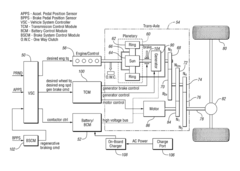
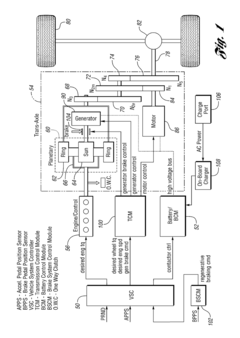
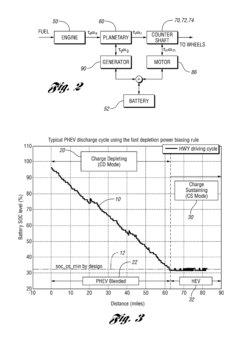
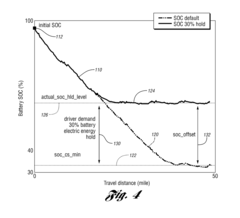
- A method for controlling PHEVs that allows drivers to set a state of charge (SOC) offset based on desired operating modes and energy reservations, enabling flexible switching between electric vehicle (EV) and hybrid electric vehicle (HEV) modes, and reserving battery electric energy for utility purposes, using a controller to manage energy distribution between the internal combustion engine and electric machine.
A hybrid vehicle
PatentWO2022044029A1
Innovation
- A drive mode engagement control system utilizing a battery management system, vehicle mode processor units, sensors for real-time data, and a method to apply predetermined brake torque on electric machines and an integrated starter generator to manage mode transitions smoothly, ensuring seamless power source changes without compromising vehicle performance.


Environmental Impact of HEVs
The environmental impact of Hybrid Electric Vehicles (HEVs) is a critical aspect of their deployment and adoption. HEVs have shown significant potential in reducing greenhouse gas emissions and improving air quality, particularly in urban areas. Compared to conventional internal combustion engine vehicles, HEVs emit fewer pollutants and consume less fuel, resulting in a lower carbon footprint over their lifecycle.
One of the primary environmental benefits of HEVs is their improved fuel efficiency. By combining an electric motor with a gasoline engine, HEVs can achieve higher miles per gallon ratings, reducing overall fuel consumption. This reduction in fuel use directly translates to lower carbon dioxide emissions, a major contributor to global warming. Studies have shown that HEVs can reduce CO2 emissions by 25-35% compared to their conventional counterparts, depending on the specific model and driving conditions.
In addition to reduced CO2 emissions, HEVs also contribute to improved local air quality. The electric motor allows for zero-emission operation during low-speed driving and idling, which is particularly beneficial in congested urban environments. This results in lower emissions of particulate matter, nitrogen oxides, and other harmful pollutants associated with respiratory diseases and smog formation.
However, the environmental impact of HEVs extends beyond their operational phase. The production of batteries and electric components for HEVs does have an environmental cost, including the extraction of raw materials and energy-intensive manufacturing processes. Despite this, lifecycle assessments have consistently shown that the overall environmental benefits of HEVs outweigh the additional production impacts when compared to conventional vehicles.
The end-of-life phase of HEVs also presents both challenges and opportunities. The recycling and proper disposal of batteries and electronic components are crucial to minimizing the environmental impact. Advancements in battery recycling technologies and the development of circular economy practices are helping to address these concerns, potentially turning end-of-life HEVs into valuable sources of raw materials for new batteries and components.
As HEV technology continues to evolve, their environmental impact is expected to improve further. Innovations in battery technology, lightweight materials, and powertrain efficiency are likely to enhance the environmental benefits of HEVs. Additionally, the increasing use of renewable energy sources for electricity generation will further reduce the lifecycle emissions associated with HEVs, particularly as the grid becomes cleaner.
One of the primary environmental benefits of HEVs is their improved fuel efficiency. By combining an electric motor with a gasoline engine, HEVs can achieve higher miles per gallon ratings, reducing overall fuel consumption. This reduction in fuel use directly translates to lower carbon dioxide emissions, a major contributor to global warming. Studies have shown that HEVs can reduce CO2 emissions by 25-35% compared to their conventional counterparts, depending on the specific model and driving conditions.
In addition to reduced CO2 emissions, HEVs also contribute to improved local air quality. The electric motor allows for zero-emission operation during low-speed driving and idling, which is particularly beneficial in congested urban environments. This results in lower emissions of particulate matter, nitrogen oxides, and other harmful pollutants associated with respiratory diseases and smog formation.
However, the environmental impact of HEVs extends beyond their operational phase. The production of batteries and electric components for HEVs does have an environmental cost, including the extraction of raw materials and energy-intensive manufacturing processes. Despite this, lifecycle assessments have consistently shown that the overall environmental benefits of HEVs outweigh the additional production impacts when compared to conventional vehicles.
The end-of-life phase of HEVs also presents both challenges and opportunities. The recycling and proper disposal of batteries and electronic components are crucial to minimizing the environmental impact. Advancements in battery recycling technologies and the development of circular economy practices are helping to address these concerns, potentially turning end-of-life HEVs into valuable sources of raw materials for new batteries and components.
As HEV technology continues to evolve, their environmental impact is expected to improve further. Innovations in battery technology, lightweight materials, and powertrain efficiency are likely to enhance the environmental benefits of HEVs. Additionally, the increasing use of renewable energy sources for electricity generation will further reduce the lifecycle emissions associated with HEVs, particularly as the grid becomes cleaner.
HEV Infrastructure Development
The development of Hybrid Electric Vehicle (HEV) infrastructure is a critical component in the widespread adoption and success of these environmentally friendly vehicles. As HEVs gain popularity, the need for a robust and efficient infrastructure to support their operation becomes increasingly important. This infrastructure encompasses charging stations, maintenance facilities, and specialized service centers designed to cater to the unique requirements of hybrid vehicles.
One of the primary focuses of HEV infrastructure development is the establishment of an extensive network of charging stations. These stations are essential for plug-in hybrid electric vehicles (PHEVs) that rely on both electric power and conventional fuel. The strategic placement of charging stations in urban areas, along highways, and at popular destinations is crucial to alleviate range anxiety and encourage the use of electric power over traditional fuel.
In addition to charging stations, the development of HEV infrastructure includes the creation of specialized maintenance and repair facilities. These centers are equipped with the necessary tools and expertise to service the complex systems found in hybrid vehicles, including high-voltage batteries, electric motors, and advanced power management systems. The availability of such facilities ensures that HEV owners can receive proper maintenance and repairs, prolonging the lifespan of their vehicles and maintaining optimal performance.
Another important aspect of HEV infrastructure development is the integration of smart grid technologies. These systems enable efficient energy management and load balancing, allowing for better utilization of renewable energy sources and reducing strain on the electrical grid during peak charging times. Smart grid integration also facilitates the implementation of vehicle-to-grid (V2G) technologies, where HEVs can potentially feed energy back into the grid during periods of high demand.
The development of HEV infrastructure also involves the creation of standardized protocols for charging and communication between vehicles and charging stations. These standards ensure interoperability across different vehicle models and charging station manufacturers, simplifying the charging process for consumers and promoting widespread adoption of HEV technology.
As HEV infrastructure continues to evolve, there is a growing focus on the development of fast-charging technologies. These advancements aim to significantly reduce charging times, making HEVs more convenient for long-distance travel and addressing one of the primary concerns of potential adopters. The implementation of high-power charging stations along major transportation corridors is a key component of this strategy, enabling drivers to quickly recharge their vehicles during extended journeys.
One of the primary focuses of HEV infrastructure development is the establishment of an extensive network of charging stations. These stations are essential for plug-in hybrid electric vehicles (PHEVs) that rely on both electric power and conventional fuel. The strategic placement of charging stations in urban areas, along highways, and at popular destinations is crucial to alleviate range anxiety and encourage the use of electric power over traditional fuel.
In addition to charging stations, the development of HEV infrastructure includes the creation of specialized maintenance and repair facilities. These centers are equipped with the necessary tools and expertise to service the complex systems found in hybrid vehicles, including high-voltage batteries, electric motors, and advanced power management systems. The availability of such facilities ensures that HEV owners can receive proper maintenance and repairs, prolonging the lifespan of their vehicles and maintaining optimal performance.
Another important aspect of HEV infrastructure development is the integration of smart grid technologies. These systems enable efficient energy management and load balancing, allowing for better utilization of renewable energy sources and reducing strain on the electrical grid during peak charging times. Smart grid integration also facilitates the implementation of vehicle-to-grid (V2G) technologies, where HEVs can potentially feed energy back into the grid during periods of high demand.
The development of HEV infrastructure also involves the creation of standardized protocols for charging and communication between vehicles and charging stations. These standards ensure interoperability across different vehicle models and charging station manufacturers, simplifying the charging process for consumers and promoting widespread adoption of HEV technology.
As HEV infrastructure continues to evolve, there is a growing focus on the development of fast-charging technologies. These advancements aim to significantly reduce charging times, making HEVs more convenient for long-distance travel and addressing one of the primary concerns of potential adopters. The implementation of high-power charging stations along major transportation corridors is a key component of this strategy, enabling drivers to quickly recharge their vehicles during extended journeys.
Unlock deeper insights with Patsnap Eureka Quick Research — get a full tech report to explore trends and direct your research. Try now!
Generate Your Research Report Instantly with AI Agent
Supercharge your innovation with Patsnap Eureka AI Agent Platform!