

Elevating HEV Performance: Insights from Recent Studies
AUG 14, 20259 MIN READ
Generate Your Research Report Instantly with AI Agent
PatSnap Eureka helps you evaluate technical feasibility & market potential.
HEV Technology Evolution and Objectives
Hybrid Electric Vehicles (HEVs) have undergone significant technological evolution since their inception in the late 20th century. The primary objective of HEV technology has been to improve fuel efficiency and reduce emissions while maintaining or enhancing vehicle performance. This goal has driven continuous innovation in powertrain design, energy management systems, and battery technology.
The evolution of HEV technology can be traced through several key stages. Initially, parallel hybrid systems were introduced, combining internal combustion engines with electric motors. This was followed by the development of series hybrid systems, which used the combustion engine primarily as a generator. The next major advancement came with the introduction of plug-in hybrid electric vehicles (PHEVs), allowing for extended electric-only driving ranges.
Recent technological objectives in HEV development have focused on improving overall system efficiency, increasing electric-only driving range, and enhancing power density of electric motors and batteries. Manufacturers are striving to optimize the integration of electric and combustion powertrains, aiming for seamless transitions and improved energy recuperation during braking and deceleration.
Another significant objective has been the development of more advanced battery technologies. Lithium-ion batteries have become the standard, but research continues into solid-state batteries and other chemistries that promise higher energy density, faster charging times, and improved safety. Alongside battery advancements, there's a push for more efficient power electronics and motor designs to maximize the utilization of stored energy.
The evolution of HEV technology has also been driven by increasingly stringent emissions regulations worldwide. This has led to the development of more sophisticated engine management systems and the integration of technologies like cylinder deactivation and advanced thermal management to further reduce fuel consumption and emissions.
Looking forward, the objectives for HEV technology include further electrification of vehicle systems, development of intelligent energy management algorithms leveraging artificial intelligence, and the integration of HEVs with smart grid technologies. There's also a growing focus on reducing the environmental impact of HEV production and end-of-life recycling, aligning with broader sustainability goals.
As HEV technology continues to evolve, the line between hybrid and fully electric vehicles is becoming increasingly blurred. Future objectives may include the development of modular powertrain systems that can easily transition between hybrid and full electric configurations, providing manufacturers with flexibility to adapt to changing market demands and regulatory requirements.
The evolution of HEV technology can be traced through several key stages. Initially, parallel hybrid systems were introduced, combining internal combustion engines with electric motors. This was followed by the development of series hybrid systems, which used the combustion engine primarily as a generator. The next major advancement came with the introduction of plug-in hybrid electric vehicles (PHEVs), allowing for extended electric-only driving ranges.
Recent technological objectives in HEV development have focused on improving overall system efficiency, increasing electric-only driving range, and enhancing power density of electric motors and batteries. Manufacturers are striving to optimize the integration of electric and combustion powertrains, aiming for seamless transitions and improved energy recuperation during braking and deceleration.
Another significant objective has been the development of more advanced battery technologies. Lithium-ion batteries have become the standard, but research continues into solid-state batteries and other chemistries that promise higher energy density, faster charging times, and improved safety. Alongside battery advancements, there's a push for more efficient power electronics and motor designs to maximize the utilization of stored energy.
The evolution of HEV technology has also been driven by increasingly stringent emissions regulations worldwide. This has led to the development of more sophisticated engine management systems and the integration of technologies like cylinder deactivation and advanced thermal management to further reduce fuel consumption and emissions.
Looking forward, the objectives for HEV technology include further electrification of vehicle systems, development of intelligent energy management algorithms leveraging artificial intelligence, and the integration of HEVs with smart grid technologies. There's also a growing focus on reducing the environmental impact of HEV production and end-of-life recycling, aligning with broader sustainability goals.
As HEV technology continues to evolve, the line between hybrid and fully electric vehicles is becoming increasingly blurred. Future objectives may include the development of modular powertrain systems that can easily transition between hybrid and full electric configurations, providing manufacturers with flexibility to adapt to changing market demands and regulatory requirements.
Market Demand Analysis for HEVs
The market demand for Hybrid Electric Vehicles (HEVs) has been experiencing significant growth in recent years, driven by increasing environmental awareness, stringent emission regulations, and rising fuel costs. This trend is expected to continue as consumers seek more fuel-efficient and eco-friendly transportation options.
Global HEV sales have shown a steady upward trajectory, with major automotive markets such as China, Europe, and North America leading the charge. In 2020, despite the overall automotive industry downturn due to the COVID-19 pandemic, HEV sales demonstrated resilience and even growth in some regions. This indicates a robust and growing consumer preference for hybrid technology.
The market potential for HEVs remains substantial, with projections suggesting continued expansion over the next decade. Factors contributing to this growth include government incentives for low-emission vehicles, advancements in battery technology, and the increasing availability of HEV models across various vehicle segments.
Consumer demand for HEVs is driven by several key factors. Fuel efficiency remains a primary consideration, with HEVs offering significant improvements over conventional internal combustion engine vehicles. Environmental concerns also play a crucial role, as consumers seek to reduce their carbon footprint. Additionally, the lower total cost of ownership associated with HEVs, including reduced fuel consumption and potential tax incentives, appeals to cost-conscious buyers.
The HEV market is witnessing a shift in consumer preferences towards larger vehicle segments. While compact and mid-size HEVs have traditionally dominated the market, there is growing demand for hybrid SUVs and crossovers. This trend aligns with the overall automotive market shift towards larger vehicles and presents opportunities for manufacturers to expand their HEV offerings.
Industry trends indicate that HEVs are increasingly seen as a bridge technology between conventional vehicles and fully electric vehicles. As battery technology improves and charging infrastructure expands, some consumers view HEVs as a stepping stone towards eventual adoption of all-electric vehicles. This perception is influencing purchasing decisions and shaping the long-term market outlook for HEVs.
The commercial sector also presents significant growth potential for HEVs. Fleet operators, including taxi services, delivery companies, and car rental agencies, are increasingly adopting hybrid vehicles to reduce operating costs and meet corporate sustainability goals. This trend is expected to contribute to the overall market growth of HEVs in the coming years.
Global HEV sales have shown a steady upward trajectory, with major automotive markets such as China, Europe, and North America leading the charge. In 2020, despite the overall automotive industry downturn due to the COVID-19 pandemic, HEV sales demonstrated resilience and even growth in some regions. This indicates a robust and growing consumer preference for hybrid technology.
The market potential for HEVs remains substantial, with projections suggesting continued expansion over the next decade. Factors contributing to this growth include government incentives for low-emission vehicles, advancements in battery technology, and the increasing availability of HEV models across various vehicle segments.
Consumer demand for HEVs is driven by several key factors. Fuel efficiency remains a primary consideration, with HEVs offering significant improvements over conventional internal combustion engine vehicles. Environmental concerns also play a crucial role, as consumers seek to reduce their carbon footprint. Additionally, the lower total cost of ownership associated with HEVs, including reduced fuel consumption and potential tax incentives, appeals to cost-conscious buyers.
The HEV market is witnessing a shift in consumer preferences towards larger vehicle segments. While compact and mid-size HEVs have traditionally dominated the market, there is growing demand for hybrid SUVs and crossovers. This trend aligns with the overall automotive market shift towards larger vehicles and presents opportunities for manufacturers to expand their HEV offerings.
Industry trends indicate that HEVs are increasingly seen as a bridge technology between conventional vehicles and fully electric vehicles. As battery technology improves and charging infrastructure expands, some consumers view HEVs as a stepping stone towards eventual adoption of all-electric vehicles. This perception is influencing purchasing decisions and shaping the long-term market outlook for HEVs.
The commercial sector also presents significant growth potential for HEVs. Fleet operators, including taxi services, delivery companies, and car rental agencies, are increasingly adopting hybrid vehicles to reduce operating costs and meet corporate sustainability goals. This trend is expected to contribute to the overall market growth of HEVs in the coming years.
Current HEV Challenges and Limitations
Hybrid Electric Vehicles (HEVs) have made significant strides in recent years, yet they still face several challenges and limitations that hinder their widespread adoption and optimal performance. One of the primary issues is the complexity of the powertrain system, which combines both internal combustion engines and electric motors. This complexity often leads to increased manufacturing costs and potential reliability concerns, as more components mean more potential points of failure.
Battery technology remains a critical limitation for HEVs. While advancements have been made, current battery systems still struggle with energy density, charging speed, and longevity. This impacts the overall electric range of HEVs and their ability to operate in pure electric mode for extended periods. Additionally, the added weight of battery packs can negatively affect vehicle dynamics and fuel efficiency.
Thermal management is another significant challenge for HEVs. The integration of electric components with traditional combustion engines creates unique cooling requirements. Inefficient thermal management can lead to reduced battery life, decreased performance, and potential safety issues. Engineers must develop sophisticated cooling systems that can effectively manage heat across both the electric and combustion components of the vehicle.
Control strategies for power distribution between the electric motor and internal combustion engine present ongoing challenges. Optimizing the balance between these two power sources to maximize efficiency and performance under various driving conditions remains a complex task. This is particularly evident in real-world driving scenarios where conditions can change rapidly and unpredictably.
The cost of HEV technology continues to be a limiting factor in widespread adoption. While prices have decreased over time, HEVs still command a premium over conventional vehicles. This price difference is largely attributed to the advanced components required, such as high-capacity batteries, electric motors, and sophisticated control systems. Reducing costs while maintaining or improving performance is a key challenge for manufacturers.
Infrastructure limitations also pose challenges for HEVs, particularly for plug-in hybrid models. The availability of charging stations, especially in urban areas and along highways, can impact the practicality of these vehicles for some consumers. This infrastructure gap can lead to range anxiety and limit the full potential of plug-in hybrid technology.
Lastly, regulatory challenges and varying emissions standards across different regions create complexities for HEV manufacturers. Designing vehicles that comply with diverse and evolving regulations while maintaining performance and efficiency across global markets requires significant research and development efforts.
Battery technology remains a critical limitation for HEVs. While advancements have been made, current battery systems still struggle with energy density, charging speed, and longevity. This impacts the overall electric range of HEVs and their ability to operate in pure electric mode for extended periods. Additionally, the added weight of battery packs can negatively affect vehicle dynamics and fuel efficiency.
Thermal management is another significant challenge for HEVs. The integration of electric components with traditional combustion engines creates unique cooling requirements. Inefficient thermal management can lead to reduced battery life, decreased performance, and potential safety issues. Engineers must develop sophisticated cooling systems that can effectively manage heat across both the electric and combustion components of the vehicle.
Control strategies for power distribution between the electric motor and internal combustion engine present ongoing challenges. Optimizing the balance between these two power sources to maximize efficiency and performance under various driving conditions remains a complex task. This is particularly evident in real-world driving scenarios where conditions can change rapidly and unpredictably.
The cost of HEV technology continues to be a limiting factor in widespread adoption. While prices have decreased over time, HEVs still command a premium over conventional vehicles. This price difference is largely attributed to the advanced components required, such as high-capacity batteries, electric motors, and sophisticated control systems. Reducing costs while maintaining or improving performance is a key challenge for manufacturers.
Infrastructure limitations also pose challenges for HEVs, particularly for plug-in hybrid models. The availability of charging stations, especially in urban areas and along highways, can impact the practicality of these vehicles for some consumers. This infrastructure gap can lead to range anxiety and limit the full potential of plug-in hybrid technology.
Lastly, regulatory challenges and varying emissions standards across different regions create complexities for HEV manufacturers. Designing vehicles that comply with diverse and evolving regulations while maintaining performance and efficiency across global markets requires significant research and development efforts.
Recent HEV Performance Solutions
01 Thermal management systems for HEVs
Advanced thermal management systems are crucial for optimizing HEV performance. These systems regulate the temperature of various components, including the battery, electric motor, and power electronics, to ensure efficient operation and longevity. Effective thermal management can improve overall vehicle efficiency, extend battery life, and enhance driving range.- Thermal management systems for HEVs: Hybrid Electric Vehicles (HEVs) require efficient thermal management systems to optimize performance and battery life. These systems often include advanced cooling mechanisms for power electronics, electric motors, and battery packs. Improved thermal management can lead to enhanced overall vehicle efficiency, increased driving range, and prolonged component lifespan.
- Power control and energy management: HEV performance is significantly influenced by sophisticated power control and energy management strategies. These systems optimize the distribution of power between the internal combustion engine and electric motor, manage regenerative braking, and control battery charging and discharging. Advanced algorithms and control units are employed to maximize fuel efficiency and reduce emissions while maintaining performance.
- Electric drivetrain and motor improvements: Enhancements in electric drivetrains and motors play a crucial role in HEV performance. This includes the development of more efficient electric motors, advanced power electronics, and improved transmission systems. These innovations contribute to increased power output, better acceleration, and improved overall vehicle dynamics.
- Battery technology advancements: Advancements in battery technology are fundamental to improving HEV performance. This includes the development of higher energy density batteries, faster charging capabilities, and improved battery management systems. Enhanced battery performance leads to increased electric-only driving range, better overall fuel economy, and improved vehicle performance.
- Vehicle lightweighting and aerodynamics: HEV performance can be enhanced through vehicle lightweighting and improved aerodynamics. This involves the use of advanced materials to reduce vehicle weight, as well as design optimizations to minimize air resistance. These improvements contribute to better fuel efficiency, increased range, and enhanced overall performance of hybrid electric vehicles.
02 Power control and energy management
Sophisticated power control and energy management strategies are essential for maximizing HEV performance. These systems optimize the distribution of power between the internal combustion engine and electric motor, manage battery charging and discharging, and implement regenerative braking. Advanced algorithms and control units are used to balance performance, efficiency, and emissions.Expand Specific Solutions03 Lightweight materials and aerodynamic design
The use of lightweight materials and aerodynamic design principles significantly impacts HEV performance. Advanced materials such as high-strength steel, aluminum, and composites reduce vehicle weight, while improved aerodynamics minimize drag. These factors contribute to increased fuel efficiency, extended electric range, and enhanced overall performance.Expand Specific Solutions04 Advanced electric drivetrain components
Innovations in electric drivetrain components, including high-efficiency electric motors, advanced power electronics, and improved battery technologies, play a crucial role in enhancing HEV performance. These advancements result in increased power output, improved energy density, faster charging capabilities, and extended electric driving range.Expand Specific Solutions05 Intelligent vehicle systems and connectivity
Integration of intelligent vehicle systems and connectivity features enhances HEV performance through real-time data analysis and predictive algorithms. These systems optimize route planning, adapt to driving conditions, and provide driver assistance features. Additionally, vehicle-to-grid (V2G) technology enables HEVs to interact with the power grid, potentially improving energy efficiency and grid stability.Expand Specific Solutions
Key Players in HEV Industry
The HEV performance enhancement landscape is characterized by a mature market with significant growth potential. Major automotive manufacturers like Ford, Toyota, BMW, and Hyundai are leading the charge, investing heavily in research and development. The market is experiencing rapid expansion, driven by increasing environmental concerns and government regulations. Technological advancements from companies such as BYD and Geely are pushing the boundaries of HEV efficiency and performance. Academic institutions like Jilin University and the University of Michigan are contributing valuable research, fostering innovation in this field. The collaboration between industry and academia is accelerating progress, with a focus on improving battery technology, powertrain efficiency, and overall vehicle performance.
Toyota Motor Engineering & Manufacturing North America, Inc.
Technical Solution: Toyota has pioneered HEV technology with its renowned Hybrid Synergy Drive system. Recent studies have shown that Toyota's latest HEV models incorporate a more compact and powerful electric motor, coupled with a highly efficient gasoline engine. The system features an advanced power split device that allows for seamless transitions between electric and gasoline power, optimizing efficiency across various driving conditions. Toyota has also implemented a sophisticated energy management system that utilizes artificial intelligence to learn driver behavior and adapt powertrain operation accordingly, resulting in up to 10% improvement in fuel efficiency [4]. Furthermore, Toyota has developed a new heat recovery system that captures waste heat from the engine to warm the cabin and battery, reducing the energy load on the powertrain and improving overall efficiency by up to 5% in cold weather conditions [5].
Strengths: Proven reliability, advanced AI-based energy management, and efficient heat recovery system. Weaknesses: Slightly higher complexity in powertrain design, which may impact maintenance costs.
BYD Co., Ltd.
Technical Solution: BYD has made significant strides in HEV technology with its DM-i super hybrid system. This innovative powertrain combines a highly efficient Xiaoyun engine with a powerful electric motor and a high-capacity blade battery. The system utilizes a multi-mode hybrid transmission that enables seamless switching between pure electric, series hybrid, and parallel hybrid modes, optimizing efficiency across various driving scenarios. BYD's HEV technology incorporates an intelligent energy management system that uses machine learning algorithms to predict energy demands and optimize power distribution, resulting in up to 12% improvement in overall efficiency [6]. Additionally, BYD has developed a novel thermal management system that integrates the cooling of the engine, electric motor, and battery, reducing energy consumption and improving overall system efficiency by up to 7% [7].
Strengths: Advanced multi-mode hybrid system, high-capacity blade battery technology, and intelligent energy management. Weaknesses: Limited global market presence compared to some competitors, potentially affecting widespread adoption.
Core Innovations in HEV Technology
Hybrid electric vehicle and method of controlling the same
PatentActiveUS11794720B2
Innovation
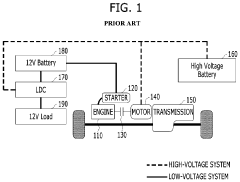
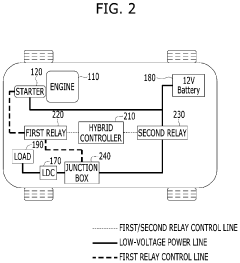
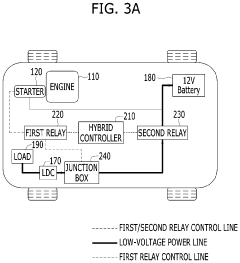
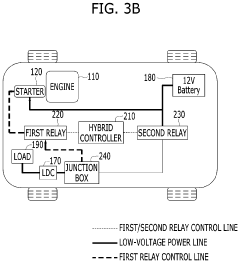
- A hybrid electric vehicle system with a first relay to control the starter and a second relay between the DC-DC converter and the electric load, along with a controller that adjusts their states to maintain stable engine cranking by compensating for the DC-DC converter failure by operating the engine clutch in a slip state and increasing the driving motor's torque for kinetic energy.
Advanced automated hybrid electric vehicle with performance monitoring system
PatentActiveIN202121031277A
Innovation
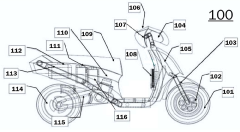
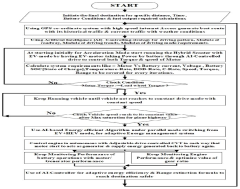
- The implementation of Artificial Intelligence (AI) and Internet of Things (IoT) controlled systems for automatic mode shifting, real-time motor and battery condition monitoring, intelligent thermal management, and fast bidirectional charging, which optimize energy use and simplify maintenance, enabling efficient and extended vehicle range with reduced human effort.


Environmental Impact of HEVs
Hybrid Electric Vehicles (HEVs) have emerged as a significant step towards sustainable transportation, offering a balance between conventional internal combustion engines and fully electric vehicles. The environmental impact of HEVs is a crucial aspect to consider when evaluating their overall performance and contribution to sustainability goals.
One of the primary environmental benefits of HEVs is their reduced fuel consumption compared to conventional vehicles. By combining an electric motor with a gasoline engine, HEVs can achieve significantly higher fuel efficiency, particularly in urban driving conditions. This translates to lower greenhouse gas emissions, as less fuel is burned per mile traveled.
Recent studies have shown that HEVs can reduce CO2 emissions by 25-35% compared to their conventional counterparts, depending on the specific model and driving conditions. This reduction in emissions contributes to improved air quality in urban areas and helps mitigate the transportation sector's impact on climate change.
However, the environmental impact of HEVs extends beyond tailpipe emissions. The production of batteries for HEVs involves energy-intensive processes and the extraction of rare earth metals, which can have significant environmental consequences. Researchers are actively working on developing more sustainable battery technologies and improving recycling processes to address these concerns.
Lifecycle assessments of HEVs have revealed that while they may have a higher environmental impact during production compared to conventional vehicles, this is typically offset by their lower emissions during operation. The break-even point, where an HEV's total environmental impact becomes lower than that of a conventional vehicle, varies but is generally reached within a few years of operation.
Another important consideration is the source of electricity used to charge HEVs. In regions where electricity is primarily generated from renewable sources, the environmental benefits of HEVs are further amplified. Conversely, in areas heavily reliant on fossil fuels for electricity generation, the net environmental benefit may be reduced.
The noise pollution reduction offered by HEVs, particularly at low speeds when operating in electric-only mode, is an often-overlooked environmental benefit. This can contribute to improved quality of life in urban areas and reduce the negative impacts of traffic noise on human health and wildlife.
As HEV technology continues to evolve, manufacturers are focusing on improving battery efficiency, reducing the environmental impact of production processes, and enhancing overall vehicle performance. These advancements are expected to further increase the positive environmental impact of HEVs in the coming years.
One of the primary environmental benefits of HEVs is their reduced fuel consumption compared to conventional vehicles. By combining an electric motor with a gasoline engine, HEVs can achieve significantly higher fuel efficiency, particularly in urban driving conditions. This translates to lower greenhouse gas emissions, as less fuel is burned per mile traveled.
Recent studies have shown that HEVs can reduce CO2 emissions by 25-35% compared to their conventional counterparts, depending on the specific model and driving conditions. This reduction in emissions contributes to improved air quality in urban areas and helps mitigate the transportation sector's impact on climate change.
However, the environmental impact of HEVs extends beyond tailpipe emissions. The production of batteries for HEVs involves energy-intensive processes and the extraction of rare earth metals, which can have significant environmental consequences. Researchers are actively working on developing more sustainable battery technologies and improving recycling processes to address these concerns.
Lifecycle assessments of HEVs have revealed that while they may have a higher environmental impact during production compared to conventional vehicles, this is typically offset by their lower emissions during operation. The break-even point, where an HEV's total environmental impact becomes lower than that of a conventional vehicle, varies but is generally reached within a few years of operation.
Another important consideration is the source of electricity used to charge HEVs. In regions where electricity is primarily generated from renewable sources, the environmental benefits of HEVs are further amplified. Conversely, in areas heavily reliant on fossil fuels for electricity generation, the net environmental benefit may be reduced.
The noise pollution reduction offered by HEVs, particularly at low speeds when operating in electric-only mode, is an often-overlooked environmental benefit. This can contribute to improved quality of life in urban areas and reduce the negative impacts of traffic noise on human health and wildlife.
As HEV technology continues to evolve, manufacturers are focusing on improving battery efficiency, reducing the environmental impact of production processes, and enhancing overall vehicle performance. These advancements are expected to further increase the positive environmental impact of HEVs in the coming years.
HEV Policy and Regulations
The regulatory landscape for Hybrid Electric Vehicles (HEVs) has been evolving rapidly in recent years, reflecting the growing importance of these vehicles in addressing environmental concerns and energy efficiency goals. Governments worldwide are implementing policies and regulations to promote HEV adoption and improve their performance.
In the United States, the Corporate Average Fuel Economy (CAFE) standards have been a significant driver for HEV development. These standards require automakers to achieve increasingly stringent fleet-wide fuel economy targets, incentivizing the production and sale of more efficient vehicles, including HEVs. The Environmental Protection Agency (EPA) and the National Highway Traffic Safety Administration (NHTSA) jointly administer these standards, which have been instrumental in pushing manufacturers to invest in HEV technology.
The European Union has also been at the forefront of HEV policy development. The EU's CO2 emission standards for new passenger cars and light commercial vehicles have been progressively tightened, with specific targets set for 2025 and 2030. These regulations have led to a surge in HEV offerings from European automakers, as they seek to comply with the stringent emission limits.
China, the world's largest automotive market, has implemented a dual-credit policy that combines Corporate Average Fuel Consumption (CAFC) requirements with New Energy Vehicle (NEV) credits. This policy effectively mandates automakers to produce a certain percentage of low-emission vehicles, including HEVs, or face penalties. The Chinese government has also provided substantial subsidies and tax incentives to promote HEV adoption, although these are being gradually phased out in favor of market-driven growth.
Japan, a pioneer in HEV technology, has long supported the development and adoption of these vehicles through a combination of tax incentives, subsidies, and stringent fuel economy standards. The country's Top Runner Program, which sets efficiency benchmarks based on the best-performing products in each category, has been particularly effective in driving HEV innovation.
At the local level, many cities and regions have implemented their own policies to encourage HEV use. These include preferential parking, access to high-occupancy vehicle lanes, and exemptions from congestion charges or vehicle registration restrictions. Such measures have proven effective in increasing HEV adoption rates in urban areas.
As HEV technology continues to advance, policymakers are also focusing on regulations related to battery recycling and end-of-life vehicle management. The EU's proposed Battery Regulation, for instance, aims to ensure sustainable and ethical sourcing of battery materials, as well as efficient recycling processes for HEV batteries.
In the United States, the Corporate Average Fuel Economy (CAFE) standards have been a significant driver for HEV development. These standards require automakers to achieve increasingly stringent fleet-wide fuel economy targets, incentivizing the production and sale of more efficient vehicles, including HEVs. The Environmental Protection Agency (EPA) and the National Highway Traffic Safety Administration (NHTSA) jointly administer these standards, which have been instrumental in pushing manufacturers to invest in HEV technology.
The European Union has also been at the forefront of HEV policy development. The EU's CO2 emission standards for new passenger cars and light commercial vehicles have been progressively tightened, with specific targets set for 2025 and 2030. These regulations have led to a surge in HEV offerings from European automakers, as they seek to comply with the stringent emission limits.
China, the world's largest automotive market, has implemented a dual-credit policy that combines Corporate Average Fuel Consumption (CAFC) requirements with New Energy Vehicle (NEV) credits. This policy effectively mandates automakers to produce a certain percentage of low-emission vehicles, including HEVs, or face penalties. The Chinese government has also provided substantial subsidies and tax incentives to promote HEV adoption, although these are being gradually phased out in favor of market-driven growth.
Japan, a pioneer in HEV technology, has long supported the development and adoption of these vehicles through a combination of tax incentives, subsidies, and stringent fuel economy standards. The country's Top Runner Program, which sets efficiency benchmarks based on the best-performing products in each category, has been particularly effective in driving HEV innovation.
At the local level, many cities and regions have implemented their own policies to encourage HEV use. These include preferential parking, access to high-occupancy vehicle lanes, and exemptions from congestion charges or vehicle registration restrictions. Such measures have proven effective in increasing HEV adoption rates in urban areas.
As HEV technology continues to advance, policymakers are also focusing on regulations related to battery recycling and end-of-life vehicle management. The EU's proposed Battery Regulation, for instance, aims to ensure sustainable and ethical sourcing of battery materials, as well as efficient recycling processes for HEV batteries.
Unlock deeper insights with PatSnap Eureka Quick Research — get a full tech report to explore trends and direct your research. Try now!
Generate Your Research Report Instantly with AI Agent
Supercharge your innovation with PatSnap Eureka AI Agent Platform!