Fast Charging Mechanisms in Enovix Batteries Technical Insights and Performance
Fast Charging Evolution
Fast charging technology for batteries has undergone significant evolution over the past decade, driven by the increasing demand for rapid power replenishment in various applications, particularly in electric vehicles and portable electronics. The journey of fast charging mechanisms has been marked by several key milestones and technological breakthroughs.
In the early stages of battery development, charging speeds were limited by the chemical processes within the cells and the risk of degradation associated with rapid charging. However, as research progressed, new electrode materials and electrolyte formulations emerged, enabling faster ion transfer and reduced internal resistance.
One of the pivotal advancements in fast charging came with the introduction of lithium-ion batteries, which offered higher energy densities and faster charging capabilities compared to their predecessors. This breakthrough paved the way for more aggressive charging protocols, such as Constant Current-Constant Voltage (CC-CV) charging, which became the industry standard for many years.
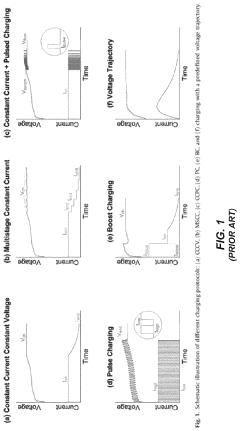
As the demand for even faster charging grew, researchers began exploring advanced charging algorithms and battery management systems. Pulse charging techniques were developed, allowing for short bursts of high current followed by rest periods, which helped mitigate heat generation and extend battery life while reducing charging times.
The next significant leap in fast charging evolution came with the development of silicon-based anodes, which offered higher capacity and faster charging rates compared to traditional graphite anodes. This innovation laid the groundwork for companies like Enovix to push the boundaries of charging speeds further.
Enovix's approach to fast charging represents a culmination of these evolutionary steps, incorporating advanced materials science, innovative cell architecture, and sophisticated charging algorithms. Their silicon-lithium battery technology leverages the high capacity of silicon anodes while addressing the historical challenges of silicon expansion during charging.
The evolution of fast charging has also seen advancements in thermal management systems, crucial for maintaining battery health during rapid charging. Liquid cooling systems and smart temperature control algorithms have been integrated into battery packs to dissipate heat more effectively, allowing for sustained high-power charging without compromising safety or longevity.
Looking forward, the trajectory of fast charging evolution points towards even more rapid charging capabilities, with research focusing on novel electrode materials, solid-state electrolytes, and advanced cell designs. The goal is to achieve charging speeds that rival the refueling time of conventional vehicles, potentially enabling electric vehicles to be recharged in minutes rather than hours.
Market Demand Analysis
The market demand for fast-charging battery technologies has been growing exponentially in recent years, driven by the rapid adoption of electric vehicles (EVs) and portable electronic devices. Enovix's innovative battery technology, which promises significantly faster charging capabilities, is poised to address this burgeoning market need.
In the EV sector, consumer surveys consistently highlight charging time as a major concern for potential buyers. A study by J.D. Power revealed that charging speed ranks among the top three factors influencing EV purchase decisions. With the global EV market projected to grow at a CAGR of over 20% in the next decade, the demand for fast-charging solutions is expected to surge correspondingly.
The consumer electronics market also presents a substantial opportunity for fast-charging technologies. Smartphone users, in particular, express a strong desire for reduced charging times. A survey conducted by a leading market research firm found that over 70% of smartphone users consider fast charging a "must-have" feature in their next device purchase.
Industry analysts predict that the global fast-charging market will experience robust growth, with some estimates suggesting it could reach a value of several billion dollars by 2025. This growth is fueled not only by consumer demand but also by regulatory pressures in various countries to accelerate the transition to electric mobility.
Enovix's silicon-anode technology, which enables faster charging without compromising battery life or safety, aligns well with these market trends. The company's approach addresses key pain points in both the EV and consumer electronics sectors, potentially offering a competitive edge in these rapidly evolving markets.
However, it's important to note that the fast-charging market is becoming increasingly competitive. Several major battery manufacturers and tech companies are investing heavily in developing their own rapid charging solutions. This competition could potentially impact Enovix's market share and pricing power.
Despite the competitive landscape, the overall market trajectory remains highly favorable for advanced battery technologies. The increasing focus on sustainability and the push for longer-range EVs are likely to sustain the demand for innovative battery solutions in the long term.
In conclusion, the market demand analysis for Enovix's fast-charging battery technology reveals a significant and growing opportunity. The confluence of consumer preferences, regulatory trends, and technological advancements creates a favorable environment for the adoption of such solutions across multiple industries.
Enovix Battery Challenges
Enovix, a pioneering battery technology company, faces several significant challenges in its pursuit of advanced fast-charging mechanisms for its silicon-anode lithium-ion batteries. One of the primary hurdles is managing the substantial volume expansion of silicon during lithium insertion, which can lead to mechanical stress and degradation of the electrode structure. This expansion, if not properly controlled, can result in capacity fade and reduced cycle life, potentially limiting the battery's long-term performance and reliability.
Another critical challenge lies in optimizing the electrolyte formulation to enable rapid lithium-ion transport while maintaining stability at high charging rates. The electrolyte must facilitate swift ion movement without compromising the formation of a stable solid-electrolyte interphase (SEI) layer, which is crucial for preventing continuous electrolyte decomposition and ensuring battery longevity. Achieving this delicate balance is essential for realizing the full potential of fast-charging capabilities.
Thermal management presents a formidable obstacle in fast-charging scenarios. The rapid influx of energy during high-rate charging generates significant heat, which can accelerate side reactions, lead to thermal runaway, and compromise safety. Developing effective cooling strategies and heat dissipation mechanisms is paramount to maintain battery integrity and performance during fast charging operations.
The intricate 3D silicon anode structure employed by Enovix, while innovative, introduces manufacturing complexities that must be addressed to scale production efficiently. Ensuring consistent quality and performance across large-scale manufacturing processes remains a challenge, particularly in maintaining the precise architecture that enables the battery's unique properties.
Furthermore, Enovix must navigate the regulatory landscape and safety standards associated with fast-charging technologies. Demonstrating compliance with industry safety protocols and obtaining necessary certifications are critical steps in bringing their advanced batteries to market. This process involves rigorous testing and validation to ensure that the fast-charging mechanisms do not compromise the overall safety and reliability of the battery system.
Lastly, the company faces the challenge of cost-effectively integrating its technology into existing battery manufacturing ecosystems. Developing processes that are compatible with current production lines while delivering the promised performance improvements is crucial for widespread adoption. This integration must be achieved without significantly increasing production costs, ensuring that the advanced batteries remain economically viable for various applications.
Current Fast Charging
01 Advanced electrode and cell design for fast charging
Enovix batteries utilize innovative electrode and cell designs to enable fast charging capabilities. This includes optimized electrode structures, improved ion transport pathways, and enhanced current collection systems. These design features allow for rapid charge acceptance and reduced internal resistance, facilitating faster charging times while maintaining battery performance and longevity.- Advanced electrode and cell design for fast charging: Enovix batteries utilize innovative electrode and cell designs to enable fast charging capabilities. This includes optimized electrode structures, improved ion transport pathways, and enhanced current collection systems. These design features allow for rapid charge acceptance and reduced internal resistance, facilitating faster charging times while maintaining battery performance and longevity.
- Thermal management systems for fast charging: Effective thermal management is crucial for fast charging of Enovix batteries. Advanced cooling systems and heat dissipation techniques are employed to prevent overheating during rapid charging. This may include active cooling mechanisms, thermally conductive materials, and intelligent temperature monitoring to ensure safe and efficient fast charging operations.
- Smart charging algorithms and control systems: Enovix batteries incorporate sophisticated charging algorithms and control systems to optimize the fast charging process. These intelligent systems dynamically adjust charging parameters based on battery state, temperature, and other factors to maximize charging speed while preserving battery health and safety. Advanced battery management systems (BMS) play a crucial role in implementing these smart charging strategies.
- High-capacity anode materials for fast charging: The use of advanced anode materials with high capacity and rapid lithium-ion insertion/extraction capabilities is key to Enovix's fast charging technology. These materials, which may include silicon-based anodes or other novel compositions, allow for quicker charge acceptance and higher energy density, contributing to faster overall charging times while maintaining or improving battery capacity.
- Fast-charging compatible electrolyte formulations: Enovix batteries employ specially formulated electrolytes that are optimized for fast charging applications. These electrolytes feature enhanced ionic conductivity, improved stability at high charging rates, and compatibility with the electrode materials used. The tailored electrolyte compositions contribute to faster ion transport and reduced internal resistance during rapid charging cycles.
02 Thermal management systems for fast charging
Effective thermal management is crucial for fast charging of Enovix batteries. Advanced cooling systems and heat dissipation techniques are employed to manage temperature increases during rapid charging. This helps prevent degradation of battery components and ensures safe operation under high-power charging conditions, allowing for sustained fast charging capabilities.Expand Specific Solutions03 Smart charging algorithms and control systems
Enovix batteries incorporate intelligent charging algorithms and control systems to optimize the fast charging process. These systems dynamically adjust charging parameters based on battery state, temperature, and other factors. By continuously monitoring and adapting the charging profile, the system maximizes charging speed while preserving battery health and safety.Expand Specific Solutions04 Advanced materials for improved fast charging performance
The use of advanced materials in Enovix batteries contributes to their fast charging capabilities. This includes high-performance electrode materials, electrolytes with enhanced conductivity, and separator materials that facilitate rapid ion transport. These materials work together to reduce internal resistance and improve charge acceptance rates, enabling faster charging times.Expand Specific Solutions05 Integration of fast charging technology with energy storage systems
Enovix fast charging technology is designed for seamless integration with various energy storage systems and applications. This includes compatibility with high-power charging infrastructure, grid-scale energy storage, and electric vehicle systems. The integration focuses on optimizing power delivery, managing energy flow, and ensuring interoperability with existing charging standards and protocols.Expand Specific Solutions
Key Industry Players
The fast charging mechanisms in Enovix batteries represent a competitive landscape in an evolving industry. The market is in a growth phase, with increasing demand for rapid charging solutions in electric vehicles and consumer electronics. The global fast charging market size is expanding rapidly, driven by technological advancements and consumer expectations. In terms of technical maturity, companies like Samsung Electronics, LG Innotek, and Contemporary Amperex Technology are leading the way with advanced battery technologies. Emerging players such as Qnovo and Goiku Battery are introducing innovative battery management systems and diagnostic tools. Established automotive manufacturers like Hyundai, Audi, and Kia are also investing heavily in fast charging technologies to support their electric vehicle lineups.
Contemporary Amperex Technology Co., Ltd.
Samsung Electronics Co., Ltd.
Enovix Core Innovations
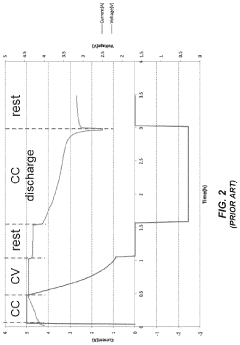
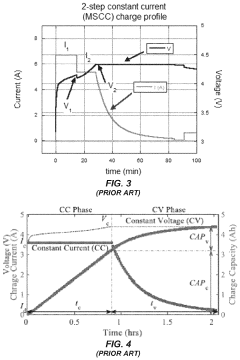
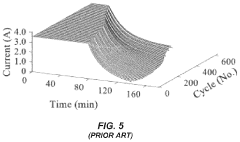
- A Voltage Staged Intermittent Pulse (VSIP) method that applies a series of constant voltage stages with intermittent voltage plateaus and rest periods for the charging current, allowing for safe and efficient charging below 60 minutes while monitoring temperature and voltage limits, and utilizing machine-learning techniques to adjust parameters for optimal charging.
- A fast charging circuit design incorporating a switching charger and a bypass charging circuit, where the first switch is turned on when the battery voltage is low and the second switch is turned on when the voltage is high, allowing the battery to receive power through the bypass circuit with lower impedance, thereby minimizing power loss and enhancing efficiency.


Safety Considerations
Safety considerations are paramount in the development and implementation of fast charging mechanisms for Enovix batteries. The rapid transfer of energy during fast charging can potentially lead to thermal runaway, a condition where the battery's temperature increases uncontrollably, potentially resulting in fire or explosion. To mitigate these risks, Enovix has implemented several safety features and protocols.
One of the primary safety measures is the advanced thermal management system integrated into Enovix batteries. This system continuously monitors the battery's temperature during charging and discharging cycles, ensuring that it remains within safe operating limits. If the temperature approaches critical levels, the system can automatically adjust the charging rate or even terminate the process to prevent overheating.
The unique 3D silicon anode structure of Enovix batteries also contributes to their safety profile during fast charging. The silicon material's ability to expand and contract without degradation reduces the risk of internal short circuits, which can be a significant safety concern in conventional lithium-ion batteries subjected to rapid charging.
Enovix has also incorporated advanced battery management systems (BMS) that provide real-time monitoring of various parameters, including voltage, current, and state of charge. These systems can detect anomalies and implement protective measures, such as reducing charging current or disconnecting the battery if necessary.
Furthermore, the company has developed proprietary algorithms that optimize the charging process, balancing speed with safety. These algorithms dynamically adjust the charging profile based on the battery's condition, ambient temperature, and other factors to maximize charging speed while minimizing stress on the battery components.
To ensure long-term safety and reliability, Enovix conducts extensive testing of their batteries under various fast charging conditions. This includes accelerated life cycle testing, abuse testing, and simulations of extreme environmental conditions. The data gathered from these tests informs continuous improvements in battery design and safety features.
Regulatory compliance is another critical aspect of Enovix's safety considerations. The company ensures that their fast charging mechanisms meet or exceed industry standards and regulations, including those set by organizations such as UL, IEC, and various transportation authorities.
In conclusion, while fast charging mechanisms in Enovix batteries offer significant performance advantages, the company has prioritized safety through a multi-faceted approach. This includes advanced thermal management, innovative battery design, intelligent control systems, and rigorous testing protocols. These measures collectively aim to provide users with a safe and reliable fast charging experience, minimizing the risks associated with rapid energy transfer in high-capacity batteries.
Environmental Impact
The environmental impact of fast charging mechanisms in Enovix batteries is a crucial aspect to consider in the broader context of sustainable energy solutions. Enovix's innovative battery technology, while primarily focused on performance improvements, also offers potential environmental benefits that warrant examination.
One of the key environmental advantages of Enovix's fast charging batteries lies in their increased energy density and longer lifespan. By enabling more energy storage in a smaller form factor, these batteries can potentially reduce the overall material requirements for battery production. This efficiency gain translates to fewer raw materials extracted and processed, thereby minimizing the environmental footprint associated with battery manufacturing.
The extended cycle life of Enovix batteries also contributes to reduced electronic waste. As these batteries can withstand more charge-discharge cycles before degradation, they effectively extend the usable life of devices they power. This longevity can lead to a decrease in the frequency of battery replacements and, by extension, a reduction in the volume of discarded batteries entering the waste stream.
Fast charging capabilities, while primarily a performance feature, can indirectly benefit the environment by promoting the adoption of electric vehicles (EVs). The ability to rapidly charge EV batteries addresses one of the main barriers to widespread EV adoption – charging time. As more consumers switch to EVs, there is potential for significant reductions in greenhouse gas emissions from the transportation sector.
However, it is important to note that fast charging mechanisms can potentially impact battery longevity if not properly managed. Enovix's technology addresses this concern through advanced electrode designs and thermal management systems, which help mitigate the negative effects of rapid charging on battery lifespan. This approach ensures that the environmental benefits of longer-lasting batteries are not compromised by the fast charging feature.
The production process of Enovix batteries also merits consideration from an environmental perspective. While specific details of their manufacturing process are proprietary, the company has indicated a focus on sustainable production methods. This includes efforts to minimize energy consumption during manufacturing and the use of recyclable materials where possible.
In terms of end-of-life considerations, the recyclability of Enovix batteries is an important factor. The company has stated a commitment to designing batteries with recyclability in mind, which could contribute to a more circular economy for battery materials. However, detailed information on the specific recycling processes for these advanced batteries is still emerging and will be crucial for a comprehensive environmental assessment.