

How Model Predictive Control Reduces Energy Costs
SEP 5, 20259 MIN READ
Generate Your Research Report Instantly with AI Agent
PatSnap Eureka helps you evaluate technical feasibility & market potential.
MPC Technology Evolution and Energy Efficiency Goals
Model Predictive Control (MPC) has evolved significantly since its conceptual development in the 1960s. Initially emerging from optimal control theory, MPC gained practical implementation capabilities in the 1980s when computing power became sufficient to solve complex optimization problems in real-time. The technology's evolution has been characterized by progressive improvements in algorithmic efficiency, computational methods, and implementation frameworks, transforming it from a theoretical concept to a practical industrial solution.
Early MPC applications focused primarily on process control in petrochemical industries, where slow dynamics allowed sufficient computation time. As computational capabilities advanced through the 1990s and 2000s, MPC expanded into faster dynamic systems including HVAC, power generation, and manufacturing. This evolution paralleled growing global awareness of energy efficiency and sustainability concerns, creating a natural convergence of technological capability and market need.
The energy efficiency goals associated with MPC have evolved from simple cost reduction to comprehensive sustainability objectives. Initially, MPC implementations aimed to optimize operational parameters to minimize direct energy consumption. Modern implementations now incorporate multiple objectives including carbon footprint reduction, demand response participation, renewable energy integration, and grid stability support, while maintaining or improving occupant comfort and production quality.
A significant milestone in MPC evolution was the development of economic MPC frameworks in the early 2000s, which directly incorporated cost functions into the control objective rather than treating them as separate considerations. This approach enabled systems to dynamically respond to variable energy pricing, weather forecasts, and changing operational conditions, creating opportunities for substantial cost savings beyond what traditional control strategies could achieve.
Recent technological advancements have further enhanced MPC's energy efficiency capabilities. Machine learning integration has improved prediction accuracy for demand forecasting and system modeling. Cloud computing has enabled more complex optimization calculations without requiring extensive on-site hardware. Edge computing developments have allowed distributed MPC implementations that can coordinate multiple systems while maintaining resilience and reducing communication overhead.
The current technological frontier focuses on scalable MPC solutions that can be deployed across diverse energy-consuming systems with minimal customization requirements. Research efforts are directed toward self-tuning algorithms that reduce implementation costs, robust formulations that maintain performance despite uncertainties, and hierarchical frameworks that coordinate multiple control layers from device-level to enterprise energy management systems.
Early MPC applications focused primarily on process control in petrochemical industries, where slow dynamics allowed sufficient computation time. As computational capabilities advanced through the 1990s and 2000s, MPC expanded into faster dynamic systems including HVAC, power generation, and manufacturing. This evolution paralleled growing global awareness of energy efficiency and sustainability concerns, creating a natural convergence of technological capability and market need.
The energy efficiency goals associated with MPC have evolved from simple cost reduction to comprehensive sustainability objectives. Initially, MPC implementations aimed to optimize operational parameters to minimize direct energy consumption. Modern implementations now incorporate multiple objectives including carbon footprint reduction, demand response participation, renewable energy integration, and grid stability support, while maintaining or improving occupant comfort and production quality.
A significant milestone in MPC evolution was the development of economic MPC frameworks in the early 2000s, which directly incorporated cost functions into the control objective rather than treating them as separate considerations. This approach enabled systems to dynamically respond to variable energy pricing, weather forecasts, and changing operational conditions, creating opportunities for substantial cost savings beyond what traditional control strategies could achieve.
Recent technological advancements have further enhanced MPC's energy efficiency capabilities. Machine learning integration has improved prediction accuracy for demand forecasting and system modeling. Cloud computing has enabled more complex optimization calculations without requiring extensive on-site hardware. Edge computing developments have allowed distributed MPC implementations that can coordinate multiple systems while maintaining resilience and reducing communication overhead.
The current technological frontier focuses on scalable MPC solutions that can be deployed across diverse energy-consuming systems with minimal customization requirements. Research efforts are directed toward self-tuning algorithms that reduce implementation costs, robust formulations that maintain performance despite uncertainties, and hierarchical frameworks that coordinate multiple control layers from device-level to enterprise energy management systems.
Market Demand for Energy Cost Reduction Solutions
The global market for energy cost reduction solutions is experiencing unprecedented growth, driven by the convergence of economic pressures, environmental regulations, and technological advancements. Organizations across industrial, commercial, and residential sectors are actively seeking innovative approaches to optimize energy consumption while maintaining operational efficiency. Recent market research indicates that the global energy management systems market is projected to reach $82.0 billion by 2027, growing at a CAGR of 13.5% from 2022.
Model Predictive Control (MPC) solutions are emerging as a particularly sought-after segment within this market, with industries recognizing their potential to deliver substantial energy savings compared to conventional control methods. The demand is especially pronounced in energy-intensive sectors such as manufacturing, where energy costs can represent up to 40% of operational expenses, and in commercial buildings, which account for approximately 35% of global energy consumption.
Regulatory frameworks worldwide are significantly influencing market dynamics. The European Union's Energy Efficiency Directive, China's 14th Five-Year Plan energy intensity reduction targets, and the United States' renewed focus on climate action through initiatives like the Clean Energy Plan are creating robust market incentives for advanced energy management technologies like MPC.
The COVID-19 pandemic has accelerated this trend, as organizations seek to reduce operational costs amid economic uncertainty. A 2022 survey of Fortune 500 companies revealed that 78% have increased their investments in energy efficiency technologies, with predictive control systems ranking among the top three priority areas.
The market demonstrates strong regional variations in adoption patterns. North America and Europe currently lead in MPC implementation, driven by mature regulatory environments and higher energy costs. However, the Asia-Pacific region is witnessing the fastest growth rate, with China and India making significant investments in industrial automation and smart building technologies that incorporate predictive control capabilities.
End-users are increasingly demanding solutions that offer rapid return on investment, with payback periods of less than two years being a common benchmark. This has created a competitive landscape where vendors are focusing on demonstrating concrete cost savings through case studies and performance guarantees. Industries with continuous processes such as chemical manufacturing, pulp and paper, and food processing represent particularly high-value market segments due to their energy-intensive operations and potential for optimization.
The market is also seeing growing demand for integrated solutions that combine MPC with other technologies such as IoT sensors, cloud computing, and artificial intelligence to create comprehensive energy management ecosystems. This integration capability has become a key differentiator for solution providers competing in this rapidly evolving marketplace.
Model Predictive Control (MPC) solutions are emerging as a particularly sought-after segment within this market, with industries recognizing their potential to deliver substantial energy savings compared to conventional control methods. The demand is especially pronounced in energy-intensive sectors such as manufacturing, where energy costs can represent up to 40% of operational expenses, and in commercial buildings, which account for approximately 35% of global energy consumption.
Regulatory frameworks worldwide are significantly influencing market dynamics. The European Union's Energy Efficiency Directive, China's 14th Five-Year Plan energy intensity reduction targets, and the United States' renewed focus on climate action through initiatives like the Clean Energy Plan are creating robust market incentives for advanced energy management technologies like MPC.
The COVID-19 pandemic has accelerated this trend, as organizations seek to reduce operational costs amid economic uncertainty. A 2022 survey of Fortune 500 companies revealed that 78% have increased their investments in energy efficiency technologies, with predictive control systems ranking among the top three priority areas.
The market demonstrates strong regional variations in adoption patterns. North America and Europe currently lead in MPC implementation, driven by mature regulatory environments and higher energy costs. However, the Asia-Pacific region is witnessing the fastest growth rate, with China and India making significant investments in industrial automation and smart building technologies that incorporate predictive control capabilities.
End-users are increasingly demanding solutions that offer rapid return on investment, with payback periods of less than two years being a common benchmark. This has created a competitive landscape where vendors are focusing on demonstrating concrete cost savings through case studies and performance guarantees. Industries with continuous processes such as chemical manufacturing, pulp and paper, and food processing represent particularly high-value market segments due to their energy-intensive operations and potential for optimization.
The market is also seeing growing demand for integrated solutions that combine MPC with other technologies such as IoT sensors, cloud computing, and artificial intelligence to create comprehensive energy management ecosystems. This integration capability has become a key differentiator for solution providers competing in this rapidly evolving marketplace.
Current State and Challenges in MPC Implementation
Model Predictive Control (MPC) has gained significant traction in industrial applications for energy optimization, yet its implementation faces several technical and practical challenges. Currently, MPC technology has reached a mature state in process industries, particularly in petrochemical, refining, and power generation sectors, where it has demonstrated energy savings of 2-10% while maintaining or improving production quality.
The computational complexity of MPC remains a significant challenge, especially for large-scale systems with numerous variables and constraints. Real-time implementation requires solving complex optimization problems within strict time constraints, which can be computationally intensive. This challenge becomes more pronounced in systems with fast dynamics where control decisions must be made in milliseconds rather than minutes.
Model accuracy presents another critical challenge. MPC's performance heavily depends on the quality of the predictive model used. Developing accurate models that capture system dynamics, nonlinearities, and disturbances requires substantial engineering effort and expertise. Inaccurate models can lead to suboptimal control decisions or even system instability, negating potential energy savings.
Robustness issues also plague MPC implementation. Control systems must maintain performance despite model uncertainties, parameter variations, and external disturbances. While robust MPC formulations exist, they often increase computational complexity or reduce performance to ensure stability under worst-case scenarios.
The integration of MPC with existing control infrastructure presents practical challenges. Many industrial facilities operate with legacy control systems that may not easily accommodate advanced control algorithms. This integration often requires significant modifications to existing hardware and software architectures, creating technical barriers and increasing implementation costs.
Maintenance and tuning of MPC systems demand specialized knowledge that may not be readily available in many organizations. The complexity of MPC algorithms makes troubleshooting and performance optimization challenging for operators without advanced control expertise. This knowledge gap often leads to underperforming implementations or abandonment of MPC projects.
Geographically, MPC technology adoption shows significant regional variations. North America and Europe lead in implementation, particularly in energy-intensive industries, while adoption in developing economies remains limited due to technical expertise shortages and implementation costs. Academic research centers in these regions, along with specialized control engineering firms, continue to drive innovations in MPC algorithms and applications.
Recent technological developments have focused on addressing these challenges through distributed MPC architectures, economic MPC formulations that directly incorporate energy costs in the objective function, and learning-based approaches that improve model accuracy over time. Despite these advances, the gap between theoretical capabilities and practical implementation remains a significant barrier to wider adoption of MPC for energy cost reduction.
The computational complexity of MPC remains a significant challenge, especially for large-scale systems with numerous variables and constraints. Real-time implementation requires solving complex optimization problems within strict time constraints, which can be computationally intensive. This challenge becomes more pronounced in systems with fast dynamics where control decisions must be made in milliseconds rather than minutes.
Model accuracy presents another critical challenge. MPC's performance heavily depends on the quality of the predictive model used. Developing accurate models that capture system dynamics, nonlinearities, and disturbances requires substantial engineering effort and expertise. Inaccurate models can lead to suboptimal control decisions or even system instability, negating potential energy savings.
Robustness issues also plague MPC implementation. Control systems must maintain performance despite model uncertainties, parameter variations, and external disturbances. While robust MPC formulations exist, they often increase computational complexity or reduce performance to ensure stability under worst-case scenarios.
The integration of MPC with existing control infrastructure presents practical challenges. Many industrial facilities operate with legacy control systems that may not easily accommodate advanced control algorithms. This integration often requires significant modifications to existing hardware and software architectures, creating technical barriers and increasing implementation costs.
Maintenance and tuning of MPC systems demand specialized knowledge that may not be readily available in many organizations. The complexity of MPC algorithms makes troubleshooting and performance optimization challenging for operators without advanced control expertise. This knowledge gap often leads to underperforming implementations or abandonment of MPC projects.
Geographically, MPC technology adoption shows significant regional variations. North America and Europe lead in implementation, particularly in energy-intensive industries, while adoption in developing economies remains limited due to technical expertise shortages and implementation costs. Academic research centers in these regions, along with specialized control engineering firms, continue to drive innovations in MPC algorithms and applications.
Recent technological developments have focused on addressing these challenges through distributed MPC architectures, economic MPC formulations that directly incorporate energy costs in the objective function, and learning-based approaches that improve model accuracy over time. Despite these advances, the gap between theoretical capabilities and practical implementation remains a significant barrier to wider adoption of MPC for energy cost reduction.
Existing MPC Solutions for Energy Optimization
01 MPC for building energy management
Model Predictive Control (MPC) systems are implemented in building energy management to optimize heating, ventilation, and air conditioning (HVAC) operations. These systems use predictive models to forecast building thermal behavior, occupancy patterns, and weather conditions to minimize energy consumption while maintaining comfort levels. The MPC algorithms continuously adjust control parameters based on real-time data and predictions, resulting in significant energy cost reductions compared to conventional control methods.- MPC for Building Energy Management: Model Predictive Control (MPC) systems are implemented in building energy management to optimize heating, ventilation, and air conditioning (HVAC) operations. These systems use predictive algorithms to anticipate building thermal behavior, occupancy patterns, and weather conditions to minimize energy consumption while maintaining comfort levels. The MPC framework allows for dynamic adjustment of temperature setpoints and equipment scheduling based on real-time data and forecasts, resulting in significant energy cost reductions compared to conventional control methods.
- Grid Integration and Demand Response: MPC strategies enable effective integration with power grids and participation in demand response programs. These control systems optimize energy consumption based on dynamic electricity pricing, grid signals, and renewable energy availability. By forecasting energy demand and adjusting consumption patterns accordingly, MPC systems can shift loads to off-peak periods, reduce peak demand charges, and capitalize on lower electricity rates. This approach facilitates grid stability while minimizing operational costs for energy consumers.
- Renewable Energy Integration and Storage Optimization: MPC frameworks optimize the integration of renewable energy sources and energy storage systems to reduce energy costs. These control systems forecast renewable energy generation (such as solar and wind) alongside energy demand patterns to determine optimal charging and discharging schedules for batteries and other storage technologies. By maximizing self-consumption of on-site renewable energy and minimizing grid electricity purchases during high-price periods, MPC significantly reduces overall energy costs while maintaining system reliability.
- Industrial Process Energy Optimization: MPC techniques are applied to industrial processes to optimize energy consumption while maintaining production requirements. These systems model complex industrial operations and predict energy needs based on production schedules, equipment efficiency, and process constraints. By continuously adjusting operational parameters to minimize energy usage without compromising output quality or quantity, MPC enables significant cost savings in energy-intensive industries such as manufacturing, chemical processing, and water treatment facilities.
- Advanced MPC Algorithms and Machine Learning Integration: Enhanced MPC approaches incorporate machine learning and artificial intelligence to improve prediction accuracy and control performance for energy cost reduction. These advanced algorithms learn from historical operational data to refine system models, adapt to changing conditions, and improve forecasting capabilities. By combining traditional MPC frameworks with neural networks, reinforcement learning, and other AI techniques, these systems can better handle uncertainties in weather, occupancy, and energy prices, leading to more robust energy cost optimization across various applications.
02 Grid integration and demand response optimization
MPC strategies are employed to optimize energy costs through intelligent grid integration and demand response management. These systems predict electricity price fluctuations, renewable energy availability, and grid demand to schedule energy consumption during lower-cost periods. The controllers can automatically adjust building loads, energy storage systems, and distributed energy resources to participate in demand response programs, reducing peak demand charges and taking advantage of time-of-use pricing structures.Expand Specific Solutions03 Industrial process energy optimization
Model Predictive Control is implemented in industrial settings to optimize energy-intensive processes while maintaining production requirements. These systems model complex industrial operations and their energy consumption patterns to identify optimal control strategies. By predicting process behavior and energy needs, the MPC algorithms can adjust operational parameters to minimize energy costs while ensuring product quality and throughput targets are met, resulting in significant operational cost savings.Expand Specific Solutions04 Renewable energy integration and storage management
MPC systems are designed to optimize the integration of renewable energy sources and energy storage systems to reduce overall energy costs. These controllers predict renewable energy generation (solar, wind) alongside energy demand patterns to determine optimal charging and discharging schedules for storage systems. By maximizing self-consumption of renewable energy and minimizing grid purchases during high-price periods, these systems significantly reduce energy costs while maintaining reliable operation.Expand Specific Solutions05 Advanced forecasting and machine learning in MPC
Enhanced MPC systems incorporate advanced forecasting techniques and machine learning algorithms to improve energy cost optimization. These systems utilize artificial intelligence to continuously refine prediction models based on historical data, weather patterns, occupancy behaviors, and energy market conditions. The integration of machine learning enables more accurate forecasting, adaptive control strategies, and autonomous decision-making capabilities that lead to progressive improvements in energy cost reduction over time.Expand Specific Solutions
Leading Companies and Research Institutions in MPC
Model Predictive Control (MPC) for energy cost reduction is evolving in a rapidly growing market, currently transitioning from early adoption to mainstream implementation. The global market for energy management systems using MPC is expanding at approximately 12-15% annually, driven by increasing energy costs and sustainability mandates. Technologically, MPC solutions have reached moderate maturity, with significant advancements from key players. Siemens AG and Mitsubishi Electric lead with comprehensive building automation solutions, while Tata Consultancy Services and QCoefficient offer specialized software implementations. Academic institutions like Tsinghua University and University of Michigan are advancing theoretical frameworks. Companies like ZF Friedrichshafen and Renesas Electronics are integrating MPC into industrial applications, while utilities such as State Grid Fujian are implementing grid-level solutions, demonstrating the technology's cross-sector applicability.
Siemens AG
Technical Solution: Siemens AG has developed advanced Model Predictive Control (MPC) solutions that integrate with their building management systems and industrial automation platforms. Their MPC technology utilizes dynamic mathematical models to predict future system behavior and optimize control decisions in real-time. Siemens' approach incorporates weather forecasts, occupancy patterns, and energy pricing data to proactively manage HVAC systems, reducing energy consumption by 15-30% compared to conventional control methods. Their SIMORE (Siemens Model Predictive Control Engine) platform enables building operators to define comfort constraints while the algorithm continuously calculates the most energy-efficient operation strategy. The system adapts to changing conditions and learns from historical performance data, improving efficiency over time. Siemens has implemented this technology in commercial buildings, district energy systems, and industrial processes worldwide, demonstrating consistent energy savings while maintaining or improving occupant comfort.
Strengths: Seamless integration with existing building management systems; comprehensive approach incorporating multiple data streams; proven track record with documented energy savings across diverse applications. Weaknesses: Higher initial implementation costs compared to conventional controls; requires significant computational resources; effectiveness depends on accuracy of predictive models and quality of input data.
Vestas Wind Systems A/S
Technical Solution: Vestas has pioneered the application of Model Predictive Control to wind farm energy production optimization. Their MPC technology focuses on maximizing energy output while minimizing operational costs and extending equipment lifespan. The system incorporates weather forecasting data, turbine performance models, and grid demand predictions to optimize individual turbine operation within the wind farm. Vestas' approach uses distributed MPC algorithms that allow each turbine to operate semi-autonomously while coordinating with others to minimize wake effects and optimize overall farm production. Their PowerPlus™ solutions incorporate MPC to increase annual energy production by 1-4% without hardware modifications. The control system also predicts maintenance needs based on operational patterns, allowing for preventive maintenance that reduces downtime and extends turbine life. By optimizing pitch and yaw control through predictive algorithms, Vestas' technology reduces mechanical loads during high-wind events while maximizing energy capture during optimal conditions.
Strengths: Specialized expertise in renewable energy applications; demonstrated production increases without hardware changes; integrated approach to both energy production and equipment longevity. Weaknesses: Highly specialized for wind energy applications with limited transferability to other sectors; effectiveness dependent on weather forecast accuracy; complex implementation requiring specialized knowledge.
Key Algorithms and Mathematical Frameworks
Predictive control method for a multilevel converter
PatentActiveUS20230299698A1
Innovation
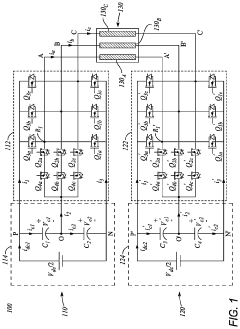
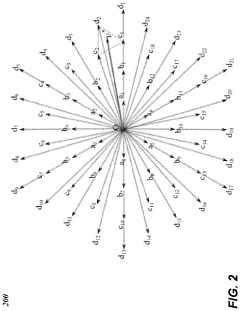
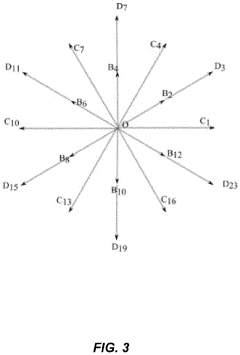
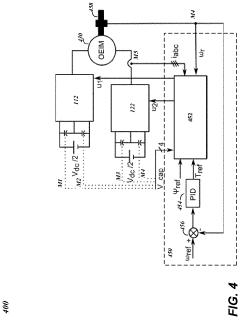
- Implementing a reduced switching state model predictive control (MPC) that incorporates common-mode voltage reduction/elimination (CMVR/CMVE) and DC link capacitor balancing, using a set of 219 or 115 reduced switching states to minimize computation time and improve performance, specifically for 5-level dual T-type multilevel converters connected to three-phase open-end induction motors.
Robust performance improvement method for model prediction control of permanent magnet synchronous motor
PatentActiveCN111987943A
Innovation
- Development of Finite Control Set Model Predictive Control (FCS-MPC) algorithm that transforms complex cost function optimization into integer programming problems, making MPC applicable in motor drive systems with high switching frequencies.
- Utilization of the discrete switching characteristics of inverters to establish a finite control set composed of eight basic switching combinations of two-level voltage source inverters, simplifying the control input space.
- Application of exhaustive search optimization method to obtain the optimal solution of the cost function in permanent magnet synchronous motor control systems.


ROI Analysis of MPC Energy Solutions
The implementation of Model Predictive Control (MPC) systems for energy management represents a significant capital investment that requires thorough financial analysis. When evaluating the return on investment for MPC energy solutions, organizations typically observe payback periods ranging from 6 months to 3 years, depending on facility size, energy consumption patterns, and existing control infrastructure.
Initial implementation costs for MPC solutions include hardware components, software licensing, integration services, and staff training. For medium-sized industrial facilities, these upfront investments typically range from $50,000 to $250,000. However, larger enterprises with complex energy systems may see implementation costs exceeding $500,000.
Energy cost reduction serves as the primary ROI driver, with most facilities reporting 10-30% decreases in overall energy expenditure following MPC implementation. These savings stem from multiple optimization mechanisms: reduced peak demand charges (15-25% reduction), improved equipment efficiency (8-15% improvement), and decreased overall consumption (10-20% reduction). The financial impact becomes particularly significant in regions with high energy costs or volatile pricing structures.
Operational benefits further enhance ROI calculations beyond direct energy savings. MPC systems typically reduce maintenance costs by 5-15% through optimized equipment operation that minimizes wear and extends asset lifespans. Additionally, many organizations report labor savings of 5-10% as automation reduces manual intervention requirements for energy management tasks.
Risk mitigation represents another valuable ROI component often overlooked in traditional analyses. MPC systems provide enhanced resilience against energy price volatility, regulatory changes, and supply disruptions. Organizations implementing advanced MPC solutions report up to 40% reduction in energy-related operational disruptions, translating to significant avoided costs.
The ROI timeline typically follows a predictable pattern, with initial benefits appearing within 3-6 months of implementation. Full ROI realization generally occurs within 12-24 months as system optimization continues and operational efficiencies compound. Organizations implementing MPC solutions across multiple facilities often see accelerating returns as implementation expertise develops and best practices transfer between locations.
Initial implementation costs for MPC solutions include hardware components, software licensing, integration services, and staff training. For medium-sized industrial facilities, these upfront investments typically range from $50,000 to $250,000. However, larger enterprises with complex energy systems may see implementation costs exceeding $500,000.
Energy cost reduction serves as the primary ROI driver, with most facilities reporting 10-30% decreases in overall energy expenditure following MPC implementation. These savings stem from multiple optimization mechanisms: reduced peak demand charges (15-25% reduction), improved equipment efficiency (8-15% improvement), and decreased overall consumption (10-20% reduction). The financial impact becomes particularly significant in regions with high energy costs or volatile pricing structures.
Operational benefits further enhance ROI calculations beyond direct energy savings. MPC systems typically reduce maintenance costs by 5-15% through optimized equipment operation that minimizes wear and extends asset lifespans. Additionally, many organizations report labor savings of 5-10% as automation reduces manual intervention requirements for energy management tasks.
Risk mitigation represents another valuable ROI component often overlooked in traditional analyses. MPC systems provide enhanced resilience against energy price volatility, regulatory changes, and supply disruptions. Organizations implementing advanced MPC solutions report up to 40% reduction in energy-related operational disruptions, translating to significant avoided costs.
The ROI timeline typically follows a predictable pattern, with initial benefits appearing within 3-6 months of implementation. Full ROI realization generally occurs within 12-24 months as system optimization continues and operational efficiencies compound. Organizations implementing MPC solutions across multiple facilities often see accelerating returns as implementation expertise develops and best practices transfer between locations.
Integration with Renewable Energy Systems
The integration of Model Predictive Control (MPC) with renewable energy systems represents a significant advancement in sustainable energy management. Renewable energy sources such as solar and wind power are inherently variable and intermittent, creating challenges for grid stability and efficient energy utilization. MPC provides a sophisticated framework to address these challenges by optimizing energy production, storage, and consumption in real-time while accounting for future predictions.
When implemented in hybrid renewable energy systems, MPC algorithms can forecast renewable energy generation based on weather predictions, historical data patterns, and current conditions. These forecasts enable the controller to make proactive decisions about energy distribution, storage charging/discharging cycles, and load management. For instance, if the MPC system predicts abundant solar generation in the coming hours, it may reduce reliance on battery storage or conventional power sources, thereby maximizing renewable energy utilization and reducing operational costs.
The economic benefits of integrating MPC with renewable energy systems are substantial. Studies indicate that MPC implementation can improve renewable energy utilization by 15-25% compared to conventional control methods. This translates directly to reduced dependency on fossil fuels and lower energy costs. Additionally, MPC helps mitigate the financial impacts of renewable energy curtailment—a common issue when generation exceeds demand or transmission capacity—by optimizing storage and consumption patterns.
Energy storage systems, particularly batteries, benefit significantly from MPC integration. The controller can optimize charging and discharging cycles based on predicted renewable generation, grid demand, and electricity pricing. This intelligent management extends battery lifespan by preventing harmful charging patterns while maximizing economic value through strategic energy arbitrage—storing energy when prices are low and discharging when prices peak.
For microgrid applications, MPC facilitates seamless coordination between multiple renewable sources, storage systems, and loads. The controller can balance supply and demand while maintaining system stability and minimizing costs. This capability is particularly valuable in remote or island communities where grid reliability is critical and energy costs are typically high.
Recent advancements in MPC algorithms have further enhanced their effectiveness in renewable energy integration. Machine learning techniques now complement traditional MPC by improving prediction accuracy and adapting to changing system dynamics. These hybrid approaches demonstrate up to 30% improvement in energy cost reduction compared to conventional MPC implementations, particularly in environments with highly variable renewable resources.
When implemented in hybrid renewable energy systems, MPC algorithms can forecast renewable energy generation based on weather predictions, historical data patterns, and current conditions. These forecasts enable the controller to make proactive decisions about energy distribution, storage charging/discharging cycles, and load management. For instance, if the MPC system predicts abundant solar generation in the coming hours, it may reduce reliance on battery storage or conventional power sources, thereby maximizing renewable energy utilization and reducing operational costs.
The economic benefits of integrating MPC with renewable energy systems are substantial. Studies indicate that MPC implementation can improve renewable energy utilization by 15-25% compared to conventional control methods. This translates directly to reduced dependency on fossil fuels and lower energy costs. Additionally, MPC helps mitigate the financial impacts of renewable energy curtailment—a common issue when generation exceeds demand or transmission capacity—by optimizing storage and consumption patterns.
Energy storage systems, particularly batteries, benefit significantly from MPC integration. The controller can optimize charging and discharging cycles based on predicted renewable generation, grid demand, and electricity pricing. This intelligent management extends battery lifespan by preventing harmful charging patterns while maximizing economic value through strategic energy arbitrage—storing energy when prices are low and discharging when prices peak.
For microgrid applications, MPC facilitates seamless coordination between multiple renewable sources, storage systems, and loads. The controller can balance supply and demand while maintaining system stability and minimizing costs. This capability is particularly valuable in remote or island communities where grid reliability is critical and energy costs are typically high.
Recent advancements in MPC algorithms have further enhanced their effectiveness in renewable energy integration. Machine learning techniques now complement traditional MPC by improving prediction accuracy and adapting to changing system dynamics. These hybrid approaches demonstrate up to 30% improvement in energy cost reduction compared to conventional MPC implementations, particularly in environments with highly variable renewable resources.
Unlock deeper insights with PatSnap Eureka Quick Research — get a full tech report to explore trends and direct your research. Try now!
Generate Your Research Report Instantly with AI Agent
Supercharge your innovation with PatSnap Eureka AI Agent Platform!