

Model Predictive Control In Industrial Automation Systems
SEP 8, 20259 MIN READ
Generate Your Research Report Instantly with AI Agent
PatSnap Eureka helps you evaluate technical feasibility & market potential.
MPC Technology Evolution and Objectives
Model Predictive Control (MPC) emerged in the late 1970s as an advanced process control methodology, initially developed to address complex control challenges in oil refineries and petrochemical plants. The evolution of MPC technology has been closely tied to advancements in computational capabilities, mathematical optimization techniques, and industrial automation requirements.
The foundational concept of MPC involves using a dynamic model of the process to predict future behavior and optimize control actions over a receding horizon. Early implementations, known as Dynamic Matrix Control (DMC) and Identification and Command (IDCOM), laid the groundwork for modern MPC applications. These early systems were limited by computational constraints but demonstrated significant potential for improving process efficiency and stability.
Throughout the 1980s and 1990s, MPC technology underwent substantial refinement with the development of more sophisticated algorithms and mathematical frameworks. The introduction of state-space models, robust control techniques, and nonlinear MPC variants expanded the applicability of this technology across diverse industrial sectors. Concurrently, hardware improvements enabled real-time implementation of increasingly complex control strategies.
The 2000s witnessed the integration of MPC with other advanced control methodologies, including adaptive control, fuzzy logic, and neural networks. This integration enhanced the capability of MPC systems to handle process uncertainties, disturbances, and changing operating conditions. The development of explicit MPC formulations also facilitated implementation on systems with limited computational resources.
Recent technological advancements have focused on distributed MPC architectures for large-scale systems, economic MPC formulations that directly incorporate business objectives into control decisions, and stochastic MPC approaches that explicitly account for uncertainties in process dynamics and disturbances.
The primary objectives of MPC technology in industrial automation systems encompass several dimensions. Operationally, MPC aims to maintain process variables within specified constraints while optimizing performance metrics such as production efficiency, energy consumption, and product quality. Economically, the technology seeks to maximize profitability by balancing production targets against operational costs and market conditions.
From a technical perspective, MPC objectives include improving control performance through accurate prediction of system behavior, handling multivariable interactions effectively, and maintaining stability under varying conditions. Additionally, modern MPC implementations strive for enhanced robustness against model uncertainties and external disturbances, along with increased adaptability to changing process characteristics and operational requirements.
The future trajectory of MPC technology is oriented toward greater autonomy, self-learning capabilities, and seamless integration with industrial IoT ecosystems and digital twin technologies, positioning it as a cornerstone of Industry 4.0 initiatives.
The foundational concept of MPC involves using a dynamic model of the process to predict future behavior and optimize control actions over a receding horizon. Early implementations, known as Dynamic Matrix Control (DMC) and Identification and Command (IDCOM), laid the groundwork for modern MPC applications. These early systems were limited by computational constraints but demonstrated significant potential for improving process efficiency and stability.
Throughout the 1980s and 1990s, MPC technology underwent substantial refinement with the development of more sophisticated algorithms and mathematical frameworks. The introduction of state-space models, robust control techniques, and nonlinear MPC variants expanded the applicability of this technology across diverse industrial sectors. Concurrently, hardware improvements enabled real-time implementation of increasingly complex control strategies.
The 2000s witnessed the integration of MPC with other advanced control methodologies, including adaptive control, fuzzy logic, and neural networks. This integration enhanced the capability of MPC systems to handle process uncertainties, disturbances, and changing operating conditions. The development of explicit MPC formulations also facilitated implementation on systems with limited computational resources.
Recent technological advancements have focused on distributed MPC architectures for large-scale systems, economic MPC formulations that directly incorporate business objectives into control decisions, and stochastic MPC approaches that explicitly account for uncertainties in process dynamics and disturbances.
The primary objectives of MPC technology in industrial automation systems encompass several dimensions. Operationally, MPC aims to maintain process variables within specified constraints while optimizing performance metrics such as production efficiency, energy consumption, and product quality. Economically, the technology seeks to maximize profitability by balancing production targets against operational costs and market conditions.
From a technical perspective, MPC objectives include improving control performance through accurate prediction of system behavior, handling multivariable interactions effectively, and maintaining stability under varying conditions. Additionally, modern MPC implementations strive for enhanced robustness against model uncertainties and external disturbances, along with increased adaptability to changing process characteristics and operational requirements.
The future trajectory of MPC technology is oriented toward greater autonomy, self-learning capabilities, and seamless integration with industrial IoT ecosystems and digital twin technologies, positioning it as a cornerstone of Industry 4.0 initiatives.
Industrial Automation Market Demand Analysis
The industrial automation market is experiencing significant growth driven by the increasing need for operational efficiency, cost reduction, and process optimization across various sectors. The global industrial automation market was valued at approximately $191.89 billion in 2021 and is projected to reach $355.44 billion by 2028, growing at a CAGR of 9.2% during the forecast period. This robust growth reflects the expanding adoption of advanced control technologies, particularly Model Predictive Control (MPC) systems.
Manufacturing industries, including automotive, electronics, and consumer goods, represent the largest segment demanding MPC solutions. These sectors seek to enhance production efficiency, reduce energy consumption, and maintain consistent product quality through precise process control. The automotive industry alone has seen a 15% increase in MPC implementation for assembly line optimization over the past three years.
Process industries such as oil and gas, chemicals, and pharmaceuticals demonstrate particularly strong demand for MPC technologies. These sectors operate complex, continuous processes where even minor improvements in control efficiency can yield substantial financial benefits. In the chemical industry, MPC implementations have shown to reduce energy consumption by 5-10% while increasing throughput by 3-5%.
Regional analysis reveals that North America and Europe currently lead in MPC adoption, accounting for approximately 60% of the global market share. However, the Asia-Pacific region is experiencing the fastest growth rate at 12.3% annually, driven by rapid industrialization in China, India, and Southeast Asian countries.
Key market drivers include the increasing focus on sustainability and energy efficiency, with 78% of industrial companies citing these factors as primary motivations for implementing advanced control systems. The push toward Industry 4.0 and smart manufacturing has created a fertile environment for MPC technology integration, with 67% of manufacturers planning to increase investments in advanced process control over the next five years.
Labor shortages and rising labor costs are accelerating automation adoption, with companies reporting average labor cost savings of 15-20% following comprehensive automation implementations. Additionally, stringent regulatory requirements for product quality and process safety, particularly in pharmaceutical and food processing industries, are driving demand for precise control technologies like MPC.
Customer expectations are evolving toward more customized products with consistent quality, requiring flexible manufacturing systems with advanced control capabilities. This trend is particularly evident in consumer goods manufacturing, where production lines must rapidly adapt to changing product specifications while maintaining optimal efficiency.
Manufacturing industries, including automotive, electronics, and consumer goods, represent the largest segment demanding MPC solutions. These sectors seek to enhance production efficiency, reduce energy consumption, and maintain consistent product quality through precise process control. The automotive industry alone has seen a 15% increase in MPC implementation for assembly line optimization over the past three years.
Process industries such as oil and gas, chemicals, and pharmaceuticals demonstrate particularly strong demand for MPC technologies. These sectors operate complex, continuous processes where even minor improvements in control efficiency can yield substantial financial benefits. In the chemical industry, MPC implementations have shown to reduce energy consumption by 5-10% while increasing throughput by 3-5%.
Regional analysis reveals that North America and Europe currently lead in MPC adoption, accounting for approximately 60% of the global market share. However, the Asia-Pacific region is experiencing the fastest growth rate at 12.3% annually, driven by rapid industrialization in China, India, and Southeast Asian countries.
Key market drivers include the increasing focus on sustainability and energy efficiency, with 78% of industrial companies citing these factors as primary motivations for implementing advanced control systems. The push toward Industry 4.0 and smart manufacturing has created a fertile environment for MPC technology integration, with 67% of manufacturers planning to increase investments in advanced process control over the next five years.
Labor shortages and rising labor costs are accelerating automation adoption, with companies reporting average labor cost savings of 15-20% following comprehensive automation implementations. Additionally, stringent regulatory requirements for product quality and process safety, particularly in pharmaceutical and food processing industries, are driving demand for precise control technologies like MPC.
Customer expectations are evolving toward more customized products with consistent quality, requiring flexible manufacturing systems with advanced control capabilities. This trend is particularly evident in consumer goods manufacturing, where production lines must rapidly adapt to changing product specifications while maintaining optimal efficiency.
MPC Implementation Challenges in Industry
Despite the significant potential of Model Predictive Control (MPC) in industrial automation systems, several implementation challenges persist that limit its widespread adoption. One of the primary obstacles is the computational complexity associated with solving optimization problems in real-time. Industrial processes often require control decisions within milliseconds, yet traditional MPC algorithms may demand substantial computational resources, creating a fundamental mismatch between theoretical capabilities and practical requirements.
The development of accurate process models represents another significant hurdle. MPC performance directly correlates with model fidelity, yet industrial processes frequently exhibit nonlinear behaviors, time-varying parameters, and complex dynamics that prove difficult to capture mathematically. This modeling challenge becomes particularly acute in multivariable systems with strong interactions between process variables.
Economic considerations further complicate MPC implementation. The initial investment for MPC deployment encompasses software licensing, hardware upgrades, engineering services, and staff training. Many organizations struggle to quantify the return on investment, especially when comparing MPC with conventional control strategies that may appear more cost-effective in the short term despite offering inferior performance.
Technical expertise requirements present another barrier. Successful MPC implementation demands specialized knowledge spanning control theory, optimization techniques, and process engineering. The scarcity of professionals possessing this multidisciplinary expertise creates bottlenecks in project execution and ongoing system maintenance.
Integration with existing control infrastructure introduces additional complexity. Most industrial facilities operate with established distributed control systems (DCS) or programmable logic controllers (PLCs). Ensuring seamless communication between these legacy systems and advanced MPC solutions requires careful interface design and robust communication protocols.
Robustness and reliability concerns also impede adoption. Industrial environments demand control systems that maintain performance despite disturbances, sensor failures, and changing operating conditions. MPC algorithms must incorporate constraint handling mechanisms and fallback strategies to ensure safe operation under all circumstances.
Validation and regulatory compliance add another layer of complexity. In regulated industries such as pharmaceuticals or food processing, control systems must undergo rigorous validation procedures. Demonstrating that an MPC implementation consistently meets regulatory requirements can be time-consuming and documentation-intensive.
Finally, organizational resistance to change often undermines implementation efforts. Operators accustomed to conventional control approaches may resist transitioning to MPC-based systems, particularly when the underlying algorithms appear as "black boxes" with limited transparency in decision-making processes.
The development of accurate process models represents another significant hurdle. MPC performance directly correlates with model fidelity, yet industrial processes frequently exhibit nonlinear behaviors, time-varying parameters, and complex dynamics that prove difficult to capture mathematically. This modeling challenge becomes particularly acute in multivariable systems with strong interactions between process variables.
Economic considerations further complicate MPC implementation. The initial investment for MPC deployment encompasses software licensing, hardware upgrades, engineering services, and staff training. Many organizations struggle to quantify the return on investment, especially when comparing MPC with conventional control strategies that may appear more cost-effective in the short term despite offering inferior performance.
Technical expertise requirements present another barrier. Successful MPC implementation demands specialized knowledge spanning control theory, optimization techniques, and process engineering. The scarcity of professionals possessing this multidisciplinary expertise creates bottlenecks in project execution and ongoing system maintenance.
Integration with existing control infrastructure introduces additional complexity. Most industrial facilities operate with established distributed control systems (DCS) or programmable logic controllers (PLCs). Ensuring seamless communication between these legacy systems and advanced MPC solutions requires careful interface design and robust communication protocols.
Robustness and reliability concerns also impede adoption. Industrial environments demand control systems that maintain performance despite disturbances, sensor failures, and changing operating conditions. MPC algorithms must incorporate constraint handling mechanisms and fallback strategies to ensure safe operation under all circumstances.
Validation and regulatory compliance add another layer of complexity. In regulated industries such as pharmaceuticals or food processing, control systems must undergo rigorous validation procedures. Demonstrating that an MPC implementation consistently meets regulatory requirements can be time-consuming and documentation-intensive.
Finally, organizational resistance to change often undermines implementation efforts. Operators accustomed to conventional control approaches may resist transitioning to MPC-based systems, particularly when the underlying algorithms appear as "black boxes" with limited transparency in decision-making processes.
Current MPC Frameworks and Architectures
01 Industrial process control applications
Model Predictive Control (MPC) is widely applied in industrial processes to optimize operations and improve efficiency. These systems use mathematical models to predict future behavior and calculate optimal control actions. MPC algorithms can handle complex constraints and multiple variables simultaneously, making them suitable for manufacturing, chemical processing, and other industrial applications where precise control is critical for product quality and operational efficiency.- Industrial Process Control Applications: Model Predictive Control (MPC) is widely applied in industrial processes to optimize operations and improve efficiency. These systems use mathematical models to predict future process behavior and calculate optimal control actions. MPC algorithms can handle complex constraints and multiple variables simultaneously, making them particularly valuable in manufacturing, chemical processing, and energy production where precise control is critical for product quality and operational safety.
- Automotive and Vehicle Control Systems: Model Predictive Control is increasingly implemented in automotive applications for advanced driver assistance systems and autonomous driving technologies. These control systems predict vehicle dynamics and traffic conditions to optimize trajectory planning, speed control, and fuel efficiency. MPC algorithms in vehicles can balance multiple objectives such as safety, comfort, and energy consumption while respecting physical constraints and regulatory requirements.
- Energy Management and Optimization: MPC frameworks are employed in energy management systems to optimize resource allocation, reduce consumption, and integrate renewable energy sources. These control strategies can predict energy demand patterns, weather conditions, and market prices to make optimal decisions about generation, storage, and distribution. The predictive capabilities allow for proactive management of energy resources while maintaining system stability and meeting operational constraints.
- Advanced Learning and Adaptive MPC: Recent developments in Model Predictive Control incorporate machine learning techniques to enhance model accuracy and adaptability. These systems can learn from historical data and operational experience to improve prediction quality and control performance over time. Adaptive MPC approaches can automatically adjust their internal models to account for changing system dynamics or operating conditions, making them more robust against uncertainties and disturbances.
- Distributed and Networked MPC Systems: Distributed Model Predictive Control architectures enable coordination among multiple interconnected subsystems while maintaining computational efficiency. These approaches divide large-scale control problems into smaller, more manageable components that communicate and collaborate to achieve global objectives. Networked MPC systems can handle communication delays, data loss, and synchronization issues while providing robust performance for complex systems like smart grids, water networks, or large industrial facilities.
02 Energy management and optimization
Model Predictive Control techniques are implemented in energy systems to optimize consumption, distribution, and generation. These controllers predict energy demands and environmental conditions to adjust operations proactively. By incorporating weather forecasts, usage patterns, and equipment constraints, MPC systems can significantly reduce energy costs while maintaining comfort levels in buildings or efficiency in power generation facilities. This approach enables better integration of renewable energy sources and improves overall system resilience.Expand Specific Solutions03 Automotive and vehicle control systems
Model Predictive Control is increasingly used in automotive applications for advanced driver assistance systems and autonomous driving technologies. These controllers predict vehicle dynamics and traffic conditions to optimize trajectory planning, speed control, and fuel efficiency. MPC algorithms can balance multiple objectives such as safety, comfort, and energy consumption while respecting vehicle limitations and traffic rules. The predictive nature allows vehicles to anticipate changes in driving conditions and respond proactively rather than reactively.Expand Specific Solutions04 Machine learning enhanced MPC
Integration of machine learning techniques with Model Predictive Control creates more adaptive and robust control systems. These hybrid approaches use data-driven methods to improve model accuracy and controller performance over time. Neural networks and other AI techniques can identify patterns in system behavior that might be difficult to model using first principles alone. This combination allows controllers to handle uncertainties, disturbances, and changing conditions more effectively while maintaining computational efficiency and control performance.Expand Specific Solutions05 Distributed and networked MPC architectures
Distributed Model Predictive Control architectures enable coordination of multiple subsystems across networked environments. These approaches divide complex control problems into manageable components while maintaining overall system performance. Communication protocols and coordination strategies allow individual controllers to share information and collaborate toward global objectives. This architecture is particularly valuable for large-scale systems such as smart grids, water networks, and manufacturing facilities where centralized control would be computationally prohibitive or vulnerable to single-point failures.Expand Specific Solutions
Leading MPC Solution Providers
Model Predictive Control (MPC) in industrial automation is currently in a mature growth phase, with the global market expected to reach significant expansion due to increasing demand for process optimization and energy efficiency. The technology has evolved from theoretical concepts to practical implementations across various industries. Leading players include Siemens AG, ABB Group, Honeywell International, and Rockwell Automation, who have established strong market positions through comprehensive MPC solutions. Mitsubishi Electric, Emerson (Fisher-Rosemount), and OMRON are advancing specialized applications, while automotive manufacturers like Toyota and Nissan are implementing MPC for vehicle control systems. Academic institutions such as Zhejiang University and Central South University collaborate with industry partners to drive innovation in this field.
Rockwell Automation Technologies, Inc.
Technical Solution: Rockwell Automation has developed a comprehensive Model Predictive Control (MPC) solution called "Pavilion8" that integrates with their broader FactoryTalk analytics platform. Their approach combines traditional MPC with machine learning capabilities to create adaptive control systems that continuously improve performance over time. The Pavilion8 MPC technology employs multi-variable control algorithms that can handle hundreds of process variables simultaneously while respecting operational constraints. Their implementation includes a virtual process model that runs in parallel with the physical system, allowing for real-time optimization and what-if scenario analysis. Rockwell's MPC solution is particularly notable for its integration capabilities with existing control systems, enabling phased implementation without requiring complete system overhauls. The technology has demonstrated significant improvements in process stability, reduced energy consumption, and increased throughput across various industrial applications including oil refining, chemical processing, and food production.
Strengths: Seamless integration with existing automation infrastructure; robust handling of process constraints; proven track record across multiple industries with documented ROI. Weaknesses: Higher initial implementation costs compared to traditional control methods; requires significant process expertise for model development and maintenance; performance depends on model accuracy which can degrade over time without proper calibration.
Mitsubishi Electric Corp.
Technical Solution: Mitsubishi Electric has developed the MELSEC-Q series PLC-based Model Predictive Control solution that brings advanced process control capabilities to their automation platform. Their approach focuses on making MPC technology accessible to traditional PLC environments through specialized function blocks that can be integrated into standard ladder logic programming. Mitsubishi's implementation includes a simplified modeling interface that allows process engineers to develop control models without extensive mathematical expertise, using process response data to automatically generate appropriate models. Their MPC solution features a unique "warm start" capability that ensures smooth controller transitions during mode changes or after maintenance periods. The technology incorporates specialized algorithms for handling input constraints and rate-of-change limitations that are common in industrial equipment protection scenarios. Mitsubishi has successfully deployed this technology in various applications including HVAC systems, water treatment facilities, and discrete manufacturing processes where traditional PID control struggles with multiple interacting variables. Their implementation is particularly notable for its ability to function effectively with limited computational resources, making it suitable for distributed control applications where processing power may be constrained.
Strengths: Excellent integration with existing PLC infrastructure; lower implementation complexity compared to traditional MPC systems; reduced hardware requirements; accessible to engineers without specialized control theory background. Weaknesses: Limited handling of highly complex nonlinear systems; fewer advanced features compared to dedicated MPC platforms; constraints on model size and complexity; less suitable for very large-scale processes with hundreds of variables.
Key Patents and Algorithms in MPC
Model predictive control systems for process automation plants
PatentWO2024182167A1
Innovation
- The implementation of a model predictive control (MPC) system that includes multiple MPC models corresponding to different operating states, allowing for automatic or manual switching based on current state parameters, and the use of clustering algorithms and online model estimation to dynamically adjust process models, ensuring accurate control across varying operational conditions.


Integrated optimal model predictive control in a process control system
PatentInactiveUS6721609B1
Innovation
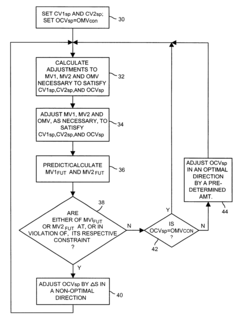
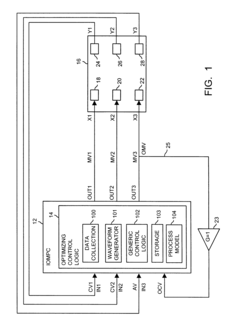
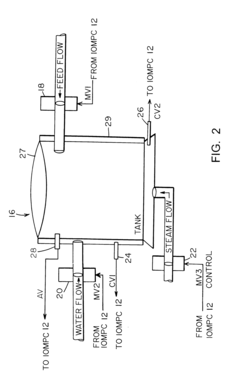
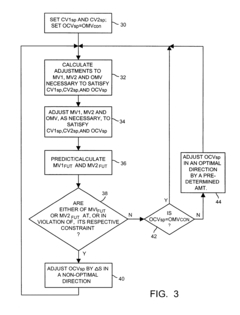
- A multi-input/multi-output logic controller with a feedback path and setpoint adjustment unit that monitors and adjusts process outputs to prevent constraint limit violations, using a model predictive controller to optimize process inputs and maintain desired setpoints while avoiding physical constraint limits.
Energy Efficiency Impact of MPC Systems
Model Predictive Control (MPC) systems have demonstrated significant potential for enhancing energy efficiency across various industrial automation applications. The implementation of MPC algorithms has shown energy consumption reductions ranging from 10% to 30% compared to conventional control methods, depending on the specific industry and process characteristics.
In manufacturing environments, MPC systems optimize energy usage by precisely predicting future process states and calculating optimal control actions that minimize energy consumption while maintaining production targets. For instance, in cement production facilities, MPC implementations have achieved energy savings of approximately 15% by optimizing kiln operations through predictive thermal management.
The chemical processing industry has witnessed particularly impressive results, with MPC systems reducing steam consumption by up to 25% in distillation columns. These systems accomplish this by continuously adjusting operating parameters based on economic objectives that balance production requirements with energy costs, effectively minimizing the specific energy consumption per unit of product.
HVAC systems in industrial facilities represent another area where MPC delivers substantial energy benefits. By incorporating weather forecasts, occupancy patterns, and thermal dynamics into control decisions, MPC-based climate control systems can reduce heating and cooling energy requirements by 20-25% compared to traditional PID controllers, while maintaining or improving comfort conditions.
The energy efficiency advantages of MPC extend to utility systems as well. In industrial boiler operations, predictive control strategies have demonstrated fuel savings of 10-15% by optimizing combustion parameters, managing load variations, and reducing unnecessary cycling. Similarly, in compressed air systems, MPC implementation has shown electricity consumption reductions of approximately 18% through optimal compressor sequencing and pressure management.
Long-term operational data indicates that MPC systems maintain their efficiency benefits over time, with some implementations showing continuous improvement through adaptive algorithms that refine their predictive models based on actual performance data. The return on investment for energy-focused MPC projects typically ranges from 6 to 24 months, depending on the scale and complexity of the industrial process.
As energy costs continue to rise and environmental regulations become more stringent, the energy efficiency impact of MPC systems represents an increasingly valuable proposition for industrial operators seeking both operational cost reductions and sustainability improvements.
In manufacturing environments, MPC systems optimize energy usage by precisely predicting future process states and calculating optimal control actions that minimize energy consumption while maintaining production targets. For instance, in cement production facilities, MPC implementations have achieved energy savings of approximately 15% by optimizing kiln operations through predictive thermal management.
The chemical processing industry has witnessed particularly impressive results, with MPC systems reducing steam consumption by up to 25% in distillation columns. These systems accomplish this by continuously adjusting operating parameters based on economic objectives that balance production requirements with energy costs, effectively minimizing the specific energy consumption per unit of product.
HVAC systems in industrial facilities represent another area where MPC delivers substantial energy benefits. By incorporating weather forecasts, occupancy patterns, and thermal dynamics into control decisions, MPC-based climate control systems can reduce heating and cooling energy requirements by 20-25% compared to traditional PID controllers, while maintaining or improving comfort conditions.
The energy efficiency advantages of MPC extend to utility systems as well. In industrial boiler operations, predictive control strategies have demonstrated fuel savings of 10-15% by optimizing combustion parameters, managing load variations, and reducing unnecessary cycling. Similarly, in compressed air systems, MPC implementation has shown electricity consumption reductions of approximately 18% through optimal compressor sequencing and pressure management.
Long-term operational data indicates that MPC systems maintain their efficiency benefits over time, with some implementations showing continuous improvement through adaptive algorithms that refine their predictive models based on actual performance data. The return on investment for energy-focused MPC projects typically ranges from 6 to 24 months, depending on the scale and complexity of the industrial process.
As energy costs continue to rise and environmental regulations become more stringent, the energy efficiency impact of MPC systems represents an increasingly valuable proposition for industrial operators seeking both operational cost reductions and sustainability improvements.
Integration with Industry 4.0 Technologies
The convergence of Model Predictive Control (MPC) with Industry 4.0 technologies represents a transformative integration that significantly enhances industrial automation capabilities. This integration leverages the predictive optimization strengths of MPC alongside the connectivity and intelligence features of Industry 4.0, creating systems with unprecedented adaptability and efficiency.
MPC's integration with Industrial Internet of Things (IIoT) infrastructure enables real-time data collection from distributed sensors throughout production environments. This continuous data stream provides MPC algorithms with comprehensive operational visibility, allowing for more accurate process modeling and prediction. The resulting control decisions benefit from a holistic understanding of system states rather than isolated process variables.
Cloud computing platforms have revolutionized MPC implementation by providing scalable computational resources for handling complex optimization calculations. This cloud-based approach eliminates traditional hardware constraints, enabling more sophisticated control models with longer prediction horizons and consideration of additional variables and constraints. Furthermore, edge computing architectures complement cloud solutions by performing time-sensitive calculations directly at production sites, reducing latency for critical control decisions.
Advanced data analytics and machine learning algorithms enhance MPC performance through continuous model refinement. These technologies identify patterns in historical process data, automatically updating internal models to reflect changing equipment conditions or material properties. This self-tuning capability maintains optimal control performance despite system degradation or environmental variations.
Digital twin technology creates virtual replicas of physical production systems that operate in parallel with MPC controllers. These digital twins serve as simulation environments for testing control strategies before implementation and provide reference models for detecting anomalies in actual system behavior. When integrated with MPC, digital twins enable predictive maintenance by forecasting equipment failures before they impact production.
Augmented reality interfaces are transforming how operators interact with MPC systems. These interfaces overlay critical process information and control recommendations onto physical equipment views, enabling intuitive monitoring and adjustment of complex control parameters. This technology bridges the gap between sophisticated algorithmic control and human supervision, particularly valuable during process transitions or unexpected disturbances.
Cybersecurity frameworks have evolved specifically for protecting MPC implementations in connected industrial environments. These frameworks employ encryption, authentication protocols, and intrusion detection systems tailored to the real-time requirements of control systems, ensuring that the benefits of connectivity do not compromise operational security.
MPC's integration with Industrial Internet of Things (IIoT) infrastructure enables real-time data collection from distributed sensors throughout production environments. This continuous data stream provides MPC algorithms with comprehensive operational visibility, allowing for more accurate process modeling and prediction. The resulting control decisions benefit from a holistic understanding of system states rather than isolated process variables.
Cloud computing platforms have revolutionized MPC implementation by providing scalable computational resources for handling complex optimization calculations. This cloud-based approach eliminates traditional hardware constraints, enabling more sophisticated control models with longer prediction horizons and consideration of additional variables and constraints. Furthermore, edge computing architectures complement cloud solutions by performing time-sensitive calculations directly at production sites, reducing latency for critical control decisions.
Advanced data analytics and machine learning algorithms enhance MPC performance through continuous model refinement. These technologies identify patterns in historical process data, automatically updating internal models to reflect changing equipment conditions or material properties. This self-tuning capability maintains optimal control performance despite system degradation or environmental variations.
Digital twin technology creates virtual replicas of physical production systems that operate in parallel with MPC controllers. These digital twins serve as simulation environments for testing control strategies before implementation and provide reference models for detecting anomalies in actual system behavior. When integrated with MPC, digital twins enable predictive maintenance by forecasting equipment failures before they impact production.
Augmented reality interfaces are transforming how operators interact with MPC systems. These interfaces overlay critical process information and control recommendations onto physical equipment views, enabling intuitive monitoring and adjustment of complex control parameters. This technology bridges the gap between sophisticated algorithmic control and human supervision, particularly valuable during process transitions or unexpected disturbances.
Cybersecurity frameworks have evolved specifically for protecting MPC implementations in connected industrial environments. These frameworks employ encryption, authentication protocols, and intrusion detection systems tailored to the real-time requirements of control systems, ensuring that the benefits of connectivity do not compromise operational security.
Unlock deeper insights with PatSnap Eureka Quick Research — get a full tech report to explore trends and direct your research. Try now!
Generate Your Research Report Instantly with AI Agent
Supercharge your innovation with PatSnap Eureka AI Agent Platform!