

Model Predictive Control For Advanced Industrial Processes
SEP 5, 20259 MIN READ
Generate Your Research Report Instantly with AI Agent
PatSnap Eureka helps you evaluate technical feasibility & market potential.
MPC Technology Evolution and Objectives
Model Predictive Control (MPC) emerged in the late 1970s as a revolutionary approach to process control, initially developed to address the complex control challenges in oil refineries and petrochemical plants. The fundamental concept behind MPC involves using a dynamic model of the process to predict future behavior and optimize control actions accordingly, distinguishing it from traditional PID controllers that rely solely on past errors.
The evolution of MPC technology can be traced through several distinct phases. The first generation, developed in the 1980s, focused on linear models with constraints, primarily implemented in large-scale industrial processes where the economic benefits could justify the significant computational requirements. During the 1990s, the second generation introduced more sophisticated algorithms and expanded the application scope to include a wider range of industrial processes.
The early 2000s marked a significant turning point with the advent of faster computing capabilities, enabling real-time implementation of increasingly complex MPC algorithms. This third generation saw the integration of nonlinear models and robust control techniques, addressing previously challenging process dynamics and uncertainties.
Current state-of-the-art MPC technology, representing the fourth generation, incorporates machine learning techniques, adaptive models, and distributed computing architectures. These advancements have dramatically expanded the applicability of MPC across diverse industrial sectors, including energy systems, manufacturing, automotive, aerospace, and even biomedical applications.
The primary objectives of modern MPC technology in advanced industrial processes include optimizing process efficiency, ensuring product quality consistency, minimizing energy consumption, and reducing environmental impact. Additionally, MPC aims to enhance operational safety by maintaining process variables within specified constraints while responding effectively to disturbances and setpoint changes.
Looking forward, the technological trajectory of MPC is moving toward greater autonomy, with self-tuning capabilities and integration with artificial intelligence systems. The convergence of MPC with Industry 4.0 technologies presents opportunities for unprecedented levels of process optimization and operational excellence.
A critical objective for future MPC development is reducing implementation complexity while maintaining performance benefits, making this advanced control strategy accessible to smaller-scale operations and processes with limited engineering resources. This democratization of MPC technology represents a significant frontier in the ongoing evolution of industrial process control.
The evolution of MPC technology can be traced through several distinct phases. The first generation, developed in the 1980s, focused on linear models with constraints, primarily implemented in large-scale industrial processes where the economic benefits could justify the significant computational requirements. During the 1990s, the second generation introduced more sophisticated algorithms and expanded the application scope to include a wider range of industrial processes.
The early 2000s marked a significant turning point with the advent of faster computing capabilities, enabling real-time implementation of increasingly complex MPC algorithms. This third generation saw the integration of nonlinear models and robust control techniques, addressing previously challenging process dynamics and uncertainties.
Current state-of-the-art MPC technology, representing the fourth generation, incorporates machine learning techniques, adaptive models, and distributed computing architectures. These advancements have dramatically expanded the applicability of MPC across diverse industrial sectors, including energy systems, manufacturing, automotive, aerospace, and even biomedical applications.
The primary objectives of modern MPC technology in advanced industrial processes include optimizing process efficiency, ensuring product quality consistency, minimizing energy consumption, and reducing environmental impact. Additionally, MPC aims to enhance operational safety by maintaining process variables within specified constraints while responding effectively to disturbances and setpoint changes.
Looking forward, the technological trajectory of MPC is moving toward greater autonomy, with self-tuning capabilities and integration with artificial intelligence systems. The convergence of MPC with Industry 4.0 technologies presents opportunities for unprecedented levels of process optimization and operational excellence.
A critical objective for future MPC development is reducing implementation complexity while maintaining performance benefits, making this advanced control strategy accessible to smaller-scale operations and processes with limited engineering resources. This democratization of MPC technology represents a significant frontier in the ongoing evolution of industrial process control.
Industrial Process Control Market Analysis
The industrial process control market is experiencing significant growth driven by the increasing adoption of advanced control technologies, particularly Model Predictive Control (MPC). The global market for industrial process control systems was valued at approximately 70 billion USD in 2022 and is projected to reach 110 billion USD by 2028, representing a compound annual growth rate of 7.8%. This growth is primarily fueled by the rising demand for automation and optimization in manufacturing processes across various industries.
The oil and gas sector currently dominates the industrial process control market, accounting for roughly 30% of the total market share. This is followed by chemical and petrochemical industries at 25%, power generation at 15%, and food and beverage at 10%. The remaining market share is distributed among pharmaceuticals, mining, and other manufacturing sectors. The adoption of MPC technology shows particularly strong growth in chemical processing and oil refining, where complex processes with multiple variables and constraints are common.
Geographically, North America leads the market with approximately 35% share, followed by Europe at 28% and Asia-Pacific at 25%. The Asia-Pacific region, particularly China and India, is expected to witness the highest growth rate in the coming years due to rapid industrialization and increasing investments in manufacturing infrastructure.
The market is characterized by a shift from traditional Proportional-Integral-Derivative (PID) controllers to more sophisticated MPC systems. This transition is driven by the need for improved process efficiency, reduced energy consumption, and stricter regulatory requirements regarding product quality and environmental impact. Industries are increasingly recognizing the value of MPC in handling complex, multivariable processes with constraints and time delays.
Customer demand is primarily focused on solutions that offer seamless integration with existing systems, user-friendly interfaces, and demonstrable return on investment. End-users are particularly interested in MPC technologies that can adapt to changing process conditions and provide predictive maintenance capabilities. The growing trend toward Industry 4.0 and smart manufacturing is further accelerating the adoption of advanced process control solutions.
Market research indicates that companies implementing MPC technology typically achieve 2-5% improvement in throughput, 3-8% reduction in energy consumption, and 5-15% decrease in quality variations. These tangible benefits are driving the business case for MPC adoption across various industrial sectors, despite the higher initial investment compared to conventional control systems.
The oil and gas sector currently dominates the industrial process control market, accounting for roughly 30% of the total market share. This is followed by chemical and petrochemical industries at 25%, power generation at 15%, and food and beverage at 10%. The remaining market share is distributed among pharmaceuticals, mining, and other manufacturing sectors. The adoption of MPC technology shows particularly strong growth in chemical processing and oil refining, where complex processes with multiple variables and constraints are common.
Geographically, North America leads the market with approximately 35% share, followed by Europe at 28% and Asia-Pacific at 25%. The Asia-Pacific region, particularly China and India, is expected to witness the highest growth rate in the coming years due to rapid industrialization and increasing investments in manufacturing infrastructure.
The market is characterized by a shift from traditional Proportional-Integral-Derivative (PID) controllers to more sophisticated MPC systems. This transition is driven by the need for improved process efficiency, reduced energy consumption, and stricter regulatory requirements regarding product quality and environmental impact. Industries are increasingly recognizing the value of MPC in handling complex, multivariable processes with constraints and time delays.
Customer demand is primarily focused on solutions that offer seamless integration with existing systems, user-friendly interfaces, and demonstrable return on investment. End-users are particularly interested in MPC technologies that can adapt to changing process conditions and provide predictive maintenance capabilities. The growing trend toward Industry 4.0 and smart manufacturing is further accelerating the adoption of advanced process control solutions.
Market research indicates that companies implementing MPC technology typically achieve 2-5% improvement in throughput, 3-8% reduction in energy consumption, and 5-15% decrease in quality variations. These tangible benefits are driving the business case for MPC adoption across various industrial sectors, despite the higher initial investment compared to conventional control systems.
MPC Implementation Challenges and Constraints
Despite the significant advantages of Model Predictive Control (MPC) in advanced industrial processes, implementing this technology presents numerous challenges that must be carefully addressed. One of the primary obstacles is the computational complexity associated with solving optimization problems in real-time. As industrial processes become more complex with multiple variables and constraints, the computational burden increases exponentially, potentially leading to issues with meeting critical control deadlines in fast-dynamic systems.
Model development and validation represent another significant challenge. Creating accurate process models requires extensive process knowledge, historical data, and validation procedures. Many industrial processes exhibit nonlinear behaviors, time-varying parameters, and complex dynamics that are difficult to capture in mathematical models. Inaccurate models can lead to suboptimal control performance or even system instability.
The integration of MPC systems with existing control infrastructure presents technical hurdles. Legacy systems often operate on different platforms with proprietary protocols, making seamless communication between MPC controllers and existing SCADA or DCS systems challenging. This integration complexity can significantly increase implementation costs and timelines.
Constraint handling, while a strength of MPC, also introduces implementation difficulties. Real-world processes have numerous operational constraints related to equipment limitations, safety requirements, and product quality specifications. Properly defining these constraints in the MPC framework requires careful engineering judgment and extensive process knowledge.
Economic considerations further complicate MPC implementation. The initial investment for MPC projects is substantial, including costs for modeling, software, hardware, integration, and training. Organizations must carefully evaluate the return on investment, which may not be immediately apparent, especially for processes with thin profit margins.
Maintenance and sustainability of MPC systems present ongoing challenges. As processes evolve or equipment ages, models may become less accurate, requiring regular updates and revalidation. This necessitates maintaining specialized expertise within the organization or relying on external consultants, both of which have associated costs and knowledge management implications.
Human factors also play a crucial role in successful MPC implementation. Operator acceptance and understanding are essential, as resistance to new control technologies can undermine even technically sound implementations. Training requirements are substantial, and the transition from conventional control approaches to advanced MPC strategies requires careful change management.
Regulatory compliance adds another layer of complexity, particularly in highly regulated industries such as pharmaceuticals or food processing. MPC implementations must demonstrate compliance with relevant standards and regulations, which may require additional validation efforts and documentation.
Model development and validation represent another significant challenge. Creating accurate process models requires extensive process knowledge, historical data, and validation procedures. Many industrial processes exhibit nonlinear behaviors, time-varying parameters, and complex dynamics that are difficult to capture in mathematical models. Inaccurate models can lead to suboptimal control performance or even system instability.
The integration of MPC systems with existing control infrastructure presents technical hurdles. Legacy systems often operate on different platforms with proprietary protocols, making seamless communication between MPC controllers and existing SCADA or DCS systems challenging. This integration complexity can significantly increase implementation costs and timelines.
Constraint handling, while a strength of MPC, also introduces implementation difficulties. Real-world processes have numerous operational constraints related to equipment limitations, safety requirements, and product quality specifications. Properly defining these constraints in the MPC framework requires careful engineering judgment and extensive process knowledge.
Economic considerations further complicate MPC implementation. The initial investment for MPC projects is substantial, including costs for modeling, software, hardware, integration, and training. Organizations must carefully evaluate the return on investment, which may not be immediately apparent, especially for processes with thin profit margins.
Maintenance and sustainability of MPC systems present ongoing challenges. As processes evolve or equipment ages, models may become less accurate, requiring regular updates and revalidation. This necessitates maintaining specialized expertise within the organization or relying on external consultants, both of which have associated costs and knowledge management implications.
Human factors also play a crucial role in successful MPC implementation. Operator acceptance and understanding are essential, as resistance to new control technologies can undermine even technically sound implementations. Training requirements are substantial, and the transition from conventional control approaches to advanced MPC strategies requires careful change management.
Regulatory compliance adds another layer of complexity, particularly in highly regulated industries such as pharmaceuticals or food processing. MPC implementations must demonstrate compliance with relevant standards and regulations, which may require additional validation efforts and documentation.
Current MPC Algorithms and Frameworks
01 Industrial Process Control Applications of MPC
Model Predictive Control (MPC) is widely implemented in industrial process control systems to optimize operations and improve efficiency. These applications include manufacturing processes, chemical plants, and production lines where MPC algorithms predict future system behavior based on dynamic models and adjust control variables accordingly. The technology enables real-time optimization while handling constraints and multiple variables simultaneously, resulting in improved product quality, reduced energy consumption, and enhanced operational stability.- Industrial process control applications of MPC: Model Predictive Control (MPC) is widely applied in industrial processes to optimize operations and improve efficiency. These applications include manufacturing systems, chemical processes, and production lines where MPC algorithms predict future behaviors based on dynamic models of the process. The control strategy calculates optimal control actions while considering constraints and multiple variables, resulting in improved product quality, reduced energy consumption, and enhanced operational stability.
- Energy management systems using MPC: MPC techniques are implemented in energy management systems to optimize power generation, distribution, and consumption. These control systems predict energy demands and adjust operations accordingly while considering constraints such as equipment limitations and environmental factors. The predictive capabilities allow for better integration of renewable energy sources, load balancing, and demand response, ultimately leading to improved grid stability and reduced operational costs.
- Vehicle and transportation control systems: Model Predictive Control is applied in vehicle and transportation systems to enhance performance, safety, and efficiency. MPC algorithms predict vehicle behavior and traffic conditions to optimize routing, speed, and fuel consumption. These systems can handle complex constraints related to vehicle dynamics, passenger comfort, and regulatory requirements while adapting to changing environmental conditions and traffic patterns.
- Integration of MPC with machine learning and AI: Advanced implementations of Model Predictive Control incorporate machine learning and artificial intelligence techniques to enhance prediction accuracy and adaptability. These hybrid systems can learn from historical data to improve model parameters, identify patterns, and adapt to changing conditions. The integration allows for more robust control strategies that can handle uncertainties, disturbances, and nonlinear behaviors in complex systems.
- MPC for resource optimization and constraint handling: Model Predictive Control excels in optimizing resource allocation while handling multiple constraints simultaneously. These applications focus on maximizing efficiency in systems with limited resources, such as manufacturing processes, water distribution networks, or supply chains. The MPC framework allows for explicit consideration of operational constraints, equipment limitations, and quality requirements while optimizing for objectives like cost minimization or throughput maximization.
02 Energy Management and Power Systems
MPC technology is extensively applied in energy management and power systems to optimize energy usage, balance supply and demand, and integrate renewable energy sources. The predictive capabilities allow these systems to anticipate changes in energy demand or supply conditions and proactively adjust control parameters. This approach enables more efficient grid management, reduced operational costs, and improved stability in power distribution networks while accommodating the variability inherent in renewable energy generation.Expand Specific Solutions03 Advanced Manufacturing and Production Optimization
In advanced manufacturing environments, MPC algorithms optimize production processes by predicting system behavior and adjusting control parameters to maintain optimal operating conditions. These systems can simultaneously manage multiple constraints and objectives while adapting to changing production requirements. The technology enables manufacturers to improve product quality, reduce waste, increase throughput, and enhance overall equipment effectiveness through predictive rather than reactive control strategies.Expand Specific Solutions04 Automotive and Vehicle Control Systems
MPC technology is implemented in automotive and vehicle control systems to enhance performance, efficiency, and safety. These applications include engine management, transmission control, autonomous driving features, and vehicle dynamics management. By predicting vehicle behavior and optimizing control actions, MPC systems can improve fuel efficiency, reduce emissions, enhance driving comfort, and support advanced driver assistance systems through anticipatory rather than reactive control approaches.Expand Specific Solutions05 MPC Algorithm Development and Implementation Methods
Significant research focuses on developing and implementing MPC algorithms with improved computational efficiency, robustness, and adaptability. These developments include techniques for handling model uncertainties, reducing computational complexity, implementing distributed MPC architectures, and integrating machine learning approaches. Advanced implementation methods enable MPC to be deployed in systems with limited computational resources or those requiring rapid response times while maintaining control performance and stability guarantees.Expand Specific Solutions
Leading MPC Technology Providers and Competitors
Model Predictive Control (MPC) for advanced industrial processes is evolving rapidly in a maturing market estimated at $500-700 million annually with 8-10% growth. The competitive landscape features established automation giants like Siemens AG, Honeywell International, ABB Group, and Yokogawa Electric dominating with comprehensive solutions, while specialized players such as Rockwell Automation and Emerson (Fisher-Rosemount) focus on industry-specific implementations. Recent entrants like Phaidra are disrupting with AI-enhanced MPC solutions. Technology maturity varies across sectors, with oil/gas and chemical processing having well-established implementations, while newer applications in renewable energy and smart manufacturing remain in early adoption phases. Academic institutions like Central South University and Northeastern University are advancing theoretical frameworks, creating a dynamic ecosystem of innovation and commercialization.
Fisher-Rosemount Systems, Inc.
Technical Solution: Fisher-Rosemount Systems has developed DeltaV Predict, an advanced model predictive control solution integrated within their DeltaV distributed control system. This technology implements multivariable predictive control algorithms that simultaneously manipulate multiple process inputs while accounting for constraints and interactions between variables. Their approach uses dynamic matrix control (DMC) methodology with step response models that capture the relationship between manipulated variables and controlled outputs. The system features adaptive capabilities that automatically update models based on real-time process data, ensuring control performance remains optimal despite process changes or equipment degradation. DeltaV Predict includes tools for automated step testing and model identification that significantly reduce implementation time compared to traditional MPC deployments. The solution also incorporates economic optimization functionality that allows users to maximize process profitability while maintaining stable operation within constraints.
Strengths: Seamless integration with existing DeltaV control systems reduces implementation complexity; adaptive modeling capabilities maintain performance over time without extensive retuning. Weaknesses: Requires significant process knowledge for initial configuration; may have higher computational requirements than simpler control strategies; effectiveness depends on quality of initial process models.
Honeywell International Technologies Ltd.
Technical Solution: Honeywell's Profit Controller is their flagship Model Predictive Control (MPC) solution designed for complex industrial processes. The technology employs a multivariable control framework that predicts future process behavior using dynamic models and optimizes control actions accordingly. Profit Controller utilizes state-space models that capture complex process dynamics and interactions between variables, allowing for robust handling of process constraints and disturbances. The system incorporates Honeywell's patented Robust MPC algorithms that maintain stability even with model uncertainties and process variations. Their implementation includes automated step testing and model identification tools that reduce commissioning time by up to 50% compared to traditional approaches. Honeywell has enhanced their MPC technology with machine learning capabilities that continuously improve model accuracy based on operational data. The solution also features economic optimization functionality that maximizes process profitability while maintaining stable operation within defined constraints.
Strengths: Robust performance even with model uncertainties; extensive industrial deployment experience across various sectors; strong integration with Honeywell's Experion control system. Weaknesses: Proprietary nature may limit integration with third-party systems; requires specialized expertise for implementation and maintenance; higher initial investment compared to conventional control strategies.
Key Patents and Research in Advanced MPC
Integrated model predictive control and advanced process control
PatentActiveUS10338543B2
Innovation
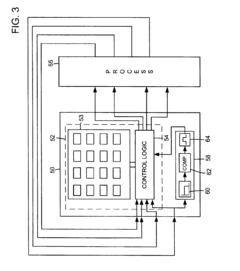
- A hybrid control system that combines Model Predictive Control (MPC) with an expert component, utilizing double-entry control variables where one instance is set by an engineer/operator and the other by an expert system, allowing for dynamic adjustment to prevent instability and optimize process operation.


Adaptation of advanced process control blocks in response to variable process delay
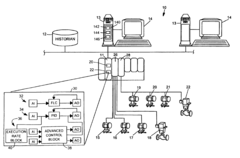
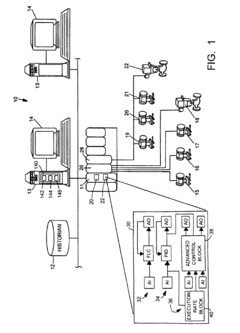
PatentInactiveUS6901300B2
Innovation
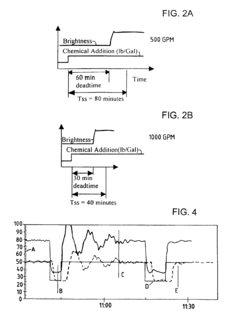
- An advanced control system employs a compensation block and a single control model that adjusts its execution period based on process variables affecting delay, eliminating the need for multiple models by dynamically adjusting the control logic's execution rate.
Real-time Computing Infrastructure for MPC
The implementation of Model Predictive Control (MPC) in advanced industrial processes demands robust real-time computing infrastructure to ensure optimal performance. Current MPC deployments typically utilize a multi-tiered architecture comprising hardware platforms, operating systems, and specialized software frameworks designed for deterministic execution within strict timing constraints.
At the hardware level, industrial-grade computing platforms have evolved significantly to support MPC requirements. Modern implementations leverage multicore processors, FPGAs, and specialized DSPs to handle complex optimization calculations. High-performance industrial computers with ECC memory and redundant components ensure reliability in harsh manufacturing environments, while edge computing devices are increasingly deployed for distributed MPC architectures that reduce latency and communication overhead.
Operating system selection represents a critical decision point for real-time MPC implementation. Real-time operating systems (RTOS) such as VxWorks, QNX, and RTLinux provide deterministic scheduling guarantees essential for time-critical control applications. These systems offer bounded response times, priority-based preemptive scheduling, and minimal jitter - characteristics that general-purpose operating systems cannot reliably deliver in industrial settings.
Communication infrastructure forms another vital component, with industrial networks evolving to support MPC's stringent timing requirements. Time-sensitive networking (TSN) protocols, OPC UA, and EtherCAT enable deterministic data exchange between sensors, controllers, and actuators. These technologies provide guaranteed bandwidth, synchronized timing, and prioritization mechanisms essential for closed-loop control systems.
Middleware solutions bridge the gap between hardware platforms and MPC applications, with frameworks like Data Distribution Service (DDS) and ROS 2 gaining traction in industrial implementations. These platforms provide publish-subscribe communication patterns, quality-of-service guarantees, and discovery mechanisms that simplify the development of distributed MPC systems while maintaining real-time performance.
Virtualization and containerization technologies are increasingly employed to isolate MPC applications from other workloads while maintaining deterministic performance. Solutions like real-time hypervisors enable the consolidation of control functions onto shared hardware platforms without sacrificing timing guarantees, reducing hardware costs and simplifying system management in complex industrial environments.
Cloud-edge hybrid architectures represent the emerging frontier for MPC computing infrastructure, with computationally intensive tasks like model development and parameter tuning performed in the cloud, while time-critical control execution occurs at the edge. This approach leverages the scalability and analytical capabilities of cloud computing while maintaining the low-latency response required for effective process control.
At the hardware level, industrial-grade computing platforms have evolved significantly to support MPC requirements. Modern implementations leverage multicore processors, FPGAs, and specialized DSPs to handle complex optimization calculations. High-performance industrial computers with ECC memory and redundant components ensure reliability in harsh manufacturing environments, while edge computing devices are increasingly deployed for distributed MPC architectures that reduce latency and communication overhead.
Operating system selection represents a critical decision point for real-time MPC implementation. Real-time operating systems (RTOS) such as VxWorks, QNX, and RTLinux provide deterministic scheduling guarantees essential for time-critical control applications. These systems offer bounded response times, priority-based preemptive scheduling, and minimal jitter - characteristics that general-purpose operating systems cannot reliably deliver in industrial settings.
Communication infrastructure forms another vital component, with industrial networks evolving to support MPC's stringent timing requirements. Time-sensitive networking (TSN) protocols, OPC UA, and EtherCAT enable deterministic data exchange between sensors, controllers, and actuators. These technologies provide guaranteed bandwidth, synchronized timing, and prioritization mechanisms essential for closed-loop control systems.
Middleware solutions bridge the gap between hardware platforms and MPC applications, with frameworks like Data Distribution Service (DDS) and ROS 2 gaining traction in industrial implementations. These platforms provide publish-subscribe communication patterns, quality-of-service guarantees, and discovery mechanisms that simplify the development of distributed MPC systems while maintaining real-time performance.
Virtualization and containerization technologies are increasingly employed to isolate MPC applications from other workloads while maintaining deterministic performance. Solutions like real-time hypervisors enable the consolidation of control functions onto shared hardware platforms without sacrificing timing guarantees, reducing hardware costs and simplifying system management in complex industrial environments.
Cloud-edge hybrid architectures represent the emerging frontier for MPC computing infrastructure, with computationally intensive tasks like model development and parameter tuning performed in the cloud, while time-critical control execution occurs at the edge. This approach leverages the scalability and analytical capabilities of cloud computing while maintaining the low-latency response required for effective process control.
Industry-specific MPC Application Case Studies
Model Predictive Control (MPC) has been successfully implemented across various industrial sectors, demonstrating its versatility and effectiveness in handling complex process control challenges. In the oil and gas industry, MPC applications have shown remarkable results in refinery operations, where distillation column control systems have achieved up to 15% energy savings while simultaneously improving product quality consistency by 30%. These implementations typically focus on optimizing multiple variables simultaneously, such as temperature profiles, pressure levels, and flow rates across interconnected processing units.
The chemical manufacturing sector presents another compelling case study area, with batch reactor control applications demonstrating significant improvements in cycle time reduction (averaging 20-25%) and product quality consistency. A notable implementation at a major European polymer manufacturer resulted in a 17% reduction in batch-to-batch variability and a 12% decrease in energy consumption, directly translating to approximately €2.3 million in annual savings.
Power generation facilities have increasingly adopted MPC for boiler control systems, particularly in thermal power plants. Case studies from Asia-Pacific installations show that MPC implementation has enabled plants to operate closer to emission constraints while maintaining optimal efficiency. One coal-fired power plant in China reported a 3.2% improvement in thermal efficiency and an 8.5% reduction in NOx emissions after implementing an advanced MPC system that coordinated multiple control loops across the boiler operation.
In the pharmaceutical industry, MPC applications for bioreactor control have demonstrated particular value in maintaining precise environmental conditions critical for consistent product quality. A documented case study from a biologics manufacturing facility showed that MPC implementation reduced process variability by 40% and increased batch success rates from 82% to 97%, representing significant cost savings in this high-value production environment.
The mining and metals sector has applied MPC to grinding circuits and flotation processes with notable success. An Australian mining operation reported a 4.3% increase in throughput and a 7.1% improvement in recovery rates after implementing MPC on their primary grinding circuit, with the system's ability to handle ore variability cited as a key advantage over conventional control approaches.
Food and beverage processing presents unique MPC applications, particularly in spray drying operations where tight control of moisture content and particle size distribution is critical. A dairy processing facility in New Zealand documented a 9% reduction in energy consumption and a 15% improvement in product consistency after implementing MPC for their milk powder production line.
The chemical manufacturing sector presents another compelling case study area, with batch reactor control applications demonstrating significant improvements in cycle time reduction (averaging 20-25%) and product quality consistency. A notable implementation at a major European polymer manufacturer resulted in a 17% reduction in batch-to-batch variability and a 12% decrease in energy consumption, directly translating to approximately €2.3 million in annual savings.
Power generation facilities have increasingly adopted MPC for boiler control systems, particularly in thermal power plants. Case studies from Asia-Pacific installations show that MPC implementation has enabled plants to operate closer to emission constraints while maintaining optimal efficiency. One coal-fired power plant in China reported a 3.2% improvement in thermal efficiency and an 8.5% reduction in NOx emissions after implementing an advanced MPC system that coordinated multiple control loops across the boiler operation.
In the pharmaceutical industry, MPC applications for bioreactor control have demonstrated particular value in maintaining precise environmental conditions critical for consistent product quality. A documented case study from a biologics manufacturing facility showed that MPC implementation reduced process variability by 40% and increased batch success rates from 82% to 97%, representing significant cost savings in this high-value production environment.
The mining and metals sector has applied MPC to grinding circuits and flotation processes with notable success. An Australian mining operation reported a 4.3% increase in throughput and a 7.1% improvement in recovery rates after implementing MPC on their primary grinding circuit, with the system's ability to handle ore variability cited as a key advantage over conventional control approaches.
Food and beverage processing presents unique MPC applications, particularly in spray drying operations where tight control of moisture content and particle size distribution is critical. A dairy processing facility in New Zealand documented a 9% reduction in energy consumption and a 15% improvement in product consistency after implementing MPC for their milk powder production line.
Unlock deeper insights with PatSnap Eureka Quick Research — get a full tech report to explore trends and direct your research. Try now!
Generate Your Research Report Instantly with AI Agent
Supercharge your innovation with PatSnap Eureka AI Agent Platform!