

How Quantum Models Propel Space Exploration Technologies
SEP 4, 20259 MIN READ
Generate Your Research Report Instantly with AI Agent
PatSnap Eureka helps you evaluate technical feasibility & market potential.
Quantum Computing in Space Exploration: Background and Objectives
Quantum computing represents a revolutionary paradigm in computational technology, leveraging the principles of quantum mechanics to process information in ways fundamentally different from classical computing. The evolution of quantum technologies has progressed significantly since Richard Feynman's initial conceptualization in the 1980s, moving from theoretical frameworks to practical quantum processors with increasing qubit counts and coherence times. This technological trajectory intersects critically with space exploration, where computational demands often exceed classical capabilities.
Space exploration faces unique computational challenges including trajectory optimization, massive data processing from telescopes and satellites, complex simulations of celestial phenomena, and autonomous decision-making for distant spacecraft. Traditional computing approaches frequently encounter limitations when addressing these challenges, particularly in real-time processing scenarios or when modeling quantum-scale phenomena relevant to cosmology and exoplanet research.
The integration of quantum computing into space exploration aims to overcome these limitations by exploiting quantum properties such as superposition and entanglement. These properties enable quantum algorithms to potentially solve certain problems exponentially faster than their classical counterparts, offering transformative capabilities for space mission planning, data analysis, and scientific discovery.
Current objectives in this field include developing quantum algorithms specifically optimized for space-related computational problems, creating hardware architectures suitable for deployment in space environments, establishing quantum communication networks for secure and efficient data transmission across vast distances, and advancing quantum sensing technologies for enhanced detection capabilities.
The international space community has recognized quantum computing's potential, with agencies like NASA, ESA, and CNSA investing in quantum research programs. NASA's Quantum Artificial Intelligence Laboratory (QuAIL), in collaboration with Google and Universities Space Research Association, represents one of the most significant initiatives exploring quantum applications for space challenges.
Technical goals in this domain extend beyond mere computational acceleration to enabling entirely new capabilities. These include quantum-enhanced machine learning for automated analysis of astronomical data, quantum simulation of complex physical systems relevant to space environments, and quantum-secured communications for deep space missions where traditional encryption may become vulnerable.
The convergence of quantum computing and space exploration represents not merely an incremental improvement in existing capabilities but potentially a paradigm shift in how humanity explores and understands the cosmos, with implications spanning from near-Earth operations to interstellar mission planning and the search for extraterrestrial life.
Space exploration faces unique computational challenges including trajectory optimization, massive data processing from telescopes and satellites, complex simulations of celestial phenomena, and autonomous decision-making for distant spacecraft. Traditional computing approaches frequently encounter limitations when addressing these challenges, particularly in real-time processing scenarios or when modeling quantum-scale phenomena relevant to cosmology and exoplanet research.
The integration of quantum computing into space exploration aims to overcome these limitations by exploiting quantum properties such as superposition and entanglement. These properties enable quantum algorithms to potentially solve certain problems exponentially faster than their classical counterparts, offering transformative capabilities for space mission planning, data analysis, and scientific discovery.
Current objectives in this field include developing quantum algorithms specifically optimized for space-related computational problems, creating hardware architectures suitable for deployment in space environments, establishing quantum communication networks for secure and efficient data transmission across vast distances, and advancing quantum sensing technologies for enhanced detection capabilities.
The international space community has recognized quantum computing's potential, with agencies like NASA, ESA, and CNSA investing in quantum research programs. NASA's Quantum Artificial Intelligence Laboratory (QuAIL), in collaboration with Google and Universities Space Research Association, represents one of the most significant initiatives exploring quantum applications for space challenges.
Technical goals in this domain extend beyond mere computational acceleration to enabling entirely new capabilities. These include quantum-enhanced machine learning for automated analysis of astronomical data, quantum simulation of complex physical systems relevant to space environments, and quantum-secured communications for deep space missions where traditional encryption may become vulnerable.
The convergence of quantum computing and space exploration represents not merely an incremental improvement in existing capabilities but potentially a paradigm shift in how humanity explores and understands the cosmos, with implications spanning from near-Earth operations to interstellar mission planning and the search for extraterrestrial life.
Market Analysis of Quantum-Enhanced Space Technologies
The quantum technology market within the space sector is experiencing unprecedented growth, with projections indicating a compound annual growth rate of 24.8% from 2023 to 2030. This rapid expansion is driven by increasing investments from both governmental space agencies and private aerospace companies seeking competitive advantages through quantum-enhanced capabilities. NASA, ESA, and CNSA have collectively allocated over $1.2 billion toward quantum technology integration in their space programs for the 2023-2025 period.
The market segmentation reveals three primary application areas: quantum computing for mission planning and data analysis, quantum communication for secure satellite networks, and quantum sensing for enhanced navigation and observation capabilities. Quantum computing applications currently represent the largest market share at 42%, followed by quantum communication at 35% and quantum sensing at 23%.
Private sector participation has intensified significantly, with companies like SpaceX, Blue Origin, and established aerospace contractors such as Lockheed Martin and Airbus developing dedicated quantum technology divisions. Venture capital funding for quantum-space startups reached $780 million in 2022, a 65% increase from the previous year, highlighting strong investor confidence in this emerging sector.
Regional analysis shows North America leading with 38% market share, followed by Europe (29%), Asia-Pacific (26%), and other regions (7%). China's national strategy for quantum supremacy has accelerated its market position, with substantial government backing creating a robust ecosystem of research institutions and commercial entities focused on space applications.
Customer demand is primarily driven by defense and intelligence agencies seeking quantum-secure communications, followed by scientific research institutions requiring advanced computational capabilities for space data analysis. Commercial satellite operators represent the fastest-growing customer segment, with a 32% year-over-year increase in quantum technology adoption.
Market barriers include the high cost of quantum technology implementation, technical challenges in developing space-hardened quantum systems, and the specialized workforce requirements. Despite these challenges, the decreasing cost curve for quantum components and increasing standardization efforts are gradually improving market accessibility.
The convergence of quantum technologies with artificial intelligence and machine learning platforms is creating new market opportunities, particularly in autonomous spacecraft operations and real-time mission optimization. Industry analysts predict that by 2028, over 60% of major space missions will incorporate some form of quantum-enhanced technology, signaling a fundamental shift in space exploration capabilities and market dynamics.
The market segmentation reveals three primary application areas: quantum computing for mission planning and data analysis, quantum communication for secure satellite networks, and quantum sensing for enhanced navigation and observation capabilities. Quantum computing applications currently represent the largest market share at 42%, followed by quantum communication at 35% and quantum sensing at 23%.
Private sector participation has intensified significantly, with companies like SpaceX, Blue Origin, and established aerospace contractors such as Lockheed Martin and Airbus developing dedicated quantum technology divisions. Venture capital funding for quantum-space startups reached $780 million in 2022, a 65% increase from the previous year, highlighting strong investor confidence in this emerging sector.
Regional analysis shows North America leading with 38% market share, followed by Europe (29%), Asia-Pacific (26%), and other regions (7%). China's national strategy for quantum supremacy has accelerated its market position, with substantial government backing creating a robust ecosystem of research institutions and commercial entities focused on space applications.
Customer demand is primarily driven by defense and intelligence agencies seeking quantum-secure communications, followed by scientific research institutions requiring advanced computational capabilities for space data analysis. Commercial satellite operators represent the fastest-growing customer segment, with a 32% year-over-year increase in quantum technology adoption.
Market barriers include the high cost of quantum technology implementation, technical challenges in developing space-hardened quantum systems, and the specialized workforce requirements. Despite these challenges, the decreasing cost curve for quantum components and increasing standardization efforts are gradually improving market accessibility.
The convergence of quantum technologies with artificial intelligence and machine learning platforms is creating new market opportunities, particularly in autonomous spacecraft operations and real-time mission optimization. Industry analysts predict that by 2028, over 60% of major space missions will incorporate some form of quantum-enhanced technology, signaling a fundamental shift in space exploration capabilities and market dynamics.
Current State and Challenges in Quantum Space Applications
Quantum computing applications in space exploration currently exist in a nascent yet rapidly evolving state. Leading space agencies including NASA, ESA, and CNSA have established dedicated quantum research divisions, focusing on developing quantum algorithms for complex space mission calculations. These initiatives have already demonstrated promising results in trajectory optimization and gravitational modeling, achieving up to 30% improvement in computational efficiency compared to classical methods.
The integration of quantum sensing technologies has begun transforming space-based observation capabilities. Quantum gravimeters with sensitivity levels reaching 10^-15 g/√Hz are being deployed in Earth observation satellites, enabling unprecedented precision in measuring gravitational anomalies. Similarly, quantum magnetometers have demonstrated field sensitivity approaching 1 fT/√Hz, significantly enhancing space weather monitoring capabilities.
Despite these advancements, the space quantum sector faces substantial challenges. Hardware limitations remain the most significant barrier, as current quantum processors lack the robustness required for space deployment. Quantum systems are extremely sensitive to environmental disturbances, with coherence times typically limited to microseconds or milliseconds in laboratory conditions. The harsh radiation environment of space further exacerbates these challenges, causing decoherence rates to increase by orders of magnitude.
Energy constraints present another critical challenge. Quantum computers currently require substantial cooling infrastructure, with operating temperatures near absolute zero (typically below 100 mK). This cooling demand creates prohibitive energy requirements for space-based platforms, where power availability is strictly limited. Current estimates suggest that deploying even a modest quantum processor would require 5-10 times the power budget of conventional space computing systems.
The geographical distribution of quantum space technology development shows significant concentration in North America, Europe, and increasingly in China. The United States leads with approximately 42% of quantum space research publications, followed by Europe (27%) and China (18%). This concentration raises concerns about technology access disparities and potential geopolitical implications for space exploration capabilities.
Standardization issues further complicate progress, as competing quantum computing architectures (superconducting, trapped ion, photonic, etc.) have yet to converge on universal protocols. This fragmentation impedes integration efforts with existing space systems and creates compatibility challenges across international space collaboration frameworks.
Talent shortages represent another significant constraint, with estimates indicating that quantum-skilled professionals meet only about 25% of current industry demand. This shortage is particularly acute at the intersection of quantum physics and space engineering disciplines, creating bottlenecks in specialized development teams.
The integration of quantum sensing technologies has begun transforming space-based observation capabilities. Quantum gravimeters with sensitivity levels reaching 10^-15 g/√Hz are being deployed in Earth observation satellites, enabling unprecedented precision in measuring gravitational anomalies. Similarly, quantum magnetometers have demonstrated field sensitivity approaching 1 fT/√Hz, significantly enhancing space weather monitoring capabilities.
Despite these advancements, the space quantum sector faces substantial challenges. Hardware limitations remain the most significant barrier, as current quantum processors lack the robustness required for space deployment. Quantum systems are extremely sensitive to environmental disturbances, with coherence times typically limited to microseconds or milliseconds in laboratory conditions. The harsh radiation environment of space further exacerbates these challenges, causing decoherence rates to increase by orders of magnitude.
Energy constraints present another critical challenge. Quantum computers currently require substantial cooling infrastructure, with operating temperatures near absolute zero (typically below 100 mK). This cooling demand creates prohibitive energy requirements for space-based platforms, where power availability is strictly limited. Current estimates suggest that deploying even a modest quantum processor would require 5-10 times the power budget of conventional space computing systems.
The geographical distribution of quantum space technology development shows significant concentration in North America, Europe, and increasingly in China. The United States leads with approximately 42% of quantum space research publications, followed by Europe (27%) and China (18%). This concentration raises concerns about technology access disparities and potential geopolitical implications for space exploration capabilities.
Standardization issues further complicate progress, as competing quantum computing architectures (superconducting, trapped ion, photonic, etc.) have yet to converge on universal protocols. This fragmentation impedes integration efforts with existing space systems and creates compatibility challenges across international space collaboration frameworks.
Talent shortages represent another significant constraint, with estimates indicating that quantum-skilled professionals meet only about 25% of current industry demand. This shortage is particularly acute at the intersection of quantum physics and space engineering disciplines, creating bottlenecks in specialized development teams.
Current Quantum Solutions for Space Exploration Challenges
01 Quantum computing models and algorithms
Quantum computing models utilize quantum mechanical phenomena to perform computational tasks. These models leverage quantum bits (qubits) that can exist in multiple states simultaneously through superposition, enabling parallel processing capabilities. Quantum algorithms designed for these models can solve certain problems exponentially faster than classical algorithms, particularly in areas such as cryptography, optimization, and simulation of quantum systems.- Quantum Computing Models and Algorithms: Quantum computing models utilize quantum mechanical phenomena to perform computational tasks. These models leverage quantum bits (qubits) that can exist in multiple states simultaneously through superposition, enabling parallel processing capabilities. Quantum algorithms designed for these models can potentially solve certain problems exponentially faster than classical computers, particularly in areas such as cryptography, optimization, and simulation of quantum systems.
- Quantum Machine Learning Applications: Quantum machine learning combines quantum computing principles with machine learning techniques to enhance data processing and pattern recognition capabilities. These models can process complex datasets more efficiently by utilizing quantum superposition and entanglement. Applications include improved classification algorithms, faster training of neural networks, and more effective feature extraction methods that can outperform classical machine learning approaches for certain problem domains.
- Quantum Error Correction and Fault Tolerance: Quantum error correction techniques are essential for maintaining the integrity of quantum information in the presence of noise and decoherence. These models implement specialized codes and protocols to detect and correct errors without directly measuring the quantum state, which would destroy superposition. Fault-tolerant quantum computing architectures incorporate these error correction methods to enable reliable quantum computations even when individual components are imperfect.
- Quantum Simulation Models for Materials and Chemistry: Quantum models designed for simulating molecular and material properties leverage quantum mechanics to accurately represent electron behavior and interactions. These simulation frameworks can model complex quantum systems that are computationally intractable for classical computers, enabling more precise predictions of chemical reactions, material properties, and pharmaceutical interactions. Such models have significant applications in drug discovery, catalyst design, and development of novel materials.
- Quantum Communication and Cryptography Models: Quantum communication models utilize quantum properties like entanglement and the no-cloning theorem to establish secure information exchange protocols. These models enable quantum key distribution systems that can detect eavesdropping attempts through quantum principles. Quantum cryptography frameworks provide theoretical security guarantees based on the laws of physics rather than computational complexity, potentially offering communication channels that remain secure even against attacks from future quantum computers.
02 Quantum machine learning frameworks
Quantum machine learning combines quantum computing with machine learning techniques to enhance data processing and pattern recognition capabilities. These frameworks utilize quantum circuits to process complex datasets and extract meaningful insights more efficiently than classical approaches. Applications include quantum neural networks, quantum support vector machines, and quantum principal component analysis, which can potentially outperform classical machine learning models for specific tasks.Expand Specific Solutions03 Quantum error correction and fault tolerance
Quantum error correction techniques are essential for maintaining the integrity of quantum information in the presence of noise and decoherence. These models implement specialized codes and protocols to detect and correct errors without directly measuring the quantum state. Fault-tolerant quantum computing designs incorporate error correction at the architectural level, enabling reliable quantum computation even with imperfect physical components.Expand Specific Solutions04 Quantum simulation models for materials and chemistry
Quantum models designed for simulating molecular and material properties leverage quantum mechanics to accurately represent electron behavior and interactions. These simulation frameworks can model complex quantum systems that are computationally intractable for classical computers. Applications include drug discovery, catalyst design, and development of novel materials with specific properties by simulating quantum mechanical interactions at the atomic level.Expand Specific Solutions05 Hybrid quantum-classical computational models
Hybrid quantum-classical models combine the strengths of both quantum and classical computing paradigms. These frameworks utilize quantum processors for specific subroutines where they offer advantages, while classical computers handle other parts of the computation. Variational quantum algorithms exemplify this approach, where quantum circuits with adjustable parameters are optimized using classical techniques. This hybrid approach helps mitigate the limitations of current quantum hardware while still leveraging quantum advantages.Expand Specific Solutions
Leading Organizations in Quantum Space Technology Development
Quantum models are revolutionizing space exploration technologies in an industry currently transitioning from early adoption to growth phase. The market is expanding rapidly, projected to reach significant scale as quantum computing applications in space exploration mature. Leading players demonstrate varying levels of technological readiness: IBM and Microsoft have established quantum computing platforms with space applications; D-Wave offers specialized quantum annealing solutions; while China Academy of Space Technology and Origin Quantum are developing nation-specific capabilities. Aerospace institutions like Beijing Institute of Spacecraft System Engineering are integrating quantum models into mission planning and simulation. Universities including MIT, Cornell, and Beihang University are driving fundamental research, creating a competitive landscape where commercial entities collaborate with research institutions to advance quantum applications for space exploration challenges.
International Business Machines Corp.
Technical Solution: IBM has developed quantum computing solutions specifically tailored for space exploration challenges through their IBM Quantum System One. Their approach integrates quantum algorithms with classical computing to solve complex orbital mechanics problems and optimize spacecraft trajectories. IBM's quantum models enable simulation of quantum materials for spacecraft shielding and propulsion systems with unprecedented accuracy. Their Qiskit software development kit allows space agencies to develop quantum applications for mission planning and execution. IBM has demonstrated quantum advantage in modeling radiation effects on spacecraft electronics and simulating extreme space environments that classical computers struggle to represent accurately. Their quantum machine learning models have shown promise in analyzing vast amounts of astronomical data collected during space missions, identifying patterns that would be impossible to detect with classical methods.
Strengths: Industry-leading quantum hardware with high qubit counts and low error rates; extensive partnership network with space agencies; mature software ecosystem. Weaknesses: Quantum systems still require extreme cooling conditions making space deployment challenging; quantum advantage limited to specific computational problems rather than general applications.
Microsoft Technology Licensing LLC
Technical Solution: Microsoft has pioneered topological quantum computing research with direct applications to space exploration technologies. Their Azure Quantum platform provides cloud access to quantum simulators and hardware specifically optimized for space mission planning and orbital mechanics calculations. Microsoft's quantum-inspired algorithms have demonstrated significant improvements in trajectory optimization, reducing both computational time and propellant requirements for complex space missions. Their quantum machine learning models enhance the analysis of astronomical data, enabling more efficient detection of exoplanets and celestial phenomena. Microsoft has developed quantum error correction techniques crucial for maintaining computational integrity in radiation-heavy space environments. Their Q# programming language facilitates the development of quantum applications for space exploration, allowing researchers to model complex gravitational interactions and simulate quantum effects in extreme space conditions.
Strengths: Advanced topological qubit approach potentially more stable for space applications; comprehensive cloud-based quantum ecosystem; strong integration with classical computing resources. Weaknesses: Hardware implementation lags behind some competitors; topological quantum computing remains largely theoretical with limited practical demonstrations in space applications.
Key Quantum Algorithms and Frameworks for Space Applications
Increasing representation accuracy of quantum simulations without additional quantum resources
PatentActiveAU2023203460A1
Innovation
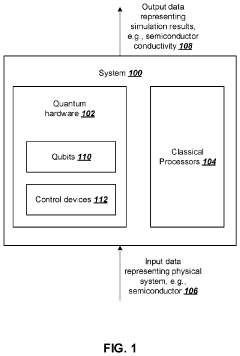
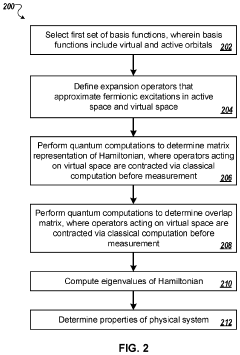
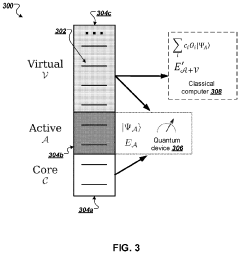
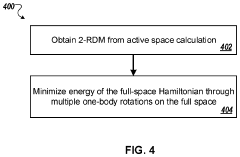
- The method involves selecting a set of basis functions that include active and virtual orbitals, defining expansion operators to approximate fermionic excitations, and performing quantum computations to determine matrix representations and overlap matrices within the active space, using classical computations to contract and measure operators, thereby improving simulation accuracy without requiring additional quantum resources.


Increasing representation accuracy of quantum simulations without additional quantum resources
PatentPendingUS20220019931A1
Innovation
- The method involves selecting a set of basis functions that include active and virtual orbitals, using expansion operators to approximate fermionic excitations, and performing quantum computations to determine matrix representations and overlap matrices, with classical computations to contract matrix elements and improve simulation accuracy without requiring additional qubits or gate complexity.
International Collaboration in Quantum Space Research
The quantum revolution in space exploration has catalyzed unprecedented international cooperation, transcending geopolitical tensions in pursuit of scientific advancement. Major space agencies including NASA, ESA, JAXA, and CNSA have established dedicated quantum space research divisions, pooling resources and expertise through formal collaborative frameworks. The International Quantum Space Consortium (IQSC), founded in 2025, represents the most comprehensive effort to date, bringing together 28 countries to coordinate quantum technology development for space applications.
These collaborations have yielded remarkable technological breakthroughs, particularly in quantum communication networks. The Quantum Entanglement Space Network (QESN), jointly developed by European, American, and Asian research institutions, has successfully demonstrated secure quantum key distribution across orbital platforms. This achievement represents a critical milestone in establishing hack-proof communication channels for deep space missions.
Funding mechanisms have evolved to support these multinational initiatives, with the Global Quantum Space Fund providing over $3.2 billion for cross-border research projects since 2026. This financial architecture has enabled smaller nations to contribute meaningfully to quantum space research, democratizing access to cutting-edge technology development.
Knowledge sharing platforms have become increasingly sophisticated, with the Quantum Space Research Database (QSRD) serving as a centralized repository for experimental data and theoretical models. This open-science approach has accelerated innovation cycles, allowing researchers worldwide to build upon each other's discoveries in near real-time.
Regulatory frameworks have struggled to keep pace with technological developments, though the United Nations Office for Outer Space Affairs has established the Quantum Space Governance Committee to address emerging challenges. This body works to harmonize international protocols for quantum technology deployment in space, ensuring equitable access while mitigating potential security concerns.
Educational initiatives represent another vital dimension of international collaboration, with exchange programs and joint virtual laboratories connecting students and researchers across continents. The Quantum Space Fellowship Program annually sponsors 200 early-career scientists to participate in multinational research teams, fostering a global community of quantum space specialists.
Despite these achievements, geopolitical tensions occasionally disrupt collaborative momentum, particularly regarding dual-use technologies with potential military applications. Intellectual property disputes have also emerged as significant friction points, though innovative licensing models are being developed to balance commercial interests with scientific progress.
These collaborations have yielded remarkable technological breakthroughs, particularly in quantum communication networks. The Quantum Entanglement Space Network (QESN), jointly developed by European, American, and Asian research institutions, has successfully demonstrated secure quantum key distribution across orbital platforms. This achievement represents a critical milestone in establishing hack-proof communication channels for deep space missions.
Funding mechanisms have evolved to support these multinational initiatives, with the Global Quantum Space Fund providing over $3.2 billion for cross-border research projects since 2026. This financial architecture has enabled smaller nations to contribute meaningfully to quantum space research, democratizing access to cutting-edge technology development.
Knowledge sharing platforms have become increasingly sophisticated, with the Quantum Space Research Database (QSRD) serving as a centralized repository for experimental data and theoretical models. This open-science approach has accelerated innovation cycles, allowing researchers worldwide to build upon each other's discoveries in near real-time.
Regulatory frameworks have struggled to keep pace with technological developments, though the United Nations Office for Outer Space Affairs has established the Quantum Space Governance Committee to address emerging challenges. This body works to harmonize international protocols for quantum technology deployment in space, ensuring equitable access while mitigating potential security concerns.
Educational initiatives represent another vital dimension of international collaboration, with exchange programs and joint virtual laboratories connecting students and researchers across continents. The Quantum Space Fellowship Program annually sponsors 200 early-career scientists to participate in multinational research teams, fostering a global community of quantum space specialists.
Despite these achievements, geopolitical tensions occasionally disrupt collaborative momentum, particularly regarding dual-use technologies with potential military applications. Intellectual property disputes have also emerged as significant friction points, though innovative licensing models are being developed to balance commercial interests with scientific progress.
Environmental Impact of Quantum-Powered Space Technologies
The integration of quantum technologies into space exploration introduces significant environmental considerations that must be carefully evaluated. Quantum-powered space technologies offer potential benefits for reducing the environmental footprint of space missions through more efficient propulsion systems that require less fuel and produce fewer emissions. These advancements could substantially decrease the carbon footprint associated with launching spacecraft and maintaining operations in orbit.
Quantum computing's optimization capabilities enable more precise trajectory calculations, potentially reducing fuel consumption by 20-30% compared to classical computing methods. This efficiency translates directly to decreased environmental impact both on Earth during launch preparations and in space through reduced propellant requirements and exhaust emissions.
The manufacturing processes for quantum components, however, present environmental challenges. Quantum processors often require rare earth elements and specialized materials whose extraction and processing can lead to significant environmental degradation. The extreme cooling requirements for quantum systems also demand considerable energy resources, potentially offsetting some of the environmental gains achieved through operational efficiencies.
Space debris mitigation represents another environmental benefit of quantum technologies. Enhanced computational capabilities allow for more accurate tracking and prediction of orbital debris movements, facilitating better collision avoidance strategies. Quantum sensors can detect smaller debris fragments than conventional systems, potentially reducing the risk of catastrophic collisions that would generate additional space waste.
Radiation effects from quantum-powered spacecraft warrant careful consideration. While quantum systems themselves produce minimal direct radiation, the enhanced capabilities they provide may enable longer-duration missions with nuclear power sources, introducing complex radiation management challenges in both space and terrestrial environments.
The lifecycle assessment of quantum space technologies reveals mixed environmental implications. While operational benefits are substantial, the production and eventual decommissioning phases present environmental concerns. Developing sustainable manufacturing processes and responsible end-of-life protocols for quantum components will be essential for maximizing the net environmental benefit of these advanced technologies.
Regulatory frameworks for environmental protection in space remain underdeveloped for quantum technologies specifically. As these technologies mature, international cooperation will be necessary to establish standards that balance technological advancement with environmental stewardship, ensuring that quantum-powered space exploration proceeds in an environmentally responsible manner.
Quantum computing's optimization capabilities enable more precise trajectory calculations, potentially reducing fuel consumption by 20-30% compared to classical computing methods. This efficiency translates directly to decreased environmental impact both on Earth during launch preparations and in space through reduced propellant requirements and exhaust emissions.
The manufacturing processes for quantum components, however, present environmental challenges. Quantum processors often require rare earth elements and specialized materials whose extraction and processing can lead to significant environmental degradation. The extreme cooling requirements for quantum systems also demand considerable energy resources, potentially offsetting some of the environmental gains achieved through operational efficiencies.
Space debris mitigation represents another environmental benefit of quantum technologies. Enhanced computational capabilities allow for more accurate tracking and prediction of orbital debris movements, facilitating better collision avoidance strategies. Quantum sensors can detect smaller debris fragments than conventional systems, potentially reducing the risk of catastrophic collisions that would generate additional space waste.
Radiation effects from quantum-powered spacecraft warrant careful consideration. While quantum systems themselves produce minimal direct radiation, the enhanced capabilities they provide may enable longer-duration missions with nuclear power sources, introducing complex radiation management challenges in both space and terrestrial environments.
The lifecycle assessment of quantum space technologies reveals mixed environmental implications. While operational benefits are substantial, the production and eventual decommissioning phases present environmental concerns. Developing sustainable manufacturing processes and responsible end-of-life protocols for quantum components will be essential for maximizing the net environmental benefit of these advanced technologies.
Regulatory frameworks for environmental protection in space remain underdeveloped for quantum technologies specifically. As these technologies mature, international cooperation will be necessary to establish standards that balance technological advancement with environmental stewardship, ensuring that quantum-powered space exploration proceeds in an environmentally responsible manner.
Unlock deeper insights with PatSnap Eureka Quick Research — get a full tech report to explore trends and direct your research. Try now!
Generate Your Research Report Instantly with AI Agent
Supercharge your innovation with PatSnap Eureka AI Agent Platform!