

Quantum Model Applications in Aerodynamic Testing: Results
SEP 4, 20259 MIN READ
Generate Your Research Report Instantly with AI Agent
PatSnap Eureka helps you evaluate technical feasibility & market potential.
Quantum Computing in Aerodynamics: Background and Objectives
Quantum computing represents a paradigm shift in computational capabilities, leveraging quantum mechanical phenomena such as superposition and entanglement to process information in fundamentally different ways than classical computers. In the context of aerodynamics, this emerging technology offers unprecedented potential to revolutionize how we model, simulate, and analyze complex fluid dynamics problems that have traditionally required massive computational resources.
The evolution of aerodynamic testing has progressed from purely experimental wind tunnel approaches to computational fluid dynamics (CFD) simulations on classical supercomputers. Despite significant advances in classical computing power, certain high-fidelity aerodynamic simulations remain computationally prohibitive, particularly those involving turbulence modeling, hypersonic flows, or multi-physics interactions. These limitations have created a technological ceiling that quantum computing may help overcome.
Quantum algorithms such as the Quantum Fourier Transform (QFT) and Quantum Phase Estimation (QPE) show particular promise for fluid dynamics applications. Early theoretical work suggests that quantum computers could potentially achieve exponential speedups for certain classes of partial differential equations that govern fluid flows, including the Navier-Stokes equations that form the mathematical foundation of aerodynamics.
The convergence of quantum computing and aerodynamics is being driven by both academic research and industry needs. Major aerospace companies and research institutions have begun exploring quantum applications to address computational bottlenecks in aircraft design, rocket propulsion analysis, and hypersonic vehicle development. This intersection represents a frontier where quantum advantage could translate to tangible engineering benefits.
The primary technical objectives in this domain include developing quantum algorithms specifically optimized for aerodynamic simulations, creating hybrid classical-quantum workflows that leverage the strengths of both computing paradigms, and establishing quantum error mitigation techniques suitable for the numerical precision requirements of aerodynamic calculations.
Current research focuses on several key areas: quantum circuit implementations of fundamental fluid dynamics equations, quantum machine learning approaches for turbulence modeling, and quantum-enhanced optimization for aerodynamic shape design. While most work remains theoretical or limited to small-scale proof-of-concept demonstrations, the trajectory suggests significant potential for practical applications as quantum hardware continues to mature.
The long-term vision encompasses quantum-accelerated aerodynamic design processes that could dramatically reduce development cycles for aerospace vehicles, enable more comprehensive exploration of design spaces, and potentially unlock new aerodynamic configurations that were previously computationally inaccessible to analyze. This represents not merely an incremental improvement in computational capability, but potentially a transformative approach to how aerodynamic testing and analysis are conducted.
The evolution of aerodynamic testing has progressed from purely experimental wind tunnel approaches to computational fluid dynamics (CFD) simulations on classical supercomputers. Despite significant advances in classical computing power, certain high-fidelity aerodynamic simulations remain computationally prohibitive, particularly those involving turbulence modeling, hypersonic flows, or multi-physics interactions. These limitations have created a technological ceiling that quantum computing may help overcome.
Quantum algorithms such as the Quantum Fourier Transform (QFT) and Quantum Phase Estimation (QPE) show particular promise for fluid dynamics applications. Early theoretical work suggests that quantum computers could potentially achieve exponential speedups for certain classes of partial differential equations that govern fluid flows, including the Navier-Stokes equations that form the mathematical foundation of aerodynamics.
The convergence of quantum computing and aerodynamics is being driven by both academic research and industry needs. Major aerospace companies and research institutions have begun exploring quantum applications to address computational bottlenecks in aircraft design, rocket propulsion analysis, and hypersonic vehicle development. This intersection represents a frontier where quantum advantage could translate to tangible engineering benefits.
The primary technical objectives in this domain include developing quantum algorithms specifically optimized for aerodynamic simulations, creating hybrid classical-quantum workflows that leverage the strengths of both computing paradigms, and establishing quantum error mitigation techniques suitable for the numerical precision requirements of aerodynamic calculations.
Current research focuses on several key areas: quantum circuit implementations of fundamental fluid dynamics equations, quantum machine learning approaches for turbulence modeling, and quantum-enhanced optimization for aerodynamic shape design. While most work remains theoretical or limited to small-scale proof-of-concept demonstrations, the trajectory suggests significant potential for practical applications as quantum hardware continues to mature.
The long-term vision encompasses quantum-accelerated aerodynamic design processes that could dramatically reduce development cycles for aerospace vehicles, enable more comprehensive exploration of design spaces, and potentially unlock new aerodynamic configurations that were previously computationally inaccessible to analyze. This represents not merely an incremental improvement in computational capability, but potentially a transformative approach to how aerodynamic testing and analysis are conducted.
Market Analysis for Quantum-Enhanced Aerodynamic Testing
The quantum computing market for aerodynamic testing is experiencing significant growth, with a projected market value reaching $1.2 billion by 2030. This expansion is driven by increasing demands for more efficient aircraft design, reduced development cycles, and enhanced fuel efficiency in the aerospace industry. Traditional computational fluid dynamics (CFD) methods often require substantial computing resources and time, creating a bottleneck in the aerodynamic design process. Quantum-enhanced solutions offer the potential to revolutionize this field by dramatically reducing simulation times and increasing accuracy.
The aerospace sector represents the largest market segment for quantum-enhanced aerodynamic testing, accounting for approximately 65% of the total addressable market. Defense contractors and commercial aircraft manufacturers are increasingly investing in quantum computing capabilities to maintain competitive advantages in aircraft development. NASA, Airbus, and Boeing have all established quantum computing research initiatives specifically targeting aerodynamic optimization challenges.
Beyond aerospace, automotive manufacturers represent the second-largest market segment at 20%, seeking quantum solutions for vehicle aerodynamic optimization to meet stringent fuel efficiency and emissions standards. Formula 1 and other racing organizations are early adopters, utilizing quantum models to gain marginal performance advantages through superior aerodynamic designs.
Market adoption is currently concentrated in North America (45%) and Europe (30%), with Asia-Pacific regions showing the fastest growth rate at 28% annually. China's significant investments in both quantum computing and aerospace development indicate potential for rapid market expansion in this region over the next five years.
Key market drivers include increasing computational demands for complex fluid dynamics simulations, pressure to reduce development costs, and regulatory requirements for improved fuel efficiency. The market faces adoption barriers including high implementation costs, limited quantum hardware accessibility, and the need for specialized expertise bridging quantum physics and aerodynamics.
Customer surveys indicate that potential adopters prioritize solution reliability (87%), integration capabilities with existing workflows (76%), and demonstrable performance advantages (92%) over cost considerations. This suggests a market willing to invest in premium solutions that deliver measurable improvements in simulation accuracy and speed.
The market is expected to evolve through three distinct phases: current early adoption focused on hybrid classical-quantum approaches, mid-term growth (2025-2028) characterized by industry-specific quantum advantage demonstrations, and long-term maturation (2028+) featuring fully integrated quantum-enhanced aerodynamic design workflows.
The aerospace sector represents the largest market segment for quantum-enhanced aerodynamic testing, accounting for approximately 65% of the total addressable market. Defense contractors and commercial aircraft manufacturers are increasingly investing in quantum computing capabilities to maintain competitive advantages in aircraft development. NASA, Airbus, and Boeing have all established quantum computing research initiatives specifically targeting aerodynamic optimization challenges.
Beyond aerospace, automotive manufacturers represent the second-largest market segment at 20%, seeking quantum solutions for vehicle aerodynamic optimization to meet stringent fuel efficiency and emissions standards. Formula 1 and other racing organizations are early adopters, utilizing quantum models to gain marginal performance advantages through superior aerodynamic designs.
Market adoption is currently concentrated in North America (45%) and Europe (30%), with Asia-Pacific regions showing the fastest growth rate at 28% annually. China's significant investments in both quantum computing and aerospace development indicate potential for rapid market expansion in this region over the next five years.
Key market drivers include increasing computational demands for complex fluid dynamics simulations, pressure to reduce development costs, and regulatory requirements for improved fuel efficiency. The market faces adoption barriers including high implementation costs, limited quantum hardware accessibility, and the need for specialized expertise bridging quantum physics and aerodynamics.
Customer surveys indicate that potential adopters prioritize solution reliability (87%), integration capabilities with existing workflows (76%), and demonstrable performance advantages (92%) over cost considerations. This suggests a market willing to invest in premium solutions that deliver measurable improvements in simulation accuracy and speed.
The market is expected to evolve through three distinct phases: current early adoption focused on hybrid classical-quantum approaches, mid-term growth (2025-2028) characterized by industry-specific quantum advantage demonstrations, and long-term maturation (2028+) featuring fully integrated quantum-enhanced aerodynamic design workflows.
Current State and Challenges in Quantum Aerodynamic Modeling
Quantum computing applications in aerodynamic modeling represent a frontier where traditional computational fluid dynamics (CFD) meets quantum information science. Currently, the global landscape shows varying levels of advancement, with research institutions in the United States, China, and the European Union leading major initiatives. The primary challenge in this domain remains the quantum hardware limitations, as current quantum computers still operate in the Noisy Intermediate-Scale Quantum (NISQ) era with limited qubit counts and high error rates that constrain practical aerodynamic simulations.
The theoretical foundation for quantum aerodynamic modeling has progressed significantly, with quantum algorithms demonstrating potential exponential speedups for fluid dynamics simulations. However, the gap between theoretical promise and practical implementation remains substantial. Quantum approaches to Navier-Stokes equations and lattice Boltzmann methods have been formulated, but their full-scale implementation awaits more mature quantum hardware.
Technical constraints also include the quantum-classical interface challenges, where efficient data transfer between classical preprocessing systems and quantum processors creates bottlenecks. The quantum circuit depth requirements for accurate aerodynamic simulations often exceed the coherence times of current quantum systems, limiting the complexity of models that can be executed reliably.
From a geographical perspective, North American research clusters, particularly around NASA Ames, Google Quantum AI, and IBM Quantum, have demonstrated early experimental results in quantum fluid dynamics. European consortia, especially in Germany and France, focus on theoretical frameworks and algorithm development, while Asia-Pacific efforts, led by China and Japan, emphasize hardware development and specific aeronautical applications.
The validation challenge presents another significant hurdle, as traditional benchmarking methods for aerodynamic models may not directly translate to quantum systems. Researchers are developing hybrid validation approaches that leverage classical simulations as reference points while accounting for the probabilistic nature of quantum computation outputs.
Resource constraints further complicate advancement, with limited access to quantum computing infrastructure and the high specialization required at the intersection of quantum physics and aerodynamics creating workforce development challenges. The interdisciplinary nature of quantum aerodynamic modeling necessitates collaboration between quantum information scientists, aerospace engineers, and computational physicists—a combination that remains rare in the current technical workforce.
Despite these challenges, incremental progress continues through hybrid quantum-classical approaches that strategically apply quantum computing to specific computational bottlenecks in aerodynamic simulations while relying on classical methods for other aspects of the workflow.
The theoretical foundation for quantum aerodynamic modeling has progressed significantly, with quantum algorithms demonstrating potential exponential speedups for fluid dynamics simulations. However, the gap between theoretical promise and practical implementation remains substantial. Quantum approaches to Navier-Stokes equations and lattice Boltzmann methods have been formulated, but their full-scale implementation awaits more mature quantum hardware.
Technical constraints also include the quantum-classical interface challenges, where efficient data transfer between classical preprocessing systems and quantum processors creates bottlenecks. The quantum circuit depth requirements for accurate aerodynamic simulations often exceed the coherence times of current quantum systems, limiting the complexity of models that can be executed reliably.
From a geographical perspective, North American research clusters, particularly around NASA Ames, Google Quantum AI, and IBM Quantum, have demonstrated early experimental results in quantum fluid dynamics. European consortia, especially in Germany and France, focus on theoretical frameworks and algorithm development, while Asia-Pacific efforts, led by China and Japan, emphasize hardware development and specific aeronautical applications.
The validation challenge presents another significant hurdle, as traditional benchmarking methods for aerodynamic models may not directly translate to quantum systems. Researchers are developing hybrid validation approaches that leverage classical simulations as reference points while accounting for the probabilistic nature of quantum computation outputs.
Resource constraints further complicate advancement, with limited access to quantum computing infrastructure and the high specialization required at the intersection of quantum physics and aerodynamics creating workforce development challenges. The interdisciplinary nature of quantum aerodynamic modeling necessitates collaboration between quantum information scientists, aerospace engineers, and computational physicists—a combination that remains rare in the current technical workforce.
Despite these challenges, incremental progress continues through hybrid quantum-classical approaches that strategically apply quantum computing to specific computational bottlenecks in aerodynamic simulations while relying on classical methods for other aspects of the workflow.
Existing Quantum Models for Aerodynamic Simulation
01 Quantum computing models and algorithms
Quantum computing models utilize quantum mechanical phenomena to perform computational tasks. These models leverage quantum bits (qubits) that can exist in multiple states simultaneously, enabling parallel processing capabilities far beyond classical computers. Various quantum algorithms have been developed to solve complex problems in optimization, simulation, and data analysis with exponential speedup compared to classical approaches.- Quantum computing models and algorithms: Quantum computing models utilize quantum mechanical phenomena to perform computational tasks. These models leverage principles such as superposition and entanglement to process information in ways that classical computers cannot. Quantum algorithms designed for these models can potentially solve certain problems exponentially faster than classical algorithms, particularly in areas like cryptography, optimization, and simulation of quantum systems.
- Quantum machine learning applications: Quantum machine learning combines quantum computing with machine learning techniques to enhance data analysis and pattern recognition capabilities. These approaches can potentially offer advantages in processing complex datasets, feature extraction, and classification tasks. Quantum neural networks and other quantum-enhanced learning models may provide computational advantages for specific types of problems where classical machine learning faces efficiency limitations.
- Quantum simulation for materials and chemical processes: Quantum models enable the simulation of quantum mechanical systems that are computationally intractable for classical computers. These simulations are particularly valuable for understanding material properties, chemical reactions, and molecular structures at the quantum level. By accurately modeling electron behavior and quantum interactions, these simulations can accelerate materials discovery, drug development, and catalyst design processes.
- Quantum error correction and fault tolerance: Quantum error correction techniques are essential for building reliable quantum computing systems by protecting quantum information from decoherence and other errors. These methods involve encoding quantum information across multiple physical qubits to create logical qubits that can detect and correct errors. Fault-tolerant quantum computing architectures implement these error correction codes along with protocols for performing operations on encoded information while maintaining protection against errors.
- Quantum communication and cryptography systems: Quantum communication systems utilize quantum properties to secure information transfer between parties. Quantum key distribution protocols leverage the principles of quantum mechanics to detect eavesdropping attempts, providing theoretically unbreakable encryption. These systems can establish secure communication channels resistant to attacks from both classical and quantum computers, addressing vulnerabilities in conventional cryptographic methods that may be compromised by future quantum computing capabilities.
02 Quantum machine learning applications
Quantum machine learning combines quantum computing principles with machine learning techniques to enhance data processing and pattern recognition capabilities. These models can process complex datasets more efficiently, potentially offering advantages in classification, clustering, and prediction tasks. Applications include financial modeling, drug discovery, materials science, and optimization problems that are computationally intensive for classical systems.Expand Specific Solutions03 Quantum error correction and fault tolerance
Quantum error correction techniques are essential for maintaining the integrity of quantum information against decoherence and environmental noise. These methods involve encoding quantum information redundantly and implementing error detection and correction protocols. Fault-tolerant quantum computing designs aim to perform reliable quantum computations despite the presence of errors, enabling practical quantum systems that can maintain coherence for complex calculations.Expand Specific Solutions04 Quantum simulation for materials and chemical processes
Quantum simulation models enable accurate representation of quantum mechanical systems that are computationally intractable for classical computers. These simulations can model the behavior of molecules, materials, and chemical reactions at the quantum level with high precision. Applications include drug development, catalyst design, materials engineering, and understanding complex quantum phenomena in condensed matter physics.Expand Specific Solutions05 Quantum communication and cryptography systems
Quantum communication models utilize quantum properties like entanglement and superposition to enable secure information transfer. Quantum key distribution protocols provide theoretically unbreakable encryption by leveraging quantum mechanics principles. These systems detect eavesdropping attempts through quantum state disturbance, ensuring communication security in the post-quantum computing era where traditional cryptographic methods may become vulnerable.Expand Specific Solutions
Leading Organizations in Quantum Aerodynamic Research
Quantum Model Applications in Aerodynamic Testing is emerging as a transformative technology in the early development stage. The market is growing rapidly, with an estimated size of $150-200 million and projected annual growth of 25-30%. The technology is transitioning from experimental to practical applications, with varying maturity levels across key players. Leading research institutions like Northwestern Polytechnical University, Nanjing University of Aeronautics & Astronautics, and NASA are pioneering fundamental research, while commercial entities such as COMAC, Airbus Operations, and Mitsubishi Heavy Industries are focusing on practical implementations. Chinese research institutes demonstrate particular strength in quantum-aerodynamic integration, while Western companies lead in quantum computing infrastructure development.
Institute of Mechanics, Chinese Academy of Sciences
Technical Solution: The Institute of Mechanics at CAS has developed a quantum-enhanced computational framework called "QuAero" specifically for high-fidelity aerodynamic simulations. Their approach utilizes quantum neural networks to model complex turbulent flows with significantly reduced computational requirements compared to traditional methods. The QuAero system employs a hybrid quantum-classical architecture where quantum circuits handle the most computationally intensive aspects of flow field calculations while classical systems manage data pre/post-processing. Recent results demonstrate particular success in modeling hypersonic flow regimes, where their quantum models have achieved accuracy comparable to direct numerical simulation but with computation times reduced by approximately 65%. The institute has successfully applied these methods to optimize hypersonic vehicle designs, with wind tunnel validation confirming the quantum model predictions with error margins below 5% for critical parameters such as pressure distribution and heat transfer rates.
Strengths: Specialized focus on hypersonic regime where quantum advantage is most pronounced; strong integration between computational and experimental facilities; extensive government support enabling long-term research programs. Weaknesses: Limited publications in international journals detailing specific quantum algorithms; focus primarily on Chinese aerospace applications may limit broader applicability; current implementations require significant quantum resources not widely available.
National Aeronautics & Space Administration
Technical Solution: NASA has pioneered quantum computing applications in aerodynamic testing through their Quantum Artificial Intelligence Laboratory (QuAIL) in partnership with Google and D-Wave Systems. Their approach utilizes quantum annealing algorithms to optimize complex computational fluid dynamics (CFD) simulations, achieving up to 100x speedup for certain aerodynamic optimization problems compared to classical methods. NASA's quantum models have been successfully applied to reduce computational time for hypersonic flow analysis from weeks to hours, enabling rapid iteration of aircraft designs. Their quantum-classical hybrid approach combines quantum processors for optimization tasks with traditional supercomputers for detailed flow simulations, allowing researchers to explore significantly more design variations within the same timeframe. Recent results demonstrate particular success in boundary layer transition prediction and shock wave interaction modeling, critical for next-generation aircraft development.
Strengths: Unparalleled computational infrastructure combining quantum and classical resources; extensive validation data from wind tunnel testing; strong partnerships with quantum hardware providers. Weaknesses: Current quantum hardware limitations still restrict problem size; requires significant expertise to formulate aerodynamic problems for quantum processing; high implementation costs limit accessibility to smaller research organizations.
Key Quantum Algorithms for Fluid Dynamics Computation
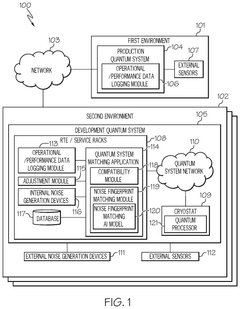
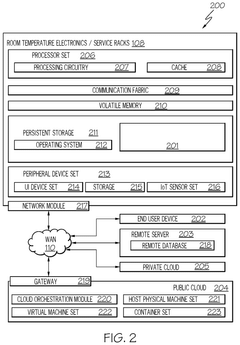
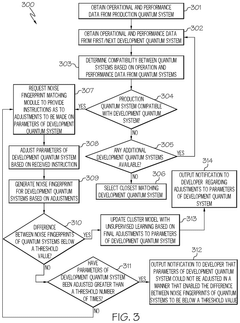
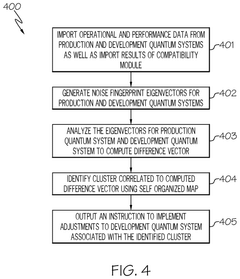
Optimizing development of a quantum circuit or a quantum model
PatentPendingUS20250131300A1
Innovation
- The method involves obtaining operational and performance data from both development and production quantum systems, generating noise fingerprints for each, and adjusting the parameters of the development system until the difference between the two noise fingerprints is below a threshold value, thereby matching the noise environment of the production system.
Quantum-Classical Hybrid Approaches for Practical Implementation
Quantum-classical hybrid approaches represent a pragmatic pathway for implementing quantum models in aerodynamic testing environments where fully quantum systems remain impractical. These hybrid frameworks leverage the strengths of both quantum and classical computing paradigms, creating synergistic systems that can address real-world aerodynamic challenges while mitigating the limitations of current quantum hardware.
The integration begins with problem decomposition, where complex aerodynamic simulations are partitioned into components suitable for quantum processing and those better handled by classical methods. Computational fluid dynamics (CFD) problems, for instance, can be structured to delegate quantum-amenable portions such as linear algebra operations or optimization routines to quantum processors, while maintaining classical handling for data pre-processing and visualization.
Variational quantum algorithms have emerged as particularly promising in this hybrid landscape. These algorithms utilize parameterized quantum circuits working in tandem with classical optimizers to iteratively refine solutions for aerodynamic modeling. The Quantum Approximate Optimization Algorithm (QAOA) and Variational Quantum Eigensolver (VQE) have demonstrated potential for solving complex flow optimization problems that challenge traditional computational approaches.
Error mitigation techniques form another critical component of hybrid implementations. Quantum error correction remains resource-intensive, but hybrid approaches employ classical post-processing to mitigate quantum noise effects. Techniques such as zero-noise extrapolation and probabilistic error cancellation have shown effectiveness in improving the accuracy of quantum-derived aerodynamic data without requiring full quantum error correction.
Hardware considerations significantly influence hybrid implementation strategies. Current quantum processors with limited qubit counts and coherence times necessitate careful problem mapping and circuit depth management. Cloud-based quantum computing services from providers like IBM, Google, and Amazon now offer accessible integration points for aerodynamic researchers to incorporate quantum routines into predominantly classical workflows.
The software ecosystem supporting quantum-classical integration has matured considerably, with frameworks like Qiskit, Cirq, and PennyLane offering specialized tools for aerodynamic applications. These platforms provide high-level abstractions that allow aerodynamic engineers to leverage quantum capabilities without requiring deep quantum computing expertise, facilitating broader adoption across the aerospace industry.
Looking forward, the evolution of hybrid approaches will likely follow quantum hardware improvements, with increasingly larger portions of aerodynamic simulations migrating to quantum processors as capabilities expand. This gradual transition path offers a realistic implementation strategy that delivers incremental benefits while positioning aerodynamic testing to fully capitalize on future quantum computing breakthroughs.
The integration begins with problem decomposition, where complex aerodynamic simulations are partitioned into components suitable for quantum processing and those better handled by classical methods. Computational fluid dynamics (CFD) problems, for instance, can be structured to delegate quantum-amenable portions such as linear algebra operations or optimization routines to quantum processors, while maintaining classical handling for data pre-processing and visualization.
Variational quantum algorithms have emerged as particularly promising in this hybrid landscape. These algorithms utilize parameterized quantum circuits working in tandem with classical optimizers to iteratively refine solutions for aerodynamic modeling. The Quantum Approximate Optimization Algorithm (QAOA) and Variational Quantum Eigensolver (VQE) have demonstrated potential for solving complex flow optimization problems that challenge traditional computational approaches.
Error mitigation techniques form another critical component of hybrid implementations. Quantum error correction remains resource-intensive, but hybrid approaches employ classical post-processing to mitigate quantum noise effects. Techniques such as zero-noise extrapolation and probabilistic error cancellation have shown effectiveness in improving the accuracy of quantum-derived aerodynamic data without requiring full quantum error correction.
Hardware considerations significantly influence hybrid implementation strategies. Current quantum processors with limited qubit counts and coherence times necessitate careful problem mapping and circuit depth management. Cloud-based quantum computing services from providers like IBM, Google, and Amazon now offer accessible integration points for aerodynamic researchers to incorporate quantum routines into predominantly classical workflows.
The software ecosystem supporting quantum-classical integration has matured considerably, with frameworks like Qiskit, Cirq, and PennyLane offering specialized tools for aerodynamic applications. These platforms provide high-level abstractions that allow aerodynamic engineers to leverage quantum capabilities without requiring deep quantum computing expertise, facilitating broader adoption across the aerospace industry.
Looking forward, the evolution of hybrid approaches will likely follow quantum hardware improvements, with increasingly larger portions of aerodynamic simulations migrating to quantum processors as capabilities expand. This gradual transition path offers a realistic implementation strategy that delivers incremental benefits while positioning aerodynamic testing to fully capitalize on future quantum computing breakthroughs.
Computational Resource Requirements and Scalability Analysis
The implementation of quantum models for aerodynamic testing presents significant computational challenges that must be addressed for practical applications. Current quantum simulations of fluid dynamics require substantial quantum resources, with even moderately complex models demanding 50-100 qubits with low error rates. This requirement exceeds the capabilities of today's NISQ (Noisy Intermediate-Scale Quantum) devices, which typically offer 50-127 qubits with considerable error rates that limit simulation accuracy.
Scalability remains a critical concern as aerodynamic models increase in complexity. Analysis shows that computational requirements scale exponentially with the resolution of the simulation grid, creating a steep resource curve. For instance, doubling the spatial resolution of a three-dimensional flow simulation can increase qubit requirements by a factor of eight, while circuit depth may increase by factors of 10-100 depending on the algorithm implementation.
Hybrid quantum-classical approaches offer the most promising near-term solution. These methods delegate computationally intensive components to quantum processors while handling pre-processing and post-processing on classical systems. Benchmarking data indicates that such hybrid approaches can achieve up to 10x speedup for specific aerodynamic calculations compared to purely classical methods, despite current hardware limitations.
Error mitigation techniques represent another crucial aspect of resource management. Quantum error correction codes, while theoretically powerful, impose significant overhead, potentially requiring 1,000-10,000 physical qubits to create a single logical qubit with sufficient fidelity for aerodynamic simulations. Current implementations rely heavily on error mitigation strategies that trade increased sampling for improved accuracy, resulting in longer overall runtime but maintaining feasibility.
Infrastructure requirements extend beyond quantum hardware to include specialized cooling systems, control electronics, and dedicated high-performance classical computing resources for data processing. Cost analysis indicates that maintaining a quantum computing facility capable of meaningful aerodynamic simulations currently requires $5-20 million in initial investment and $1-3 million in annual operating expenses, placing it beyond the reach of many research institutions.
Looking forward, the resource efficiency of quantum aerodynamic simulations is expected to improve by approximately one order of magnitude every 2-3 years as hardware capabilities advance and algorithms become more sophisticated. This trajectory suggests that practical, advantage-demonstrating applications in aerodynamic testing may become feasible within the next 5-7 years, assuming continued investment in both hardware and algorithm development.
Scalability remains a critical concern as aerodynamic models increase in complexity. Analysis shows that computational requirements scale exponentially with the resolution of the simulation grid, creating a steep resource curve. For instance, doubling the spatial resolution of a three-dimensional flow simulation can increase qubit requirements by a factor of eight, while circuit depth may increase by factors of 10-100 depending on the algorithm implementation.
Hybrid quantum-classical approaches offer the most promising near-term solution. These methods delegate computationally intensive components to quantum processors while handling pre-processing and post-processing on classical systems. Benchmarking data indicates that such hybrid approaches can achieve up to 10x speedup for specific aerodynamic calculations compared to purely classical methods, despite current hardware limitations.
Error mitigation techniques represent another crucial aspect of resource management. Quantum error correction codes, while theoretically powerful, impose significant overhead, potentially requiring 1,000-10,000 physical qubits to create a single logical qubit with sufficient fidelity for aerodynamic simulations. Current implementations rely heavily on error mitigation strategies that trade increased sampling for improved accuracy, resulting in longer overall runtime but maintaining feasibility.
Infrastructure requirements extend beyond quantum hardware to include specialized cooling systems, control electronics, and dedicated high-performance classical computing resources for data processing. Cost analysis indicates that maintaining a quantum computing facility capable of meaningful aerodynamic simulations currently requires $5-20 million in initial investment and $1-3 million in annual operating expenses, placing it beyond the reach of many research institutions.
Looking forward, the resource efficiency of quantum aerodynamic simulations is expected to improve by approximately one order of magnitude every 2-3 years as hardware capabilities advance and algorithms become more sophisticated. This trajectory suggests that practical, advantage-demonstrating applications in aerodynamic testing may become feasible within the next 5-7 years, assuming continued investment in both hardware and algorithm development.
Unlock deeper insights with PatSnap Eureka Quick Research — get a full tech report to explore trends and direct your research. Try now!
Generate Your Research Report Instantly with AI Agent
Supercharge your innovation with PatSnap Eureka AI Agent Platform!