
How to Adapt Distributed Control Systems to Emerging Communication Technologies
APR 28, 202610 MIN READ
Generate Your Research Report Instantly with AI Agent
Patsnap Eureka helps you evaluate technical feasibility & market potential.
DCS Evolution and Communication Technology Integration Goals
Distributed Control Systems have undergone significant transformation since their inception in the 1970s, evolving from centralized architectures to highly distributed, networked control environments. The historical progression began with proprietary communication protocols and dedicated hardware, gradually transitioning toward standardized networking solutions and software-defined control paradigms. This evolution has been driven by increasing demands for operational efficiency, system flexibility, and real-time performance across industrial sectors.
The contemporary landscape presents unprecedented opportunities for DCS modernization through emerging communication technologies. Fifth-generation wireless networks, edge computing architectures, and advanced networking protocols are reshaping the fundamental assumptions underlying traditional control system design. These technological advances promise to address longstanding limitations in latency, bandwidth, and system scalability while introducing new paradigms for distributed intelligence and autonomous operation.
Current integration objectives focus on achieving seamless interoperability between legacy DCS infrastructure and next-generation communication platforms. The primary goal involves developing adaptive frameworks that can dynamically optimize communication pathways based on real-time network conditions and control requirements. This includes implementing intelligent protocol selection mechanisms, adaptive quality-of-service management, and resilient communication architectures that maintain operational continuity under varying network conditions.
Strategic technology integration aims to leverage emerging communication capabilities for enhanced system performance and operational flexibility. Key objectives include reducing control loop latencies through edge computing integration, implementing predictive maintenance capabilities through advanced sensor networks, and enabling dynamic system reconfiguration through software-defined networking approaches. These goals align with broader industrial digitalization initiatives and the transition toward Industry 4.0 paradigms.
The ultimate vision encompasses creating self-adapting control systems that can automatically optimize their communication strategies based on evolving technological landscapes and operational requirements. This involves developing machine learning algorithms for network optimization, implementing blockchain-based security frameworks for distributed control networks, and establishing standardized interfaces for seamless technology integration. Success in these areas will position DCS platforms to capitalize on future communication innovations while maintaining the reliability and performance standards essential for critical industrial applications.
The contemporary landscape presents unprecedented opportunities for DCS modernization through emerging communication technologies. Fifth-generation wireless networks, edge computing architectures, and advanced networking protocols are reshaping the fundamental assumptions underlying traditional control system design. These technological advances promise to address longstanding limitations in latency, bandwidth, and system scalability while introducing new paradigms for distributed intelligence and autonomous operation.
Current integration objectives focus on achieving seamless interoperability between legacy DCS infrastructure and next-generation communication platforms. The primary goal involves developing adaptive frameworks that can dynamically optimize communication pathways based on real-time network conditions and control requirements. This includes implementing intelligent protocol selection mechanisms, adaptive quality-of-service management, and resilient communication architectures that maintain operational continuity under varying network conditions.
Strategic technology integration aims to leverage emerging communication capabilities for enhanced system performance and operational flexibility. Key objectives include reducing control loop latencies through edge computing integration, implementing predictive maintenance capabilities through advanced sensor networks, and enabling dynamic system reconfiguration through software-defined networking approaches. These goals align with broader industrial digitalization initiatives and the transition toward Industry 4.0 paradigms.
The ultimate vision encompasses creating self-adapting control systems that can automatically optimize their communication strategies based on evolving technological landscapes and operational requirements. This involves developing machine learning algorithms for network optimization, implementing blockchain-based security frameworks for distributed control networks, and establishing standardized interfaces for seamless technology integration. Success in these areas will position DCS platforms to capitalize on future communication innovations while maintaining the reliability and performance standards essential for critical industrial applications.
Market Demand for Advanced DCS Communication Solutions
The global distributed control systems market is experiencing unprecedented growth driven by the convergence of industrial digitalization and advanced communication technologies. Manufacturing industries, particularly in process automation sectors such as oil and gas, chemicals, pharmaceuticals, and power generation, are increasingly demanding DCS solutions that can seamlessly integrate with emerging communication protocols and standards.
Traditional DCS architectures face significant limitations when attempting to incorporate modern communication technologies such as 5G networks, Time-Sensitive Networking (TSN), and Industrial Internet of Things (IoT) protocols. Industrial operators require systems capable of supporting real-time data exchange, enhanced cybersecurity features, and interoperability across diverse communication platforms while maintaining the reliability and deterministic performance characteristics essential for critical process control applications.
The demand for advanced DCS communication solutions is particularly pronounced in smart manufacturing environments where operational technology and information technology convergence is accelerating. Industries are seeking systems that can support edge computing capabilities, cloud connectivity, and artificial intelligence integration while preserving the stringent safety and reliability requirements inherent to industrial control systems.
Energy sector transformation, including renewable energy integration and smart grid development, is creating substantial market demand for DCS platforms capable of managing distributed energy resources through advanced communication networks. These applications require sophisticated communication capabilities to coordinate multiple generation sources, energy storage systems, and demand response mechanisms across geographically dispersed installations.
Regulatory compliance requirements and cybersecurity concerns are driving additional market demand for DCS communication solutions that incorporate advanced security protocols and encryption standards. Industries operating under strict regulatory frameworks require systems that can demonstrate compliance with emerging cybersecurity standards while maintaining operational efficiency and system performance.
The pharmaceutical and biotechnology sectors represent rapidly growing market segments demanding DCS solutions with enhanced communication capabilities to support complex manufacturing processes, regulatory compliance, and quality assurance requirements. These industries require systems capable of integrating with laboratory information management systems, manufacturing execution systems, and enterprise resource planning platforms through standardized communication protocols.
Market research indicates strong demand growth in emerging economies where industrial infrastructure development is accelerating, creating opportunities for advanced DCS communication solutions that can support modern industrial automation requirements from initial implementation rather than requiring costly retrofitting of legacy systems.
Traditional DCS architectures face significant limitations when attempting to incorporate modern communication technologies such as 5G networks, Time-Sensitive Networking (TSN), and Industrial Internet of Things (IoT) protocols. Industrial operators require systems capable of supporting real-time data exchange, enhanced cybersecurity features, and interoperability across diverse communication platforms while maintaining the reliability and deterministic performance characteristics essential for critical process control applications.
The demand for advanced DCS communication solutions is particularly pronounced in smart manufacturing environments where operational technology and information technology convergence is accelerating. Industries are seeking systems that can support edge computing capabilities, cloud connectivity, and artificial intelligence integration while preserving the stringent safety and reliability requirements inherent to industrial control systems.
Energy sector transformation, including renewable energy integration and smart grid development, is creating substantial market demand for DCS platforms capable of managing distributed energy resources through advanced communication networks. These applications require sophisticated communication capabilities to coordinate multiple generation sources, energy storage systems, and demand response mechanisms across geographically dispersed installations.
Regulatory compliance requirements and cybersecurity concerns are driving additional market demand for DCS communication solutions that incorporate advanced security protocols and encryption standards. Industries operating under strict regulatory frameworks require systems that can demonstrate compliance with emerging cybersecurity standards while maintaining operational efficiency and system performance.
The pharmaceutical and biotechnology sectors represent rapidly growing market segments demanding DCS solutions with enhanced communication capabilities to support complex manufacturing processes, regulatory compliance, and quality assurance requirements. These industries require systems capable of integrating with laboratory information management systems, manufacturing execution systems, and enterprise resource planning platforms through standardized communication protocols.
Market research indicates strong demand growth in emerging economies where industrial infrastructure development is accelerating, creating opportunities for advanced DCS communication solutions that can support modern industrial automation requirements from initial implementation rather than requiring costly retrofitting of legacy systems.
Current DCS Communication Challenges and Technology Gaps
Traditional DCS architectures face significant communication bottlenecks that limit their ability to integrate with modern industrial ecosystems. Legacy fieldbus protocols such as Foundation Fieldbus and HART, while reliable, operate at relatively low data rates and lack the bandwidth necessary for advanced analytics and real-time optimization. These protocols typically support data transmission rates of 31.25 kbps to 2.5 Mbps, which proves insufficient for handling the massive data volumes generated by modern smart sensors and IoT devices.
Latency constraints represent another critical challenge in current DCS implementations. Many existing systems exhibit response times ranging from 100 milliseconds to several seconds, which fails to meet the stringent requirements of time-critical applications such as safety instrumented systems and high-speed process control loops. This latency issue becomes particularly pronounced when attempting to implement advanced control algorithms that require rapid feedback loops and real-time decision-making capabilities.
Interoperability gaps between different vendor systems create substantial integration challenges. Current DCS platforms often operate as isolated islands, with proprietary communication protocols that hinder seamless data exchange between systems from different manufacturers. This fragmentation results in increased engineering complexity, higher maintenance costs, and reduced operational flexibility when attempting to implement plant-wide optimization strategies.
Cybersecurity vulnerabilities in legacy communication infrastructures pose escalating risks as industrial systems become increasingly connected. Many existing DCS networks were designed with minimal security considerations, relying primarily on physical isolation for protection. The integration of emerging communication technologies exposes these systems to sophisticated cyber threats, requiring comprehensive security frameworks that many current architectures cannot adequately support.
Scalability limitations in traditional DCS communication architectures restrict their ability to accommodate growing industrial demands. Existing hierarchical communication structures often struggle to handle the exponential increase in connected devices and data points without significant performance degradation. The rigid topology of conventional systems makes it challenging to dynamically add new nodes or reconfigure network structures to meet evolving operational requirements.
Bandwidth allocation inefficiencies in current DCS networks result in suboptimal resource utilization and communication bottlenecks. Traditional systems typically employ static bandwidth allocation schemes that cannot adapt to varying communication demands across different operational scenarios. This inflexibility leads to either over-provisioning of network resources or performance degradation during peak communication periods, ultimately impacting overall system efficiency and responsiveness.
Latency constraints represent another critical challenge in current DCS implementations. Many existing systems exhibit response times ranging from 100 milliseconds to several seconds, which fails to meet the stringent requirements of time-critical applications such as safety instrumented systems and high-speed process control loops. This latency issue becomes particularly pronounced when attempting to implement advanced control algorithms that require rapid feedback loops and real-time decision-making capabilities.
Interoperability gaps between different vendor systems create substantial integration challenges. Current DCS platforms often operate as isolated islands, with proprietary communication protocols that hinder seamless data exchange between systems from different manufacturers. This fragmentation results in increased engineering complexity, higher maintenance costs, and reduced operational flexibility when attempting to implement plant-wide optimization strategies.
Cybersecurity vulnerabilities in legacy communication infrastructures pose escalating risks as industrial systems become increasingly connected. Many existing DCS networks were designed with minimal security considerations, relying primarily on physical isolation for protection. The integration of emerging communication technologies exposes these systems to sophisticated cyber threats, requiring comprehensive security frameworks that many current architectures cannot adequately support.
Scalability limitations in traditional DCS communication architectures restrict their ability to accommodate growing industrial demands. Existing hierarchical communication structures often struggle to handle the exponential increase in connected devices and data points without significant performance degradation. The rigid topology of conventional systems makes it challenging to dynamically add new nodes or reconfigure network structures to meet evolving operational requirements.
Bandwidth allocation inefficiencies in current DCS networks result in suboptimal resource utilization and communication bottlenecks. Traditional systems typically employ static bandwidth allocation schemes that cannot adapt to varying communication demands across different operational scenarios. This inflexibility leads to either over-provisioning of network resources or performance degradation during peak communication periods, ultimately impacting overall system efficiency and responsiveness.
Existing DCS Communication Adaptation Solutions
01 Network communication and data transmission in distributed control systems
Methods and systems for enabling communication between distributed control nodes through various network protocols and data transmission techniques. These approaches focus on ensuring reliable data exchange, reducing latency, and maintaining network integrity across distributed control architectures. The technologies include wireless communication protocols, data packet management, and network topology optimization for industrial control applications.- Network communication and data transmission in distributed control systems: Technologies for enabling reliable communication between distributed control nodes, including protocols for data exchange, network architectures, and methods for ensuring data integrity across distributed networks. These systems focus on real-time data transmission, fault-tolerant communication channels, and standardized protocols that allow different control components to communicate effectively in industrial environments.
- Redundancy and fault tolerance mechanisms: Implementation of backup systems and failover mechanisms to ensure continuous operation when individual components fail. These approaches include redundant controllers, automatic switching between primary and backup systems, and diagnostic methods for detecting system failures before they impact operations. The focus is on maintaining system availability and preventing single points of failure in critical control applications.
- Modular control architecture and scalability: Design methodologies for creating flexible, expandable control systems that can be easily modified or scaled according to changing requirements. These systems feature modular components that can be added, removed, or reconfigured without disrupting overall system operation. The architecture supports distributed processing capabilities and allows for incremental system expansion.
- Real-time monitoring and supervisory control: Systems for centralized monitoring and control of distributed processes, including human-machine interfaces, data visualization, and remote supervision capabilities. These technologies enable operators to monitor system performance, adjust parameters, and respond to alarms from a central location while maintaining distributed control functionality at the field level.
- Integration with industrial automation and IoT devices: Methods for connecting distributed control systems with various industrial devices, sensors, and Internet of Things components. These integration approaches include standardized interfaces, device discovery protocols, and data mapping techniques that enable seamless connectivity between legacy systems and modern smart devices in industrial automation environments.
02 Real-time monitoring and control algorithms
Advanced algorithms and methodologies for real-time monitoring, control, and decision-making in distributed systems. These solutions encompass predictive control strategies, adaptive algorithms, and intelligent monitoring systems that can respond to changing conditions automatically. The focus is on maintaining system stability, optimizing performance, and ensuring rapid response to system disturbances or failures.Expand Specific Solutions03 Security and authentication mechanisms
Security frameworks and authentication protocols designed specifically for distributed control environments. These technologies address cybersecurity threats, implement secure communication channels, and provide robust authentication methods to protect critical infrastructure. The solutions include encryption techniques, access control systems, and intrusion detection mechanisms tailored for industrial control systems.Expand Specific Solutions04 System integration and interoperability
Technologies and standards for integrating diverse control components and ensuring interoperability between different system elements. These approaches facilitate seamless integration of legacy systems with modern distributed architectures, enable cross-platform compatibility, and provide standardized interfaces for various control devices and software applications.Expand Specific Solutions05 Fault tolerance and system reliability
Mechanisms and strategies for ensuring system reliability, fault detection, and recovery in distributed control environments. These solutions include redundancy management, automatic failover systems, diagnostic capabilities, and self-healing mechanisms that maintain system operation even when individual components fail. The focus is on minimizing downtime and ensuring continuous operation of critical control processes.Expand Specific Solutions
Key Players in DCS and Communication Technology Industry
The distributed control systems (DCS) market is experiencing a transformative phase as it adapts to emerging communication technologies, representing a mature industry undergoing significant technological evolution. The market, valued at approximately $20 billion globally, is driven by increasing industrial automation demands and the integration of IoT, 5G, and edge computing technologies. Industry leaders like Siemens AG, ABB Ltd., and Yokogawa Electric Corp. demonstrate high technological maturity through their advanced automation platforms, while telecommunications giants such as Huawei Technologies and China Mobile are accelerating convergence between traditional DCS and modern communication infrastructures. Companies like Qualcomm and NEC Corp. are pushing wireless communication boundaries, enabling more flexible and scalable distributed architectures. The competitive landscape shows established automation vendors collaborating with communication technology providers to develop next-generation systems that leverage real-time data processing, enhanced cybersecurity, and seamless connectivity across industrial networks.
Siemens AG
Technical Solution: Siemens has developed the SIMATIC PCS 7 distributed control system that integrates with emerging communication technologies including Industrial Ethernet, PROFINET, and wireless protocols. Their approach focuses on seamless integration of IT and OT networks through standardized communication interfaces and cybersecurity frameworks. The system supports real-time data exchange with latency requirements below 1ms for critical applications, enabling integration with 5G networks and edge computing platforms. Siemens implements time-sensitive networking (TSN) standards to ensure deterministic communication in industrial environments, while providing cloud connectivity through their MindSphere IoT platform for remote monitoring and predictive maintenance capabilities.
Strengths: Comprehensive ecosystem with strong cybersecurity features and proven industrial reliability. Weaknesses: High implementation costs and complexity in legacy system integration.
Hitachi Ltd.
Technical Solution: Hitachi's distributed control system solution, part of their Lumada IoT platform, integrates emerging communication technologies through a hybrid cloud-edge architecture that supports both on-premises and cloud-based control functions. Their approach utilizes advanced analytics and machine learning algorithms to optimize communication network performance and predict potential failures. The system supports multiple communication standards including TSN, 5G, and satellite communications for remote locations. Hitachi's solution features adaptive bandwidth management that can dynamically allocate network resources based on real-time control requirements, ensuring critical control loops maintain sub-100ms response times even during network congestion. The platform incorporates blockchain technology for secure data exchange and supports digital twin implementations for virtual commissioning and testing of control strategies.
Strengths: Strong integration with IoT platforms and advanced predictive analytics capabilities. Weaknesses: Limited market presence in some industrial sectors and dependency on proprietary technologies that may limit third-party integration options.
Core Innovations in DCS Communication Integration
Method and system for modular interoperable distributed control
PatentActiveUS20160065656A1
Innovation
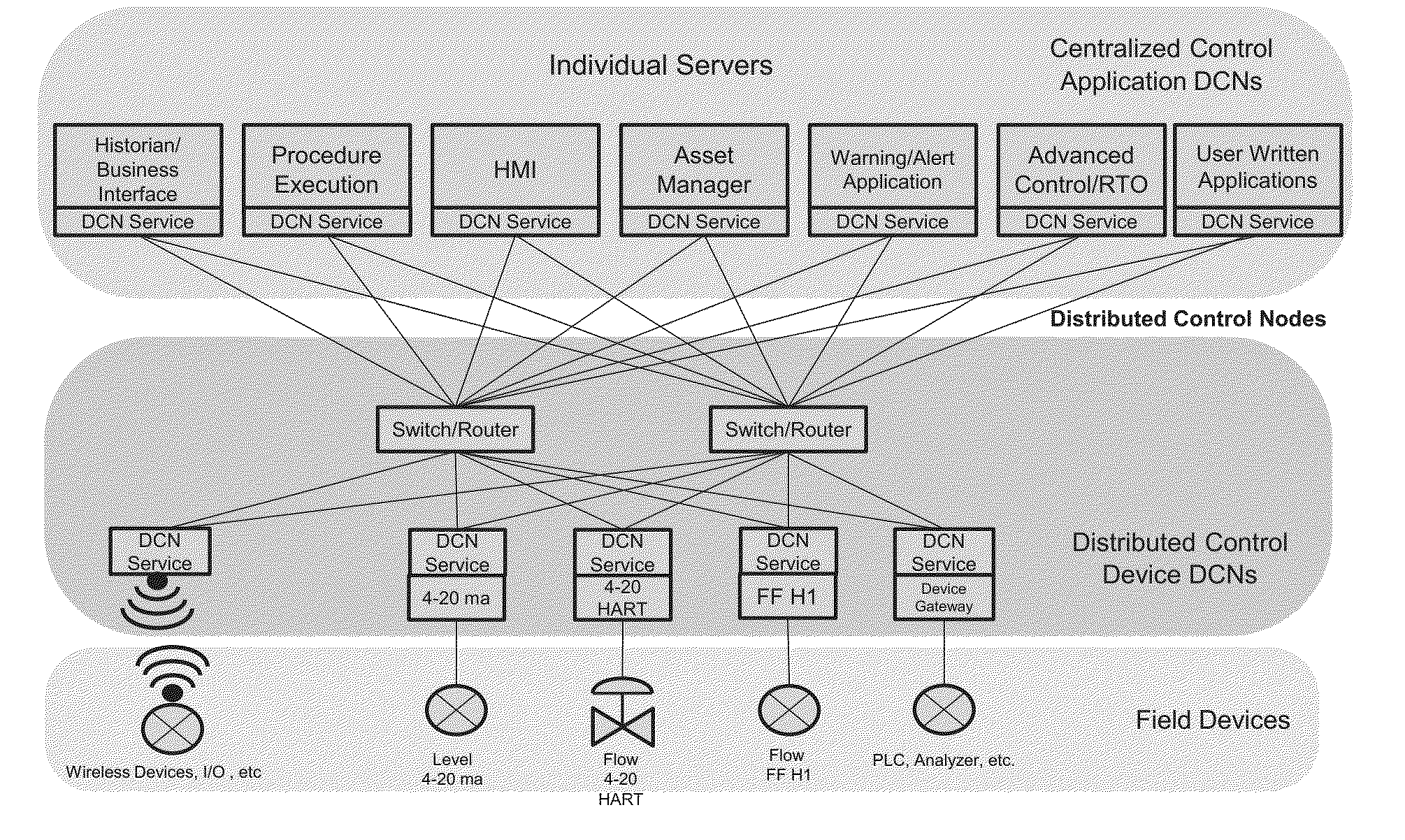
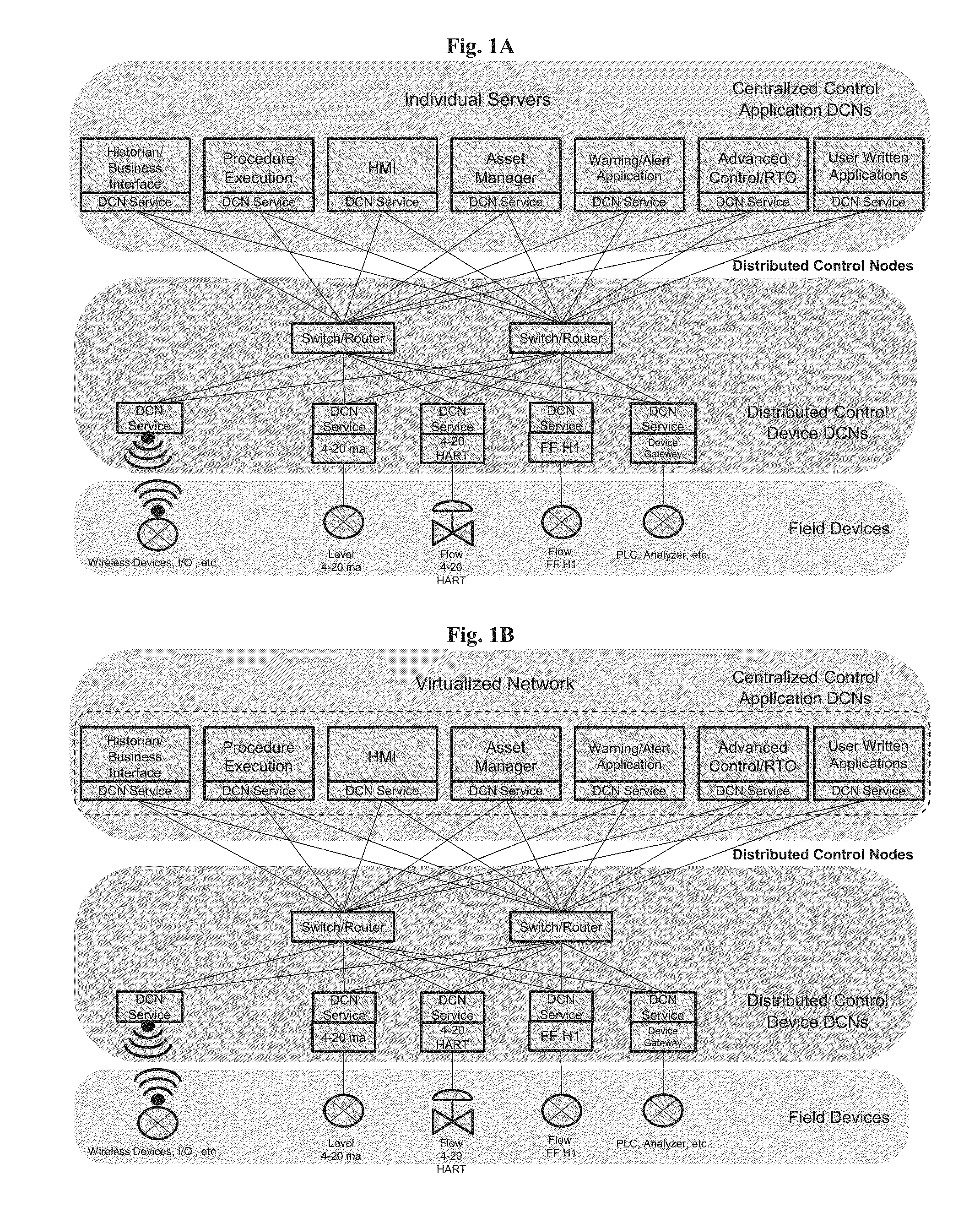
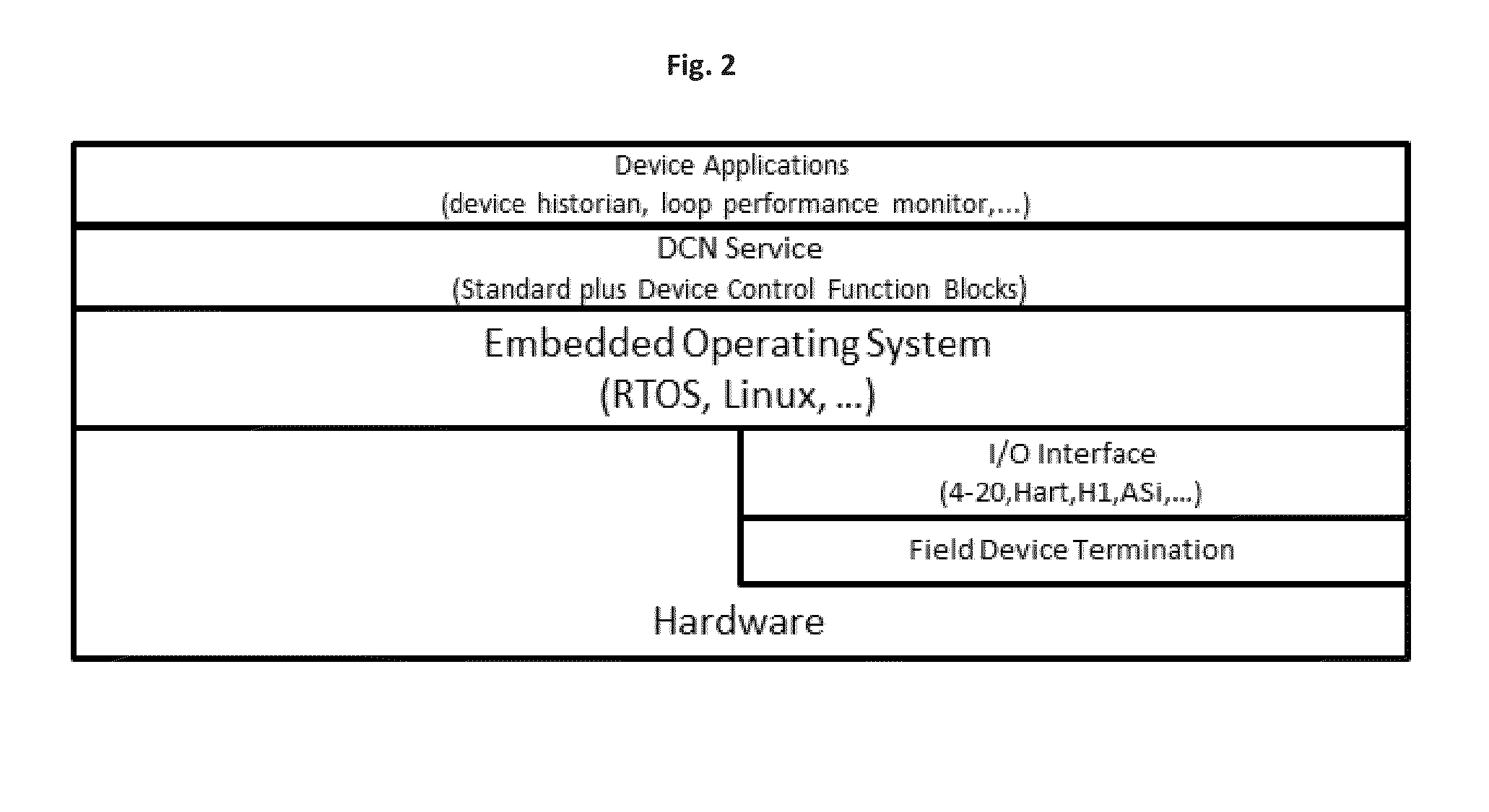
- A modular, interoperable DCS architecture utilizing distributed control nodes (DCNs) with a high-speed Layer 3 Ethernet switch fabric and industry-standard software runtime, enabling flexible integration of applications and I/O interfaces, and allowing for peer-to-peer communication between Device DCNs and Application DCNs using standard function blocks and protocols.

Control device and distributed control system
PatentActiveUS11977362B2
Innovation
- Implementing a control system that allocates time slots on a network and synchronizes data writing and reading across nodes using TSN standardization, ensuring data is written and stored in a common area simultaneously across all nodes.


Cybersecurity Framework for Modern DCS Networks
The integration of emerging communication technologies into distributed control systems necessitates a comprehensive cybersecurity framework that addresses the unique vulnerabilities and threat vectors introduced by modern network architectures. As DCS environments evolve to incorporate wireless protocols, cloud connectivity, and IoT devices, traditional security perimeters become increasingly porous, requiring adaptive defense mechanisms that can scale with technological advancement.
Modern DCS networks face unprecedented cybersecurity challenges due to their hybrid nature, combining legacy industrial protocols with contemporary communication standards. The convergence of operational technology and information technology creates attack surfaces that span from field devices utilizing wireless sensor networks to cloud-based analytics platforms. This expanded attack landscape demands a multi-layered security approach that encompasses device authentication, network segmentation, and real-time threat detection capabilities.
A robust cybersecurity framework for modern DCS networks must incorporate zero-trust architecture principles, where every communication endpoint requires continuous verification regardless of its network location. This approach becomes particularly critical when integrating 5G networks, edge computing nodes, and software-defined networking components that introduce dynamic topology changes and increased data flow complexity.
The framework should establish secure communication channels through advanced encryption protocols specifically designed for industrial environments, balancing security requirements with real-time performance constraints. Implementation of blockchain-based device identity management and secure key distribution mechanisms ensures authenticated communication across heterogeneous network segments while maintaining the low-latency requirements essential for control system operations.
Continuous monitoring and anomaly detection capabilities form the cornerstone of proactive cybersecurity measures, utilizing machine learning algorithms to identify unusual communication patterns or unauthorized access attempts. These systems must be capable of distinguishing between legitimate operational variations and potential security breaches while providing automated response mechanisms that can isolate compromised network segments without disrupting critical control functions.
Regular security assessments and penetration testing protocols specifically tailored for DCS environments ensure the framework remains effective against evolving threat landscapes. The integration of threat intelligence feeds and collaborative security information sharing among industry stakeholders enhances the collective defense posture against sophisticated cyber attacks targeting critical infrastructure systems.
Modern DCS networks face unprecedented cybersecurity challenges due to their hybrid nature, combining legacy industrial protocols with contemporary communication standards. The convergence of operational technology and information technology creates attack surfaces that span from field devices utilizing wireless sensor networks to cloud-based analytics platforms. This expanded attack landscape demands a multi-layered security approach that encompasses device authentication, network segmentation, and real-time threat detection capabilities.
A robust cybersecurity framework for modern DCS networks must incorporate zero-trust architecture principles, where every communication endpoint requires continuous verification regardless of its network location. This approach becomes particularly critical when integrating 5G networks, edge computing nodes, and software-defined networking components that introduce dynamic topology changes and increased data flow complexity.
The framework should establish secure communication channels through advanced encryption protocols specifically designed for industrial environments, balancing security requirements with real-time performance constraints. Implementation of blockchain-based device identity management and secure key distribution mechanisms ensures authenticated communication across heterogeneous network segments while maintaining the low-latency requirements essential for control system operations.
Continuous monitoring and anomaly detection capabilities form the cornerstone of proactive cybersecurity measures, utilizing machine learning algorithms to identify unusual communication patterns or unauthorized access attempts. These systems must be capable of distinguishing between legitimate operational variations and potential security breaches while providing automated response mechanisms that can isolate compromised network segments without disrupting critical control functions.
Regular security assessments and penetration testing protocols specifically tailored for DCS environments ensure the framework remains effective against evolving threat landscapes. The integration of threat intelligence feeds and collaborative security information sharing among industry stakeholders enhances the collective defense posture against sophisticated cyber attacks targeting critical infrastructure systems.
Industrial Standards for DCS Communication Protocols
Industrial standards for DCS communication protocols serve as the foundational framework that enables interoperability, reliability, and security across distributed control systems. These standards have evolved significantly to accommodate emerging communication technologies while maintaining backward compatibility with legacy systems. The standardization landscape encompasses multiple layers of communication architecture, from physical transmission protocols to application-level data exchange formats.
The International Electrotechnical Commission (IEC) has established several critical standards that govern DCS communications. IEC 61850, originally developed for power system automation, has expanded its influence into broader industrial applications due to its robust object-oriented data modeling approach. This standard defines communication protocols for intelligent electronic devices and supports both Ethernet-based and serial communication methods. IEC 61499, focusing on distributed industrial-process measurement and control systems, provides a framework for function block programming that facilitates distributed control architectures.
Foundation Fieldbus and HART protocols represent mature standards that continue to evolve with technological advancement. Foundation Fieldbus H1 operates at 31.25 kbit/s and supports intrinsically safe applications, while High Speed Ethernet (HSE) enables 100 Mbps communication for backbone networks. The HART protocol, widely adopted in process industries, has transitioned from its analog 4-20mA roots to support digital communication through WirelessHART technology, demonstrating successful adaptation to emerging wireless communication paradigms.
Ethernet-based standards have gained prominence as industrial networks migrate toward IP-based architectures. EtherNet/IP, developed by ODVA, leverages standard Ethernet and Internet protocols while providing real-time communication capabilities essential for control applications. Similarly, PROFINET, standardized under IEC 61158 and IEC 61784, offers three communication classes ranging from non-real-time to isochronous real-time communication, accommodating diverse industrial requirements.
The emergence of Time-Sensitive Networking (TSN) standards represents a significant advancement in industrial communication protocols. IEEE 802.1 TSN suite provides deterministic communication over standard Ethernet infrastructure, enabling convergence of operational technology and information technology networks. These standards address critical timing requirements while supporting mixed-criticality traffic flows essential for modern DCS implementations.
Cybersecurity considerations have become integral to communication protocol standards. IEC 62443 series provides comprehensive security guidelines for industrial automation and control systems, defining security levels and zones that align with communication protocol implementations. This standard framework ensures that emerging communication technologies maintain appropriate security postures while enabling enhanced connectivity and functionality in distributed control environments.
The International Electrotechnical Commission (IEC) has established several critical standards that govern DCS communications. IEC 61850, originally developed for power system automation, has expanded its influence into broader industrial applications due to its robust object-oriented data modeling approach. This standard defines communication protocols for intelligent electronic devices and supports both Ethernet-based and serial communication methods. IEC 61499, focusing on distributed industrial-process measurement and control systems, provides a framework for function block programming that facilitates distributed control architectures.
Foundation Fieldbus and HART protocols represent mature standards that continue to evolve with technological advancement. Foundation Fieldbus H1 operates at 31.25 kbit/s and supports intrinsically safe applications, while High Speed Ethernet (HSE) enables 100 Mbps communication for backbone networks. The HART protocol, widely adopted in process industries, has transitioned from its analog 4-20mA roots to support digital communication through WirelessHART technology, demonstrating successful adaptation to emerging wireless communication paradigms.
Ethernet-based standards have gained prominence as industrial networks migrate toward IP-based architectures. EtherNet/IP, developed by ODVA, leverages standard Ethernet and Internet protocols while providing real-time communication capabilities essential for control applications. Similarly, PROFINET, standardized under IEC 61158 and IEC 61784, offers three communication classes ranging from non-real-time to isochronous real-time communication, accommodating diverse industrial requirements.
The emergence of Time-Sensitive Networking (TSN) standards represents a significant advancement in industrial communication protocols. IEEE 802.1 TSN suite provides deterministic communication over standard Ethernet infrastructure, enabling convergence of operational technology and information technology networks. These standards address critical timing requirements while supporting mixed-criticality traffic flows essential for modern DCS implementations.
Cybersecurity considerations have become integral to communication protocol standards. IEC 62443 series provides comprehensive security guidelines for industrial automation and control systems, defining security levels and zones that align with communication protocol implementations. This standard framework ensures that emerging communication technologies maintain appropriate security postures while enabling enhanced connectivity and functionality in distributed control environments.
Unlock deeper insights with Patsnap Eureka Quick Research — get a full tech report to explore trends and direct your research. Try now!
Generate Your Research Report Instantly with AI Agent
Supercharge your innovation with Patsnap Eureka AI Agent Platform!