

How to Utilize Advanced ULED Techniques in Design?
JUN 20, 20259 MIN READ
Generate Your Research Report Instantly with AI Agent
PatSnap Eureka helps you evaluate technical feasibility & market potential.
ULED Technology Evolution and Objectives
ULED (Ultra Light Emitting Diode) technology has undergone significant evolution since its inception, revolutionizing display and lighting industries. The journey of ULED began with the development of traditional LED technology and has progressed rapidly to address the growing demand for higher quality, energy-efficient displays and lighting solutions.
The primary objective of ULED technology is to enhance display performance while reducing power consumption and improving overall efficiency. This aligns with the global trend towards sustainable and eco-friendly technologies. ULED aims to deliver superior image quality, including better contrast ratios, wider color gamut, and higher brightness levels, while maintaining energy efficiency.
One of the key milestones in ULED evolution was the introduction of quantum dot technology, which significantly improved color accuracy and brightness. This breakthrough allowed for the production of displays with more vibrant and lifelike colors, setting new standards in the industry. Subsequently, the development of mini-LED and micro-LED technologies further pushed the boundaries of what was possible with ULED displays.
The ongoing evolution of ULED technology focuses on several critical areas. These include improving pixel density for higher resolution displays, enhancing local dimming capabilities for better contrast and black levels, and developing more efficient light-emitting materials. Additionally, researchers are exploring ways to reduce production costs and improve manufacturing processes to make ULED technology more accessible to a broader market.
Another significant objective in ULED development is the integration of advanced control systems and software algorithms. These innovations aim to optimize display performance in real-time, adjusting brightness and color based on ambient lighting conditions and content being displayed. This adaptive capability not only enhances user experience but also contributes to energy conservation.
Looking ahead, the ULED technology roadmap includes ambitious goals such as developing flexible and transparent displays, improving durability and lifespan of ULED panels, and exploring new applications beyond traditional display and lighting use cases. There is also a growing focus on integrating ULED technology with other emerging technologies like augmented reality (AR) and virtual reality (VR) to create more immersive visual experiences.
In conclusion, the evolution of ULED technology represents a continuous pursuit of excellence in display and lighting solutions. By setting clear objectives for improved performance, energy efficiency, and versatility, ULED technology is poised to play a crucial role in shaping the future of visual technologies across various industries and applications.
The primary objective of ULED technology is to enhance display performance while reducing power consumption and improving overall efficiency. This aligns with the global trend towards sustainable and eco-friendly technologies. ULED aims to deliver superior image quality, including better contrast ratios, wider color gamut, and higher brightness levels, while maintaining energy efficiency.
One of the key milestones in ULED evolution was the introduction of quantum dot technology, which significantly improved color accuracy and brightness. This breakthrough allowed for the production of displays with more vibrant and lifelike colors, setting new standards in the industry. Subsequently, the development of mini-LED and micro-LED technologies further pushed the boundaries of what was possible with ULED displays.
The ongoing evolution of ULED technology focuses on several critical areas. These include improving pixel density for higher resolution displays, enhancing local dimming capabilities for better contrast and black levels, and developing more efficient light-emitting materials. Additionally, researchers are exploring ways to reduce production costs and improve manufacturing processes to make ULED technology more accessible to a broader market.
Another significant objective in ULED development is the integration of advanced control systems and software algorithms. These innovations aim to optimize display performance in real-time, adjusting brightness and color based on ambient lighting conditions and content being displayed. This adaptive capability not only enhances user experience but also contributes to energy conservation.
Looking ahead, the ULED technology roadmap includes ambitious goals such as developing flexible and transparent displays, improving durability and lifespan of ULED panels, and exploring new applications beyond traditional display and lighting use cases. There is also a growing focus on integrating ULED technology with other emerging technologies like augmented reality (AR) and virtual reality (VR) to create more immersive visual experiences.
In conclusion, the evolution of ULED technology represents a continuous pursuit of excellence in display and lighting solutions. By setting clear objectives for improved performance, energy efficiency, and versatility, ULED technology is poised to play a crucial role in shaping the future of visual technologies across various industries and applications.
Market Demand for ULED Applications
The market demand for ULED (Ultra Light Emitting Diode) applications has been experiencing significant growth in recent years, driven by the technology's superior performance characteristics and expanding use cases across various industries. ULED technology offers enhanced brightness, contrast, and energy efficiency compared to traditional LED displays, making it increasingly attractive for both consumer and commercial applications.
In the consumer electronics sector, ULED displays are gaining traction in high-end televisions and monitors. The demand for larger screens with higher resolutions and improved picture quality has led manufacturers to adopt ULED technology to meet consumer expectations. This trend is particularly evident in the premium segment of the market, where consumers are willing to pay a premium for superior visual experiences.
The automotive industry represents another significant market for ULED applications. As vehicles become more technologically advanced, there is a growing demand for high-quality displays in dashboards, infotainment systems, and heads-up displays. ULED technology's ability to provide bright, clear visuals even in challenging lighting conditions makes it ideal for automotive applications, contributing to improved safety and user experience.
Commercial signage and digital out-of-home advertising are also driving the demand for ULED displays. The technology's high brightness and contrast ratios allow for better visibility in outdoor environments, even in direct sunlight. This has led to increased adoption in areas such as retail, transportation hubs, and sports venues, where large-format displays are used to convey information and advertisements.
The healthcare sector is emerging as a promising market for ULED applications. High-resolution medical imaging displays benefit from ULED technology's ability to produce accurate colors and fine details, crucial for diagnostic purposes. Additionally, ULED-based surgical lights are being developed to provide better illumination during medical procedures, potentially improving surgical outcomes.
In the industrial and manufacturing sectors, ULED technology is finding applications in control panels, human-machine interfaces, and quality inspection systems. The technology's durability, longevity, and ability to perform in harsh environments make it suitable for industrial applications where reliability is paramount.
As smart cities and IoT initiatives continue to evolve, there is a growing demand for ULED displays in public information systems, traffic management, and environmental monitoring applications. The technology's energy efficiency aligns well with sustainability goals, making it an attractive option for large-scale urban deployments.
While the market demand for ULED applications is robust, challenges such as high initial costs and competition from other display technologies like OLED and MicroLED persist. However, ongoing research and development efforts are expected to address these challenges, potentially expanding the market further in the coming years.
In the consumer electronics sector, ULED displays are gaining traction in high-end televisions and monitors. The demand for larger screens with higher resolutions and improved picture quality has led manufacturers to adopt ULED technology to meet consumer expectations. This trend is particularly evident in the premium segment of the market, where consumers are willing to pay a premium for superior visual experiences.
The automotive industry represents another significant market for ULED applications. As vehicles become more technologically advanced, there is a growing demand for high-quality displays in dashboards, infotainment systems, and heads-up displays. ULED technology's ability to provide bright, clear visuals even in challenging lighting conditions makes it ideal for automotive applications, contributing to improved safety and user experience.
Commercial signage and digital out-of-home advertising are also driving the demand for ULED displays. The technology's high brightness and contrast ratios allow for better visibility in outdoor environments, even in direct sunlight. This has led to increased adoption in areas such as retail, transportation hubs, and sports venues, where large-format displays are used to convey information and advertisements.
The healthcare sector is emerging as a promising market for ULED applications. High-resolution medical imaging displays benefit from ULED technology's ability to produce accurate colors and fine details, crucial for diagnostic purposes. Additionally, ULED-based surgical lights are being developed to provide better illumination during medical procedures, potentially improving surgical outcomes.
In the industrial and manufacturing sectors, ULED technology is finding applications in control panels, human-machine interfaces, and quality inspection systems. The technology's durability, longevity, and ability to perform in harsh environments make it suitable for industrial applications where reliability is paramount.
As smart cities and IoT initiatives continue to evolve, there is a growing demand for ULED displays in public information systems, traffic management, and environmental monitoring applications. The technology's energy efficiency aligns well with sustainability goals, making it an attractive option for large-scale urban deployments.
While the market demand for ULED applications is robust, challenges such as high initial costs and competition from other display technologies like OLED and MicroLED persist. However, ongoing research and development efforts are expected to address these challenges, potentially expanding the market further in the coming years.
ULED Technical Challenges and Limitations
ULED (Ultra Light Emitting Diode) technology, while promising significant advancements in display technology, faces several technical challenges and limitations that need to be addressed for widespread adoption and optimal performance.
One of the primary challenges is the complexity of the manufacturing process. ULED displays require precise control over the deposition of quantum dot materials and the formation of nanostructures. This level of precision demands advanced manufacturing techniques and equipment, which can significantly increase production costs and limit scalability.
Color accuracy and consistency pose another significant hurdle. While ULED technology offers a wider color gamut than traditional LED displays, maintaining color accuracy across the entire display and ensuring consistency between different ULED panels remains challenging. This is particularly crucial for applications requiring high color fidelity, such as professional graphic design or medical imaging.
Power efficiency, although improved compared to conventional LEDs, still presents room for enhancement. ULED displays consume less power than their predecessors, but further optimization is needed to compete with emerging technologies like microLED in terms of energy efficiency, especially for battery-powered devices.
Longevity and degradation of ULED materials over time is another area of concern. The quantum dot materials used in ULED displays can degrade when exposed to heat, moisture, or oxygen, potentially leading to reduced brightness and color shift over the lifespan of the display. Developing more stable materials and effective encapsulation techniques is crucial for ensuring long-term reliability.
Heat management remains a significant technical challenge. ULED displays generate heat during operation, which can affect performance and lifespan if not properly managed. Implementing effective thermal management solutions without compromising the display's thinness or increasing costs is a complex engineering task.
The integration of ULED technology with flexible or curved displays presents additional technical hurdles. While ULED offers potential advantages in these form factors, ensuring uniform performance across bent or flexed surfaces requires further research and development.
Lastly, the cost of ULED technology remains a limiting factor for widespread adoption. The advanced materials and manufacturing processes required for ULED displays currently result in higher production costs compared to conventional LED or OLED displays. Reducing these costs while maintaining performance advantages is crucial for ULED to gain market share in competitive display markets.
One of the primary challenges is the complexity of the manufacturing process. ULED displays require precise control over the deposition of quantum dot materials and the formation of nanostructures. This level of precision demands advanced manufacturing techniques and equipment, which can significantly increase production costs and limit scalability.
Color accuracy and consistency pose another significant hurdle. While ULED technology offers a wider color gamut than traditional LED displays, maintaining color accuracy across the entire display and ensuring consistency between different ULED panels remains challenging. This is particularly crucial for applications requiring high color fidelity, such as professional graphic design or medical imaging.
Power efficiency, although improved compared to conventional LEDs, still presents room for enhancement. ULED displays consume less power than their predecessors, but further optimization is needed to compete with emerging technologies like microLED in terms of energy efficiency, especially for battery-powered devices.
Longevity and degradation of ULED materials over time is another area of concern. The quantum dot materials used in ULED displays can degrade when exposed to heat, moisture, or oxygen, potentially leading to reduced brightness and color shift over the lifespan of the display. Developing more stable materials and effective encapsulation techniques is crucial for ensuring long-term reliability.
Heat management remains a significant technical challenge. ULED displays generate heat during operation, which can affect performance and lifespan if not properly managed. Implementing effective thermal management solutions without compromising the display's thinness or increasing costs is a complex engineering task.
The integration of ULED technology with flexible or curved displays presents additional technical hurdles. While ULED offers potential advantages in these form factors, ensuring uniform performance across bent or flexed surfaces requires further research and development.
Lastly, the cost of ULED technology remains a limiting factor for widespread adoption. The advanced materials and manufacturing processes required for ULED displays currently result in higher production costs compared to conventional LED or OLED displays. Reducing these costs while maintaining performance advantages is crucial for ULED to gain market share in competitive display markets.
Current ULED Design Solutions
01 ULED structure and composition
Ultra Light Emitting Diodes (ULEDs) are advanced semiconductor devices designed for high-efficiency light emission. They typically consist of multiple layers of semiconductor materials, including quantum wells and barrier layers, to enhance light output and efficiency. The structure may include novel materials or compositions to improve performance.- ULED structure and composition: Ultra Light Emitting Diodes (ULEDs) are advanced semiconductor devices with unique structural and compositional features. They are designed to emit light with high efficiency and brightness while maintaining a compact form factor. The structure typically includes specialized layers of semiconductor materials and may incorporate novel materials or quantum structures to enhance performance.
- ULED manufacturing processes: The manufacturing of ULEDs involves sophisticated processes to achieve their ultra-small size and high performance. These may include advanced epitaxial growth techniques, precise doping methods, and specialized packaging processes. The manufacturing techniques aim to optimize light output, reduce power consumption, and ensure reliability in a miniaturized form factor.
- ULED applications in display technology: ULEDs are increasingly being utilized in display technologies, offering advantages such as high brightness, wide color gamut, and energy efficiency. They are particularly suitable for micro-LED displays, which can provide superior image quality and contrast compared to traditional LED displays. Applications include high-resolution screens for smartphones, televisions, and augmented reality devices.
- ULED power efficiency and thermal management: A key focus in ULED development is maximizing power efficiency while managing heat generation. This involves innovative designs for current spreading, improved light extraction techniques, and advanced thermal management solutions. These improvements aim to increase the overall efficiency of ULEDs, reduce power consumption, and extend their operational lifespan.
- ULED color tuning and spectral control: ULEDs are being developed with advanced color tuning capabilities and precise spectral control. This involves techniques such as quantum dot integration, phosphor engineering, and multi-layer emissive structures. These advancements allow for a wider color gamut, improved color accuracy, and the ability to dynamically adjust light output characteristics for various applications.
02 ULED manufacturing processes
Manufacturing techniques for ULEDs involve sophisticated processes such as epitaxial growth, photolithography, and thin-film deposition. These methods are crucial for creating the precise layered structures required for high-performance ULEDs. Advanced packaging techniques may also be employed to enhance light extraction and thermal management.Expand Specific Solutions03 ULED applications in displays
ULEDs are increasingly used in display technologies, offering advantages such as high brightness, energy efficiency, and improved color gamut. They are particularly suitable for high-resolution displays in various devices, including smartphones, televisions, and automotive displays. The technology allows for thinner and more flexible display designs.Expand Specific Solutions04 ULED power efficiency and thermal management
A key focus in ULED development is improving power efficiency and managing heat generation. This involves optimizing the electrical and optical properties of the device, as well as developing advanced heat dissipation techniques. Improved efficiency and thermal management lead to longer device lifetimes and better overall performance.Expand Specific Solutions05 ULED color tuning and light quality
ULEDs can be engineered to produce a wide range of colors with high purity. This is achieved through careful design of the active layers and the use of phosphors or quantum dots. Advanced color tuning techniques allow for precise control over the spectral output, enabling high-quality lighting and display applications with improved color rendering.Expand Specific Solutions
Key ULED Industry Players
The advanced ULED (Ultra Light Emitting Diode) technology market is in a growth phase, with increasing adoption across various industries. The market size is expanding rapidly, driven by demand for high-quality displays in consumer electronics, automotive, and signage applications. Technologically, ULED is maturing, with companies like Lumileds LLC, Huawei Technologies Co., Ltd., and TCL China Star Optoelectronics Technology Co., Ltd. leading innovation. These firms are advancing ULED techniques in design, focusing on improving efficiency, color accuracy, and brightness. Other players like Xiamen San'an Optoelectronics Co., Ltd. and ZTE Corp. are also contributing to the technology's evolution, indicating a competitive and dynamic market landscape.
Huawei Technologies Co., Ltd.
Technical Solution: Huawei has developed advanced ULED (Ultra LED) technology for their smart TVs. Their ULED technology incorporates quantum dot color enhancement, HDR, local dimming, and AI-powered picture quality optimization. Huawei's ULED displays use a combination of hardware improvements and software algorithms to enhance color accuracy, contrast, and overall picture quality. The company has also integrated their HarmonyOS into ULED TVs, allowing for seamless connectivity with other Huawei devices and smart home integration.
Strengths: Comprehensive ecosystem integration, advanced AI-powered optimization. Weaknesses: Limited global market presence due to geopolitical challenges.
TCL China Star Optoelectronics Technology Co., Ltd.
Technical Solution: TCL CSOT has developed their own version of ULED technology, which they call QLED. Their approach combines quantum dot technology with mini-LED backlighting to achieve superior color performance and contrast. TCL's QLED displays use a proprietary AiPQ Engine Gen 2 with machine-learning algorithms to optimize picture quality in real-time. They have also introduced 8K resolution QLED TVs, pushing the boundaries of display technology. TCL CSOT's ULED techniques focus on enhancing color volume, peak brightness, and local dimming capabilities.
Strengths: Strong manufacturing capabilities, competitive pricing. Weaknesses: Brand recognition in premium markets compared to some competitors.
Core ULED Innovations Analysis
Assembly of semiconductor devices
PatentInactiveGB2545155A
Innovation
- A method using a deformable intermediate layer on the ILED chips for conformal contact with a pick-up tool (PUT) head, enabling precise adhesion and release of chips onto a glass TFT substrate, with the layer being removable post-assembly, and employing a structured surface for enhanced adhesion and release mechanisms.


Micro light emitting device and display thereof
PatentWO2020015353A1
Innovation
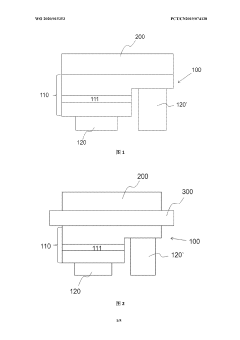
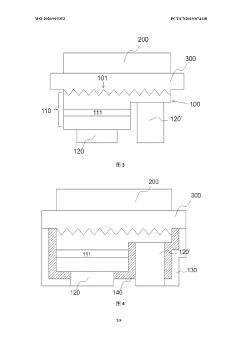
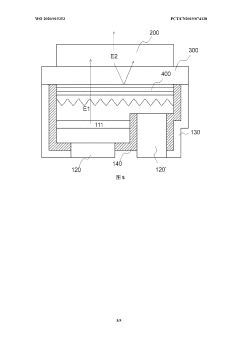
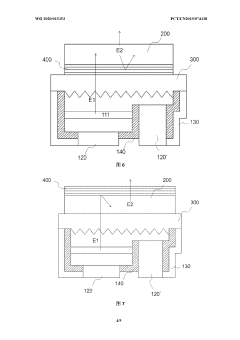
- Using a micro-light-emitting diode structure with a transparent adhesive layer, the blue/green light is converted into red light through photon conversion technology, the AlInGaP-based quantum well layer is used to achieve efficient photon conversion, and anti-reflection and anti-reflection are set on the micro-light-emitting diode. The film layer and light reflective layer optimize the light emission efficiency.
ULED Manufacturing Processes
The manufacturing processes for Ultra Light Emitting Diodes (ULED) involve a series of sophisticated techniques that are crucial for achieving the advanced performance characteristics of these cutting-edge display technologies. The process typically begins with the preparation of a suitable substrate, often made of high-quality glass or silicon wafers, which serves as the foundation for the subsequent layers.
One of the key steps in ULED manufacturing is the deposition of the active light-emitting layers. This is commonly achieved through advanced epitaxial growth techniques such as Metal-Organic Chemical Vapor Deposition (MOCVD) or Molecular Beam Epitaxy (MBE). These methods allow for precise control over the thickness and composition of the semiconductor layers, which is essential for optimizing the light emission properties of the ULED.
Following the deposition of the active layers, a series of photolithography and etching steps are employed to define the individual ULED structures. This process involves the use of high-resolution photoresists and advanced etching techniques, such as Reactive Ion Etching (RIE) or Inductively Coupled Plasma (ICP) etching, to create the desired micro-LED patterns with high precision and uniformity.
The next critical stage in ULED manufacturing is the formation of electrical contacts. This typically involves the deposition of transparent conductive oxides (TCOs) like Indium Tin Oxide (ITO) for the top electrode, and metallic layers for the bottom electrode. Advanced techniques such as e-beam evaporation or sputtering are used to ensure uniform and low-resistance contacts.
To enhance the light extraction efficiency of ULEDs, various surface texturing and nanostructuring techniques are employed. These may include the creation of photonic crystal structures, nanopillar arrays, or the application of anti-reflection coatings. Such features are typically fabricated using nanoimprint lithography or self-assembled nanostructure growth methods.
The final stages of ULED manufacturing involve packaging and integration. This includes the application of protective encapsulation layers, often using advanced polymer materials, and the integration of the ULED array with driving circuitry. For flexible ULED displays, additional processes such as transfer printing or laser lift-off may be employed to separate the ULED structures from their growth substrates and transfer them onto flexible polymer substrates.
Throughout the manufacturing process, stringent quality control measures are implemented, including in-line optical and electrical characterization, to ensure the consistency and reliability of the produced ULEDs. Advanced automation and robotics are increasingly being utilized to enhance the precision and throughput of these manufacturing processes, contributing to the scalability and cost-effectiveness of ULED production.
One of the key steps in ULED manufacturing is the deposition of the active light-emitting layers. This is commonly achieved through advanced epitaxial growth techniques such as Metal-Organic Chemical Vapor Deposition (MOCVD) or Molecular Beam Epitaxy (MBE). These methods allow for precise control over the thickness and composition of the semiconductor layers, which is essential for optimizing the light emission properties of the ULED.
Following the deposition of the active layers, a series of photolithography and etching steps are employed to define the individual ULED structures. This process involves the use of high-resolution photoresists and advanced etching techniques, such as Reactive Ion Etching (RIE) or Inductively Coupled Plasma (ICP) etching, to create the desired micro-LED patterns with high precision and uniformity.
The next critical stage in ULED manufacturing is the formation of electrical contacts. This typically involves the deposition of transparent conductive oxides (TCOs) like Indium Tin Oxide (ITO) for the top electrode, and metallic layers for the bottom electrode. Advanced techniques such as e-beam evaporation or sputtering are used to ensure uniform and low-resistance contacts.
To enhance the light extraction efficiency of ULEDs, various surface texturing and nanostructuring techniques are employed. These may include the creation of photonic crystal structures, nanopillar arrays, or the application of anti-reflection coatings. Such features are typically fabricated using nanoimprint lithography or self-assembled nanostructure growth methods.
The final stages of ULED manufacturing involve packaging and integration. This includes the application of protective encapsulation layers, often using advanced polymer materials, and the integration of the ULED array with driving circuitry. For flexible ULED displays, additional processes such as transfer printing or laser lift-off may be employed to separate the ULED structures from their growth substrates and transfer them onto flexible polymer substrates.
Throughout the manufacturing process, stringent quality control measures are implemented, including in-line optical and electrical characterization, to ensure the consistency and reliability of the produced ULEDs. Advanced automation and robotics are increasingly being utilized to enhance the precision and throughput of these manufacturing processes, contributing to the scalability and cost-effectiveness of ULED production.
Energy Efficiency in ULED Design
Energy efficiency is a critical aspect of ULED (Ultra Light Emitting Diode) design, as it directly impacts the performance, longevity, and environmental footprint of these advanced lighting solutions. The pursuit of energy-efficient ULED designs has led to significant advancements in both materials science and manufacturing processes.
One of the primary approaches to enhancing energy efficiency in ULED design is through the optimization of the semiconductor materials used in the diode structure. Researchers have made substantial progress in developing novel compound semiconductors that exhibit superior electron mobility and reduced energy loss during the light emission process. These materials, often based on gallium nitride (GaN) or indium gallium nitride (InGaN), allow for more efficient conversion of electrical energy into light.
Another key area of focus is the improvement of quantum well structures within the ULED. By carefully engineering the thickness and composition of quantum wells, designers can enhance the electron-hole recombination efficiency, resulting in higher light output for a given input power. This approach has led to the development of multi-quantum well (MQW) structures that significantly boost the overall energy efficiency of ULEDs.
Thermal management plays a crucial role in maintaining the energy efficiency of ULEDs over their operational lifetime. Advanced heat dissipation techniques, such as the integration of micro-channel cooling systems or the use of high thermal conductivity substrates, help to mitigate performance degradation due to heat buildup. These thermal management solutions ensure that ULEDs can operate at peak efficiency for extended periods, even under high-power conditions.
The implementation of advanced optical designs has also contributed to improved energy efficiency in ULEDs. Techniques such as photonic crystal structures and surface plasmon coupling have been employed to enhance light extraction efficiency, reducing internal reflections and minimizing energy loss within the device. These optical enhancements allow a greater proportion of the generated light to be emitted from the ULED, thereby increasing its overall efficiency.
Recent developments in driver electronics have further boosted the energy efficiency of ULED systems. Intelligent power management circuits, capable of dynamically adjusting current flow based on ambient conditions and user requirements, help to optimize energy consumption without compromising on light output quality. Additionally, the integration of advanced dimming technologies allows for precise control over light intensity, enabling further energy savings in various applications.
As ULED technology continues to evolve, researchers are exploring novel approaches to push the boundaries of energy efficiency. This includes the investigation of quantum dot-enhanced ULEDs, which promise to deliver even higher color purity and energy efficiency by leveraging the unique optical properties of semiconductor nanocrystals. The ongoing development of these advanced techniques underscores the potential for ULEDs to play a pivotal role in next-generation, energy-efficient lighting solutions across a wide range of industries and applications.
One of the primary approaches to enhancing energy efficiency in ULED design is through the optimization of the semiconductor materials used in the diode structure. Researchers have made substantial progress in developing novel compound semiconductors that exhibit superior electron mobility and reduced energy loss during the light emission process. These materials, often based on gallium nitride (GaN) or indium gallium nitride (InGaN), allow for more efficient conversion of electrical energy into light.
Another key area of focus is the improvement of quantum well structures within the ULED. By carefully engineering the thickness and composition of quantum wells, designers can enhance the electron-hole recombination efficiency, resulting in higher light output for a given input power. This approach has led to the development of multi-quantum well (MQW) structures that significantly boost the overall energy efficiency of ULEDs.
Thermal management plays a crucial role in maintaining the energy efficiency of ULEDs over their operational lifetime. Advanced heat dissipation techniques, such as the integration of micro-channel cooling systems or the use of high thermal conductivity substrates, help to mitigate performance degradation due to heat buildup. These thermal management solutions ensure that ULEDs can operate at peak efficiency for extended periods, even under high-power conditions.
The implementation of advanced optical designs has also contributed to improved energy efficiency in ULEDs. Techniques such as photonic crystal structures and surface plasmon coupling have been employed to enhance light extraction efficiency, reducing internal reflections and minimizing energy loss within the device. These optical enhancements allow a greater proportion of the generated light to be emitted from the ULED, thereby increasing its overall efficiency.
Recent developments in driver electronics have further boosted the energy efficiency of ULED systems. Intelligent power management circuits, capable of dynamically adjusting current flow based on ambient conditions and user requirements, help to optimize energy consumption without compromising on light output quality. Additionally, the integration of advanced dimming technologies allows for precise control over light intensity, enabling further energy savings in various applications.
As ULED technology continues to evolve, researchers are exploring novel approaches to push the boundaries of energy efficiency. This includes the investigation of quantum dot-enhanced ULEDs, which promise to deliver even higher color purity and energy efficiency by leveraging the unique optical properties of semiconductor nanocrystals. The ongoing development of these advanced techniques underscores the potential for ULEDs to play a pivotal role in next-generation, energy-efficient lighting solutions across a wide range of industries and applications.
Unlock deeper insights with PatSnap Eureka Quick Research — get a full tech report to explore trends and direct your research. Try now!
Generate Your Research Report Instantly with AI Agent
Supercharge your innovation with PatSnap Eureka AI Agent Platform!