
Navigating the Technological Shift with PNP Transistor Efficiency Improvements
JUL 28, 20259 MIN READ
Generate Your Research Report Instantly with AI Agent
Patsnap Eureka helps you evaluate technical feasibility & market potential.
PNP Transistor Evolution
The evolution of PNP transistors represents a significant chapter in the history of semiconductor technology. Initially developed in the early 1950s, PNP transistors emerged as a complement to their NPN counterparts, offering unique advantages in circuit design and performance.
The journey of PNP transistors began with the invention of the bipolar junction transistor (BJT) by William Shockley, John Bardeen, and Walter Brattain at Bell Labs in 1947. While the first transistors were point-contact devices, the development of the junction transistor in 1951 paved the way for both NPN and PNP configurations.
Throughout the 1960s and 1970s, PNP transistors saw significant improvements in manufacturing processes and materials. The introduction of epitaxial growth techniques and advanced doping methods allowed for better control over the transistor's characteristics, leading to enhanced performance and reliability.
The 1980s marked a turning point in PNP transistor technology with the advent of complementary bipolar processes. This innovation enabled the integration of both NPN and PNP transistors on the same chip, greatly expanding the design possibilities for analog and mixed-signal circuits.
As semiconductor technology continued to advance, the focus shifted towards miniaturization and power efficiency. The 1990s and early 2000s saw the development of advanced PNP structures, such as vertical PNP transistors and SiGe heterojunction bipolar transistors (HBTs), which offered improved high-frequency performance and reduced parasitic capacitances.
In recent years, the evolution of PNP transistors has been driven by the demands of modern electronics, particularly in areas such as power management, analog-to-digital conversion, and RF applications. Innovations in materials science and fabrication techniques have led to PNP transistors with higher current gain, lower noise, and better thermal stability.
The ongoing pursuit of efficiency improvements in PNP transistors has focused on several key areas. These include optimizing the base-emitter junction for reduced recombination, enhancing the collector design for improved high-frequency response, and developing novel device architectures that minimize parasitic effects.
Looking ahead, the evolution of PNP transistors is likely to continue in parallel with broader trends in semiconductor technology. This includes the exploration of new materials, such as wide-bandgap semiconductors, and the integration of PNP structures into advanced process nodes to support emerging applications in 5G communications, Internet of Things (IoT) devices, and automotive electronics.
The journey of PNP transistors began with the invention of the bipolar junction transistor (BJT) by William Shockley, John Bardeen, and Walter Brattain at Bell Labs in 1947. While the first transistors were point-contact devices, the development of the junction transistor in 1951 paved the way for both NPN and PNP configurations.
Throughout the 1960s and 1970s, PNP transistors saw significant improvements in manufacturing processes and materials. The introduction of epitaxial growth techniques and advanced doping methods allowed for better control over the transistor's characteristics, leading to enhanced performance and reliability.
The 1980s marked a turning point in PNP transistor technology with the advent of complementary bipolar processes. This innovation enabled the integration of both NPN and PNP transistors on the same chip, greatly expanding the design possibilities for analog and mixed-signal circuits.
As semiconductor technology continued to advance, the focus shifted towards miniaturization and power efficiency. The 1990s and early 2000s saw the development of advanced PNP structures, such as vertical PNP transistors and SiGe heterojunction bipolar transistors (HBTs), which offered improved high-frequency performance and reduced parasitic capacitances.
In recent years, the evolution of PNP transistors has been driven by the demands of modern electronics, particularly in areas such as power management, analog-to-digital conversion, and RF applications. Innovations in materials science and fabrication techniques have led to PNP transistors with higher current gain, lower noise, and better thermal stability.
The ongoing pursuit of efficiency improvements in PNP transistors has focused on several key areas. These include optimizing the base-emitter junction for reduced recombination, enhancing the collector design for improved high-frequency response, and developing novel device architectures that minimize parasitic effects.
Looking ahead, the evolution of PNP transistors is likely to continue in parallel with broader trends in semiconductor technology. This includes the exploration of new materials, such as wide-bandgap semiconductors, and the integration of PNP structures into advanced process nodes to support emerging applications in 5G communications, Internet of Things (IoT) devices, and automotive electronics.
Market Demand Analysis
The market demand for PNP transistor efficiency improvements is driven by the increasing need for high-performance, low-power electronic devices across various industries. As consumer electronics, automotive systems, and industrial applications continue to evolve, there is a growing emphasis on energy efficiency and miniaturization. This has created a significant opportunity for enhanced PNP transistors to meet these demands.
In the consumer electronics sector, the push for longer battery life and smaller form factors in smartphones, tablets, and wearable devices has intensified the need for more efficient transistors. PNP transistors, when optimized for efficiency, can contribute to reduced power consumption and improved thermal management in these devices. This is particularly crucial as 5G technology becomes more widespread, requiring more power-efficient components to offset the increased energy demands of high-speed data transmission.
The automotive industry is another key driver of demand for improved PNP transistors. With the rapid growth of electric vehicles (EVs) and advanced driver-assistance systems (ADAS), there is an increasing need for high-performance, energy-efficient semiconductors. PNP transistors play a vital role in power management, motor control, and battery management systems in EVs. Enhancing their efficiency can lead to extended driving ranges, faster charging times, and overall improved vehicle performance.
In industrial applications, the trend towards Industry 4.0 and smart manufacturing has created a surge in demand for sensors, actuators, and control systems. These systems require precise and efficient transistors to ensure accurate data collection and processing while minimizing power consumption. Improved PNP transistors can contribute to the development of more reliable and energy-efficient industrial equipment, supporting the ongoing digital transformation of manufacturing processes.
The telecommunications sector is another area where the demand for efficient PNP transistors is growing. As network infrastructure expands to support 5G and future 6G technologies, there is a need for more power-efficient components in base stations and network equipment. Enhanced PNP transistors can help reduce the energy consumption of these systems, leading to lower operational costs and improved network performance.
Furthermore, the emerging Internet of Things (IoT) ecosystem presents a significant market opportunity for improved PNP transistors. With billions of connected devices expected to be deployed in the coming years, there is a critical need for energy-efficient components that can extend battery life and reduce the overall power consumption of IoT networks. PNP transistors with enhanced efficiency can play a crucial role in enabling long-lasting, low-maintenance IoT devices across various applications, from smart homes to industrial sensors.
In conclusion, the market demand for PNP transistor efficiency improvements is robust and multifaceted, spanning across multiple industries and applications. As technology continues to advance and energy efficiency becomes increasingly important, the development of more efficient PNP transistors will remain a key focus area for semiconductor manufacturers and device designers.
In the consumer electronics sector, the push for longer battery life and smaller form factors in smartphones, tablets, and wearable devices has intensified the need for more efficient transistors. PNP transistors, when optimized for efficiency, can contribute to reduced power consumption and improved thermal management in these devices. This is particularly crucial as 5G technology becomes more widespread, requiring more power-efficient components to offset the increased energy demands of high-speed data transmission.
The automotive industry is another key driver of demand for improved PNP transistors. With the rapid growth of electric vehicles (EVs) and advanced driver-assistance systems (ADAS), there is an increasing need for high-performance, energy-efficient semiconductors. PNP transistors play a vital role in power management, motor control, and battery management systems in EVs. Enhancing their efficiency can lead to extended driving ranges, faster charging times, and overall improved vehicle performance.
In industrial applications, the trend towards Industry 4.0 and smart manufacturing has created a surge in demand for sensors, actuators, and control systems. These systems require precise and efficient transistors to ensure accurate data collection and processing while minimizing power consumption. Improved PNP transistors can contribute to the development of more reliable and energy-efficient industrial equipment, supporting the ongoing digital transformation of manufacturing processes.
The telecommunications sector is another area where the demand for efficient PNP transistors is growing. As network infrastructure expands to support 5G and future 6G technologies, there is a need for more power-efficient components in base stations and network equipment. Enhanced PNP transistors can help reduce the energy consumption of these systems, leading to lower operational costs and improved network performance.
Furthermore, the emerging Internet of Things (IoT) ecosystem presents a significant market opportunity for improved PNP transistors. With billions of connected devices expected to be deployed in the coming years, there is a critical need for energy-efficient components that can extend battery life and reduce the overall power consumption of IoT networks. PNP transistors with enhanced efficiency can play a crucial role in enabling long-lasting, low-maintenance IoT devices across various applications, from smart homes to industrial sensors.
In conclusion, the market demand for PNP transistor efficiency improvements is robust and multifaceted, spanning across multiple industries and applications. As technology continues to advance and energy efficiency becomes increasingly important, the development of more efficient PNP transistors will remain a key focus area for semiconductor manufacturers and device designers.
Current Challenges
The current challenges in improving PNP transistor efficiency are multifaceted and complex, requiring innovative solutions to overcome technological limitations. One of the primary obstacles is the inherent lower mobility of holes compared to electrons, which fundamentally limits the performance of PNP transistors relative to their NPN counterparts. This disparity in charge carrier mobility results in slower switching speeds and higher power consumption in PNP devices.
Another significant challenge lies in the fabrication process of PNP transistors. The doping profiles and junction formations required for optimal PNP performance are often more difficult to achieve with precision, leading to variations in device characteristics and reduced yield in manufacturing. This inconsistency can result in unpredictable behavior in circuit designs and increased production costs.
Heat dissipation remains a critical issue, particularly as transistor sizes continue to shrink. The thermal management of PNP transistors becomes increasingly challenging at higher frequencies and power levels, potentially leading to performance degradation and reliability concerns. Addressing this thermal challenge without compromising device density or increasing manufacturing complexity is a key area of focus for researchers and engineers.
The ongoing miniaturization trend in semiconductor technology presents its own set of challenges for PNP transistor efficiency. As device dimensions approach atomic scales, quantum effects become more pronounced, potentially altering transistor behavior in ways that are difficult to predict or control. Balancing the benefits of miniaturization with the need for consistent and reliable performance is a delicate task that requires advanced modeling and novel design approaches.
Furthermore, the integration of PNP transistors into advanced circuit designs and emerging applications poses additional challenges. As new technologies such as 5G, IoT, and AI demand ever-higher levels of performance and energy efficiency, PNP transistors must evolve to meet these requirements while maintaining compatibility with existing manufacturing processes and design methodologies.
Lastly, the industry faces the challenge of developing more environmentally sustainable manufacturing processes for PNP transistors. This includes reducing the use of rare or toxic materials, minimizing energy consumption during production, and improving the recyclability of semiconductor devices at the end of their lifecycle. Balancing these environmental considerations with the need for high-performance, cost-effective PNP transistors adds another layer of complexity to the technological shift in this field.
Another significant challenge lies in the fabrication process of PNP transistors. The doping profiles and junction formations required for optimal PNP performance are often more difficult to achieve with precision, leading to variations in device characteristics and reduced yield in manufacturing. This inconsistency can result in unpredictable behavior in circuit designs and increased production costs.
Heat dissipation remains a critical issue, particularly as transistor sizes continue to shrink. The thermal management of PNP transistors becomes increasingly challenging at higher frequencies and power levels, potentially leading to performance degradation and reliability concerns. Addressing this thermal challenge without compromising device density or increasing manufacturing complexity is a key area of focus for researchers and engineers.
The ongoing miniaturization trend in semiconductor technology presents its own set of challenges for PNP transistor efficiency. As device dimensions approach atomic scales, quantum effects become more pronounced, potentially altering transistor behavior in ways that are difficult to predict or control. Balancing the benefits of miniaturization with the need for consistent and reliable performance is a delicate task that requires advanced modeling and novel design approaches.
Furthermore, the integration of PNP transistors into advanced circuit designs and emerging applications poses additional challenges. As new technologies such as 5G, IoT, and AI demand ever-higher levels of performance and energy efficiency, PNP transistors must evolve to meet these requirements while maintaining compatibility with existing manufacturing processes and design methodologies.
Lastly, the industry faces the challenge of developing more environmentally sustainable manufacturing processes for PNP transistors. This includes reducing the use of rare or toxic materials, minimizing energy consumption during production, and improving the recyclability of semiconductor devices at the end of their lifecycle. Balancing these environmental considerations with the need for high-performance, cost-effective PNP transistors adds another layer of complexity to the technological shift in this field.
Existing Solutions
01 Improved PNP transistor structure
Advancements in PNP transistor design focus on optimizing the structure to enhance efficiency. This includes modifications to the base, emitter, and collector regions, as well as the use of novel materials and fabrication techniques to reduce parasitic capacitances and improve current gain.- Improved PNP transistor structure: Various structural improvements to PNP transistors can enhance their efficiency. These include optimizing the base width, emitter design, and collector region to reduce parasitic capacitances and improve current gain. Advanced fabrication techniques and novel materials can also be employed to create more efficient PNP transistors.
- Bipolar-CMOS integration: Integrating PNP transistors with CMOS technology can lead to improved overall circuit efficiency. This approach combines the advantages of both bipolar and CMOS technologies, allowing for better performance in mixed-signal applications and reducing power consumption in complex integrated circuits.
- High-frequency PNP transistor design: Designing PNP transistors for high-frequency applications involves optimizing the device geometry and doping profiles to minimize transit time and capacitance. This can lead to improved efficiency in radio frequency and microwave circuits, as well as in high-speed digital applications.
- Power PNP transistor efficiency: Improving the efficiency of power PNP transistors involves techniques such as reducing on-resistance, enhancing thermal management, and optimizing current distribution. These enhancements can lead to better performance in power amplifiers, voltage regulators, and other high-power applications.
- PNP transistor biasing techniques: Efficient biasing techniques for PNP transistors can significantly impact their performance and power consumption. This includes developing optimal current mirror designs, temperature compensation circuits, and adaptive biasing schemes to maintain transistor efficiency across various operating conditions.
02 Bipolar transistor fabrication methods
Various fabrication methods have been developed to improve PNP transistor efficiency. These include selective epitaxial growth, ion implantation techniques, and self-aligned processes that allow for better control of doping profiles and reduce manufacturing variations.Expand Specific Solutions03 Integration with other semiconductor devices
Efficient integration of PNP transistors with other semiconductor devices, such as NPN transistors or CMOS structures, is crucial for overall circuit performance. This involves optimizing layout, reducing parasitic effects, and developing compatible fabrication processes.Expand Specific Solutions04 Biasing and circuit design for PNP transistors
Proper biasing and circuit design techniques are essential for maximizing PNP transistor efficiency. This includes optimizing current mirror configurations, developing low-voltage operation circuits, and implementing temperature compensation methods to ensure stable performance across various operating conditions.Expand Specific Solutions05 High-frequency performance optimization
Improving the high-frequency performance of PNP transistors is crucial for many applications. Techniques include reducing base resistance, minimizing junction capacitances, and implementing advanced packaging and interconnect technologies to reduce parasitic effects and improve overall efficiency at higher frequencies.Expand Specific Solutions
Key Industry Players
The PNP transistor efficiency improvement landscape is characterized by a mature market with steady growth, driven by the continuous demand for enhanced semiconductor performance. The global market size for PNP transistors is substantial, with key players like GLOBALFOUNDRIES, IBM, and Infineon Technologies leading the charge. These companies, along with others such as Texas Instruments and STMicroelectronics, are at the forefront of technological advancements, pushing the boundaries of transistor efficiency. The technology's maturity is evident in its widespread adoption across various industries, yet there remains room for innovation, particularly in areas like power management and high-frequency applications.
Infineon Technologies AG
Technical Solution: Infineon has developed advanced PNP transistor technologies, focusing on improving efficiency and reducing power consumption. Their CoolMOS™ P7 technology utilizes a superjunction structure to achieve lower on-resistance and faster switching speeds[1]. This results in up to 4% efficiency improvement in power supply applications[2]. Infineon has also introduced SiC-based PNP transistors, which offer higher breakdown voltage and lower switching losses compared to traditional silicon-based devices[3]. These innovations have led to significant improvements in power density and overall system efficiency.
Strengths: Industry-leading power efficiency, wide range of applications from consumer electronics to industrial power systems. Weaknesses: Higher production costs for advanced technologies, potential reliability concerns with newer materials.
Texas Instruments Incorporated
Technical Solution: Texas Instruments has made significant strides in PNP transistor efficiency through their BiCOM-III™ technology. This process integrates high-performance bipolar transistors with CMOS logic, allowing for improved analog performance and reduced power consumption[4]. TI's advancements include the development of vertical PNP transistors with optimized emitter-base structures, resulting in higher current gain and lower noise figures[5]. Their PNP transistors also feature reduced parasitic capacitances, enabling faster switching speeds and improved high-frequency performance. TI has reported up to 30% reduction in power consumption for certain analog circuit designs using these enhanced PNP transistors[6].
Strengths: Excellent integration capabilities, wide range of analog and mixed-signal applications. Weaknesses: May have limitations in very high-power applications, potential cost premium for high-performance devices.
Core Innovations
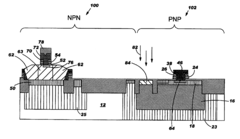
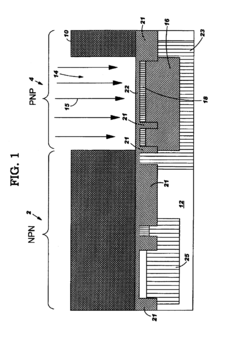
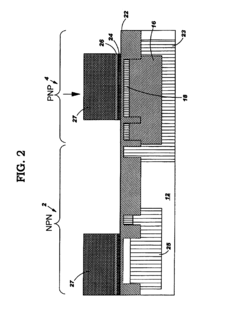
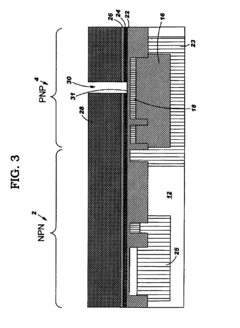
High performance vertical PNP transistor and method
PatentInactiveUS6909164B2
Innovation
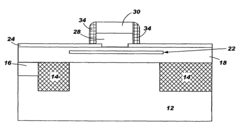
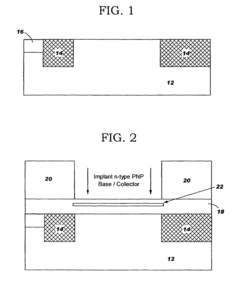
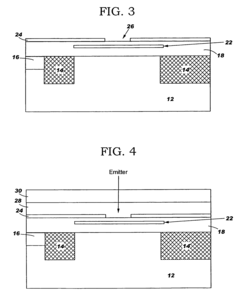
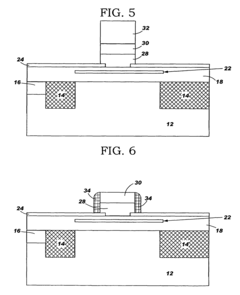
- A method for fabricating high-performance vertical PNP transistors by incorporating an emitter region with silicon and germanium, sharing a single layer of silicon with the NPN transistor's base, and adding two additional masking steps to conventional CMOS and bipolar device fabrication processes, which enhances PNP device performance.
High performance integrated vertical transistors and method of making the same
PatentInactiveUS7217628B2
Innovation
- The use of a shared silicon germanium (SiGe) low temperature epitaxial (LTE) layer allows for the fabrication of vertically aligned complementary bipolar transistors, where the epitaxially deposited extrinsic base of the NPN transistor serves as the emitter for the PNP transistor, and both transistors operate in a downward direction, utilizing advanced epitaxial techniques like molecular beam epitaxy (MBE) and low temperature epitaxy (LTE) to achieve identical vertical profiles.
Regulatory Considerations
The regulatory landscape surrounding PNP transistor efficiency improvements is complex and multifaceted, requiring careful consideration by manufacturers and industry stakeholders. As these technological advancements progress, they intersect with various regulatory domains, including energy efficiency standards, environmental regulations, and safety requirements.
Energy efficiency regulations play a crucial role in shaping the development and adoption of improved PNP transistors. Many countries have implemented stringent energy efficiency standards for electronic devices and systems, which directly impact the design and implementation of transistor technologies. Manufacturers must ensure that their PNP transistor innovations not only enhance performance but also contribute to meeting or exceeding these energy efficiency benchmarks.
Environmental regulations also significantly influence the trajectory of PNP transistor efficiency improvements. As global efforts to reduce electronic waste and promote sustainable manufacturing practices intensify, regulatory bodies are implementing stricter guidelines on the use of hazardous materials and the recyclability of electronic components. This regulatory pressure drives innovation in PNP transistor design, encouraging the development of more environmentally friendly materials and manufacturing processes.
Safety regulations form another critical aspect of the regulatory framework affecting PNP transistor advancements. As these transistors find applications in increasingly diverse and sensitive areas, such as medical devices and automotive systems, regulatory bodies are enforcing rigorous safety standards. Manufacturers must demonstrate compliance with these standards, ensuring that their improved PNP transistors meet stringent requirements for reliability, thermal management, and electromagnetic compatibility.
The global nature of the semiconductor industry necessitates consideration of international regulatory harmonization efforts. Differences in regulatory approaches across regions can create challenges for manufacturers seeking to deploy their PNP transistor innovations globally. Initiatives aimed at aligning standards and regulations across different jurisdictions are gaining traction, potentially streamlining the regulatory compliance process for innovative transistor technologies.
Intellectual property regulations also play a significant role in the development and commercialization of PNP transistor efficiency improvements. Patent laws and licensing agreements can both facilitate and constrain innovation in this field. Manufacturers must navigate a complex landscape of existing patents and potential infringement issues while seeking to protect their own innovations through strategic patenting.
As the pace of technological advancement in PNP transistors accelerates, regulatory bodies face the challenge of keeping their frameworks up-to-date and relevant. This often results in a dynamic regulatory environment, where standards and requirements evolve to keep pace with technological progress. Industry stakeholders must remain vigilant and adaptable, anticipating potential regulatory changes and proactively engaging with regulatory bodies to ensure their innovations align with emerging requirements.
Energy efficiency regulations play a crucial role in shaping the development and adoption of improved PNP transistors. Many countries have implemented stringent energy efficiency standards for electronic devices and systems, which directly impact the design and implementation of transistor technologies. Manufacturers must ensure that their PNP transistor innovations not only enhance performance but also contribute to meeting or exceeding these energy efficiency benchmarks.
Environmental regulations also significantly influence the trajectory of PNP transistor efficiency improvements. As global efforts to reduce electronic waste and promote sustainable manufacturing practices intensify, regulatory bodies are implementing stricter guidelines on the use of hazardous materials and the recyclability of electronic components. This regulatory pressure drives innovation in PNP transistor design, encouraging the development of more environmentally friendly materials and manufacturing processes.
Safety regulations form another critical aspect of the regulatory framework affecting PNP transistor advancements. As these transistors find applications in increasingly diverse and sensitive areas, such as medical devices and automotive systems, regulatory bodies are enforcing rigorous safety standards. Manufacturers must demonstrate compliance with these standards, ensuring that their improved PNP transistors meet stringent requirements for reliability, thermal management, and electromagnetic compatibility.
The global nature of the semiconductor industry necessitates consideration of international regulatory harmonization efforts. Differences in regulatory approaches across regions can create challenges for manufacturers seeking to deploy their PNP transistor innovations globally. Initiatives aimed at aligning standards and regulations across different jurisdictions are gaining traction, potentially streamlining the regulatory compliance process for innovative transistor technologies.
Intellectual property regulations also play a significant role in the development and commercialization of PNP transistor efficiency improvements. Patent laws and licensing agreements can both facilitate and constrain innovation in this field. Manufacturers must navigate a complex landscape of existing patents and potential infringement issues while seeking to protect their own innovations through strategic patenting.
As the pace of technological advancement in PNP transistors accelerates, regulatory bodies face the challenge of keeping their frameworks up-to-date and relevant. This often results in a dynamic regulatory environment, where standards and requirements evolve to keep pace with technological progress. Industry stakeholders must remain vigilant and adaptable, anticipating potential regulatory changes and proactively engaging with regulatory bodies to ensure their innovations align with emerging requirements.
Environmental Impact
The environmental impact of PNP transistor efficiency improvements is a critical consideration in the ongoing technological shift. As these transistors become more efficient, they contribute to reduced power consumption in electronic devices, leading to significant energy savings on a global scale. This reduction in energy usage translates directly to lower greenhouse gas emissions from power generation, aligning with global efforts to combat climate change.
The manufacturing process of more efficient PNP transistors also plays a crucial role in their environmental footprint. Advanced fabrication techniques often require less material and energy input, resulting in a decrease in resource consumption and waste generation. This trend towards miniaturization and improved efficiency in transistor production contributes to a more sustainable electronics industry.
Furthermore, the enhanced efficiency of PNP transistors extends the battery life of portable devices, reducing the frequency of battery replacements and, consequently, the volume of electronic waste. This longevity factor is particularly important in the context of the growing global e-waste crisis, as it helps mitigate the environmental burden associated with the disposal and recycling of electronic components.
The improved performance of PNP transistors also enables the development of more energy-efficient systems in various sectors, including automotive, industrial, and consumer electronics. For instance, in electric vehicles, more efficient transistors can lead to better power management, increased range, and reduced charging requirements, all of which contribute to lower overall environmental impact in the transportation sector.
Additionally, the advancements in PNP transistor technology support the growth of renewable energy systems. More efficient power electronics are essential for optimizing the performance of solar panels, wind turbines, and energy storage systems, thereby facilitating the transition to cleaner energy sources and reducing reliance on fossil fuels.
However, it is important to note that the environmental benefits of improved PNP transistor efficiency must be balanced against the potential negative impacts of increased electronic device production and consumption. As devices become more energy-efficient and affordable, there is a risk of a rebound effect, where overall energy consumption may increase due to higher adoption rates and usage patterns. This underscores the need for a holistic approach to environmental sustainability in the electronics industry, encompassing not only device efficiency but also responsible manufacturing, consumption, and end-of-life management practices.
The manufacturing process of more efficient PNP transistors also plays a crucial role in their environmental footprint. Advanced fabrication techniques often require less material and energy input, resulting in a decrease in resource consumption and waste generation. This trend towards miniaturization and improved efficiency in transistor production contributes to a more sustainable electronics industry.
Furthermore, the enhanced efficiency of PNP transistors extends the battery life of portable devices, reducing the frequency of battery replacements and, consequently, the volume of electronic waste. This longevity factor is particularly important in the context of the growing global e-waste crisis, as it helps mitigate the environmental burden associated with the disposal and recycling of electronic components.
The improved performance of PNP transistors also enables the development of more energy-efficient systems in various sectors, including automotive, industrial, and consumer electronics. For instance, in electric vehicles, more efficient transistors can lead to better power management, increased range, and reduced charging requirements, all of which contribute to lower overall environmental impact in the transportation sector.
Additionally, the advancements in PNP transistor technology support the growth of renewable energy systems. More efficient power electronics are essential for optimizing the performance of solar panels, wind turbines, and energy storage systems, thereby facilitating the transition to cleaner energy sources and reducing reliance on fossil fuels.
However, it is important to note that the environmental benefits of improved PNP transistor efficiency must be balanced against the potential negative impacts of increased electronic device production and consumption. As devices become more energy-efficient and affordable, there is a risk of a rebound effect, where overall energy consumption may increase due to higher adoption rates and usage patterns. This underscores the need for a holistic approach to environmental sustainability in the electronics industry, encompassing not only device efficiency but also responsible manufacturing, consumption, and end-of-life management practices.
Unlock deeper insights with Patsnap Eureka Quick Research — get a full tech report to explore trends and direct your research. Try now!
Generate Your Research Report Instantly with AI Agent
Supercharge your innovation with Patsnap Eureka AI Agent Platform!