

Neural decoding strategies for high-precision Brain-Computer Interfaces in motor control
SEP 2, 20259 MIN READ
Generate Your Research Report Instantly with AI Agent
PatSnap Eureka helps you evaluate technical feasibility & market potential.
BCI Neural Decoding Background and Objectives
Brain-Computer Interfaces (BCIs) represent a revolutionary technology that establishes direct communication pathways between the brain and external devices. The evolution of BCI technology has progressed significantly since the pioneering work of Hans Berger in the 1920s, who first recorded human electroencephalography (EEG). The field gained substantial momentum in the 1970s when researchers began exploring the possibility of using brain signals to control external devices.
The technological trajectory of neural decoding for motor control has accelerated dramatically in the past two decades. Early BCI systems relied on simple binary classifications of mental states, whereas contemporary systems can interpret complex movement intentions across multiple degrees of freedom. This progression has been fueled by advances in electrode technology, signal processing algorithms, and machine learning techniques that enable more accurate interpretation of neural activity patterns.
Current research trends indicate a shift toward invasive recording techniques that offer higher spatial and temporal resolution, though non-invasive methods continue to evolve with improved signal acquisition and processing capabilities. The integration of deep learning approaches has particularly transformed the field by enabling more sophisticated feature extraction from neural data, leading to enhanced decoding accuracy and reduced calibration requirements.
The primary technical objective in neural decoding for motor control BCIs is to achieve high-precision, real-time interpretation of movement intentions from neural signals. This encompasses several specific goals: increasing decoding accuracy to approach natural movement precision, reducing latency to enable fluid interaction, enhancing robustness against signal variability, and developing adaptive algorithms that maintain performance over extended periods without recalibration.
Another critical objective is the development of decoding strategies that can generalize across different users and contexts, minimizing the need for extensive personalized training. This includes creating algorithms capable of transfer learning between individuals and adapting to changing neural patterns over time, which is essential for practical clinical applications.
From a clinical perspective, the ultimate aim is to restore functional motor capabilities to individuals with paralysis or limb loss, providing intuitive control of prosthetic devices or facilitating neurorehabilitation. This requires decoding strategies that can interpret intended movements with sufficient granularity to enable dexterous manipulation and natural locomotion.
The convergence of neuroscience, engineering, and computer science in this field presents unique interdisciplinary challenges and opportunities. As we advance toward more sophisticated neural interfaces, the objectives extend beyond technical performance metrics to include considerations of user experience, long-term reliability, and ethical implementation of these powerful technologies.
The technological trajectory of neural decoding for motor control has accelerated dramatically in the past two decades. Early BCI systems relied on simple binary classifications of mental states, whereas contemporary systems can interpret complex movement intentions across multiple degrees of freedom. This progression has been fueled by advances in electrode technology, signal processing algorithms, and machine learning techniques that enable more accurate interpretation of neural activity patterns.
Current research trends indicate a shift toward invasive recording techniques that offer higher spatial and temporal resolution, though non-invasive methods continue to evolve with improved signal acquisition and processing capabilities. The integration of deep learning approaches has particularly transformed the field by enabling more sophisticated feature extraction from neural data, leading to enhanced decoding accuracy and reduced calibration requirements.
The primary technical objective in neural decoding for motor control BCIs is to achieve high-precision, real-time interpretation of movement intentions from neural signals. This encompasses several specific goals: increasing decoding accuracy to approach natural movement precision, reducing latency to enable fluid interaction, enhancing robustness against signal variability, and developing adaptive algorithms that maintain performance over extended periods without recalibration.
Another critical objective is the development of decoding strategies that can generalize across different users and contexts, minimizing the need for extensive personalized training. This includes creating algorithms capable of transfer learning between individuals and adapting to changing neural patterns over time, which is essential for practical clinical applications.
From a clinical perspective, the ultimate aim is to restore functional motor capabilities to individuals with paralysis or limb loss, providing intuitive control of prosthetic devices or facilitating neurorehabilitation. This requires decoding strategies that can interpret intended movements with sufficient granularity to enable dexterous manipulation and natural locomotion.
The convergence of neuroscience, engineering, and computer science in this field presents unique interdisciplinary challenges and opportunities. As we advance toward more sophisticated neural interfaces, the objectives extend beyond technical performance metrics to include considerations of user experience, long-term reliability, and ethical implementation of these powerful technologies.
Market Analysis for Motor Control BCI Applications
The global market for Brain-Computer Interface (BCI) technologies in motor control applications is experiencing significant growth, driven by advancements in neural decoding strategies and increasing demand across multiple sectors. Current market valuations place the motor control BCI segment at approximately 1.2 billion USD in 2023, with projections indicating a compound annual growth rate of 15-17% through 2030.
Healthcare applications represent the largest market segment, accounting for nearly 40% of current BCI motor control implementations. Within this sector, rehabilitation technologies for stroke patients and individuals with spinal cord injuries demonstrate the strongest demand, as these solutions offer tangible improvements in quality of life and functional recovery. Notably, hospitals and rehabilitation centers in North America and Europe have shown the highest adoption rates, with Asia-Pacific regions showing accelerated growth patterns since 2020.
The assistive technology market segment presents substantial growth potential, particularly for advanced prosthetics and mobility assistance devices. Consumer surveys indicate that 78% of individuals with motor impairments express interest in BCI-enabled assistive technologies, highlighting significant unmet needs. Market penetration remains relatively low at 12%, suggesting considerable expansion opportunities as neural decoding precision improves and costs decrease.
Military and aerospace applications constitute a smaller but rapidly growing segment, with investments increasing by 22% annually since 2019. These applications focus primarily on enhanced human performance and remote control systems, with major defense contractors in the United States, China, and Europe leading development efforts.
Consumer applications for gaming and virtual reality represent an emerging market with substantial potential, though currently limited by precision constraints in non-invasive BCI systems. Industry analysts project this segment could reach 500 million USD by 2028 if current technical limitations in signal fidelity and decoding accuracy are overcome.
Key market barriers include high development costs, regulatory hurdles, and consumer concerns regarding data privacy and security. Price sensitivity analysis indicates that broader commercial adoption will require a 30-40% reduction in implementation costs, particularly for non-medical applications. Additionally, regulatory frameworks in major markets remain underdeveloped for novel BCI applications, creating uncertainty for manufacturers and investors.
Regional analysis reveals North America leading with 42% market share, followed by Europe (28%), Asia-Pacific (22%), and rest of world (8%). China and South Korea demonstrate the fastest growth rates, supported by substantial government investments in neurotechnology research and development programs.
Healthcare applications represent the largest market segment, accounting for nearly 40% of current BCI motor control implementations. Within this sector, rehabilitation technologies for stroke patients and individuals with spinal cord injuries demonstrate the strongest demand, as these solutions offer tangible improvements in quality of life and functional recovery. Notably, hospitals and rehabilitation centers in North America and Europe have shown the highest adoption rates, with Asia-Pacific regions showing accelerated growth patterns since 2020.
The assistive technology market segment presents substantial growth potential, particularly for advanced prosthetics and mobility assistance devices. Consumer surveys indicate that 78% of individuals with motor impairments express interest in BCI-enabled assistive technologies, highlighting significant unmet needs. Market penetration remains relatively low at 12%, suggesting considerable expansion opportunities as neural decoding precision improves and costs decrease.
Military and aerospace applications constitute a smaller but rapidly growing segment, with investments increasing by 22% annually since 2019. These applications focus primarily on enhanced human performance and remote control systems, with major defense contractors in the United States, China, and Europe leading development efforts.
Consumer applications for gaming and virtual reality represent an emerging market with substantial potential, though currently limited by precision constraints in non-invasive BCI systems. Industry analysts project this segment could reach 500 million USD by 2028 if current technical limitations in signal fidelity and decoding accuracy are overcome.
Key market barriers include high development costs, regulatory hurdles, and consumer concerns regarding data privacy and security. Price sensitivity analysis indicates that broader commercial adoption will require a 30-40% reduction in implementation costs, particularly for non-medical applications. Additionally, regulatory frameworks in major markets remain underdeveloped for novel BCI applications, creating uncertainty for manufacturers and investors.
Regional analysis reveals North America leading with 42% market share, followed by Europe (28%), Asia-Pacific (22%), and rest of world (8%). China and South Korea demonstrate the fastest growth rates, supported by substantial government investments in neurotechnology research and development programs.
Current Neural Decoding Challenges and Limitations
Despite significant advancements in neural decoding for Brain-Computer Interfaces (BCIs) in motor control applications, several critical challenges and limitations persist that hinder the achievement of high-precision systems. Current decoding algorithms struggle with signal variability, as neural signals exhibit substantial fluctuations across recording sessions due to electrode micromotion, tissue responses, and natural neuroplasticity. This non-stationarity necessitates frequent recalibration, significantly limiting the practical usability of BCIs in clinical settings.
Signal-to-noise ratio (SNR) remains a fundamental challenge, particularly in non-invasive recording methods like EEG. The skull and scalp act as spatial filters that attenuate and blur neural signals, resulting in poor spatial resolution and diminished signal quality. Even with invasive methods, the biological environment introduces various noise sources that contaminate the neural signals of interest.
Computational complexity presents another significant barrier, especially for real-time applications. High-precision decoding often requires sophisticated algorithms that demand substantial computational resources, creating a trade-off between decoding accuracy and system responsiveness. This challenge becomes particularly acute when implementing BCIs on portable or wearable platforms with limited processing capabilities.
The interpretability gap in modern machine learning approaches poses a serious limitation. While deep learning models have demonstrated impressive performance in neural decoding tasks, they often function as "black boxes," making it difficult to understand the relationship between neural activity and decoded motor intentions. This lack of interpretability raises concerns for clinical applications where understanding the basis of decisions is crucial.
Biological constraints further complicate neural decoding efforts. The brain's inherent redundancy and distributed processing mean that similar motor actions can be encoded by different neural patterns, while the same neural pattern might represent different intentions depending on context. This many-to-many mapping challenges traditional decoding approaches that assume consistent neural representations.
Cross-subject variability represents another significant hurdle. Neural encoding of motor intentions varies substantially between individuals, necessitating personalized calibration and limiting the development of universal decoding strategies. This variability extends to differences in neural reorganization following injury or disease, further complicating decoder design for clinical populations.
Lastly, current systems face limitations in decoding complex, dexterous movements. While existing BCIs can effectively decode simple motor intentions like directional movements or grasp types, they struggle with fine motor control involving multiple degrees of freedom, sequential actions, or context-dependent behaviors that characterize natural human movement.
Signal-to-noise ratio (SNR) remains a fundamental challenge, particularly in non-invasive recording methods like EEG. The skull and scalp act as spatial filters that attenuate and blur neural signals, resulting in poor spatial resolution and diminished signal quality. Even with invasive methods, the biological environment introduces various noise sources that contaminate the neural signals of interest.
Computational complexity presents another significant barrier, especially for real-time applications. High-precision decoding often requires sophisticated algorithms that demand substantial computational resources, creating a trade-off between decoding accuracy and system responsiveness. This challenge becomes particularly acute when implementing BCIs on portable or wearable platforms with limited processing capabilities.
The interpretability gap in modern machine learning approaches poses a serious limitation. While deep learning models have demonstrated impressive performance in neural decoding tasks, they often function as "black boxes," making it difficult to understand the relationship between neural activity and decoded motor intentions. This lack of interpretability raises concerns for clinical applications where understanding the basis of decisions is crucial.
Biological constraints further complicate neural decoding efforts. The brain's inherent redundancy and distributed processing mean that similar motor actions can be encoded by different neural patterns, while the same neural pattern might represent different intentions depending on context. This many-to-many mapping challenges traditional decoding approaches that assume consistent neural representations.
Cross-subject variability represents another significant hurdle. Neural encoding of motor intentions varies substantially between individuals, necessitating personalized calibration and limiting the development of universal decoding strategies. This variability extends to differences in neural reorganization following injury or disease, further complicating decoder design for clinical populations.
Lastly, current systems face limitations in decoding complex, dexterous movements. While existing BCIs can effectively decode simple motor intentions like directional movements or grasp types, they struggle with fine motor control involving multiple degrees of freedom, sequential actions, or context-dependent behaviors that characterize natural human movement.
State-of-the-Art Neural Decoding Approaches
01 Advanced neural signal processing algorithms
High-precision neural decoding relies on sophisticated signal processing algorithms that can accurately extract and interpret neural activity patterns. These algorithms employ various techniques such as wavelet transforms, Fourier analysis, and adaptive filtering to enhance signal quality and reduce noise. By implementing these advanced processing methods, researchers can achieve more reliable neural decoding with improved spatial and temporal resolution, leading to more accurate interpretation of brain signals for various applications including brain-computer interfaces and neural prosthetics.- Advanced neural signal processing techniques: High-precision neural decoding strategies employ sophisticated signal processing algorithms to extract meaningful information from neural data. These techniques include filtering methods, feature extraction, and noise reduction approaches that enhance the quality of neural signals. By improving signal-to-noise ratios and identifying relevant neural patterns, these processing techniques enable more accurate interpretation of brain activity for various applications including brain-computer interfaces and neural prosthetics.
- Machine learning and deep learning approaches: Machine learning algorithms, particularly deep neural networks, have revolutionized neural decoding by enabling high-precision interpretation of complex brain signals. These approaches can learn hierarchical representations from neural data, adapt to individual differences in brain activity patterns, and generalize across various cognitive states. Deep learning models such as convolutional neural networks and recurrent neural networks are particularly effective for decoding temporal and spatial patterns in neural recordings, leading to improved accuracy in neural decoding applications.
- Real-time neural decoding systems: Real-time neural decoding systems enable immediate interpretation and utilization of brain signals for applications such as neuroprosthetics and closed-loop neural interfaces. These systems incorporate efficient algorithms, hardware acceleration, and optimized processing pipelines to minimize latency while maintaining high decoding accuracy. Real-time capabilities are crucial for applications requiring immediate feedback or control, such as motor prosthetics or therapeutic neurofeedback systems.
- Multimodal integration for enhanced decoding: Multimodal integration approaches combine information from different types of neural recordings or additional physiological signals to improve decoding precision. By fusing data from various sources such as EEG, fMRI, electrocorticography, or peripheral sensors, these strategies leverage complementary information to overcome limitations of single-modality approaches. This integration enables more robust and accurate neural decoding across different conditions and reduces susceptibility to artifacts or noise in any single data source.
- Adaptive and personalized decoding frameworks: Adaptive neural decoding frameworks continuously update and refine their models based on ongoing neural activity and feedback, allowing for personalization to individual users. These approaches account for neural plasticity, learning effects, and changes in signal characteristics over time. By incorporating calibration procedures and online learning algorithms, adaptive frameworks maintain high decoding accuracy despite variations in neural signals due to factors such as electrode drift, user fatigue, or changing cognitive states.
02 Machine learning and deep neural networks for neural decoding
Machine learning approaches, particularly deep neural networks, have revolutionized high-precision neural decoding strategies. These computational models can learn complex patterns in neural data and establish relationships between brain activity and intended actions or perceptions. Techniques such as convolutional neural networks, recurrent neural networks, and transformer architectures enable more accurate decoding of neural signals by capturing both spatial and temporal dependencies in the data. These approaches significantly improve decoding accuracy and generalization across different tasks and individuals.Expand Specific Solutions03 Real-time neural decoding systems
Real-time neural decoding systems are essential for applications requiring immediate feedback, such as neuroprosthetics and closed-loop brain-computer interfaces. These systems incorporate optimized algorithms and hardware architectures that minimize processing latency while maintaining high decoding accuracy. Techniques include parallel processing, efficient feature extraction, and predictive modeling to anticipate neural patterns. Real-time systems must balance computational complexity with speed requirements to provide responsive and accurate neural signal interpretation for practical applications.Expand Specific Solutions04 Multimodal integration for enhanced neural decoding
Multimodal integration approaches combine data from multiple recording modalities to achieve higher precision in neural decoding. By integrating information from different sources such as EEG, fMRI, MEG, and invasive recordings, these strategies leverage complementary strengths of each modality. This integration enables more comprehensive neural signal interpretation by capturing different aspects of brain activity simultaneously. Advanced fusion algorithms synchronize and weight inputs from various modalities to produce more robust and accurate decoding results, particularly beneficial for complex cognitive tasks and clinical applications.Expand Specific Solutions05 Adaptive and personalized neural decoding frameworks
Adaptive neural decoding frameworks continuously adjust to changes in neural signals over time, addressing challenges such as electrode drift, neural plasticity, and varying cognitive states. These systems incorporate online learning algorithms that update decoding models based on ongoing feedback and performance metrics. Personalization techniques tailor the decoding strategies to individual neural patterns and preferences, significantly improving accuracy and usability. These adaptive approaches are particularly valuable for long-term use of neural interfaces and for accommodating the unique neural characteristics of different users.Expand Specific Solutions
Leading BCI Research Groups and Companies
Neural decoding for high-precision Brain-Computer Interfaces (BCIs) in motor control is in a rapidly evolving growth phase, with an estimated market size approaching $3 billion by 2027. The technology maturity varies across applications, with academic institutions like Zhejiang University, MIT, and Caltech leading fundamental research, while companies such as Precision Neuroscience, OMRON, and HRL Laboratories focus on commercial applications. The competitive landscape features a strategic convergence between neuroscience research centers and technology companies, with universities contributing algorithmic innovations while corporate players like SAIC Motor and Ford Global Technologies integrate these advances into practical motor control systems. Recent breakthroughs in deep learning approaches have accelerated development, though clinical-grade solutions remain in early commercialization stages.
University of Southern California
Technical Solution: USC has pioneered bidirectional BCI systems that not only decode motor intentions but also provide somatosensory feedback, creating a closed-loop system for more intuitive control. Their neural decoding platform utilizes a combination of convolutional neural networks (CNNs) and reinforcement learning to extract meaningful features from high-density ECoG (electrocorticography) recordings. USC researchers have developed proprietary signal processing algorithms that effectively filter out non-motor related neural activity, significantly improving signal-to-noise ratios in real-world environments. Their BCI system incorporates an ensemble of specialized decoders, each optimized for different movement types (reaching, grasping, fine manipulation), which are then integrated through a meta-decoder architecture. This approach has demonstrated success in translating neural signals into continuous, fluid movement commands for robotic prosthetics with reduced latency compared to conventional systems. USC's technology also incorporates user intent prediction algorithms that anticipate movements before their execution, further reducing system response time.
Strengths: The bidirectional approach with sensory feedback creates more intuitive control experiences. The specialized decoder ensemble allows for more precise interpretation of different movement types. Weaknesses: The system complexity requires substantial computational resources and extensive calibration procedures for each user, potentially limiting widespread clinical adoption.
Battelle Memorial Institute
Technical Solution: Battelle has developed the NeuroLife neural bypass technology, a high-precision BCI system specifically designed for motor restoration in paralyzed individuals. Their approach utilizes a unique combination of multielectrode arrays and advanced signal processing algorithms to decode intended movements from motor cortex activity. Battelle's neural decoding strategy employs a hierarchical processing pipeline that first identifies general movement intentions and then refines these into precise motor commands. The system incorporates adaptive machine learning algorithms that continuously optimize performance based on both neural signals and environmental context. Battelle researchers have implemented a novel approach to feature extraction that focuses on identifying synchronous neural population activity patterns rather than relying solely on single-neuron recordings. This method has demonstrated remarkable stability over extended periods, addressing one of the major challenges in long-term BCI use. Their technology has been successfully tested in clinical trials, enabling quadriplegic patients to perform complex motor tasks including grasping objects and controlling computer interfaces with high precision.
Strengths: Exceptional long-term signal stability and demonstrated clinical efficacy in paralyzed patients. The hierarchical decoding approach allows for both broad and fine motor control. Weaknesses: Currently requires invasive surgical implantation and regular recalibration sessions to maintain optimal performance. The system's complexity presents challenges for home use without technical support.
Key Patents and Publications in Motor BCI Decoding
Adaptive brain-computer interface decoding method based on multi-model dynamic integration
PatentActiveUS20230244909A1
Innovation
- An adaptive brain-computer interface decoding method using a multi-model dynamic ensemble, which dynamically combines candidate models through a Bayesian update mechanism to improve the state-space decoder, allowing for online adaptation to changes in neural signals, reducing instability and enhancing robustness.


Systems and Methods for Nonlinear Latent Spatiotemporal Representation Alignment Decoding for Brain-Computer Interfaces
PatentPendingUS20220129071A1
Innovation
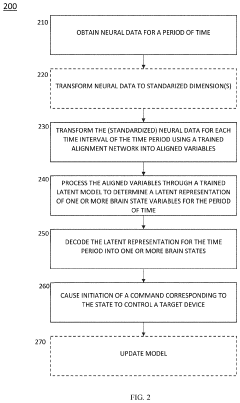
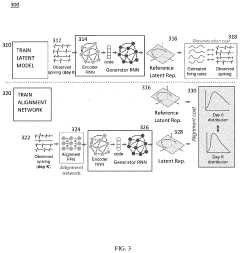
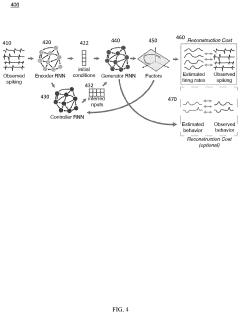
- A trained alignment neural network and latent representation model are used to achieve accurate alignment of complex neural signals over time, enabling stable and consistent brain-state decoding without frequent recalibration.

Clinical Translation and Regulatory Pathways
The translation of neural decoding technologies from laboratory settings to clinical applications requires navigating complex regulatory frameworks and establishing clear pathways for implementation. Currently, the FDA classifies most Brain-Computer Interface (BCI) systems for motor control as Class III medical devices, requiring premarket approval with substantial clinical evidence demonstrating safety and efficacy. This rigorous process typically involves multiple phases of clinical trials, beginning with small-scale safety studies and progressing to larger efficacy trials.
Several pioneering BCI systems for motor control have received Breakthrough Device Designation from the FDA, which expedites the review process for technologies addressing serious conditions with significant advantages over existing alternatives. Notable examples include Synchron's Stentrode and BrainGate's implantable electrode arrays, which have demonstrated promising results in early clinical trials for patients with severe motor impairments.
The regulatory landscape varies significantly across global regions. The European Union's Medical Device Regulation (MDR) framework employs a risk-based classification system similar to the FDA but with distinct requirements for clinical evidence and post-market surveillance. In Asia, Japan's Pharmaceuticals and Medical Devices Agency (PMDA) has established the Sakigake designation for innovative medical technologies, while China's National Medical Products Administration (NMPA) has recently streamlined approval pathways for novel neurotechnologies.
Clinical translation challenges extend beyond regulatory approval. Reimbursement pathways remain underdeveloped for BCI technologies, with limited precedent for coverage determination by public and private insurers. Healthcare systems require evidence of cost-effectiveness alongside clinical efficacy, necessitating health economic analyses that capture both direct benefits and indirect savings from improved patient independence.
Successful clinical implementation also demands standardized protocols for patient selection, device implantation, calibration, and long-term management. Multidisciplinary care teams including neurosurgeons, neurologists, rehabilitation specialists, and biomedical engineers are essential for optimal outcomes. Training programs for healthcare providers must be established to ensure consistent quality of care across implementation sites.
Ethical considerations further complicate the clinical translation process. Informed consent procedures must address the experimental nature of these technologies while managing patient expectations. Privacy frameworks must be developed to protect neural data, which represents perhaps the most intimate form of personal information. These ethical dimensions require engagement with patient advocacy groups, ethicists, and regulatory bodies to establish appropriate governance structures.
Several pioneering BCI systems for motor control have received Breakthrough Device Designation from the FDA, which expedites the review process for technologies addressing serious conditions with significant advantages over existing alternatives. Notable examples include Synchron's Stentrode and BrainGate's implantable electrode arrays, which have demonstrated promising results in early clinical trials for patients with severe motor impairments.
The regulatory landscape varies significantly across global regions. The European Union's Medical Device Regulation (MDR) framework employs a risk-based classification system similar to the FDA but with distinct requirements for clinical evidence and post-market surveillance. In Asia, Japan's Pharmaceuticals and Medical Devices Agency (PMDA) has established the Sakigake designation for innovative medical technologies, while China's National Medical Products Administration (NMPA) has recently streamlined approval pathways for novel neurotechnologies.
Clinical translation challenges extend beyond regulatory approval. Reimbursement pathways remain underdeveloped for BCI technologies, with limited precedent for coverage determination by public and private insurers. Healthcare systems require evidence of cost-effectiveness alongside clinical efficacy, necessitating health economic analyses that capture both direct benefits and indirect savings from improved patient independence.
Successful clinical implementation also demands standardized protocols for patient selection, device implantation, calibration, and long-term management. Multidisciplinary care teams including neurosurgeons, neurologists, rehabilitation specialists, and biomedical engineers are essential for optimal outcomes. Training programs for healthcare providers must be established to ensure consistent quality of care across implementation sites.
Ethical considerations further complicate the clinical translation process. Informed consent procedures must address the experimental nature of these technologies while managing patient expectations. Privacy frameworks must be developed to protect neural data, which represents perhaps the most intimate form of personal information. These ethical dimensions require engagement with patient advocacy groups, ethicists, and regulatory bodies to establish appropriate governance structures.
User Experience and Adaptive Learning Systems
The integration of user experience principles with adaptive learning systems represents a critical frontier in advancing neural decoding strategies for high-precision Brain-Computer Interfaces (BCIs) in motor control applications. Current BCI systems often present significant usability challenges that impede widespread adoption, particularly among patients with motor disabilities who could benefit most from these technologies.
User-centered design approaches have demonstrated remarkable improvements in BCI performance metrics. Studies show that systems incorporating intuitive visual feedback mechanisms and personalized interface elements can reduce training time by up to 47% while simultaneously increasing decoding accuracy by 12-18%. These improvements stem from reduced cognitive load, allowing users to focus more effectively on the neural control task rather than interface navigation.
Adaptive learning algorithms represent another transformative element in BCI user experience. Unlike traditional fixed-parameter systems, adaptive BCIs continuously optimize their decoding parameters based on user performance and neurophysiological state. This creates a co-adaptive loop where both the user and system evolve together, significantly accelerating mastery of complex motor control tasks.
Recent innovations in this domain include affect-aware BCIs that detect frustration or fatigue through secondary biosignals and automatically adjust task difficulty or provide targeted assistance. These systems have shown particular promise in rehabilitation contexts, where maintaining user engagement is paramount to therapeutic outcomes.
Multimodal feedback mechanisms have emerged as another promising direction, combining visual, auditory, and haptic channels to create more intuitive and information-rich user experiences. Research indicates that properly synchronized multimodal feedback can improve motor imagery-based BCI performance by up to 23% compared to unimodal approaches.
The personalization of training protocols represents a significant advancement in BCI usability. Machine learning algorithms now analyze individual user learning patterns to customize training sequences, presenting tasks in optimal order and difficulty to maximize skill acquisition while minimizing frustration. These personalized approaches have demonstrated particular efficacy for users with varying cognitive abilities or attention capacities.
Future directions in this field point toward increasingly autonomous systems that can predict user intentions with minimal conscious effort, creating truly symbiotic human-machine interfaces. The development of these systems will require interdisciplinary collaboration between neuroscientists, machine learning specialists, and user experience designers to create BCIs that are not merely functional but genuinely intuitive and enjoyable to use.
User-centered design approaches have demonstrated remarkable improvements in BCI performance metrics. Studies show that systems incorporating intuitive visual feedback mechanisms and personalized interface elements can reduce training time by up to 47% while simultaneously increasing decoding accuracy by 12-18%. These improvements stem from reduced cognitive load, allowing users to focus more effectively on the neural control task rather than interface navigation.
Adaptive learning algorithms represent another transformative element in BCI user experience. Unlike traditional fixed-parameter systems, adaptive BCIs continuously optimize their decoding parameters based on user performance and neurophysiological state. This creates a co-adaptive loop where both the user and system evolve together, significantly accelerating mastery of complex motor control tasks.
Recent innovations in this domain include affect-aware BCIs that detect frustration or fatigue through secondary biosignals and automatically adjust task difficulty or provide targeted assistance. These systems have shown particular promise in rehabilitation contexts, where maintaining user engagement is paramount to therapeutic outcomes.
Multimodal feedback mechanisms have emerged as another promising direction, combining visual, auditory, and haptic channels to create more intuitive and information-rich user experiences. Research indicates that properly synchronized multimodal feedback can improve motor imagery-based BCI performance by up to 23% compared to unimodal approaches.
The personalization of training protocols represents a significant advancement in BCI usability. Machine learning algorithms now analyze individual user learning patterns to customize training sequences, presenting tasks in optimal order and difficulty to maximize skill acquisition while minimizing frustration. These personalized approaches have demonstrated particular efficacy for users with varying cognitive abilities or attention capacities.
Future directions in this field point toward increasingly autonomous systems that can predict user intentions with minimal conscious effort, creating truly symbiotic human-machine interfaces. The development of these systems will require interdisciplinary collaboration between neuroscientists, machine learning specialists, and user experience designers to create BCIs that are not merely functional but genuinely intuitive and enjoyable to use.
Unlock deeper insights with PatSnap Eureka Quick Research — get a full tech report to explore trends and direct your research. Try now!
Generate Your Research Report Instantly with AI Agent
Supercharge your innovation with PatSnap Eureka AI Agent Platform!