

OFDM Vs OFDMA: Contrast Data Throughput for Network Evolution
SEP 12, 20259 MIN READ
Generate Your Research Report Instantly with AI Agent
PatSnap Eureka helps you evaluate technical feasibility & market potential.
OFDM/OFDMA Evolution and Technical Objectives
Orthogonal Frequency Division Multiplexing (OFDM) emerged in the 1960s as a digital multi-carrier modulation technique, but gained significant traction in the 1990s with wireless communications. The evolution from OFDM to Orthogonal Frequency Division Multiple Access (OFDMA) represents a critical advancement in wireless network technology, enabling more efficient spectrum utilization and improved data throughput capabilities.
OFDM technology divides a single data stream into multiple parallel streams transmitted over closely spaced orthogonal sub-carriers, effectively combating frequency-selective fading and inter-symbol interference. This fundamental approach revolutionized wireless communications by enabling reliable high-speed data transmission over challenging wireless channels.
The transition to OFDMA marked a significant evolutionary step, introducing the capability to allocate different subsets of subcarriers to individual users dynamically. This shift from single-user to multi-user paradigm dramatically improved resource allocation efficiency, particularly in scenarios with multiple users having varying channel conditions and quality of service requirements.
The technical evolution trajectory has been clearly reflected in wireless standards development. OFDM was initially adopted in IEEE 802.11a/g Wi-Fi standards, while OFDMA became a cornerstone technology in 4G LTE and has been further enhanced in 5G NR. Each generation has progressively improved spectral efficiency, reduced latency, and increased overall network capacity.
A primary technical objective in this evolution has been maximizing data throughput while maintaining reliability. OFDM systems typically achieve throughput in the range of tens to hundreds of Mbps, whereas advanced OFDMA implementations in 5G networks can theoretically support multi-Gbps speeds. This exponential improvement addresses the ever-increasing demand for bandwidth-intensive applications like 4K/8K video streaming, augmented reality, and massive IoT deployments.
Another critical objective has been reducing the overhead associated with resource allocation and control signaling. OFDMA's dynamic subcarrier allocation mechanisms have significantly improved efficiency compared to the more rigid OFDM approach, particularly in environments with rapidly changing channel conditions and varying user demands.
Looking forward, the technical objectives for future OFDM/OFDMA evolution include further enhancements to spectral efficiency through advanced modulation schemes, improved multiple access techniques, and more sophisticated channel estimation methods. Additionally, reducing power consumption while maintaining high throughput remains a significant challenge, particularly for battery-powered devices in IoT and mobile applications.
OFDM technology divides a single data stream into multiple parallel streams transmitted over closely spaced orthogonal sub-carriers, effectively combating frequency-selective fading and inter-symbol interference. This fundamental approach revolutionized wireless communications by enabling reliable high-speed data transmission over challenging wireless channels.
The transition to OFDMA marked a significant evolutionary step, introducing the capability to allocate different subsets of subcarriers to individual users dynamically. This shift from single-user to multi-user paradigm dramatically improved resource allocation efficiency, particularly in scenarios with multiple users having varying channel conditions and quality of service requirements.
The technical evolution trajectory has been clearly reflected in wireless standards development. OFDM was initially adopted in IEEE 802.11a/g Wi-Fi standards, while OFDMA became a cornerstone technology in 4G LTE and has been further enhanced in 5G NR. Each generation has progressively improved spectral efficiency, reduced latency, and increased overall network capacity.
A primary technical objective in this evolution has been maximizing data throughput while maintaining reliability. OFDM systems typically achieve throughput in the range of tens to hundreds of Mbps, whereas advanced OFDMA implementations in 5G networks can theoretically support multi-Gbps speeds. This exponential improvement addresses the ever-increasing demand for bandwidth-intensive applications like 4K/8K video streaming, augmented reality, and massive IoT deployments.
Another critical objective has been reducing the overhead associated with resource allocation and control signaling. OFDMA's dynamic subcarrier allocation mechanisms have significantly improved efficiency compared to the more rigid OFDM approach, particularly in environments with rapidly changing channel conditions and varying user demands.
Looking forward, the technical objectives for future OFDM/OFDMA evolution include further enhancements to spectral efficiency through advanced modulation schemes, improved multiple access techniques, and more sophisticated channel estimation methods. Additionally, reducing power consumption while maintaining high throughput remains a significant challenge, particularly for battery-powered devices in IoT and mobile applications.
Market Demand Analysis for High-Throughput Networks
The global demand for high-throughput networks has experienced exponential growth over the past decade, driven primarily by the proliferation of data-intensive applications and services. Video streaming platforms, cloud computing, IoT deployments, and augmented reality applications collectively generate unprecedented volumes of data traffic, necessitating more efficient transmission technologies. Market research indicates that global mobile data traffic is projected to grow at a CAGR of 24% through 2026, highlighting the critical need for advanced modulation techniques like OFDM and OFDMA.
Telecommunications operators worldwide are facing increasing pressure to deliver higher data throughput while maintaining cost efficiency. This market pressure has accelerated the evolution from OFDM-based systems (prevalent in 4G networks) toward OFDMA implementations in 5G infrastructure. The enhanced resource allocation capabilities of OFDMA directly address the multi-user, high-density deployment scenarios that characterize modern network environments.
Enterprise and industrial sectors represent significant growth segments for high-throughput network technologies. Manufacturing facilities implementing Industry 4.0 principles require ultra-reliable, low-latency communications that can support hundreds of connected devices simultaneously. The superior scheduling flexibility of OFDMA provides a compelling advantage in these environments, where resource optimization directly impacts operational efficiency.
Consumer markets continue to drive substantial demand for improved network performance. The average smartphone user now consumes over 11GB of mobile data monthly, with premium users exceeding 30GB. This consumption pattern has created market segmentation where operators can command premium pricing for guaranteed throughput levels, directly influencing technology adoption decisions between OFDM and OFDMA implementations.
Geographical market analysis reveals varying adoption rates for advanced modulation techniques. Developed markets in North America, Europe, and East Asia have aggressively deployed OFDMA-based systems to address density challenges in urban environments. Emerging markets demonstrate a hybrid approach, with OFDM systems remaining economically viable in less congested regions while OFDMA deployments focus on high-density urban centers.
The regulatory landscape significantly impacts market demand for specific throughput technologies. Spectrum allocation policies, particularly the opening of millimeter wave bands for 5G, have created new opportunities for OFDMA implementations that can efficiently utilize wider channel bandwidths. Markets with progressive spectrum policies show accelerated adoption of advanced modulation techniques that maximize spectral efficiency.
Network equipment vendors have responded to these market demands by developing flexible radio access solutions that can support both OFDM and OFDMA configurations, allowing operators to optimize deployments based on specific use cases and traffic patterns. This technological flexibility has become a key differentiator in the competitive telecommunications equipment market.
Telecommunications operators worldwide are facing increasing pressure to deliver higher data throughput while maintaining cost efficiency. This market pressure has accelerated the evolution from OFDM-based systems (prevalent in 4G networks) toward OFDMA implementations in 5G infrastructure. The enhanced resource allocation capabilities of OFDMA directly address the multi-user, high-density deployment scenarios that characterize modern network environments.
Enterprise and industrial sectors represent significant growth segments for high-throughput network technologies. Manufacturing facilities implementing Industry 4.0 principles require ultra-reliable, low-latency communications that can support hundreds of connected devices simultaneously. The superior scheduling flexibility of OFDMA provides a compelling advantage in these environments, where resource optimization directly impacts operational efficiency.
Consumer markets continue to drive substantial demand for improved network performance. The average smartphone user now consumes over 11GB of mobile data monthly, with premium users exceeding 30GB. This consumption pattern has created market segmentation where operators can command premium pricing for guaranteed throughput levels, directly influencing technology adoption decisions between OFDM and OFDMA implementations.
Geographical market analysis reveals varying adoption rates for advanced modulation techniques. Developed markets in North America, Europe, and East Asia have aggressively deployed OFDMA-based systems to address density challenges in urban environments. Emerging markets demonstrate a hybrid approach, with OFDM systems remaining economically viable in less congested regions while OFDMA deployments focus on high-density urban centers.
The regulatory landscape significantly impacts market demand for specific throughput technologies. Spectrum allocation policies, particularly the opening of millimeter wave bands for 5G, have created new opportunities for OFDMA implementations that can efficiently utilize wider channel bandwidths. Markets with progressive spectrum policies show accelerated adoption of advanced modulation techniques that maximize spectral efficiency.
Network equipment vendors have responded to these market demands by developing flexible radio access solutions that can support both OFDM and OFDMA configurations, allowing operators to optimize deployments based on specific use cases and traffic patterns. This technological flexibility has become a key differentiator in the competitive telecommunications equipment market.
Current State and Challenges in Wireless Modulation Technologies
The wireless communication landscape has witnessed significant evolution in modulation techniques, with OFDM (Orthogonal Frequency Division Multiplexing) and OFDMA (Orthogonal Frequency Division Multiple Access) emerging as pivotal technologies. Currently, OFDM serves as the foundation for 4G LTE networks, while OFDMA has become integral to advanced wireless standards including 5G NR and Wi-Fi 6.
Global implementation of these technologies varies considerably. In developed markets like North America, Europe, and East Asia, 5G networks utilizing advanced OFDMA implementations are rapidly expanding. Meanwhile, many developing regions still primarily rely on OFDM-based 4G infrastructure, creating a technological divide that impacts data throughput capabilities worldwide.
A significant technical challenge facing both technologies is spectral efficiency optimization. While OFDMA offers superior resource allocation through subcarrier assignment to multiple users simultaneously, implementation complexities arise from synchronization requirements and power control mechanisms. OFDM systems, though simpler to implement, struggle with peak-to-average power ratio (PAPR) issues that limit energy efficiency and effective range.
Interference management represents another critical challenge. As network densification continues, co-channel interference increasingly impacts both technologies. OFDMA provides more granular control through resource block allocation but requires sophisticated scheduling algorithms. OFDM systems face greater vulnerability to inter-symbol interference in high-mobility scenarios, necessitating advanced channel estimation techniques.
Hardware limitations also constrain current implementations. The computational demands of OFDMA's dynamic resource allocation require more sophisticated signal processing capabilities, particularly for mobile devices where power consumption remains a concern. This creates a balancing act between throughput performance and device battery life.
Regulatory constraints further complicate deployment scenarios. Different regions maintain varying spectrum allocation policies, forcing equipment manufacturers to develop multi-band solutions that can adapt to diverse regulatory environments while maintaining throughput performance. This fragmentation impedes global standardization efforts.
Looking at data throughput specifically, real-world performance often falls short of theoretical maximums. While laboratory tests demonstrate OFDMA's throughput advantages over OFDM, particularly in multi-user scenarios, practical deployments face challenges from channel conditions, network congestion, and implementation compromises. The gap between theoretical and achieved throughput represents a persistent challenge for network operators seeking to deliver consistent quality of service.
As networks evolve toward 6G, these modulation technologies face increasing pressure to support ultra-high reliability, massive device connectivity, and multi-gigabit data rates simultaneously – requirements that push current implementations to their fundamental limits.
Global implementation of these technologies varies considerably. In developed markets like North America, Europe, and East Asia, 5G networks utilizing advanced OFDMA implementations are rapidly expanding. Meanwhile, many developing regions still primarily rely on OFDM-based 4G infrastructure, creating a technological divide that impacts data throughput capabilities worldwide.
A significant technical challenge facing both technologies is spectral efficiency optimization. While OFDMA offers superior resource allocation through subcarrier assignment to multiple users simultaneously, implementation complexities arise from synchronization requirements and power control mechanisms. OFDM systems, though simpler to implement, struggle with peak-to-average power ratio (PAPR) issues that limit energy efficiency and effective range.
Interference management represents another critical challenge. As network densification continues, co-channel interference increasingly impacts both technologies. OFDMA provides more granular control through resource block allocation but requires sophisticated scheduling algorithms. OFDM systems face greater vulnerability to inter-symbol interference in high-mobility scenarios, necessitating advanced channel estimation techniques.
Hardware limitations also constrain current implementations. The computational demands of OFDMA's dynamic resource allocation require more sophisticated signal processing capabilities, particularly for mobile devices where power consumption remains a concern. This creates a balancing act between throughput performance and device battery life.
Regulatory constraints further complicate deployment scenarios. Different regions maintain varying spectrum allocation policies, forcing equipment manufacturers to develop multi-band solutions that can adapt to diverse regulatory environments while maintaining throughput performance. This fragmentation impedes global standardization efforts.
Looking at data throughput specifically, real-world performance often falls short of theoretical maximums. While laboratory tests demonstrate OFDMA's throughput advantages over OFDM, particularly in multi-user scenarios, practical deployments face challenges from channel conditions, network congestion, and implementation compromises. The gap between theoretical and achieved throughput represents a persistent challenge for network operators seeking to deliver consistent quality of service.
As networks evolve toward 6G, these modulation technologies face increasing pressure to support ultra-high reliability, massive device connectivity, and multi-gigabit data rates simultaneously – requirements that push current implementations to their fundamental limits.
Comparative Analysis of OFDM vs OFDMA Implementations
01 OFDM/OFDMA resource allocation techniques
Resource allocation techniques in OFDM and OFDMA systems can significantly improve data throughput. These techniques involve optimizing the assignment of subcarriers, time slots, and power to different users based on channel conditions and service requirements. Adaptive resource allocation algorithms can dynamically adjust these parameters to maximize system capacity and ensure quality of service, resulting in enhanced data throughput performance in wireless communication networks.- OFDM/OFDMA resource allocation techniques: Resource allocation techniques in OFDM and OFDMA systems can significantly improve data throughput. These techniques involve optimizing the assignment of subcarriers, time slots, and power to different users based on channel conditions and service requirements. Adaptive resource allocation algorithms can dynamically adjust these parameters to maximize system capacity and throughput while maintaining quality of service requirements for different users in varying channel conditions.
- MIMO integration with OFDM/OFDMA: Multiple-Input Multiple-Output (MIMO) technology when integrated with OFDM/OFDMA systems can substantially enhance data throughput. By utilizing multiple antennas at both transmitter and receiver sides, MIMO-OFDM systems exploit spatial diversity and multiplexing to increase spectral efficiency. This combination allows for parallel data streams to be transmitted simultaneously over the same frequency band, effectively multiplying the capacity of the wireless channel without requiring additional bandwidth.
- Advanced modulation and coding schemes: The selection of appropriate modulation and coding schemes in OFDM/OFDMA systems directly impacts data throughput. Adaptive modulation and coding allows the system to select optimal schemes based on channel conditions, balancing between throughput and reliability. Higher-order modulation schemes (such as 64-QAM or 256-QAM) can be used when channel conditions are favorable to increase data rates, while more robust coding schemes can be employed in challenging conditions to ensure reliable transmission.
- Interference management techniques: Effective interference management is crucial for maximizing data throughput in OFDM/OFDMA systems. Techniques such as inter-cell interference coordination, fractional frequency reuse, and advanced receiver algorithms can significantly reduce the impact of interference on system performance. By minimizing interference, these techniques improve signal quality, allowing for higher-order modulation schemes and consequently higher data rates, particularly for users at cell edges where interference is typically most severe.
- Channel estimation and equalization: Accurate channel estimation and equalization techniques are essential for achieving high data throughput in OFDM/OFDMA systems. These techniques compensate for channel impairments such as frequency selectivity, time variations, and multipath fading. Advanced channel estimation algorithms can track rapid channel variations, while sophisticated equalization methods can mitigate inter-symbol interference and inter-carrier interference, thereby improving signal quality and enabling higher data rates even in challenging propagation environments.
02 MIMO-OFDM systems for throughput enhancement
Multiple-Input Multiple-Output (MIMO) technology combined with OFDM/OFDMA can substantially increase data throughput. By utilizing multiple antennas at both transmitter and receiver sides, MIMO-OFDM systems exploit spatial multiplexing to transmit multiple data streams simultaneously over the same frequency band. This approach effectively increases channel capacity and spectral efficiency, leading to higher data rates without requiring additional bandwidth.Expand Specific Solutions03 Advanced modulation and coding schemes
The selection of appropriate modulation and coding schemes in OFDM/OFDMA systems plays a crucial role in optimizing data throughput. Adaptive modulation and coding allows the system to adjust the modulation order (QPSK, 16-QAM, 64-QAM, etc.) and coding rate based on channel conditions. Under favorable channel conditions, higher-order modulation and less robust coding can be used to increase data rates, while more robust schemes are employed when channel conditions deteriorate.Expand Specific Solutions04 Interference management techniques
Effective interference management is essential for maintaining high data throughput in OFDM/OFDMA networks. Techniques such as inter-cell interference coordination (ICIC), coordinated multipoint transmission (CoMP), and interference alignment can significantly reduce the impact of interference on system performance. By minimizing interference, these methods improve signal quality, allowing for higher-order modulation schemes and consequently higher data rates.Expand Specific Solutions05 Subcarrier allocation and scheduling algorithms
Efficient subcarrier allocation and scheduling algorithms are critical for maximizing data throughput in OFDM/OFDMA systems. These algorithms determine how subcarriers are assigned to users across time and frequency domains based on factors such as channel quality, traffic demands, and quality of service requirements. Proportional fair scheduling, maximum throughput scheduling, and other advanced algorithms can optimize resource utilization and significantly enhance overall system throughput.Expand Specific Solutions
Key Industry Players in OFDM/OFDMA Development
The OFDM vs OFDMA technology landscape is currently in a mature growth phase, with the market expanding as networks evolve toward higher data throughput capabilities. The global market size is estimated to exceed $50 billion, driven by increasing demand for high-speed wireless communications. Technologically, major players have established different levels of maturity: Qualcomm, Huawei, and Samsung lead with advanced implementations in commercial networks, while Ericsson and LG Electronics have developed significant intellectual property portfolios. InterDigital and Mitsubishi Electric focus on research innovations, particularly in spectrum efficiency. Apple has integrated these technologies into consumer devices, while telecom operators like SK Telecom and KT Corp have deployed large-scale implementations. The competitive landscape continues to evolve as 5G and beyond networks demand enhanced throughput capabilities.
Samsung Electronics Co., Ltd.
Technical Solution: Samsung has developed a comprehensive OFDMA solution that enhances network capacity through sophisticated resource allocation and scheduling algorithms. Their implementation features dynamic subcarrier assignment that adapts to changing channel conditions and user requirements in real-time. Samsung's approach incorporates advanced channel estimation techniques that improve the accuracy of resource allocation decisions, resulting in more efficient spectrum utilization. Their technology includes adaptive modulation and coding schemes that adjust transmission parameters based on channel quality indicators reported by user equipment. Samsung has also implemented sophisticated interference management techniques that significantly improve performance at cell edges. Their OFDMA solution features flexible bandwidth allocation capabilities, allowing operators to dynamically adjust network resources based on traffic patterns and service requirements. Samsung's implementation also includes enhanced power control mechanisms that optimize energy efficiency while maintaining performance targets.
Strengths: Excellent performance in high-mobility scenarios; sophisticated resource allocation algorithms; highly efficient spectrum utilization in multi-user environments. Weaknesses: Implementation complexity requiring specialized hardware; potentially higher power consumption; increased sensitivity to synchronization errors in dense deployments.
Huawei Technologies Co., Ltd.
Technical Solution: Huawei has developed a comprehensive OFDMA solution that enhances network capacity through sophisticated resource allocation algorithms. Their approach implements dynamic subcarrier allocation that adapts to changing channel conditions and user requirements in real-time. Huawei's implementation features advanced scheduling techniques that prioritize users based on QoS requirements, channel conditions, and service agreements. Their technology incorporates fractional frequency reuse schemes to mitigate inter-cell interference while maintaining high spectral efficiency. Huawei has also developed proprietary algorithms for power allocation across subcarriers to maximize energy efficiency while maintaining performance targets. Their OFDMA implementation includes adaptive MIMO configurations that work in conjunction with subcarrier allocation to optimize spatial multiplexing gains. Huawei's solution also features enhanced error correction coding schemes specifically optimized for OFDMA transmission characteristics.
Strengths: Excellent scalability for varying network sizes; sophisticated interference management techniques; highly efficient resource utilization in high-density deployments. Weaknesses: Complex implementation requiring significant computational resources; higher sensitivity to frequency offset errors; potentially challenging integration with legacy network infrastructure.
Core Patents and Research in Multi-carrier Modulation
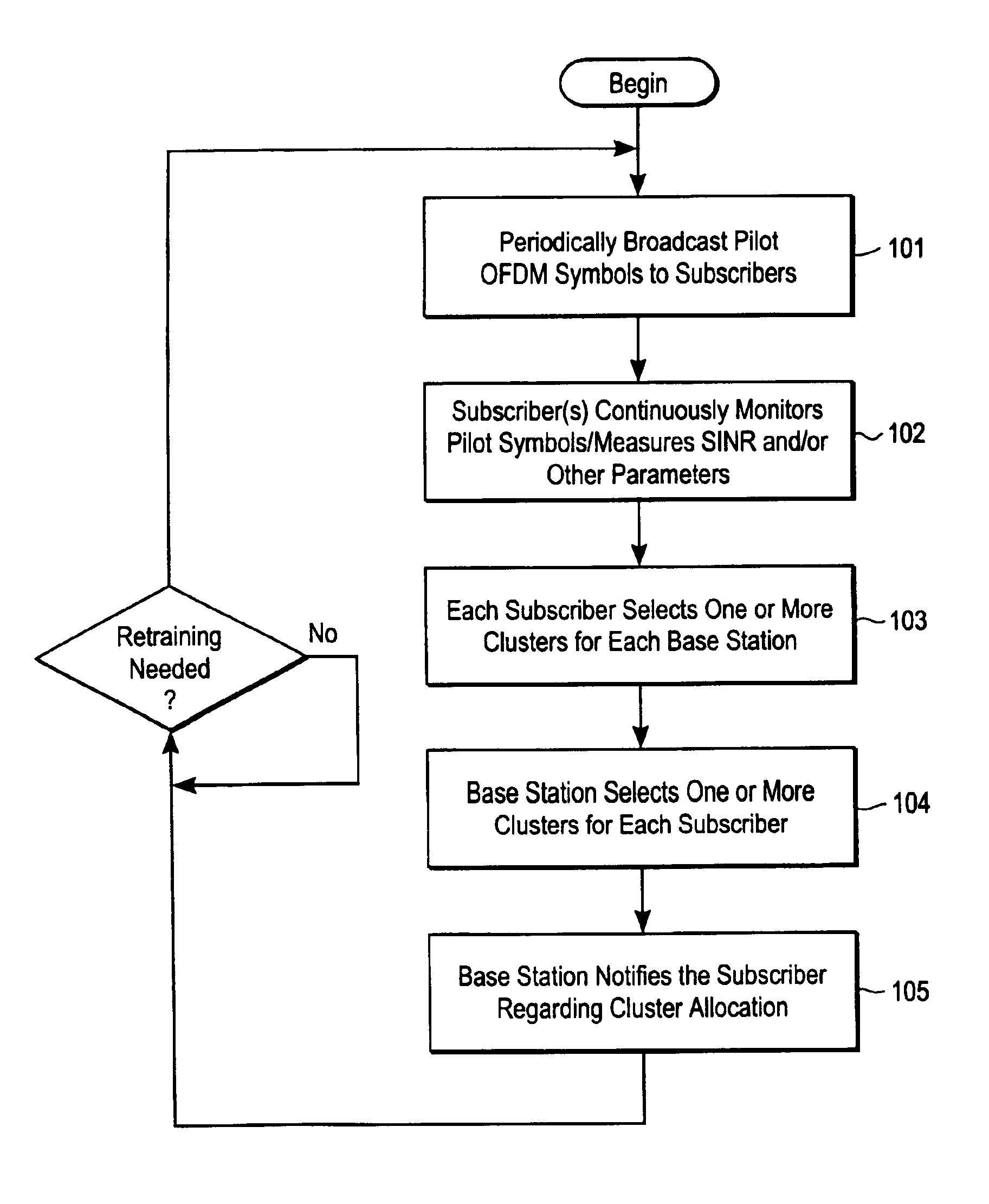
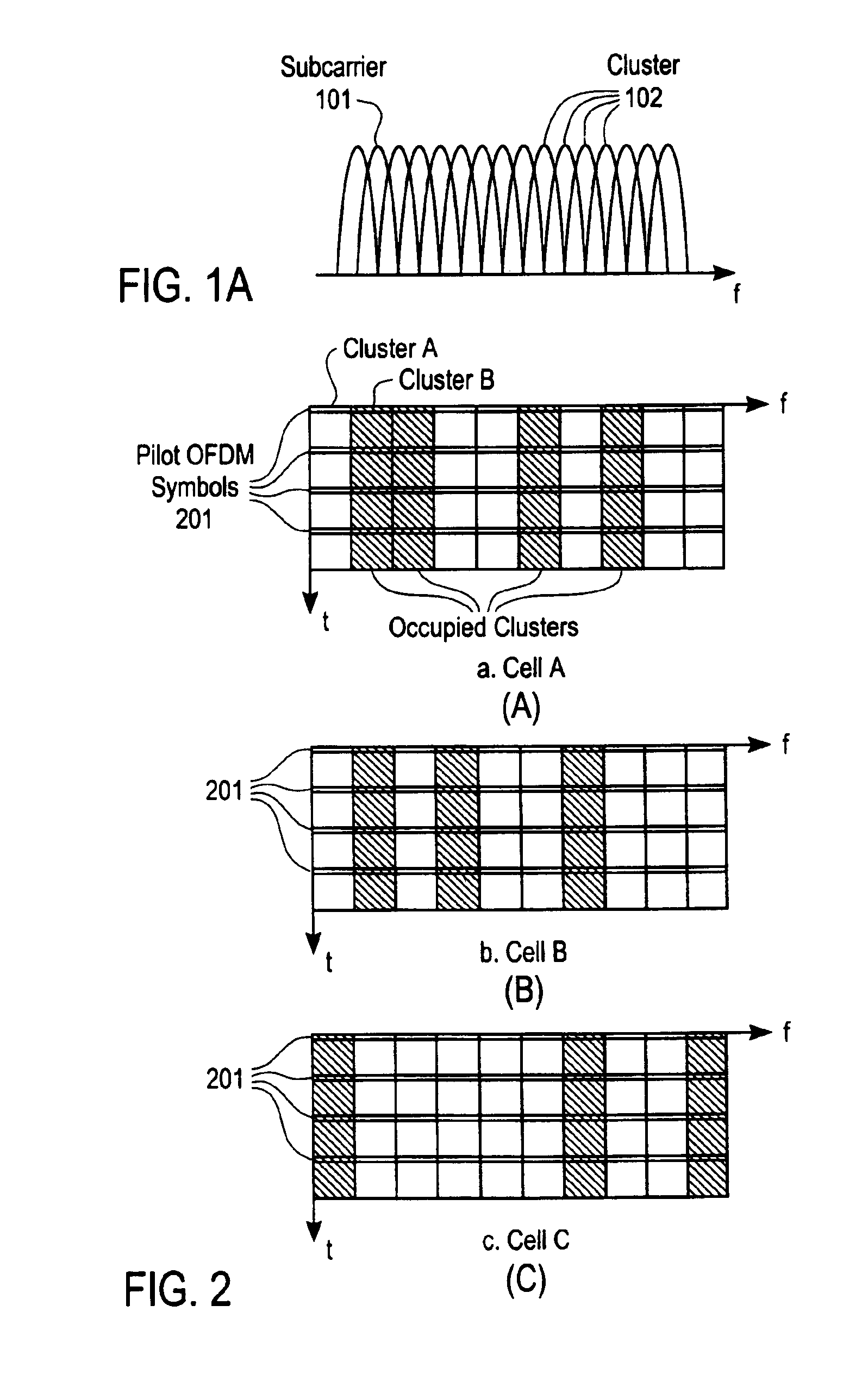
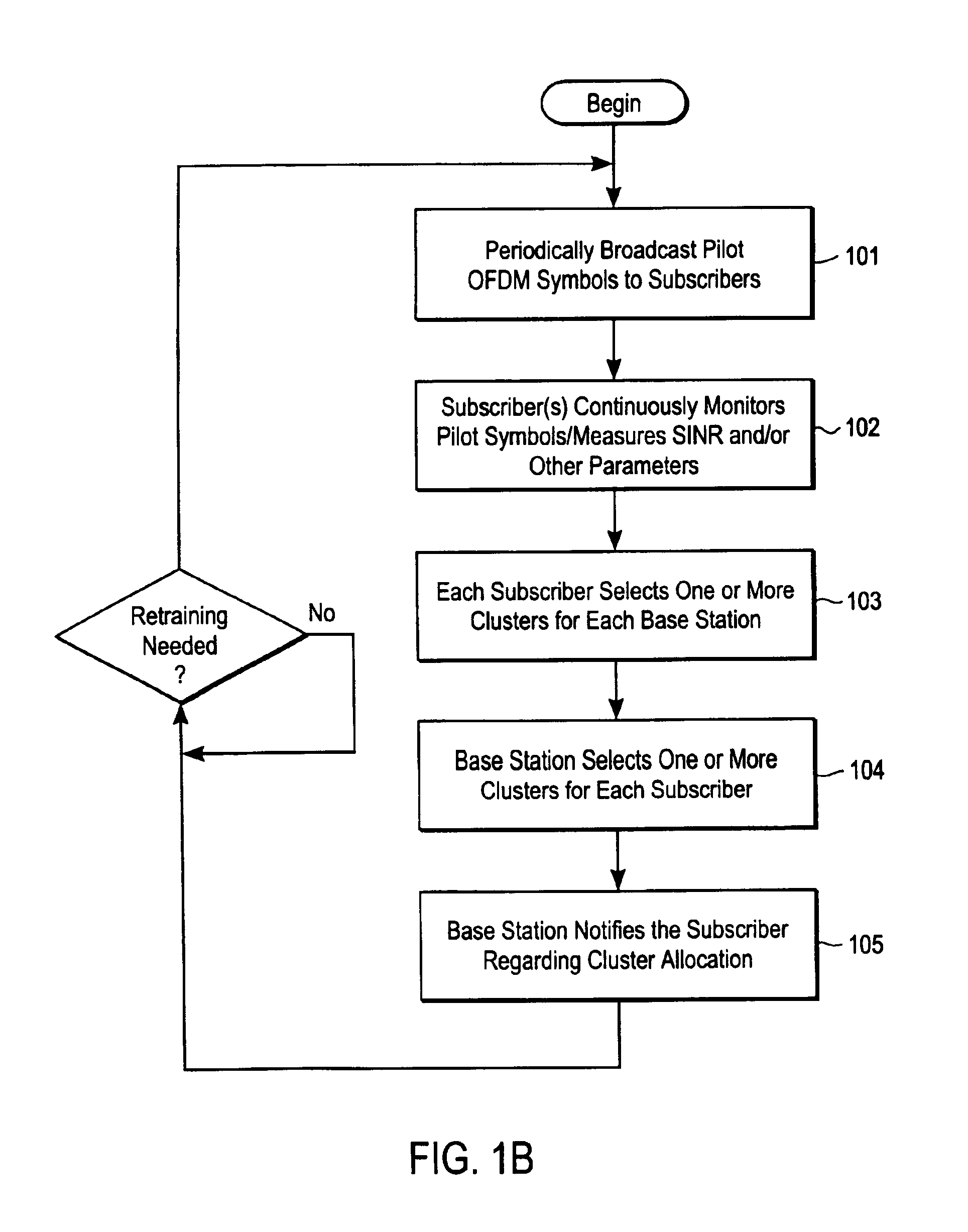
OFDMA with adaptive subcarrier-cluster configuration and selective loading
PatentInactiveUS6947748B2
Innovation
- A distributed, reduced-complexity subcarrier allocation method where each subscriber measures channel and interference information, selects candidate subcarriers, and feeds back feedback to the base station, which then makes allocation decisions based on additional information like traffic load and SINR, allowing for adaptive subcarrier selection and modulation/coding rate assignment to reduce intercell interference.

Method and apparatus to support SDMA transmission of a OFDMA based network
PatentInactiveUS20080159122A1
Innovation
- A two-stage approach is implemented, where a small subset of users is first selected for each subchannel using the Active Set Predictor (ASP) process, followed by joint optimization of scheduling and physical beamforming, reducing computational complexity through iterative power adjustments and beamforming optimizations.


Spectrum Allocation Policies and Regulatory Considerations
The regulatory landscape governing spectrum allocation significantly impacts the deployment and evolution of OFDM and OFDMA technologies across different markets. National telecommunications authorities worldwide have established varying frameworks for spectrum licensing, with some favoring auction-based approaches while others implement administrative assignments. These policies directly influence network operators' ability to leverage the throughput advantages of OFDMA in next-generation networks.
In developed markets, regulators have increasingly adopted flexible spectrum usage policies, allowing for technology-neutral licenses that enable the transition from OFDM to OFDMA without requiring new spectrum allocations. This regulatory flexibility has accelerated network evolution in regions like North America, Western Europe, and parts of Asia, where operators can repurpose existing spectrum bands for advanced OFDMA implementations.
Spectrum sharing frameworks represent another critical regulatory consideration affecting OFDMA deployment. Dynamic spectrum access policies, such as those implemented for CBRS (Citizens Broadband Radio Service) in the United States, create opportunities for more efficient spectrum utilization through OFDMA's superior resource allocation capabilities. These frameworks enable multiple service providers to share spectrum bands that would otherwise remain underutilized.
International harmonization efforts through organizations like the ITU (International Telecommunication Union) have established global or regional spectrum allocations suitable for OFDMA-based technologies. The World Radiocommunication Conference (WRC) decisions have progressively identified additional spectrum bands for mobile broadband services, facilitating wider OFDMA adoption across diverse geographic regions.
Regulatory requirements for spectral efficiency metrics increasingly favor OFDMA over traditional OFDM. Many telecommunications authorities now mandate minimum efficiency standards that effectively necessitate the superior resource allocation capabilities of OFDMA, particularly in densely populated urban environments where spectrum scarcity is most acute.
Emerging regulatory trends toward localized licensing models present new opportunities for OFDMA deployment. Several jurisdictions have introduced frameworks for private networks and campus solutions, where the granular resource allocation of OFDMA provides significant advantages for specialized industrial applications with varying throughput requirements.
The regulatory transition toward higher frequency bands, including millimeter wave spectrum, has created new challenges and opportunities for OFDMA implementations. These bands offer substantial bandwidth but require sophisticated resource allocation to overcome propagation limitations, making OFDMA's scheduling flexibility particularly valuable in these deployment scenarios.
In developed markets, regulators have increasingly adopted flexible spectrum usage policies, allowing for technology-neutral licenses that enable the transition from OFDM to OFDMA without requiring new spectrum allocations. This regulatory flexibility has accelerated network evolution in regions like North America, Western Europe, and parts of Asia, where operators can repurpose existing spectrum bands for advanced OFDMA implementations.
Spectrum sharing frameworks represent another critical regulatory consideration affecting OFDMA deployment. Dynamic spectrum access policies, such as those implemented for CBRS (Citizens Broadband Radio Service) in the United States, create opportunities for more efficient spectrum utilization through OFDMA's superior resource allocation capabilities. These frameworks enable multiple service providers to share spectrum bands that would otherwise remain underutilized.
International harmonization efforts through organizations like the ITU (International Telecommunication Union) have established global or regional spectrum allocations suitable for OFDMA-based technologies. The World Radiocommunication Conference (WRC) decisions have progressively identified additional spectrum bands for mobile broadband services, facilitating wider OFDMA adoption across diverse geographic regions.
Regulatory requirements for spectral efficiency metrics increasingly favor OFDMA over traditional OFDM. Many telecommunications authorities now mandate minimum efficiency standards that effectively necessitate the superior resource allocation capabilities of OFDMA, particularly in densely populated urban environments where spectrum scarcity is most acute.
Emerging regulatory trends toward localized licensing models present new opportunities for OFDMA deployment. Several jurisdictions have introduced frameworks for private networks and campus solutions, where the granular resource allocation of OFDMA provides significant advantages for specialized industrial applications with varying throughput requirements.
The regulatory transition toward higher frequency bands, including millimeter wave spectrum, has created new challenges and opportunities for OFDMA implementations. These bands offer substantial bandwidth but require sophisticated resource allocation to overcome propagation limitations, making OFDMA's scheduling flexibility particularly valuable in these deployment scenarios.
Energy Efficiency Comparison Between OFDM and OFDMA
Energy efficiency has become a critical factor in the evolution of wireless communication systems, particularly when comparing OFDM (Orthogonal Frequency Division Multiplexing) and OFDMA (Orthogonal Frequency Division Multiple Access) technologies. The energy consumption profiles of these two technologies differ significantly due to their fundamental operational mechanisms and resource allocation strategies.
OFDM systems allocate the entire channel bandwidth to a single user during transmission time, which can lead to inefficient power usage when the channel conditions are poor or when the user doesn't require the full bandwidth. This "all-or-nothing" approach often results in power wastage, especially in scenarios with varying traffic demands.
In contrast, OFDMA implements a more granular resource allocation by dividing the available subcarriers among multiple users simultaneously. This dynamic allocation allows for significant energy savings as the system can assign resources based on actual user requirements and channel conditions, avoiding the power overhead associated with unused bandwidth.
The power amplifier efficiency in OFDM systems is generally lower due to the high Peak-to-Average Power Ratio (PAPR), requiring amplifiers to operate with larger back-off margins. OFDMA systems can partially mitigate this issue through careful subcarrier allocation strategies, resulting in improved power amplifier efficiency and reduced overall energy consumption.
From a network perspective, OFDMA enables more efficient sleep mode operations. User equipment can power down radio components during inactive subframes, whereas in OFDM systems, devices must remain active throughout the entire transmission period, consuming energy even when not receiving data.
Quantitative studies have demonstrated that OFDMA can achieve 20-30% energy savings compared to OFDM in typical network deployments. These savings become even more pronounced in dense urban environments where traffic patterns are highly variable and user density is high.
The energy efficiency advantage of OFDMA becomes particularly evident in modern cellular networks with diverse quality of service requirements. By allocating resources more precisely to match actual demand, OFDMA systems can maintain the same throughput levels as OFDM while consuming significantly less power, leading to extended battery life for mobile devices and reduced operational costs for network operators.
Advanced implementations of OFDMA incorporate energy-aware scheduling algorithms that further optimize power consumption by considering factors such as traffic priority, delay tolerance, and battery status of connected devices, creating an intelligent energy management ecosystem that OFDM cannot match.
OFDM systems allocate the entire channel bandwidth to a single user during transmission time, which can lead to inefficient power usage when the channel conditions are poor or when the user doesn't require the full bandwidth. This "all-or-nothing" approach often results in power wastage, especially in scenarios with varying traffic demands.
In contrast, OFDMA implements a more granular resource allocation by dividing the available subcarriers among multiple users simultaneously. This dynamic allocation allows for significant energy savings as the system can assign resources based on actual user requirements and channel conditions, avoiding the power overhead associated with unused bandwidth.
The power amplifier efficiency in OFDM systems is generally lower due to the high Peak-to-Average Power Ratio (PAPR), requiring amplifiers to operate with larger back-off margins. OFDMA systems can partially mitigate this issue through careful subcarrier allocation strategies, resulting in improved power amplifier efficiency and reduced overall energy consumption.
From a network perspective, OFDMA enables more efficient sleep mode operations. User equipment can power down radio components during inactive subframes, whereas in OFDM systems, devices must remain active throughout the entire transmission period, consuming energy even when not receiving data.
Quantitative studies have demonstrated that OFDMA can achieve 20-30% energy savings compared to OFDM in typical network deployments. These savings become even more pronounced in dense urban environments where traffic patterns are highly variable and user density is high.
The energy efficiency advantage of OFDMA becomes particularly evident in modern cellular networks with diverse quality of service requirements. By allocating resources more precisely to match actual demand, OFDMA systems can maintain the same throughput levels as OFDM while consuming significantly less power, leading to extended battery life for mobile devices and reduced operational costs for network operators.
Advanced implementations of OFDMA incorporate energy-aware scheduling algorithms that further optimize power consumption by considering factors such as traffic priority, delay tolerance, and battery status of connected devices, creating an intelligent energy management ecosystem that OFDM cannot match.
Unlock deeper insights with PatSnap Eureka Quick Research — get a full tech report to explore trends and direct your research. Try now!
Generate Your Research Report Instantly with AI Agent
Supercharge your innovation with PatSnap Eureka AI Agent Platform!