

Optimizing OFDM for Enhanced Multimedia Broadcasting Services
SEP 12, 20259 MIN READ
Generate Your Research Report Instantly with AI Agent
PatSnap Eureka helps you evaluate technical feasibility & market potential.
OFDM Technology Evolution and Objectives
Orthogonal Frequency Division Multiplexing (OFDM) has evolved significantly since its theoretical conception in the 1960s, transforming from an academic concept to a cornerstone technology in modern telecommunications. Initially limited by hardware constraints, OFDM implementation became practical in the 1990s with advances in digital signal processing and integrated circuits. This evolution accelerated with the adoption of OFDM in wireless standards such as IEEE 802.11a/g/n (Wi-Fi), 4G LTE, and digital broadcasting systems including DVB-T and ISDB-T.
The fundamental principle of OFDM—dividing a communication channel into multiple orthogonal sub-carriers—has remained consistent, while implementation techniques have continuously advanced. Early OFDM systems faced challenges with peak-to-average power ratio (PAPR), synchronization issues, and limited spectral efficiency. Modern implementations have incorporated sophisticated techniques such as adaptive modulation, MIMO integration, and advanced channel coding to overcome these limitations.
In the context of multimedia broadcasting, OFDM's evolution has been particularly impactful. The technology progressed from supporting standard definition television to enabling high-definition and ultra-high-definition content delivery. This transition demanded significant improvements in data throughput, error resilience, and spectral efficiency—areas where OFDM optimization has been crucial.
Current technological objectives for OFDM optimization in multimedia broadcasting focus on several key dimensions. First, enhancing spectral efficiency to accommodate the growing bandwidth demands of advanced multimedia formats, including 4K/8K video, immersive audio, and interactive content. This requires innovations in modulation schemes and more efficient use of available spectrum.
Second, improving robustness against challenging transmission environments, particularly for mobile reception scenarios where Doppler effects and multipath fading present significant challenges. Advanced channel estimation and equalization techniques are being developed to address these issues.
Third, reducing latency to support interactive broadcasting applications and live content delivery with minimal delay. This objective is increasingly important as broadcasting services converge with internet-based delivery platforms.
Fourth, optimizing energy efficiency both at the transmission infrastructure and receiver levels. This is particularly critical for mobile devices where battery life considerations are paramount.
The overarching goal of current OFDM optimization efforts is to create a more flexible, efficient, and resilient foundation for next-generation multimedia broadcasting services that can deliver enhanced user experiences while maximizing the utilization of limited spectrum resources. These objectives align with broader industry trends toward convergence of broadcasting with broadband technologies and the growing demand for anytime, anywhere access to high-quality multimedia content.
The fundamental principle of OFDM—dividing a communication channel into multiple orthogonal sub-carriers—has remained consistent, while implementation techniques have continuously advanced. Early OFDM systems faced challenges with peak-to-average power ratio (PAPR), synchronization issues, and limited spectral efficiency. Modern implementations have incorporated sophisticated techniques such as adaptive modulation, MIMO integration, and advanced channel coding to overcome these limitations.
In the context of multimedia broadcasting, OFDM's evolution has been particularly impactful. The technology progressed from supporting standard definition television to enabling high-definition and ultra-high-definition content delivery. This transition demanded significant improvements in data throughput, error resilience, and spectral efficiency—areas where OFDM optimization has been crucial.
Current technological objectives for OFDM optimization in multimedia broadcasting focus on several key dimensions. First, enhancing spectral efficiency to accommodate the growing bandwidth demands of advanced multimedia formats, including 4K/8K video, immersive audio, and interactive content. This requires innovations in modulation schemes and more efficient use of available spectrum.
Second, improving robustness against challenging transmission environments, particularly for mobile reception scenarios where Doppler effects and multipath fading present significant challenges. Advanced channel estimation and equalization techniques are being developed to address these issues.
Third, reducing latency to support interactive broadcasting applications and live content delivery with minimal delay. This objective is increasingly important as broadcasting services converge with internet-based delivery platforms.
Fourth, optimizing energy efficiency both at the transmission infrastructure and receiver levels. This is particularly critical for mobile devices where battery life considerations are paramount.
The overarching goal of current OFDM optimization efforts is to create a more flexible, efficient, and resilient foundation for next-generation multimedia broadcasting services that can deliver enhanced user experiences while maximizing the utilization of limited spectrum resources. These objectives align with broader industry trends toward convergence of broadcasting with broadband technologies and the growing demand for anytime, anywhere access to high-quality multimedia content.
Multimedia Broadcasting Market Requirements Analysis
The multimedia broadcasting market is experiencing significant transformation driven by evolving consumer expectations and technological advancements. Current market analysis indicates a robust demand for high-definition content delivery, with 4K adoption reaching mainstream status and 8K broadcasting beginning to emerge in premium markets. This evolution necessitates more efficient transmission technologies, particularly optimized OFDM systems capable of handling increased data throughput requirements.
Consumer behavior studies reveal that viewers now expect seamless multimedia experiences across multiple devices, with 68% of global consumers regularly accessing broadcast content on at least three different device types. This multi-platform consumption pattern creates technical challenges for broadcasters who must maintain consistent quality across varying network conditions and device capabilities.
Latency requirements have become increasingly stringent, particularly for live event broadcasting where consumer tolerance for delay has decreased to under 5 seconds in competitive markets. Sports broadcasting represents a particularly demanding segment, requiring both low latency and high visual fidelity to satisfy viewer expectations.
Bandwidth efficiency remains a critical market requirement as spectrum resources face increasing competition from mobile telecommunications and other wireless services. Broadcasting service providers must maximize spectral efficiency while maintaining quality of service, creating direct demand for advanced OFDM optimization techniques that can increase bits-per-hertz performance.
Market research indicates growing consumer demand for interactive and personalized broadcasting services, with targeted content delivery becoming a key differentiator for service providers. This trend necessitates more sophisticated signal processing capabilities within the broadcasting infrastructure to support dynamic content insertion and addressable advertising.
Regulatory frameworks across major markets are increasingly emphasizing energy efficiency in broadcasting equipment, creating additional requirements for OFDM optimization that reduces power consumption while maintaining performance standards. This is particularly relevant for mobile reception scenarios where battery life considerations affect consumer experience.
Reliability metrics show that consumers expect 99.99% service availability for premium broadcasting services, requiring robust error correction and interference mitigation capabilities in next-generation OFDM implementations. Urban environments present particular challenges due to multipath interference and signal reflection issues that must be addressed through advanced channel estimation and equalization techniques.
The market increasingly demands backward compatibility with existing receiver infrastructure while simultaneously supporting next-generation capabilities, creating complex requirements for OFDM optimization that must balance innovation with installed base considerations.
Consumer behavior studies reveal that viewers now expect seamless multimedia experiences across multiple devices, with 68% of global consumers regularly accessing broadcast content on at least three different device types. This multi-platform consumption pattern creates technical challenges for broadcasters who must maintain consistent quality across varying network conditions and device capabilities.
Latency requirements have become increasingly stringent, particularly for live event broadcasting where consumer tolerance for delay has decreased to under 5 seconds in competitive markets. Sports broadcasting represents a particularly demanding segment, requiring both low latency and high visual fidelity to satisfy viewer expectations.
Bandwidth efficiency remains a critical market requirement as spectrum resources face increasing competition from mobile telecommunications and other wireless services. Broadcasting service providers must maximize spectral efficiency while maintaining quality of service, creating direct demand for advanced OFDM optimization techniques that can increase bits-per-hertz performance.
Market research indicates growing consumer demand for interactive and personalized broadcasting services, with targeted content delivery becoming a key differentiator for service providers. This trend necessitates more sophisticated signal processing capabilities within the broadcasting infrastructure to support dynamic content insertion and addressable advertising.
Regulatory frameworks across major markets are increasingly emphasizing energy efficiency in broadcasting equipment, creating additional requirements for OFDM optimization that reduces power consumption while maintaining performance standards. This is particularly relevant for mobile reception scenarios where battery life considerations affect consumer experience.
Reliability metrics show that consumers expect 99.99% service availability for premium broadcasting services, requiring robust error correction and interference mitigation capabilities in next-generation OFDM implementations. Urban environments present particular challenges due to multipath interference and signal reflection issues that must be addressed through advanced channel estimation and equalization techniques.
The market increasingly demands backward compatibility with existing receiver infrastructure while simultaneously supporting next-generation capabilities, creating complex requirements for OFDM optimization that must balance innovation with installed base considerations.
OFDM Implementation Challenges and Constraints
Despite the numerous advantages of OFDM technology in multimedia broadcasting, several significant implementation challenges and constraints must be addressed to optimize its performance. One of the primary technical hurdles is the high Peak-to-Average Power Ratio (PAPR), which occurs when multiple subcarriers align in phase, creating signal peaks that can exceed the linear range of power amplifiers. This necessitates expensive high-specification amplifiers or introduces distortion that degrades signal quality and increases bit error rates.
Frequency synchronization presents another critical challenge, as OFDM systems are highly sensitive to carrier frequency offsets. Even minor deviations can disrupt orthogonality between subcarriers, leading to inter-carrier interference (ICI) that significantly impairs system performance. This issue becomes particularly problematic in mobile broadcasting scenarios where Doppler shifts are inevitable.
Timing synchronization errors further complicate OFDM implementation, as imprecise symbol timing can cause inter-symbol interference (ISI). While the cyclic prefix provides some protection against this, it simultaneously reduces spectral efficiency by consuming bandwidth that could otherwise carry data, creating an engineering trade-off between robustness and throughput.
Hardware limitations constitute substantial constraints, particularly for consumer-grade receivers. The complex signal processing requirements of OFDM demand considerable computational resources, potentially increasing device costs and power consumption. This becomes especially challenging when implementing OFDM in portable or battery-powered devices intended for multimedia consumption.
Channel estimation accuracy represents another significant challenge, as OFDM performance heavily depends on precise knowledge of channel characteristics. In rapidly changing environments, maintaining accurate channel estimates becomes difficult, potentially leading to suboptimal equalization and increased error rates.
Regulatory constraints also impact OFDM implementation, with different regions imposing varying spectral mask requirements and power limitations. These regulations can restrict the flexibility of OFDM parameter selection and necessitate region-specific optimizations that complicate global deployment strategies.
For multimedia broadcasting specifically, maintaining consistent Quality of Service (QoS) across diverse reception conditions poses a substantial challenge. The variable bit error rates experienced by different receivers require adaptive modulation and coding schemes that can dynamically adjust to changing conditions while maintaining acceptable multimedia quality thresholds.
Frequency synchronization presents another critical challenge, as OFDM systems are highly sensitive to carrier frequency offsets. Even minor deviations can disrupt orthogonality between subcarriers, leading to inter-carrier interference (ICI) that significantly impairs system performance. This issue becomes particularly problematic in mobile broadcasting scenarios where Doppler shifts are inevitable.
Timing synchronization errors further complicate OFDM implementation, as imprecise symbol timing can cause inter-symbol interference (ISI). While the cyclic prefix provides some protection against this, it simultaneously reduces spectral efficiency by consuming bandwidth that could otherwise carry data, creating an engineering trade-off between robustness and throughput.
Hardware limitations constitute substantial constraints, particularly for consumer-grade receivers. The complex signal processing requirements of OFDM demand considerable computational resources, potentially increasing device costs and power consumption. This becomes especially challenging when implementing OFDM in portable or battery-powered devices intended for multimedia consumption.
Channel estimation accuracy represents another significant challenge, as OFDM performance heavily depends on precise knowledge of channel characteristics. In rapidly changing environments, maintaining accurate channel estimates becomes difficult, potentially leading to suboptimal equalization and increased error rates.
Regulatory constraints also impact OFDM implementation, with different regions imposing varying spectral mask requirements and power limitations. These regulations can restrict the flexibility of OFDM parameter selection and necessitate region-specific optimizations that complicate global deployment strategies.
For multimedia broadcasting specifically, maintaining consistent Quality of Service (QoS) across diverse reception conditions poses a substantial challenge. The variable bit error rates experienced by different receivers require adaptive modulation and coding schemes that can dynamically adjust to changing conditions while maintaining acceptable multimedia quality thresholds.
Current OFDM Optimization Approaches
01 OFDM Signal Processing Optimization
Various signal processing techniques can be employed to optimize OFDM systems. These include advanced modulation schemes, efficient channel estimation methods, and improved signal detection algorithms. By implementing these optimizations, OFDM systems can achieve better spectral efficiency, reduced interference, and enhanced overall performance in wireless communication networks.- OFDM Signal Processing Optimization: Various signal processing techniques can be employed to optimize OFDM systems. These include advanced modulation schemes, efficient coding algorithms, and signal conditioning methods that enhance the quality of transmission. By implementing these processing techniques, OFDM systems can achieve better spectral efficiency, reduced interference, and improved signal quality, leading to more reliable data transmission across wireless networks.
- Resource Allocation and Management in OFDM Systems: Effective resource allocation strategies are crucial for optimizing OFDM performance. This includes dynamic allocation of subcarriers, power distribution across frequency bands, and scheduling techniques that maximize system throughput. Advanced resource management algorithms can adapt to changing channel conditions, balance network load, and prioritize traffic based on quality of service requirements, resulting in more efficient utilization of available spectrum and improved overall system performance.
- MIMO-OFDM Integration and Optimization: The integration of Multiple-Input Multiple-Output (MIMO) technology with OFDM creates powerful systems with enhanced capabilities. Optimization techniques for MIMO-OFDM include spatial multiplexing, beamforming, and space-time coding that leverage multiple antennas to increase data rates and improve reliability. These approaches can significantly boost spectral efficiency, extend coverage range, and enhance resistance to fading and interference in challenging wireless environments.
- OFDM Channel Estimation and Equalization: Accurate channel estimation and equalization are essential for optimizing OFDM performance. Advanced techniques include pilot-based estimation, decision-directed methods, and adaptive equalization algorithms that compensate for channel impairments. These approaches enable OFDM systems to effectively counter frequency-selective fading, phase noise, and timing offsets, resulting in lower bit error rates and more reliable communication even in challenging propagation environments.
- OFDM for Next-Generation Wireless Networks: OFDM optimization techniques for next-generation wireless networks focus on enhancing flexibility, scalability, and energy efficiency. These include adaptive subcarrier spacing, flexible numerology, and low-latency transmission schemes that support diverse application requirements. By implementing these advanced optimization approaches, OFDM-based systems can better accommodate the varying needs of 5G and beyond networks, including massive IoT connectivity, ultra-reliable low-latency communications, and enhanced mobile broadband services.
02 Resource Allocation in OFDM Systems
Efficient resource allocation strategies are crucial for optimizing OFDM performance. These include dynamic subcarrier allocation, power distribution across frequency bands, and scheduling algorithms that adapt to channel conditions. Such techniques help maximize throughput, minimize power consumption, and ensure quality of service requirements are met in various network conditions.Expand Specific Solutions03 MIMO-OFDM Integration and Optimization
Combining Multiple-Input Multiple-Output (MIMO) technology with OFDM creates powerful systems with enhanced capabilities. Optimization techniques in this domain focus on spatial multiplexing, beamforming, and space-time coding to improve capacity and reliability. These approaches leverage spatial diversity to combat fading channels and increase data rates in wireless communications.Expand Specific Solutions04 OFDM for Next-Generation Wireless Networks
Advanced OFDM optimization techniques are being developed for 5G and beyond wireless networks. These include flexible numerology, reduced out-of-band emissions, and lower latency implementations. Such enhancements enable OFDM to support diverse use cases including enhanced mobile broadband, massive machine-type communications, and ultra-reliable low-latency communications in next-generation networks.Expand Specific Solutions05 OFDM Synchronization and Error Correction
Synchronization and error correction are critical aspects of OFDM optimization. Techniques include improved timing and frequency synchronization methods, advanced error correction coding, and robust algorithms for handling inter-carrier interference. These optimizations enhance system reliability in challenging channel conditions and improve the overall robustness of OFDM-based communication systems.Expand Specific Solutions
Key Industry Players in OFDM Broadcasting
The OFDM optimization for multimedia broadcasting services market is currently in a growth phase, with increasing demand driven by the need for enhanced spectral efficiency and robust transmission in challenging environments. The global market size is expanding rapidly as multimedia consumption continues to rise across platforms. Technologically, industry leaders like Qualcomm, Samsung Electronics, and Huawei have achieved significant maturity in OFDM implementations, with advanced solutions for multipath interference mitigation and higher data throughput. LG Electronics and ZTE are also making substantial contributions through patent innovations in channel estimation and synchronization techniques. Academic institutions like Beijing University of Posts & Telecommunications and research organizations such as NICT are accelerating development through fundamental research, while telecom operators like NTT Docomo are driving practical implementation standards.
Samsung Electronics Co., Ltd.
Technical Solution: Samsung has developed a comprehensive OFDM optimization framework for next-generation multimedia broadcasting services, particularly focusing on UHDTV and mobile broadcasting applications. Their approach implements advanced peak-to-average power ratio (PAPR) reduction techniques using selected mapping (SLM) and partial transmit sequence (PTS) methods, achieving up to 4dB PAPR reduction without significant computational overhead. Samsung's solution incorporates adaptive guard interval selection that dynamically adjusts based on channel delay spread measurements, optimizing the trade-off between intersymbol interference protection and throughput. Their implementation features sophisticated channel estimation using scattered pilots with 2D interpolation, providing robust performance in high-mobility scenarios. Samsung has also integrated AI-driven predictive resource allocation that anticipates user movement patterns to optimize multicast/broadcast resource allocation. Additionally, their system employs layered division multiplexing that enables simultaneous transmission of multiple quality versions of content, allowing receivers to decode according to their channel conditions.
Strengths: Extensive experience in consumer electronics integration enabling end-to-end optimization; strong hardware capabilities for efficient OFDM processing; leadership in ATSC 3.0 standard implementation. Weaknesses: Solutions sometimes prioritize hardware compatibility over absolute performance optimization; higher implementation complexity requiring specialized hardware; some techniques optimized for specific deployment scenarios rather than being universally applicable.
QUALCOMM, Inc.
Technical Solution: Qualcomm has developed advanced OFDM optimization techniques specifically for multimedia broadcasting through their MediaFLO technology and subsequent evolutions. Their approach incorporates dynamic subcarrier allocation that adapts to changing channel conditions, enabling more efficient spectrum utilization. Qualcomm's implementation includes proprietary time-frequency interleaving patterns that enhance robustness against frequency-selective fading and impulse noise. Their solution employs adaptive modulation and coding schemes that dynamically adjust based on channel quality indicators, allowing for optimal data rates while maintaining transmission reliability. Additionally, Qualcomm has integrated MIMO-OFDM techniques that leverage spatial diversity to increase channel capacity without additional bandwidth requirements. Their system architecture incorporates specialized hardware accelerators for FFT/IFFT operations, reducing processing latency and power consumption during OFDM symbol processing.
Strengths: Superior mobile reception performance through proprietary channel estimation algorithms; integrated system-on-chip solutions that reduce implementation complexity; extensive intellectual property portfolio in wireless communications. Weaknesses: Proprietary solutions may limit interoperability with other systems; higher licensing costs compared to open standards; optimization primarily focused on mobile rather than fixed broadcasting scenarios.
Critical Patents and Research in OFDM Enhancement
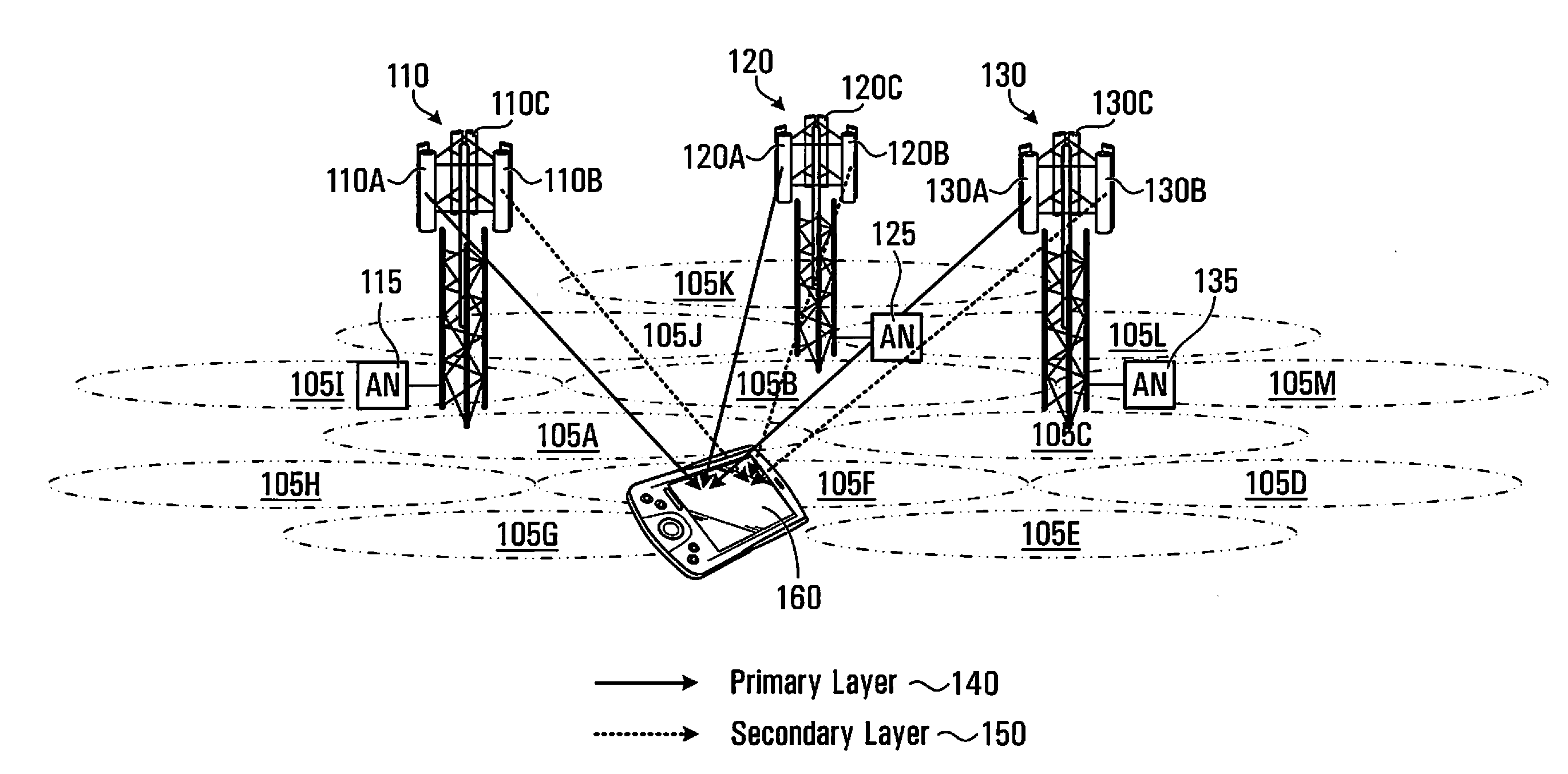
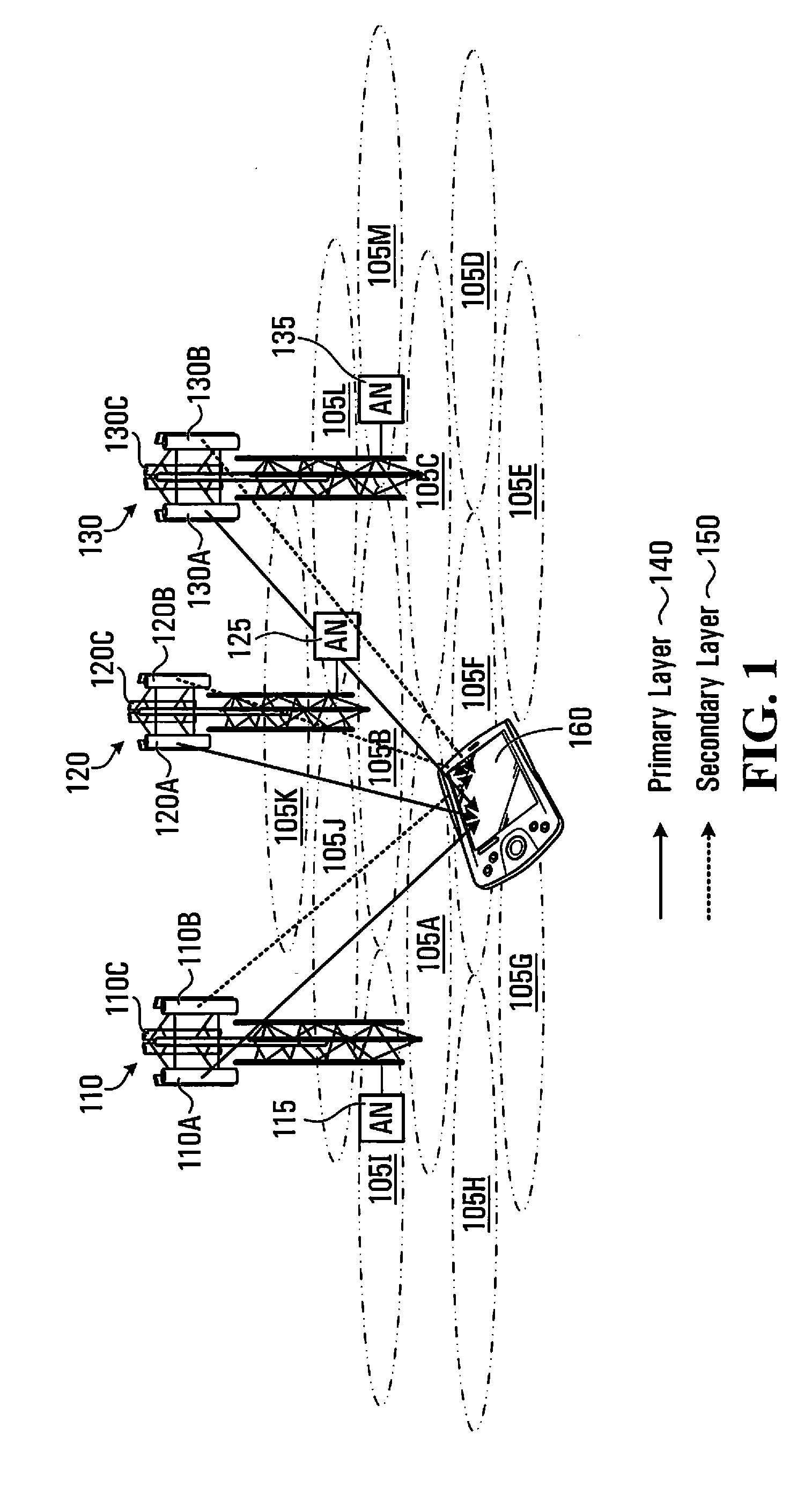
System and method for spatial multiplexing-based multiple antenna broadcast/multicast transmission
PatentInactiveUS20110235562A1
Innovation
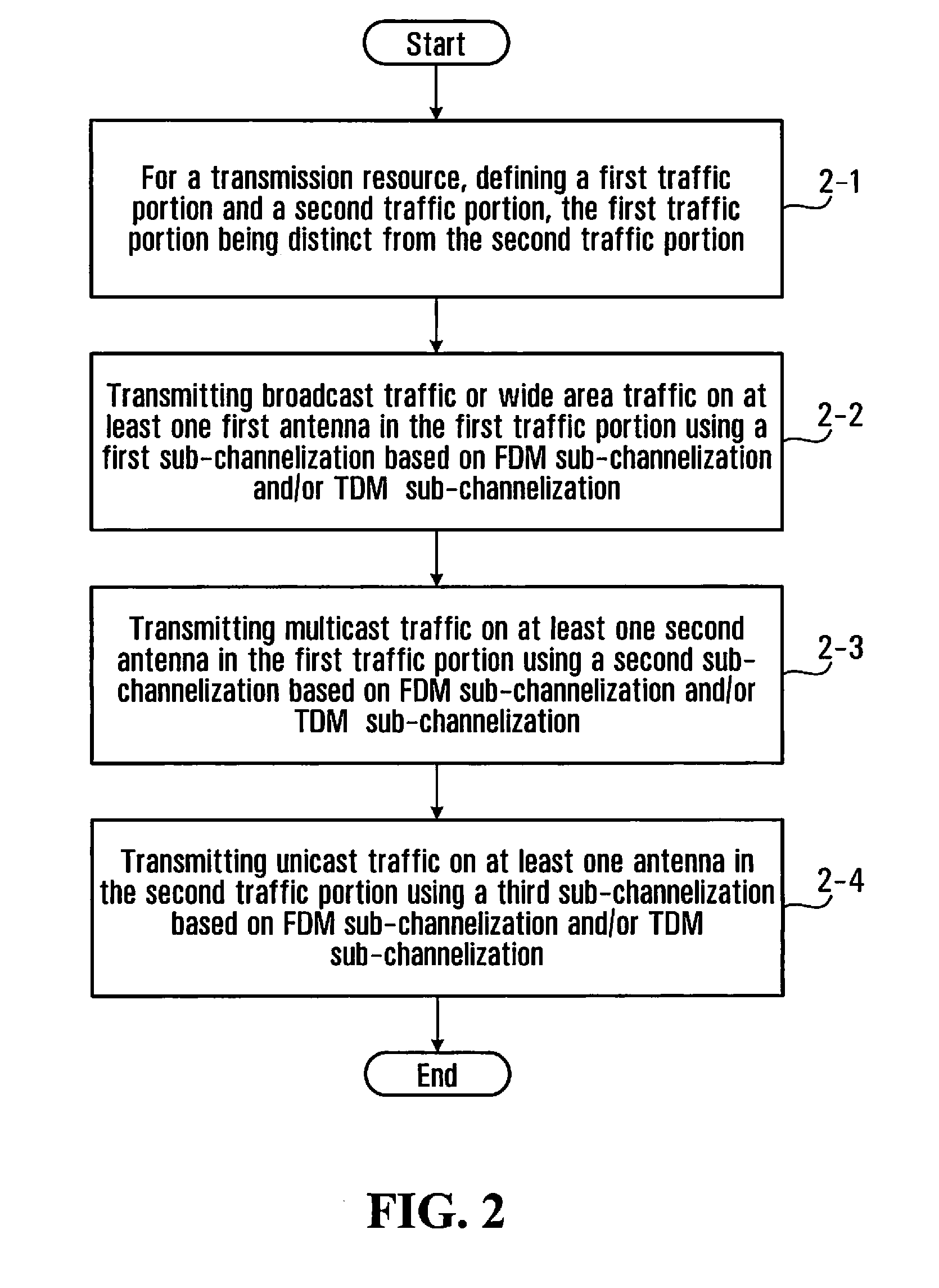
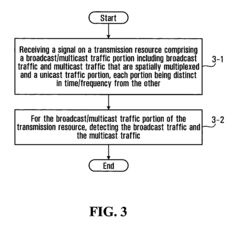
- A method employing multiple antennas for spatial multiplexing, where broadcast and multicast traffic are transmitted using distinct sub-channelizations based on FDM or TDM, and unicast traffic is transmitted separately, with the option of overlapping or distinct frequency reuse factors, and including MIMO pilots for identification, to improve coverage and reduce interference.
Improved Orthogonal Frequency Division Multiplexing (OFDM)
PatentActiveAU2010321603B2
Innovation
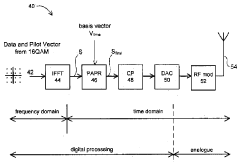
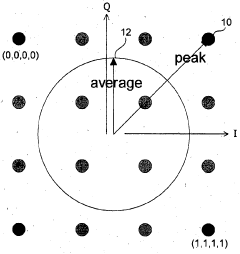
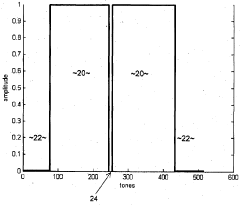
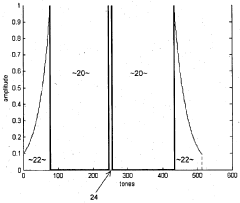
- A method that transforms digital data symbols into the time domain, generates a cancellation vector to reduce PAPR, and iteratively refines it using a basis vector with maximized differences between its elements, allowing for reduced PAPR without distorting the signal, and utilizes unused subcarriers for peak power reduction.
Spectrum Efficiency and Regulatory Considerations
Spectrum efficiency represents a critical factor in the optimization of OFDM systems for multimedia broadcasting services, particularly as demand for bandwidth continues to grow exponentially. Current OFDM implementations achieve spectral efficiency ranging from 1.5 to 5 bits/Hz/s, depending on modulation schemes and coding rates employed. Advanced techniques such as higher-order QAM modulation (256-QAM and beyond) can further increase this efficiency, though at the cost of reduced robustness against noise and interference.
The implementation of spectrum-efficient OFDM systems must navigate complex regulatory frameworks that vary significantly across global regions. In North America, the FCC has established specific guidelines for spectrum usage in broadcasting bands, while the European ETSI standards provide different parameters. These regulatory differences create challenges for equipment manufacturers seeking to develop globally compatible solutions.
Dynamic spectrum access (DSA) technologies represent a promising approach to improving spectrum utilization in OFDM systems. By enabling opportunistic use of temporarily unused frequency bands, DSA can significantly enhance overall system efficiency. Cognitive radio techniques that incorporate real-time spectrum sensing and adaptive modulation can achieve up to 30% improvement in spectrum utilization compared to static allocation methods.
Regulatory bodies worldwide are increasingly adopting flexible spectrum management policies that support more efficient OFDM implementations. These include spectrum sharing frameworks, incentive auctions, and technology-neutral licensing approaches. The transition from analog to digital broadcasting has created "digital dividend" spectrum that can be repurposed for enhanced multimedia services, though the allocation process remains politically complex in many regions.
Guard bands, traditionally used to prevent interference between adjacent channels in OFDM systems, represent a significant source of spectrum inefficiency. Recent research demonstrates that adaptive guard band allocation based on real-time interference measurements can reduce spectrum wastage by up to 25% without compromising transmission quality. Regulatory frameworks are gradually evolving to accommodate these more efficient approaches.
The international harmonization of spectrum regulations presents both opportunities and challenges for optimized OFDM systems. While standardization efforts through bodies like the ITU promote interoperability and economies of scale, they must also balance regional priorities and legacy systems. Forward-looking regulatory frameworks that anticipate technological evolution in OFDM will be essential for maximizing spectrum efficiency while ensuring fair access across diverse broadcasting applications.
The implementation of spectrum-efficient OFDM systems must navigate complex regulatory frameworks that vary significantly across global regions. In North America, the FCC has established specific guidelines for spectrum usage in broadcasting bands, while the European ETSI standards provide different parameters. These regulatory differences create challenges for equipment manufacturers seeking to develop globally compatible solutions.
Dynamic spectrum access (DSA) technologies represent a promising approach to improving spectrum utilization in OFDM systems. By enabling opportunistic use of temporarily unused frequency bands, DSA can significantly enhance overall system efficiency. Cognitive radio techniques that incorporate real-time spectrum sensing and adaptive modulation can achieve up to 30% improvement in spectrum utilization compared to static allocation methods.
Regulatory bodies worldwide are increasingly adopting flexible spectrum management policies that support more efficient OFDM implementations. These include spectrum sharing frameworks, incentive auctions, and technology-neutral licensing approaches. The transition from analog to digital broadcasting has created "digital dividend" spectrum that can be repurposed for enhanced multimedia services, though the allocation process remains politically complex in many regions.
Guard bands, traditionally used to prevent interference between adjacent channels in OFDM systems, represent a significant source of spectrum inefficiency. Recent research demonstrates that adaptive guard band allocation based on real-time interference measurements can reduce spectrum wastage by up to 25% without compromising transmission quality. Regulatory frameworks are gradually evolving to accommodate these more efficient approaches.
The international harmonization of spectrum regulations presents both opportunities and challenges for optimized OFDM systems. While standardization efforts through bodies like the ITU promote interoperability and economies of scale, they must also balance regional priorities and legacy systems. Forward-looking regulatory frameworks that anticipate technological evolution in OFDM will be essential for maximizing spectrum efficiency while ensuring fair access across diverse broadcasting applications.
Quality of Service Metrics for Multimedia Broadcasting
Quality of Service (QoS) metrics serve as critical benchmarks for evaluating the performance and user experience of multimedia broadcasting services in OFDM-based systems. These metrics provide quantifiable measurements that help service providers maintain optimal transmission quality while efficiently utilizing available network resources.
Packet Loss Rate (PLR) represents one of the fundamental QoS metrics, directly impacting the visual and auditory quality of multimedia content. For high-definition video broadcasting, the acceptable PLR threshold typically ranges between 0.1% and 1%, with values exceeding this range resulting in noticeable artifacts and degraded viewing experience. OFDM systems must implement robust error correction mechanisms to minimize packet loss, particularly in challenging propagation environments.
Latency and jitter metrics are especially crucial for interactive multimedia applications and live broadcasting scenarios. End-to-end latency should ideally remain below 100ms for interactive services, while jitter variations should not exceed 30ms to maintain synchronization between audio and video streams. OFDM parameter optimization, including cyclic prefix length and symbol duration, can significantly influence these temporal metrics.
Signal-to-Noise Ratio (SNR) and Bit Error Rate (BER) provide insights into the physical layer performance of OFDM systems. For multimedia broadcasting, maintaining an SNR above 20dB generally ensures sufficient transmission quality, while the target BER should remain below 10^-6 for reliable service delivery. These metrics directly correlate with modulation schemes and coding rates employed in the OFDM system.
Quality of Experience (QoE) metrics complement traditional QoS parameters by incorporating subjective user perception factors. Mean Opinion Score (MOS), Video Quality Metric (VQM), and Structural Similarity Index (SSIM) offer standardized approaches to evaluate perceived quality. OFDM optimization strategies should target MOS values above 4.0 (on a 5-point scale) to ensure satisfactory user experience.
Bandwidth efficiency metrics, including spectral efficiency (bits/s/Hz) and channel utilization rates, assess how effectively the OFDM system utilizes available frequency resources. Advanced multimedia codecs coupled with optimized OFDM parameters can achieve spectral efficiencies exceeding 4 bits/s/Hz while maintaining acceptable quality levels for broadcasting services.
Service availability and reliability metrics track the percentage of time the broadcasting service meets predefined quality thresholds. Industry standards typically require 99.99% availability for premium broadcasting services, necessitating robust OFDM implementations with appropriate diversity and redundancy mechanisms to overcome channel impairments.
Packet Loss Rate (PLR) represents one of the fundamental QoS metrics, directly impacting the visual and auditory quality of multimedia content. For high-definition video broadcasting, the acceptable PLR threshold typically ranges between 0.1% and 1%, with values exceeding this range resulting in noticeable artifacts and degraded viewing experience. OFDM systems must implement robust error correction mechanisms to minimize packet loss, particularly in challenging propagation environments.
Latency and jitter metrics are especially crucial for interactive multimedia applications and live broadcasting scenarios. End-to-end latency should ideally remain below 100ms for interactive services, while jitter variations should not exceed 30ms to maintain synchronization between audio and video streams. OFDM parameter optimization, including cyclic prefix length and symbol duration, can significantly influence these temporal metrics.
Signal-to-Noise Ratio (SNR) and Bit Error Rate (BER) provide insights into the physical layer performance of OFDM systems. For multimedia broadcasting, maintaining an SNR above 20dB generally ensures sufficient transmission quality, while the target BER should remain below 10^-6 for reliable service delivery. These metrics directly correlate with modulation schemes and coding rates employed in the OFDM system.
Quality of Experience (QoE) metrics complement traditional QoS parameters by incorporating subjective user perception factors. Mean Opinion Score (MOS), Video Quality Metric (VQM), and Structural Similarity Index (SSIM) offer standardized approaches to evaluate perceived quality. OFDM optimization strategies should target MOS values above 4.0 (on a 5-point scale) to ensure satisfactory user experience.
Bandwidth efficiency metrics, including spectral efficiency (bits/s/Hz) and channel utilization rates, assess how effectively the OFDM system utilizes available frequency resources. Advanced multimedia codecs coupled with optimized OFDM parameters can achieve spectral efficiencies exceeding 4 bits/s/Hz while maintaining acceptable quality levels for broadcasting services.
Service availability and reliability metrics track the percentage of time the broadcasting service meets predefined quality thresholds. Industry standards typically require 99.99% availability for premium broadcasting services, necessitating robust OFDM implementations with appropriate diversity and redundancy mechanisms to overcome channel impairments.
Unlock deeper insights with PatSnap Eureka Quick Research — get a full tech report to explore trends and direct your research. Try now!
Generate Your Research Report Instantly with AI Agent
Supercharge your innovation with PatSnap Eureka AI Agent Platform!