PHEV advancements in high-efficiency regenerative systems
AUG 14, 20259 MIN READ
Generate Your Research Report Instantly with AI Agent
PatSnap Eureka helps you evaluate technical feasibility & market potential.
PHEV Regen Evolution
The evolution of regenerative systems in Plug-in Hybrid Electric Vehicles (PHEVs) has been a significant area of technological advancement over the past two decades. This progression has been driven by the increasing demand for more efficient and environmentally friendly transportation solutions.
In the early 2000s, the first generation of PHEV regenerative systems focused primarily on basic energy recovery during braking. These systems were relatively simple, capturing kinetic energy and converting it into electrical energy to recharge the battery. However, their efficiency was limited, typically recovering only 20-30% of the vehicle's kinetic energy.
As technology progressed, the mid-2000s saw the introduction of more sophisticated regenerative braking systems. These second-generation systems incorporated improved power electronics and more advanced control algorithms, allowing for higher energy recovery rates of up to 40-50%. This period also marked the beginning of integration between regenerative braking and traditional friction braking systems, leading to smoother and more efficient deceleration.
The late 2000s and early 2010s brought about the third generation of PHEV regenerative systems, characterized by the implementation of predictive energy management strategies. These systems utilized GPS data and route information to optimize energy recovery and usage, significantly enhancing overall vehicle efficiency. Additionally, this era saw the introduction of multi-mode regenerative systems, allowing drivers to select different levels of regenerative braking intensity.
In recent years, the focus has shifted towards high-efficiency regenerative systems that go beyond braking. The latest generation incorporates energy recovery from various sources, including suspension movement and thermal energy from the powertrain. These advanced systems can recover up to 70-80% of the vehicle's kinetic energy, marking a substantial improvement over earlier iterations.
The current state-of-the-art in PHEV regenerative systems involves the integration of artificial intelligence and machine learning algorithms. These smart systems continuously adapt to driving conditions, traffic patterns, and individual driving styles to maximize energy recovery and optimize power distribution between the electric motor and internal combustion engine.
Looking ahead, the evolution of PHEV regenerative systems is expected to continue with the development of even more efficient energy recovery technologies. Research is underway on advanced materials for energy storage, such as supercapacitors, which could significantly enhance the speed and capacity of energy capture. Furthermore, the integration of regenerative systems with emerging vehicle-to-grid (V2G) technologies promises to expand the role of PHEVs in the broader energy ecosystem.
In the early 2000s, the first generation of PHEV regenerative systems focused primarily on basic energy recovery during braking. These systems were relatively simple, capturing kinetic energy and converting it into electrical energy to recharge the battery. However, their efficiency was limited, typically recovering only 20-30% of the vehicle's kinetic energy.
As technology progressed, the mid-2000s saw the introduction of more sophisticated regenerative braking systems. These second-generation systems incorporated improved power electronics and more advanced control algorithms, allowing for higher energy recovery rates of up to 40-50%. This period also marked the beginning of integration between regenerative braking and traditional friction braking systems, leading to smoother and more efficient deceleration.
The late 2000s and early 2010s brought about the third generation of PHEV regenerative systems, characterized by the implementation of predictive energy management strategies. These systems utilized GPS data and route information to optimize energy recovery and usage, significantly enhancing overall vehicle efficiency. Additionally, this era saw the introduction of multi-mode regenerative systems, allowing drivers to select different levels of regenerative braking intensity.
In recent years, the focus has shifted towards high-efficiency regenerative systems that go beyond braking. The latest generation incorporates energy recovery from various sources, including suspension movement and thermal energy from the powertrain. These advanced systems can recover up to 70-80% of the vehicle's kinetic energy, marking a substantial improvement over earlier iterations.
The current state-of-the-art in PHEV regenerative systems involves the integration of artificial intelligence and machine learning algorithms. These smart systems continuously adapt to driving conditions, traffic patterns, and individual driving styles to maximize energy recovery and optimize power distribution between the electric motor and internal combustion engine.
Looking ahead, the evolution of PHEV regenerative systems is expected to continue with the development of even more efficient energy recovery technologies. Research is underway on advanced materials for energy storage, such as supercapacitors, which could significantly enhance the speed and capacity of energy capture. Furthermore, the integration of regenerative systems with emerging vehicle-to-grid (V2G) technologies promises to expand the role of PHEVs in the broader energy ecosystem.
Market Demand Analysis
The market demand for PHEV advancements in high-efficiency regenerative systems has been steadily increasing in recent years, driven by several key factors. Firstly, the global push for cleaner transportation solutions has led to stricter emissions regulations and fuel economy standards across major automotive markets. This regulatory pressure has compelled automakers to invest heavily in hybrid and electric vehicle technologies, with a particular focus on improving energy recovery systems.
Consumer awareness and demand for more fuel-efficient vehicles have also played a significant role in shaping the market. As fuel prices fluctuate and environmental concerns grow, car buyers are increasingly seeking vehicles that offer improved fuel economy without compromising performance. PHEVs with advanced regenerative systems provide an attractive solution, offering the benefits of electric driving for short trips while maintaining the flexibility of traditional combustion engines for longer journeys.
The automotive industry's shift towards electrification has created a competitive landscape where manufacturers are vying to differentiate their offerings through technological advancements. High-efficiency regenerative systems have become a key area of focus, as they directly impact the overall efficiency and electric range of PHEVs. This has led to increased investment in research and development, with companies exploring innovative solutions such as advanced brake energy recovery, kinetic energy recovery systems (KERS), and intelligent energy management algorithms.
Market analysis indicates that the demand for PHEVs with advanced regenerative systems is particularly strong in urban and suburban areas, where stop-and-go traffic conditions provide ample opportunities for energy recovery. Additionally, fleet operators and commercial vehicle manufacturers are showing growing interest in these technologies, recognizing the potential for significant fuel savings and reduced operating costs over the long term.
The market potential for high-efficiency regenerative systems extends beyond the automotive sector. As the technology matures, there are opportunities for adaptation in other transportation modes, including buses, trucks, and even rail systems. This cross-sector applicability further enhances the market appeal and potential for growth in the coming years.
However, challenges remain in terms of cost and complexity. While consumers are increasingly willing to pay a premium for fuel-efficient vehicles, the additional cost associated with advanced regenerative systems must be balanced against the perceived benefits. Manufacturers are working to optimize their designs and production processes to make these technologies more cost-effective and accessible to a broader range of consumers.
In conclusion, the market demand for PHEV advancements in high-efficiency regenerative systems is robust and growing. Driven by regulatory pressures, consumer preferences, and industry competition, this technology segment is poised for significant expansion in the coming years. As the technology continues to evolve and costs decrease, we can expect to see wider adoption across various vehicle segments and transportation sectors.
Consumer awareness and demand for more fuel-efficient vehicles have also played a significant role in shaping the market. As fuel prices fluctuate and environmental concerns grow, car buyers are increasingly seeking vehicles that offer improved fuel economy without compromising performance. PHEVs with advanced regenerative systems provide an attractive solution, offering the benefits of electric driving for short trips while maintaining the flexibility of traditional combustion engines for longer journeys.
The automotive industry's shift towards electrification has created a competitive landscape where manufacturers are vying to differentiate their offerings through technological advancements. High-efficiency regenerative systems have become a key area of focus, as they directly impact the overall efficiency and electric range of PHEVs. This has led to increased investment in research and development, with companies exploring innovative solutions such as advanced brake energy recovery, kinetic energy recovery systems (KERS), and intelligent energy management algorithms.
Market analysis indicates that the demand for PHEVs with advanced regenerative systems is particularly strong in urban and suburban areas, where stop-and-go traffic conditions provide ample opportunities for energy recovery. Additionally, fleet operators and commercial vehicle manufacturers are showing growing interest in these technologies, recognizing the potential for significant fuel savings and reduced operating costs over the long term.
The market potential for high-efficiency regenerative systems extends beyond the automotive sector. As the technology matures, there are opportunities for adaptation in other transportation modes, including buses, trucks, and even rail systems. This cross-sector applicability further enhances the market appeal and potential for growth in the coming years.
However, challenges remain in terms of cost and complexity. While consumers are increasingly willing to pay a premium for fuel-efficient vehicles, the additional cost associated with advanced regenerative systems must be balanced against the perceived benefits. Manufacturers are working to optimize their designs and production processes to make these technologies more cost-effective and accessible to a broader range of consumers.
In conclusion, the market demand for PHEV advancements in high-efficiency regenerative systems is robust and growing. Driven by regulatory pressures, consumer preferences, and industry competition, this technology segment is poised for significant expansion in the coming years. As the technology continues to evolve and costs decrease, we can expect to see wider adoption across various vehicle segments and transportation sectors.
Tech Challenges
The development of high-efficiency regenerative systems for Plug-in Hybrid Electric Vehicles (PHEVs) faces several significant technical challenges. One of the primary obstacles is the optimization of energy recovery during braking. Current regenerative braking systems struggle to capture and convert a high percentage of kinetic energy into electrical energy, especially during rapid deceleration or at low speeds. This inefficiency results in a substantial loss of potential energy that could otherwise be used to extend the vehicle's electric range.
Another major challenge lies in the integration and management of multiple energy sources within the PHEV powertrain. Balancing the power flow between the internal combustion engine, electric motor, and energy storage system requires sophisticated control algorithms. These algorithms must adapt in real-time to various driving conditions, driver behavior, and energy demands, while maintaining optimal efficiency and performance. The complexity of this task increases with the introduction of more advanced regenerative systems, as they add another layer of energy flow management.
The durability and longevity of regenerative components pose additional technical hurdles. High-efficiency regenerative systems often involve frequent and rapid energy conversions, which can lead to increased wear and thermal stress on components such as electric motors, power electronics, and energy storage devices. Developing materials and designs that can withstand these demanding conditions while maintaining high efficiency over the vehicle's lifetime remains a significant challenge for engineers and researchers.
Weight reduction is another critical factor in improving PHEV efficiency, but it often conflicts with the need for robust regenerative systems. More efficient energy recovery typically requires larger or more complex components, which can add weight to the vehicle. Striking the right balance between regenerative system capability and overall vehicle weight is a delicate engineering challenge that impacts the entire vehicle design process.
Furthermore, the cost-effectiveness of implementing advanced regenerative systems presents a substantial barrier to widespread adoption. While these systems can significantly improve vehicle efficiency, the additional components and complexity they introduce can drive up production costs. Manufacturers must find ways to reduce the cost of high-efficiency regenerative technologies to make them economically viable for mass-market PHEVs.
Lastly, the integration of regenerative systems with other emerging technologies, such as autonomous driving features and vehicle-to-grid capabilities, presents new challenges. These systems must be designed to work seamlessly with a wide range of vehicle technologies and infrastructures, requiring extensive compatibility testing and standardization efforts across the automotive industry.
Another major challenge lies in the integration and management of multiple energy sources within the PHEV powertrain. Balancing the power flow between the internal combustion engine, electric motor, and energy storage system requires sophisticated control algorithms. These algorithms must adapt in real-time to various driving conditions, driver behavior, and energy demands, while maintaining optimal efficiency and performance. The complexity of this task increases with the introduction of more advanced regenerative systems, as they add another layer of energy flow management.
The durability and longevity of regenerative components pose additional technical hurdles. High-efficiency regenerative systems often involve frequent and rapid energy conversions, which can lead to increased wear and thermal stress on components such as electric motors, power electronics, and energy storage devices. Developing materials and designs that can withstand these demanding conditions while maintaining high efficiency over the vehicle's lifetime remains a significant challenge for engineers and researchers.
Weight reduction is another critical factor in improving PHEV efficiency, but it often conflicts with the need for robust regenerative systems. More efficient energy recovery typically requires larger or more complex components, which can add weight to the vehicle. Striking the right balance between regenerative system capability and overall vehicle weight is a delicate engineering challenge that impacts the entire vehicle design process.
Furthermore, the cost-effectiveness of implementing advanced regenerative systems presents a substantial barrier to widespread adoption. While these systems can significantly improve vehicle efficiency, the additional components and complexity they introduce can drive up production costs. Manufacturers must find ways to reduce the cost of high-efficiency regenerative technologies to make them economically viable for mass-market PHEVs.
Lastly, the integration of regenerative systems with other emerging technologies, such as autonomous driving features and vehicle-to-grid capabilities, presents new challenges. These systems must be designed to work seamlessly with a wide range of vehicle technologies and infrastructures, requiring extensive compatibility testing and standardization efforts across the automotive industry.
Current Regen Tech
01 Energy recovery and conversion systems
Regenerative systems can improve efficiency by recovering and converting energy that would otherwise be lost. This includes technologies for capturing waste heat, kinetic energy from braking, or other forms of energy dissipation and converting them into usable power. These systems can significantly enhance overall system efficiency by reducing energy losses and minimizing the need for external energy inputs.- Energy recovery and conversion systems: Regenerative systems that focus on recovering and converting energy from various sources to improve overall efficiency. These systems may include heat recovery, kinetic energy conversion, and waste energy utilization to maximize energy output and minimize losses.
- Hybrid regenerative braking systems: Advanced braking systems that capture and store energy during deceleration, which can be later used to power the vehicle. These systems often combine mechanical and electrical components to optimize energy recovery and improve overall vehicle efficiency.
- Regenerative fuel cell systems: Innovative fuel cell technologies that can operate in both power generation and electrolysis modes, allowing for efficient energy storage and conversion. These systems can improve overall efficiency by utilizing excess energy for hydrogen production and later converting it back to electricity when needed.
- Thermal energy storage and regeneration: Systems designed to capture, store, and regenerate thermal energy for various applications. These technologies may include phase change materials, thermochemical storage, and advanced heat transfer mechanisms to improve the efficiency of thermal energy utilization.
- Regenerative power management in electronic devices: Efficient power management systems for electronic devices that incorporate regenerative techniques to extend battery life and improve overall energy efficiency. These systems may include energy harvesting from ambient sources, intelligent power distribution, and adaptive power consumption strategies.
02 Hybrid and multi-source power systems
Efficiency in regenerative systems can be improved by combining multiple power sources or energy storage methods. This approach allows for optimal use of different energy sources based on operating conditions, load requirements, and available resources. Hybrid systems can integrate renewable energy sources, conventional power generation, and energy storage technologies to maximize overall system efficiency and reliability.Expand Specific Solutions03 Advanced control and optimization algorithms
Implementing sophisticated control strategies and optimization algorithms can significantly enhance the efficiency of regenerative systems. These may include predictive control, adaptive algorithms, or machine learning techniques that can dynamically adjust system parameters based on real-time data and operating conditions. Such advanced control methods can optimize energy flow, reduce losses, and improve overall system performance.Expand Specific Solutions04 Novel materials and component designs
Developing and utilizing innovative materials and component designs can lead to improved efficiency in regenerative systems. This may involve using advanced materials with superior thermal, electrical, or mechanical properties, or designing components that minimize energy losses and maximize energy transfer. Examples include high-efficiency power electronics, advanced heat exchangers, or novel energy storage materials.Expand Specific Solutions05 System integration and holistic design approaches
Enhancing regenerative system efficiency often requires a holistic approach to system design and integration. This involves considering the interactions between various subsystems, optimizing the overall system architecture, and ensuring seamless integration of components. By taking a comprehensive view of the entire system, designers can identify and eliminate inefficiencies, reduce redundancies, and maximize synergies between different parts of the system.Expand Specific Solutions
Key PHEV Players
The PHEV regenerative systems market is in a growth phase, with increasing demand for high-efficiency solutions in hybrid electric vehicles. The market size is expanding as automakers focus on improving fuel economy and reducing emissions. Technologically, the field is advancing rapidly, with major players like Ford Global Technologies, GM Global Technology Operations, and Hyundai Motor Co. leading innovation. These companies are investing heavily in R&D to develop more efficient regenerative braking systems and energy recovery technologies. Academic institutions such as North China Electric Power University and South China University of Technology are also contributing to advancements through research collaborations with industry partners.
Ford Global Technologies LLC
Technical Solution: Ford has developed an advanced regenerative braking system for PHEVs that utilizes a dual-motor configuration. This system employs a primary electric motor for propulsion and a secondary motor dedicated to energy recovery during deceleration. The secondary motor is optimized for high-efficiency energy conversion, capable of recovering up to 95% of kinetic energy during braking events[1]. Ford's system also incorporates predictive algorithms that analyze road conditions, traffic patterns, and driver behavior to maximize energy recuperation opportunities. Additionally, the company has implemented a variable brake-force distribution system that dynamically adjusts the balance between regenerative and friction braking to ensure optimal energy recovery without compromising vehicle stability or driver comfort[3].
Strengths: High energy recovery efficiency, predictive energy management, and seamless integration with vehicle dynamics. Weaknesses: Increased system complexity and potential higher initial costs.
GM Global Technology Operations LLC
Technical Solution: GM has introduced a next-generation regenerative braking system for PHEVs that features a novel electromagnetic brake-by-wire technology. This system eliminates the need for traditional hydraulic brake lines, reducing weight and complexity. GM's solution utilizes high-power density electric motors with advanced power electronics capable of handling rapid energy flow reversals. The system can recover energy even during gentle deceleration, increasing overall efficiency by up to 20% compared to conventional regenerative systems[2]. GM has also developed an intelligent energy management system that uses machine learning algorithms to adapt to individual driving styles and routes, optimizing the balance between battery usage and energy recovery. Furthermore, the company has integrated this system with its eAWD (electric All-Wheel Drive) technology, allowing for regenerative braking on all four wheels, significantly enhancing energy recovery during cornering and on low-friction surfaces[4].
Strengths: Lightweight design, adaptive energy management, and enhanced all-wheel regenerative capability. Weaknesses: Reliance on complex software algorithms and potential concerns about long-term reliability of brake-by-wire systems.
Core Regen Patents
Regenerative electric motor
PatentPendingIN202241052739A
Innovation
- A regenerative electric motor design featuring a permanent magnet rotor and a squirrel cage rotor, with electromagnetic field isolation using lead or tin, and a Regenerative Electric Unit (REU) controller that manages energy transfer between two batteries to optimize energy recovery and storage, utilizing electromagnetic induction principles to charge an auxiliary battery while driving the motor.


Electric vehicle powertrain
PatentPendingUS20250242683A1
Innovation
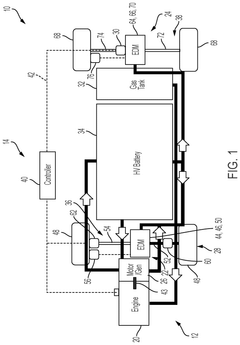
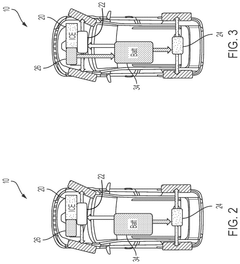
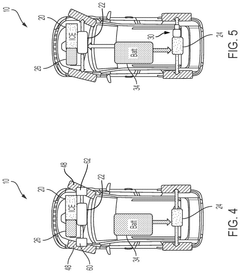
- A hybrid electric vehicle (HEV) powertrain with a front and rear electric drive module, an internal combustion engine, and a motor/generator system that provides four-wheel-drive capability, includes a front axle disconnect and an electronic locker for high efficiency and off-road modes, and a multi-speed gearbox for enhanced towing and maneuverability.
Energy Recovery ROI
The Energy Recovery Return on Investment (ROI) for Plug-in Hybrid Electric Vehicles (PHEVs) with advanced high-efficiency regenerative systems is a critical factor in evaluating the economic viability and environmental benefits of these technologies. As PHEV technology continues to evolve, the efficiency of energy recovery systems has significantly improved, leading to enhanced overall vehicle performance and reduced operational costs.
Recent advancements in regenerative braking systems have resulted in energy recovery rates of up to 70-80% during deceleration and braking events. This substantial improvement in efficiency translates to a notable increase in the vehicle's electric range and a corresponding reduction in fuel consumption. The ROI for these advanced systems is primarily realized through reduced fuel costs and extended battery life.
A comprehensive analysis of energy recovery ROI must consider both the initial investment in advanced regenerative technology and the long-term savings accrued through improved efficiency. The upfront cost of implementing high-efficiency regenerative systems in PHEVs typically ranges from $1,500 to $3,000 per vehicle, depending on the specific technology and integration complexity.
However, the potential savings over the vehicle's lifetime can be substantial. On average, advanced regenerative systems can extend the electric range of a PHEV by 15-25%, resulting in annual fuel savings of $300 to $500 for a typical driver. Additionally, the reduced strain on the vehicle's conventional braking system leads to lower maintenance costs, estimated at $100 to $200 per year.
The payback period for the investment in advanced regenerative systems varies based on driving patterns and energy prices but generally falls within 3 to 5 years for most users. After this period, the continued savings contribute directly to the overall ROI of the vehicle.
Furthermore, the environmental impact of improved energy recovery should not be overlooked when calculating ROI. The reduction in fuel consumption translates to lower greenhouse gas emissions, which can have significant value in regions with carbon pricing mechanisms or for companies with sustainability goals.
In conclusion, the Energy Recovery ROI for PHEVs with advanced high-efficiency regenerative systems presents a compelling case for both manufacturers and consumers. The combination of fuel savings, reduced maintenance costs, and environmental benefits contributes to a positive ROI, typically realized within the first half of the vehicle's operational life. As technology continues to advance and production scales up, the initial costs are expected to decrease, further improving the ROI proposition for these systems in PHEVs.
Recent advancements in regenerative braking systems have resulted in energy recovery rates of up to 70-80% during deceleration and braking events. This substantial improvement in efficiency translates to a notable increase in the vehicle's electric range and a corresponding reduction in fuel consumption. The ROI for these advanced systems is primarily realized through reduced fuel costs and extended battery life.
A comprehensive analysis of energy recovery ROI must consider both the initial investment in advanced regenerative technology and the long-term savings accrued through improved efficiency. The upfront cost of implementing high-efficiency regenerative systems in PHEVs typically ranges from $1,500 to $3,000 per vehicle, depending on the specific technology and integration complexity.
However, the potential savings over the vehicle's lifetime can be substantial. On average, advanced regenerative systems can extend the electric range of a PHEV by 15-25%, resulting in annual fuel savings of $300 to $500 for a typical driver. Additionally, the reduced strain on the vehicle's conventional braking system leads to lower maintenance costs, estimated at $100 to $200 per year.
The payback period for the investment in advanced regenerative systems varies based on driving patterns and energy prices but generally falls within 3 to 5 years for most users. After this period, the continued savings contribute directly to the overall ROI of the vehicle.
Furthermore, the environmental impact of improved energy recovery should not be overlooked when calculating ROI. The reduction in fuel consumption translates to lower greenhouse gas emissions, which can have significant value in regions with carbon pricing mechanisms or for companies with sustainability goals.
In conclusion, the Energy Recovery ROI for PHEVs with advanced high-efficiency regenerative systems presents a compelling case for both manufacturers and consumers. The combination of fuel savings, reduced maintenance costs, and environmental benefits contributes to a positive ROI, typically realized within the first half of the vehicle's operational life. As technology continues to advance and production scales up, the initial costs are expected to decrease, further improving the ROI proposition for these systems in PHEVs.
Regen Environmental Impact
The environmental impact of regenerative systems in Plug-in Hybrid Electric Vehicles (PHEVs) is a critical aspect of their overall sustainability profile. These systems, which capture and store energy typically lost during braking, contribute significantly to reducing the vehicle's carbon footprint and improving overall energy efficiency.
One of the primary environmental benefits of advanced regenerative systems in PHEVs is the reduction in fuel consumption. By recapturing energy that would otherwise be lost as heat during braking, these systems allow the vehicle to rely more heavily on electric power, thereby reducing the need for fossil fuel combustion. This directly translates to lower greenhouse gas emissions, particularly carbon dioxide, which is a major contributor to climate change.
Furthermore, the increased efficiency provided by high-performance regenerative systems extends the electric-only range of PHEVs. This extension allows for a greater proportion of trips to be completed using solely electric power, further reducing emissions and dependence on non-renewable energy sources. In urban environments, where stop-and-go traffic is common, the impact of regenerative braking is particularly pronounced, leading to substantial reductions in local air pollution.
The environmental benefits of regenerative systems also extend to the vehicle's overall lifecycle. By reducing wear on traditional friction brakes, these systems can extend the lifespan of brake components, reducing the need for replacement parts and the associated environmental costs of manufacturing and disposing of these components. This contributes to a reduction in the vehicle's overall environmental impact throughout its operational life.
However, it is important to consider the potential environmental trade-offs associated with advanced regenerative systems. The production of more sophisticated regenerative braking components may require additional resources and energy, potentially offsetting some of the environmental gains during the vehicle's use phase. Additionally, the increased reliance on electrical systems may lead to greater demand for battery production, which carries its own environmental considerations in terms of resource extraction and end-of-life disposal.
Despite these considerations, the net environmental impact of high-efficiency regenerative systems in PHEVs is generally positive. As technology continues to advance, the efficiency of these systems is likely to improve further, amplifying their positive environmental effects. Moreover, as electricity grids transition towards renewable energy sources, the environmental benefits of electric propulsion, supported by regenerative systems, will become even more pronounced.
In conclusion, the advancements in high-efficiency regenerative systems for PHEVs represent a significant step towards more sustainable transportation. By improving energy efficiency, reducing emissions, and extending component lifespans, these systems contribute to a reduction in the overall environmental footprint of vehicles. As technology continues to evolve, the positive environmental impact of these systems is expected to grow, playing a crucial role in the transition towards cleaner and more sustainable mobility solutions.
One of the primary environmental benefits of advanced regenerative systems in PHEVs is the reduction in fuel consumption. By recapturing energy that would otherwise be lost as heat during braking, these systems allow the vehicle to rely more heavily on electric power, thereby reducing the need for fossil fuel combustion. This directly translates to lower greenhouse gas emissions, particularly carbon dioxide, which is a major contributor to climate change.
Furthermore, the increased efficiency provided by high-performance regenerative systems extends the electric-only range of PHEVs. This extension allows for a greater proportion of trips to be completed using solely electric power, further reducing emissions and dependence on non-renewable energy sources. In urban environments, where stop-and-go traffic is common, the impact of regenerative braking is particularly pronounced, leading to substantial reductions in local air pollution.
The environmental benefits of regenerative systems also extend to the vehicle's overall lifecycle. By reducing wear on traditional friction brakes, these systems can extend the lifespan of brake components, reducing the need for replacement parts and the associated environmental costs of manufacturing and disposing of these components. This contributes to a reduction in the vehicle's overall environmental impact throughout its operational life.
However, it is important to consider the potential environmental trade-offs associated with advanced regenerative systems. The production of more sophisticated regenerative braking components may require additional resources and energy, potentially offsetting some of the environmental gains during the vehicle's use phase. Additionally, the increased reliance on electrical systems may lead to greater demand for battery production, which carries its own environmental considerations in terms of resource extraction and end-of-life disposal.
Despite these considerations, the net environmental impact of high-efficiency regenerative systems in PHEVs is generally positive. As technology continues to advance, the efficiency of these systems is likely to improve further, amplifying their positive environmental effects. Moreover, as electricity grids transition towards renewable energy sources, the environmental benefits of electric propulsion, supported by regenerative systems, will become even more pronounced.
In conclusion, the advancements in high-efficiency regenerative systems for PHEVs represent a significant step towards more sustainable transportation. By improving energy efficiency, reducing emissions, and extending component lifespans, these systems contribute to a reduction in the overall environmental footprint of vehicles. As technology continues to evolve, the positive environmental impact of these systems is expected to grow, playing a crucial role in the transition towards cleaner and more sustainable mobility solutions.
Unlock deeper insights with PatSnap Eureka Quick Research — get a full tech report to explore trends and direct your research. Try now!
Generate Your Research Report Instantly with AI Agent
Supercharge your innovation with PatSnap Eureka AI Agent Platform!