PNP Transistor Performance in Varying Technological Environments
JUL 28, 20259 MIN READ
Generate Your Research Report Instantly with AI Agent
Patsnap Eureka helps you evaluate technical feasibility & market potential.
PNP Transistor Evolution and Objectives
PNP transistors have played a crucial role in the evolution of semiconductor technology since their inception in the 1950s. Initially developed as a complement to NPN transistors, PNP devices have undergone significant advancements in performance, efficiency, and application versatility over the decades. The primary objective in PNP transistor development has been to enhance their switching speed, current gain, and power handling capabilities while reducing their size and power consumption.
The evolution of PNP transistors can be traced through several key technological milestones. Early germanium-based PNP transistors were limited by their low operating temperatures and high leakage currents. The transition to silicon-based devices in the 1960s marked a significant improvement, offering better thermal stability and lower leakage. The introduction of epitaxial growth techniques in the 1970s allowed for more precise control of doping profiles, leading to improved high-frequency performance.
In the 1980s and 1990s, the focus shifted towards miniaturization and integration. The development of advanced lithography techniques enabled the production of smaller, more efficient PNP transistors. This period also saw the emergence of BiCMOS technology, which combined bipolar transistors (including PNP) with CMOS devices on a single chip, offering the benefits of both technologies.
The turn of the millennium brought about further innovations in PNP transistor design. The introduction of SiGe heterojunction bipolar transistors (HBTs) represented a significant leap forward, offering superior high-frequency performance and lower noise characteristics compared to traditional silicon devices. This technology has found extensive applications in RF and microwave circuits.
Current objectives in PNP transistor development are multifaceted. There is a continued push for higher operating frequencies, with researchers exploring novel materials and device structures to break existing performance barriers. Improving power efficiency remains a critical goal, particularly for mobile and IoT applications where battery life is paramount. Additionally, there is growing interest in developing PNP transistors for extreme environment applications, such as high-temperature electronics for automotive and aerospace industries.
Looking ahead, the integration of PNP transistors with emerging technologies presents exciting possibilities. The potential combination of PNP devices with wide-bandgap semiconductors like gallium nitride (GaN) or silicon carbide (SiC) could lead to unprecedented performance in power electronics. Furthermore, the exploration of PNP transistors in quantum computing architectures represents a frontier in semiconductor research, potentially opening new avenues for quantum information processing.
The evolution of PNP transistors can be traced through several key technological milestones. Early germanium-based PNP transistors were limited by their low operating temperatures and high leakage currents. The transition to silicon-based devices in the 1960s marked a significant improvement, offering better thermal stability and lower leakage. The introduction of epitaxial growth techniques in the 1970s allowed for more precise control of doping profiles, leading to improved high-frequency performance.
In the 1980s and 1990s, the focus shifted towards miniaturization and integration. The development of advanced lithography techniques enabled the production of smaller, more efficient PNP transistors. This period also saw the emergence of BiCMOS technology, which combined bipolar transistors (including PNP) with CMOS devices on a single chip, offering the benefits of both technologies.
The turn of the millennium brought about further innovations in PNP transistor design. The introduction of SiGe heterojunction bipolar transistors (HBTs) represented a significant leap forward, offering superior high-frequency performance and lower noise characteristics compared to traditional silicon devices. This technology has found extensive applications in RF and microwave circuits.
Current objectives in PNP transistor development are multifaceted. There is a continued push for higher operating frequencies, with researchers exploring novel materials and device structures to break existing performance barriers. Improving power efficiency remains a critical goal, particularly for mobile and IoT applications where battery life is paramount. Additionally, there is growing interest in developing PNP transistors for extreme environment applications, such as high-temperature electronics for automotive and aerospace industries.
Looking ahead, the integration of PNP transistors with emerging technologies presents exciting possibilities. The potential combination of PNP devices with wide-bandgap semiconductors like gallium nitride (GaN) or silicon carbide (SiC) could lead to unprecedented performance in power electronics. Furthermore, the exploration of PNP transistors in quantum computing architectures represents a frontier in semiconductor research, potentially opening new avenues for quantum information processing.
Market Demand Analysis for PNP Transistors
The market demand for PNP transistors continues to evolve, driven by advancements in various technological environments. As electronic devices become more compact and energy-efficient, the need for high-performance PNP transistors has grown significantly. The automotive industry, in particular, has emerged as a major consumer of PNP transistors, with the increasing electrification of vehicles and the integration of advanced driver assistance systems (ADAS).
In the consumer electronics sector, the demand for PNP transistors remains strong, especially in smartphones, tablets, and wearable devices. These applications require transistors that can operate efficiently at lower voltages while maintaining high switching speeds. The Internet of Things (IoT) has also contributed to the market growth, as PNP transistors are essential components in many IoT devices and sensors.
The industrial automation sector has shown a steady increase in demand for PNP transistors, particularly in robotics and process control systems. These applications often require transistors that can withstand harsh environmental conditions and maintain reliable performance over extended periods. The aerospace and defense industries also contribute to the market demand, utilizing PNP transistors in communication systems, radar equipment, and other mission-critical applications.
The renewable energy sector has emerged as a promising market for PNP transistors, with applications in solar inverters, wind turbine control systems, and energy storage devices. As the world shifts towards cleaner energy sources, the demand for efficient power management solutions incorporating PNP transistors is expected to grow substantially.
Market analysis indicates that the global PNP transistor market is projected to experience steady growth over the next five years. This growth is attributed to the increasing adoption of electric vehicles, the expansion of 5G networks, and the ongoing digital transformation across various industries. Additionally, the development of new materials and manufacturing techniques is expected to enhance the performance of PNP transistors, further driving market demand.
However, the market also faces challenges, such as the ongoing global semiconductor shortage and the increasing complexity of electronic systems. These factors may impact the supply chain and pricing of PNP transistors in the short term. Despite these challenges, the overall market outlook remains positive, with opportunities for innovation and growth in emerging technologies like artificial intelligence, edge computing, and quantum computing, all of which will require advanced transistor technologies.
In the consumer electronics sector, the demand for PNP transistors remains strong, especially in smartphones, tablets, and wearable devices. These applications require transistors that can operate efficiently at lower voltages while maintaining high switching speeds. The Internet of Things (IoT) has also contributed to the market growth, as PNP transistors are essential components in many IoT devices and sensors.
The industrial automation sector has shown a steady increase in demand for PNP transistors, particularly in robotics and process control systems. These applications often require transistors that can withstand harsh environmental conditions and maintain reliable performance over extended periods. The aerospace and defense industries also contribute to the market demand, utilizing PNP transistors in communication systems, radar equipment, and other mission-critical applications.
The renewable energy sector has emerged as a promising market for PNP transistors, with applications in solar inverters, wind turbine control systems, and energy storage devices. As the world shifts towards cleaner energy sources, the demand for efficient power management solutions incorporating PNP transistors is expected to grow substantially.
Market analysis indicates that the global PNP transistor market is projected to experience steady growth over the next five years. This growth is attributed to the increasing adoption of electric vehicles, the expansion of 5G networks, and the ongoing digital transformation across various industries. Additionally, the development of new materials and manufacturing techniques is expected to enhance the performance of PNP transistors, further driving market demand.
However, the market also faces challenges, such as the ongoing global semiconductor shortage and the increasing complexity of electronic systems. These factors may impact the supply chain and pricing of PNP transistors in the short term. Despite these challenges, the overall market outlook remains positive, with opportunities for innovation and growth in emerging technologies like artificial intelligence, edge computing, and quantum computing, all of which will require advanced transistor technologies.
PNP Transistor Challenges in Modern Tech
PNP transistors have been a cornerstone of electronic design for decades, but their performance in modern technological environments presents unique challenges. As semiconductor technology continues to advance, the demands placed on PNP transistors have intensified, particularly in high-frequency and high-power applications. These devices, while essential for complementary circuit designs, often struggle to match the performance of their NPN counterparts in cutting-edge technologies.
One of the primary challenges facing PNP transistors is their inherently lower carrier mobility. In silicon-based semiconductors, holes (the majority carriers in PNP devices) have approximately three times lower mobility than electrons. This fundamental limitation results in slower switching speeds and reduced current-carrying capabilities compared to NPN transistors. As modern applications push for ever-higher frequencies and greater power efficiency, this disparity becomes increasingly problematic.
The scaling of semiconductor processes to smaller nodes has further exacerbated the challenges for PNP transistors. As device dimensions shrink, the impact of parasitic capacitances and resistances becomes more pronounced. These parasitics can significantly degrade the frequency response and power handling capabilities of PNP transistors, limiting their effectiveness in advanced integrated circuits. Additionally, the reduced voltage headroom in modern low-voltage designs places stricter requirements on the voltage characteristics of PNP devices.
Another critical challenge is the integration of PNP transistors into advanced process technologies. Many cutting-edge semiconductor processes are optimized for NMOS or NMOS-dominated CMOS designs, often relegating PNP transistors to secondary status. This can result in suboptimal PNP performance characteristics and limited design flexibility when incorporating these devices into complex circuits.
The thermal management of PNP transistors in high-power applications presents yet another hurdle. As power densities increase in modern electronic systems, the ability to efficiently dissipate heat becomes crucial. PNP transistors, particularly in power applications, must contend with the challenges of maintaining stable performance under varying thermal conditions while minimizing the impact on overall system thermal management.
Furthermore, the demand for PNP transistors in emerging technologies such as 5G communications, automotive electronics, and Internet of Things (IoT) devices introduces new performance requirements. These applications often necessitate a delicate balance between high-frequency operation, low power consumption, and robust reliability – a combination that stretches the capabilities of traditional PNP designs to their limits.
As the industry continues to push the boundaries of semiconductor technology, addressing these challenges in PNP transistor performance becomes increasingly critical. Innovations in materials science, device physics, and circuit design techniques will be essential to unlock the full potential of PNP transistors in modern technological environments.
One of the primary challenges facing PNP transistors is their inherently lower carrier mobility. In silicon-based semiconductors, holes (the majority carriers in PNP devices) have approximately three times lower mobility than electrons. This fundamental limitation results in slower switching speeds and reduced current-carrying capabilities compared to NPN transistors. As modern applications push for ever-higher frequencies and greater power efficiency, this disparity becomes increasingly problematic.
The scaling of semiconductor processes to smaller nodes has further exacerbated the challenges for PNP transistors. As device dimensions shrink, the impact of parasitic capacitances and resistances becomes more pronounced. These parasitics can significantly degrade the frequency response and power handling capabilities of PNP transistors, limiting their effectiveness in advanced integrated circuits. Additionally, the reduced voltage headroom in modern low-voltage designs places stricter requirements on the voltage characteristics of PNP devices.
Another critical challenge is the integration of PNP transistors into advanced process technologies. Many cutting-edge semiconductor processes are optimized for NMOS or NMOS-dominated CMOS designs, often relegating PNP transistors to secondary status. This can result in suboptimal PNP performance characteristics and limited design flexibility when incorporating these devices into complex circuits.
The thermal management of PNP transistors in high-power applications presents yet another hurdle. As power densities increase in modern electronic systems, the ability to efficiently dissipate heat becomes crucial. PNP transistors, particularly in power applications, must contend with the challenges of maintaining stable performance under varying thermal conditions while minimizing the impact on overall system thermal management.
Furthermore, the demand for PNP transistors in emerging technologies such as 5G communications, automotive electronics, and Internet of Things (IoT) devices introduces new performance requirements. These applications often necessitate a delicate balance between high-frequency operation, low power consumption, and robust reliability – a combination that stretches the capabilities of traditional PNP designs to their limits.
As the industry continues to push the boundaries of semiconductor technology, addressing these challenges in PNP transistor performance becomes increasingly critical. Innovations in materials science, device physics, and circuit design techniques will be essential to unlock the full potential of PNP transistors in modern technological environments.
Current PNP Transistor Solutions
01 Fabrication techniques for improved PNP transistor performance
Various fabrication techniques are employed to enhance PNP transistor performance. These include optimizing doping profiles, reducing base width, and improving emitter efficiency. Advanced lithography and etching processes are used to achieve precise control over transistor dimensions and characteristics.- Fabrication techniques for improved PNP transistor performance: Various fabrication techniques are employed to enhance PNP transistor performance. These include optimizing doping profiles, reducing base width, and improving emitter efficiency. Advanced lithography and etching processes are used to achieve precise control over transistor dimensions and characteristics.
- Circuit design for PNP transistor applications: Circuit designs incorporating PNP transistors are optimized for various applications. This includes current mirror configurations, differential amplifiers, and voltage regulators. Careful consideration is given to biasing conditions, load resistances, and feedback networks to maximize performance metrics such as gain, bandwidth, and noise characteristics.
- Integration of PNP transistors in BiCMOS technology: PNP transistors are integrated into BiCMOS (Bipolar Complementary Metal-Oxide-Semiconductor) processes, combining the advantages of both bipolar and CMOS technologies. This integration allows for improved analog performance while maintaining the benefits of digital CMOS circuitry, resulting in enhanced overall system performance.
- Temperature compensation and thermal management: Techniques are developed to address temperature-related issues in PNP transistor performance. This includes implementing temperature compensation circuits, optimizing layout for improved thermal management, and developing specialized packaging solutions to dissipate heat effectively.
- High-frequency performance optimization: Methods are employed to enhance the high-frequency performance of PNP transistors. This involves reducing parasitic capacitances, optimizing transistor geometry, and implementing advanced materials and structures to improve carrier mobility and transit time. These techniques result in increased cutoff frequency and improved gain-bandwidth product.
02 Circuit design for PNP transistor applications
Innovative circuit designs are developed to maximize PNP transistor performance in various applications. These include optimized biasing networks, feedback configurations, and complementary circuits. The designs focus on improving gain, bandwidth, and noise characteristics of PNP transistors in analog and digital circuits.Expand Specific Solutions03 Integration of PNP transistors in semiconductor devices
PNP transistors are integrated into various semiconductor devices to enhance overall performance. This includes their use in bipolar and BiCMOS technologies, as well as in power management and analog circuits. Integration techniques focus on optimizing layout, reducing parasitic effects, and improving thermal management.Expand Specific Solutions04 High-frequency performance optimization of PNP transistors
Techniques are developed to improve the high-frequency performance of PNP transistors. These include reducing parasitic capacitances, optimizing base transit time, and enhancing current gain at high frequencies. Advanced materials and structures are employed to achieve better frequency response and switching speeds.Expand Specific Solutions05 PNP transistor performance in extreme environments
Methods are developed to enhance PNP transistor performance in extreme environments, such as high temperatures or radiation-rich conditions. These include specialized packaging, radiation-hardening techniques, and temperature compensation circuits. The focus is on maintaining stable operation and reliability under challenging conditions.Expand Specific Solutions
Key Players in PNP Transistor Industry
The PNP transistor performance landscape is evolving rapidly, with the industry in a mature yet dynamic phase. The market size is substantial, driven by increasing demand in various technological environments. Key players like IBM, Infineon Technologies, and Texas Instruments are at the forefront, leveraging their extensive R&D capabilities to enhance PNP transistor performance. The technology's maturity is evident, with companies like NXP and STMicroelectronics offering advanced solutions. However, emerging players such as GLOBALFOUNDRIES and Shanghai Huahong Grace are also making significant strides, indicating ongoing innovation and competition in this space. The diverse range of companies involved, from established semiconductor giants to specialized manufacturers, underscores the technology's wide-ranging applications and continued relevance in modern electronics.
International Business Machines Corp.
Technical Solution: IBM has developed advanced PNP transistor technologies for varying environments. Their Silicon-Germanium (SiGe) heterojunction bipolar transistors (HBTs) have shown exceptional performance in high-frequency applications[1]. IBM's PNP transistors utilize a self-aligned emitter-base structure and optimized doping profiles to enhance current gain and frequency response[2]. The company has also implemented advanced isolation techniques to minimize parasitic capacitances, resulting in improved switching speeds and reduced power consumption[3]. IBM's PNP transistors incorporate strain engineering to enhance hole mobility, leading to better performance in both low and high-temperature environments[4].
Strengths: Superior high-frequency performance, excellent temperature stability, and low power consumption. Weaknesses: Higher manufacturing costs and complexity compared to standard bipolar transistors.
Infineon Technologies AG
Technical Solution: Infineon has developed innovative PNP transistor designs for diverse technological environments. Their OptiMOS™ technology incorporates advanced trench gate structures and optimized doping profiles to enhance PNP transistor performance[5]. Infineon's PNP transistors feature reduced on-resistance and improved thermal characteristics, making them suitable for automotive and industrial applications[6]. The company has also implemented novel packaging techniques, such as TOLT (Top-side cooled package with optimized layout for thermal performance), to improve heat dissipation in high-power environments[7]. Infineon's PNP transistors utilize advanced epitaxial layer designs to minimize parasitic effects and enhance breakdown voltage capabilities[8].
Strengths: Excellent thermal management, high reliability in harsh environments, and optimized for power applications. Weaknesses: Potentially higher cost due to advanced manufacturing processes.
Core PNP Transistor Innovations
High performance vertical PNP transistor and method
PatentInactiveUS6909164B2
Innovation
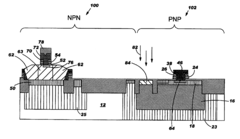
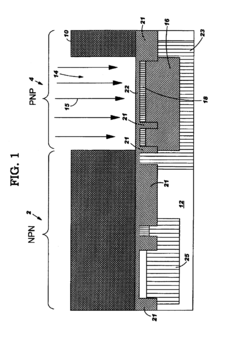
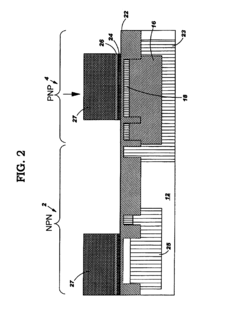
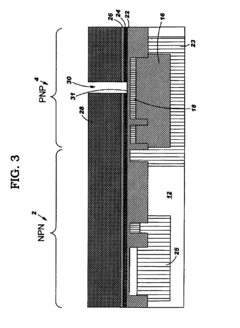
- A method for fabricating high-performance vertical PNP transistors by incorporating an emitter region with silicon and germanium, sharing a single layer of silicon with the NPN transistor's base, and adding two additional masking steps to conventional CMOS and bipolar device fabrication processes, which enhances PNP device performance.
High performance vertical PNP transistor method
PatentInactiveUS7265010B2
Innovation
- A method for fabricating high-performance vertical PNP transistors by incorporating an emitter region with silicon and germanium, sharing a single layer of silicon with the NPN transistor's base, and adding two additional masking steps to conventional CMOS and bipolar device fabrication processes, involving specific implantations and epitaxial layer growth to enhance PNP device performance.


Environmental Impact of PNP Transistors
The environmental impact of PNP transistors is a critical consideration in the context of their performance in varying technological environments. These semiconductor devices, while essential for modern electronics, contribute to environmental concerns throughout their lifecycle. The manufacturing process of PNP transistors involves the use of various chemicals and materials, some of which can be harmful to the environment if not properly managed. Silicon, the primary material used in transistor production, requires significant energy for extraction and processing, contributing to carbon emissions.
During the operational phase, PNP transistors consume energy, albeit in small amounts individually. However, considering the vast number of transistors in use globally, their cumulative energy consumption becomes substantial. This energy demand indirectly impacts the environment through increased power generation requirements, potentially leading to higher greenhouse gas emissions depending on the energy sources used.
The disposal and end-of-life management of PNP transistors present another environmental challenge. Electronic waste (e-waste) containing these components can release toxic substances into soil and water if not properly recycled or disposed of. Substances like lead, cadmium, and brominated flame retardants used in electronic components can persist in the environment and pose risks to ecosystems and human health.
However, advancements in transistor technology have led to more energy-efficient designs, reducing the environmental impact during the use phase. Modern PNP transistors are designed to operate at lower voltages and with reduced power consumption, contributing to overall energy savings in electronic devices. This trend aligns with global efforts to reduce energy consumption and mitigate climate change.
The miniaturization of transistors, including PNP types, has also had positive environmental implications. Smaller transistors require less material for production and result in more compact devices, potentially reducing the overall volume of electronic waste. Additionally, improved manufacturing processes have led to more efficient use of resources and reduced waste generation during production.
Efforts to address the environmental impact of PNP transistors and other electronic components include the development of more sustainable manufacturing practices, the use of less toxic materials, and improved recycling technologies. Green electronics initiatives aim to create more environmentally friendly products by considering the entire lifecycle of electronic components, from production to disposal.
In conclusion, while PNP transistors have contributed to environmental concerns, ongoing technological advancements and sustainability efforts are working to mitigate these impacts. The challenge lies in balancing the performance requirements of PNP transistors in varying technological environments with the need for environmental stewardship, driving innovation towards more sustainable electronic solutions.
During the operational phase, PNP transistors consume energy, albeit in small amounts individually. However, considering the vast number of transistors in use globally, their cumulative energy consumption becomes substantial. This energy demand indirectly impacts the environment through increased power generation requirements, potentially leading to higher greenhouse gas emissions depending on the energy sources used.
The disposal and end-of-life management of PNP transistors present another environmental challenge. Electronic waste (e-waste) containing these components can release toxic substances into soil and water if not properly recycled or disposed of. Substances like lead, cadmium, and brominated flame retardants used in electronic components can persist in the environment and pose risks to ecosystems and human health.
However, advancements in transistor technology have led to more energy-efficient designs, reducing the environmental impact during the use phase. Modern PNP transistors are designed to operate at lower voltages and with reduced power consumption, contributing to overall energy savings in electronic devices. This trend aligns with global efforts to reduce energy consumption and mitigate climate change.
The miniaturization of transistors, including PNP types, has also had positive environmental implications. Smaller transistors require less material for production and result in more compact devices, potentially reducing the overall volume of electronic waste. Additionally, improved manufacturing processes have led to more efficient use of resources and reduced waste generation during production.
Efforts to address the environmental impact of PNP transistors and other electronic components include the development of more sustainable manufacturing practices, the use of less toxic materials, and improved recycling technologies. Green electronics initiatives aim to create more environmentally friendly products by considering the entire lifecycle of electronic components, from production to disposal.
In conclusion, while PNP transistors have contributed to environmental concerns, ongoing technological advancements and sustainability efforts are working to mitigate these impacts. The challenge lies in balancing the performance requirements of PNP transistors in varying technological environments with the need for environmental stewardship, driving innovation towards more sustainable electronic solutions.
PNP vs NPN Transistor Comparison
PNP and NPN transistors are two fundamental types of bipolar junction transistors (BJTs) that play crucial roles in electronic circuits. While both serve similar purposes, their operational characteristics and performance attributes differ significantly, especially in varying technological environments.
PNP transistors use holes as the majority charge carriers, while NPN transistors rely on electrons. This fundamental difference affects their behavior and applications. In terms of switching speed, NPN transistors generally outperform PNP transistors. The higher mobility of electrons compared to holes allows NPN transistors to switch on and off more rapidly, making them preferable in high-frequency applications and digital circuits.
Power handling capabilities also differ between the two types. NPN transistors typically exhibit better power handling characteristics, making them more suitable for high-power applications. This is partly due to the higher electron mobility and the ease of manufacturing NPN transistors with larger current-carrying capacities.
Temperature sensitivity is another area where PNP and NPN transistors show distinct behaviors. PNP transistors tend to be more sensitive to temperature variations, which can affect their performance stability in environments with fluctuating temperatures. NPN transistors, on the other hand, generally demonstrate better temperature stability, making them more reliable in diverse operating conditions.
In terms of availability and cost, NPN transistors have historically been more prevalent and less expensive. This is primarily due to their simpler manufacturing process and higher demand in various electronic applications. However, advancements in semiconductor technology have narrowed this gap, making PNP transistors more accessible and cost-effective in recent years.
When it comes to noise performance, PNP transistors often exhibit lower noise characteristics, especially at low frequencies. This makes them preferable in certain analog and audio applications where signal integrity is crucial. NPN transistors, while generally noisier at low frequencies, tend to perform better in high-frequency, low-noise applications.
The choice between PNP and NPN transistors also impacts circuit design. PNP transistors are typically used in circuits where the emitter is at a higher potential than the collector, while NPN transistors are used in the opposite configuration. This difference affects power supply requirements and overall circuit topology, influencing the complexity and efficiency of electronic designs.
In conclusion, the selection between PNP and NPN transistors depends on the specific requirements of the application, considering factors such as switching speed, power handling, temperature sensitivity, cost, noise performance, and circuit design constraints. Understanding these differences is crucial for optimizing transistor performance across various technological environments.
PNP transistors use holes as the majority charge carriers, while NPN transistors rely on electrons. This fundamental difference affects their behavior and applications. In terms of switching speed, NPN transistors generally outperform PNP transistors. The higher mobility of electrons compared to holes allows NPN transistors to switch on and off more rapidly, making them preferable in high-frequency applications and digital circuits.
Power handling capabilities also differ between the two types. NPN transistors typically exhibit better power handling characteristics, making them more suitable for high-power applications. This is partly due to the higher electron mobility and the ease of manufacturing NPN transistors with larger current-carrying capacities.
Temperature sensitivity is another area where PNP and NPN transistors show distinct behaviors. PNP transistors tend to be more sensitive to temperature variations, which can affect their performance stability in environments with fluctuating temperatures. NPN transistors, on the other hand, generally demonstrate better temperature stability, making them more reliable in diverse operating conditions.
In terms of availability and cost, NPN transistors have historically been more prevalent and less expensive. This is primarily due to their simpler manufacturing process and higher demand in various electronic applications. However, advancements in semiconductor technology have narrowed this gap, making PNP transistors more accessible and cost-effective in recent years.
When it comes to noise performance, PNP transistors often exhibit lower noise characteristics, especially at low frequencies. This makes them preferable in certain analog and audio applications where signal integrity is crucial. NPN transistors, while generally noisier at low frequencies, tend to perform better in high-frequency, low-noise applications.
The choice between PNP and NPN transistors also impacts circuit design. PNP transistors are typically used in circuits where the emitter is at a higher potential than the collector, while NPN transistors are used in the opposite configuration. This difference affects power supply requirements and overall circuit topology, influencing the complexity and efficiency of electronic designs.
In conclusion, the selection between PNP and NPN transistors depends on the specific requirements of the application, considering factors such as switching speed, power handling, temperature sensitivity, cost, noise performance, and circuit design constraints. Understanding these differences is crucial for optimizing transistor performance across various technological environments.
Unlock deeper insights with Patsnap Eureka Quick Research — get a full tech report to explore trends and direct your research. Try now!
Generate Your Research Report Instantly with AI Agent
Supercharge your innovation with Patsnap Eureka AI Agent Platform!