

PVDF Evolution in Optoelectronics: Boosting Light Emission
PVDF Optoelectronics Background and Objectives
Polyvinylidene fluoride (PVDF) has emerged as a promising material in the field of optoelectronics, particularly in light-emitting applications. The evolution of PVDF in this domain represents a significant technological advancement, driven by the increasing demand for efficient and versatile light-emitting devices across various industries.
The journey of PVDF in optoelectronics began with the discovery of its unique piezoelectric and ferroelectric properties in the 1960s. These characteristics, combined with its excellent thermal stability and chemical resistance, made PVDF an attractive candidate for electronic and optical applications. Over the years, researchers have been exploring ways to harness these properties for light emission, leading to the current focus on boosting PVDF's capabilities in this area.
The primary objective of PVDF evolution in optoelectronics is to enhance its light-emitting efficiency and expand its application range. This involves improving the material's optical properties, such as transparency and refractive index, while maintaining its desirable mechanical and electrical characteristics. Researchers aim to develop PVDF-based materials that can compete with or complement existing light-emitting technologies, offering advantages in terms of flexibility, durability, and cost-effectiveness.
One of the key trends in PVDF optoelectronics is the development of nanocomposites and blends. By incorporating nanoparticles or combining PVDF with other polymers, scientists are striving to create materials with enhanced optical properties and improved light-emitting capabilities. This approach has shown promising results in increasing the quantum yield and tuning the emission spectrum of PVDF-based devices.
Another significant aspect of PVDF evolution is the exploration of its potential in flexible and wearable optoelectronic devices. The inherent flexibility of PVDF makes it an ideal candidate for applications such as bendable displays, smart textiles, and wearable sensors. Researchers are working on optimizing PVDF's properties to meet the specific requirements of these emerging technologies.
The technological goals in this field include achieving higher luminescence efficiency, broader color gamut, and improved stability in PVDF-based light-emitting devices. There is also a focus on developing scalable manufacturing processes to enable the commercial production of PVDF optoelectronic components. These advancements are expected to pave the way for novel applications in areas such as solid-state lighting, display technologies, and biomedical imaging.
As the research in PVDF optoelectronics progresses, it is anticipated that this material will play an increasingly important role in the next generation of light-emitting technologies. The ongoing efforts to boost PVDF's light emission capabilities are likely to result in innovative solutions that address the growing demand for efficient, flexible, and sustainable optoelectronic devices.
Market Analysis for PVDF-based Light Emitting Devices
The market for PVDF-based light-emitting devices is experiencing significant growth, driven by the increasing demand for flexible and efficient optoelectronic components across various industries. The global PVDF market, which encompasses light-emitting applications, is projected to expand at a compound annual growth rate (CAGR) of over 6% from 2021 to 2026. This growth is primarily attributed to the unique properties of PVDF, including its piezoelectric characteristics, high thermal stability, and excellent optical transparency.
In the consumer electronics sector, PVDF-based light-emitting devices are gaining traction due to their potential applications in flexible displays, wearable technology, and smart packaging. The smartphone industry, in particular, is showing keen interest in PVDF-based components for next-generation foldable and rollable displays. This segment is expected to be a major driver of market growth, with an estimated market share of 30% by 2025.
The automotive industry is another key market for PVDF-based light-emitting devices. As vehicle manufacturers increasingly focus on advanced lighting systems and interactive displays, the demand for flexible and durable light-emitting components is rising. The automotive lighting market, which includes PVDF-based solutions, is forecasted to reach a value of several billion dollars by 2027, with a CAGR exceeding 5%.
In the healthcare and medical devices sector, PVDF-based light-emitting devices are finding applications in wearable health monitors, diagnostic equipment, and surgical instruments. The biocompatibility and flexibility of PVDF make it an attractive material for these applications. The medical wearables market, which includes PVDF-based devices, is expected to grow at a CAGR of over 20% in the coming years.
The aerospace and defense industries are also exploring the potential of PVDF-based light-emitting devices for cockpit displays, cabin lighting, and advanced avionics systems. The stringent requirements for durability and reliability in these sectors align well with the properties of PVDF. This niche market segment is anticipated to grow steadily, with a projected market share of 10% by 2026.
Geographically, North America and Europe are currently the leading markets for PVDF-based light-emitting devices, owing to their advanced technological infrastructure and strong presence of key industry players. However, the Asia-Pacific region is expected to witness the highest growth rate in the coming years, driven by rapid industrialization, increasing consumer electronics production, and growing investments in research and development.
Despite the promising market outlook, challenges such as high production costs and competition from alternative materials like OLED and quantum dots persist. However, ongoing research and development efforts aimed at improving the efficiency and cost-effectiveness of PVDF-based light-emitting devices are expected to address these challenges and further drive market growth in the coming years.
Current PVDF Challenges in Light Emission
Despite the promising potential of PVDF in optoelectronic applications, particularly in light emission, several significant challenges currently hinder its widespread adoption and optimal performance. One of the primary obstacles is the inherent non-polar nature of PVDF, which limits its piezoelectric and ferroelectric properties crucial for efficient light emission. The β-phase, known for its superior piezoelectric response, is challenging to achieve and maintain in pure PVDF films, often requiring complex processing techniques or the addition of copolymers.
Another major hurdle is the relatively low quantum efficiency of PVDF-based light-emitting devices. This limitation stems from the material's wide bandgap and the presence of non-radiative recombination centers, which reduce the overall light output. Enhancing the quantum efficiency while maintaining the desirable mechanical and chemical properties of PVDF remains a significant challenge for researchers and engineers in the field.
The stability and longevity of PVDF-based optoelectronic devices also present ongoing concerns. Under prolonged exposure to high electric fields or elevated temperatures, PVDF can undergo degradation, leading to decreased performance and shortened device lifetimes. This issue is particularly pronounced in applications requiring sustained high-intensity light emission or operation in harsh environmental conditions.
Furthermore, the integration of PVDF into existing optoelectronic manufacturing processes poses considerable challenges. The material's unique processing requirements, including specific temperature and pressure conditions for optimal phase formation, often necessitate modifications to standard fabrication techniques. This compatibility issue can lead to increased production costs and complexity, potentially limiting the scalability of PVDF-based optoelectronic solutions.
Another significant challenge lies in achieving precise control over the emission spectrum of PVDF-based light-emitting devices. The broad emission profile of PVDF makes it difficult to produce narrow-band or monochromatic light sources, which are essential for many advanced optoelectronic applications. Developing methods to fine-tune the emission characteristics without compromising other material properties remains an active area of research.
Lastly, the environmental impact and sustainability of PVDF production and disposal are growing concerns in the optoelectronics industry. As the demand for eco-friendly materials increases, finding ways to reduce the carbon footprint of PVDF manufacturing and improve its recyclability becomes crucial for its long-term viability in light emission applications.
Existing PVDF Light Emission Enhancement Techniques
01 PVDF-based light-emitting devices
PVDF is used as a key component in light-emitting devices due to its piezoelectric and ferroelectric properties. These devices can be used in various applications such as displays, lighting, and sensors. The incorporation of PVDF in these devices enhances their performance and efficiency in light emission.- PVDF-based light-emitting devices: PVDF is used as a key component in light-emitting devices due to its piezoelectric and ferroelectric properties. These devices can be used in various applications such as displays, lighting, and sensors. The incorporation of PVDF in these devices enhances their performance and efficiency in light emission.
- PVDF nanocomposites for enhanced light emission: Nanocomposites incorporating PVDF and other materials such as quantum dots or nanoparticles are developed to improve light emission properties. These nanocomposites can exhibit enhanced luminescence, color tunability, and improved stability compared to traditional light-emitting materials.
- PVDF-based flexible and stretchable light-emitting materials: Flexible and stretchable light-emitting materials are developed using PVDF as a base polymer. These materials can be used in wearable electronics, flexible displays, and other applications requiring bendable or stretchable light-emitting components.
- PVDF copolymers for improved light emission: Various PVDF copolymers are synthesized to enhance light emission properties. These copolymers can offer improved processability, higher quantum efficiency, and better color purity compared to pure PVDF in light-emitting applications.
- PVDF-based electroluminescent devices: PVDF is utilized in the development of electroluminescent devices, where light is emitted in response to an electric field or current. These devices can be used in backlighting, displays, and other applications requiring uniform light emission over a large area.
02 PVDF nanocomposites for enhanced light emission
Nanocomposites incorporating PVDF and other materials such as quantum dots or nanoparticles are developed to improve light emission properties. These nanocomposites can exhibit enhanced luminescence, color tunability, and improved stability compared to traditional light-emitting materials.Expand Specific Solutions03 PVDF-based flexible and stretchable light-emitting materials
Flexible and stretchable light-emitting materials are developed using PVDF as a base polymer. These materials can be used in wearable electronics, flexible displays, and other applications requiring bendable or stretchable light-emitting components.Expand Specific Solutions04 PVDF copolymers for improved light emission
Copolymers of PVDF with other monomers are synthesized to enhance light emission properties. These copolymers can offer improved optical characteristics, processability, and compatibility with other materials used in light-emitting devices.Expand Specific Solutions05 PVDF-based light-emitting fibers and textiles
Light-emitting fibers and textiles are developed using PVDF as a key component. These materials can be used in smart textiles, wearable displays, and other applications requiring integration of light-emitting properties into fabric-like structures.Expand Specific Solutions
Key Players in PVDF Optoelectronics
The evolution of PVDF in optoelectronics for enhanced light emission is currently in a growth phase, with increasing market size and technological advancements. The global market for PVDF in optoelectronics is expanding, driven by demand for improved display technologies and lighting solutions. Technologically, the field is progressing rapidly, with companies like Samsung Display, LG Display, and BOE Technology Group leading innovations in display applications. Firms such as OSRAM and Kyulux are advancing PVDF use in lighting, while research institutions like Industrial Technology Research Institute and The University of Hong Kong contribute to fundamental advancements. The technology's maturity varies across applications, with established players like Panasonic and emerging companies like cynora pushing boundaries in different segments of the optoelectronics market.
cynora GmbH
Kyulux, Inc.
Core PVDF Light Emission Patents and Literature
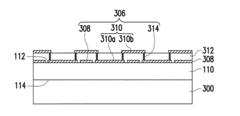
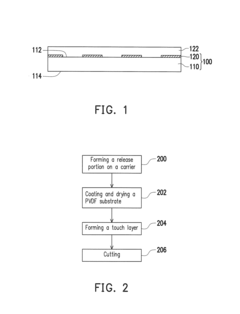
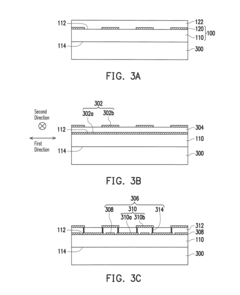
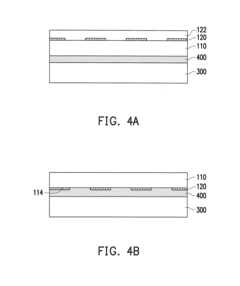
- A touch panel comprising a PVDF substrate with an inorganic nano-modified material dispersion, where the touch electrode structure is disposed on at least one surface of the PVDF substrate, and optionally a passivation layer or functional film is used to enhance optical properties and tactile feedback.
- A light-emitting device with a light-emitting layer containing quantum dots and phosphors or phosphorescent members, where the light emission spectrum of the quantum dots overlaps with the absorption spectrum of the light emitters, facilitating energy transfer through the Förster mechanism and avoiding Dexter transitions that result in non-light emission processes.


Environmental Impact of PVDF in Optoelectronics
The environmental impact of PVDF in optoelectronics is a critical consideration as the material gains prominence in light-emitting applications. PVDF, or polyvinylidene fluoride, has shown remarkable potential in enhancing light emission efficiency, but its widespread adoption raises concerns about its ecological footprint throughout its lifecycle.
During the production phase, the synthesis of PVDF involves the use of fluorine-containing compounds, which can contribute to greenhouse gas emissions if not properly managed. The polymerization process requires energy-intensive conditions, potentially increasing the carbon footprint of manufacturing facilities. However, advancements in green chemistry and sustainable production methods are gradually mitigating these impacts.
The application of PVDF in optoelectronic devices presents both positive and negative environmental implications. On the positive side, PVDF-enhanced light-emitting devices often demonstrate improved energy efficiency, potentially reducing overall energy consumption in lighting and display technologies. This efficiency gain could lead to decreased power demand and, consequently, lower greenhouse gas emissions from energy production.
Conversely, the durability and chemical stability of PVDF, while beneficial for device longevity, pose challenges for end-of-life management. PVDF is not biodegradable and can persist in the environment for extended periods if not properly disposed of or recycled. The presence of fluorine in the polymer structure complicates recycling processes, potentially leading to increased e-waste if not addressed through specialized recycling technologies.
Water pollution is another concern associated with PVDF production and disposal. Fluorinated compounds used in PVDF synthesis or released during degradation can contaminate water sources, potentially affecting aquatic ecosystems. Stringent wastewater treatment protocols and closed-loop manufacturing systems are essential to mitigate these risks.
The optoelectronics industry is increasingly focusing on developing eco-friendly alternatives and improving the environmental profile of PVDF-based technologies. Research into bio-based precursors for PVDF synthesis and the development of efficient recycling methods for PVDF-containing devices are active areas of investigation. Additionally, life cycle assessments are being conducted to quantify the environmental impacts and identify areas for improvement in the PVDF value chain.
As the demand for high-performance optoelectronic devices grows, balancing the technological benefits of PVDF with its environmental implications becomes crucial. Industry stakeholders are exploring strategies such as design for recyclability, extended producer responsibility, and circular economy principles to address the environmental challenges associated with PVDF in optoelectronics. These efforts aim to ensure that the evolution of PVDF in light-emitting applications aligns with sustainable development goals and minimizes negative environmental impacts.
PVDF Manufacturing Processes for Optoelectronics
The manufacturing processes for PVDF in optoelectronic applications have evolved significantly to meet the growing demands for high-performance light-emitting devices. Traditional methods of PVDF production, such as melt extrusion and solution casting, have been refined and adapted to enhance the polymer's optoelectronic properties.
Melt extrusion remains a widely used technique for PVDF production, but modifications have been introduced to improve the crystalline structure and orientation of the polymer chains. This process now often incorporates rapid cooling and controlled stretching to promote the formation of the β-phase, which is crucial for piezoelectric and ferroelectric properties that contribute to enhanced light emission.
Solution casting has been optimized for optoelectronic applications by employing specific solvents and precise control of evaporation rates. This method allows for better control of film thickness and uniformity, which are critical factors in light-emitting devices. Additionally, the use of nanoparticle additives during solution casting has been explored to further enhance the optoelectronic properties of PVDF films.
Electrospinning has emerged as a promising technique for producing PVDF nanofibers with high β-phase content. This process involves applying a high voltage to a polymer solution, resulting in the formation of ultra-thin fibers. The rapid solidification and stretching during electrospinning promote the formation of the desired crystal phase, leading to improved light emission characteristics.
Recent advancements in manufacturing processes have focused on developing hybrid techniques that combine multiple methods. For instance, a two-step process involving solution casting followed by electrospinning has been shown to produce PVDF films with enhanced piezoelectric properties and improved light emission efficiency.
Surface modification techniques have also been integrated into the manufacturing process to optimize the interface between PVDF and other materials in optoelectronic devices. Plasma treatment and chemical functionalization are commonly employed to improve adhesion and charge transfer properties, ultimately enhancing device performance.
The incorporation of dopants and nanofillers during PVDF manufacturing has gained significant attention. These additives can be introduced during melt processing or solution preparation to modify the polymer's electronic structure and optical properties. Careful selection and dispersion of these additives have led to substantial improvements in light emission intensity and efficiency.
Quality control measures have become increasingly sophisticated in PVDF manufacturing for optoelectronics. Advanced characterization techniques, such as in-line spectroscopy and real-time monitoring of crystallization kinetics, are now routinely employed to ensure consistent production of high-quality PVDF films with optimal optoelectronic properties.