

Improving Brain-Computer Interface Accessibility in Public Spaces
MAR 5, 20269 MIN READ
Generate Your Research Report Instantly with AI Agent
PatSnap Eureka helps you evaluate technical feasibility & market potential.
BCI Public Space Integration Background and Objectives
Brain-Computer Interface technology has undergone remarkable evolution since its inception in the 1970s, transitioning from laboratory curiosities to practical applications in medical rehabilitation and assistive technologies. The field has witnessed significant breakthroughs in signal processing, machine learning algorithms, and hardware miniaturization, enabling more sophisticated and reliable neural signal interpretation. Recent advances in non-invasive EEG systems, wireless connectivity, and real-time processing capabilities have opened new possibilities for deploying BCI systems beyond clinical settings.
The integration of BCI technology into public spaces represents a paradigm shift toward creating truly inclusive environments that accommodate individuals with diverse physical abilities. Traditional accessibility solutions, while valuable, often require physical interaction or specific motor functions that may not be available to all users. BCI systems offer an alternative pathway for human-computer interaction that bypasses conventional input methods, potentially revolutionizing how people with severe motor impairments navigate and interact with public infrastructure.
Current technological trends indicate a convergence of several enabling factors that make public space BCI integration increasingly feasible. The proliferation of Internet of Things devices, smart city infrastructure, and ubiquitous computing platforms provides the necessary technological foundation. Simultaneously, advances in edge computing and 5G connectivity address the latency and processing requirements critical for real-time BCI applications in dynamic public environments.
The primary objective of this research initiative centers on developing robust, scalable BCI solutions that can seamlessly integrate with existing public infrastructure while maintaining high reliability and user safety standards. This involves addressing fundamental challenges related to signal quality in noisy environments, user authentication and privacy protection, and system interoperability across diverse hardware platforms and service providers.
A secondary objective focuses on establishing comprehensive accessibility frameworks that extend beyond basic functionality to encompass user experience, dignity, and independence. This includes developing intuitive calibration procedures that can be completed quickly in public settings, creating standardized interfaces that work consistently across different locations and services, and ensuring that BCI-enabled accessibility features enhance rather than stigmatize the user experience.
The research also aims to address the broader societal implications of BCI technology deployment in public spaces, including ethical considerations around neural data privacy, equitable access to advanced assistive technologies, and the potential for creating new forms of digital divide. These objectives require interdisciplinary collaboration spanning neuroscience, engineering, urban planning, and social policy domains to ensure that technological advancement translates into meaningful improvements in quality of life for individuals with disabilities.
The integration of BCI technology into public spaces represents a paradigm shift toward creating truly inclusive environments that accommodate individuals with diverse physical abilities. Traditional accessibility solutions, while valuable, often require physical interaction or specific motor functions that may not be available to all users. BCI systems offer an alternative pathway for human-computer interaction that bypasses conventional input methods, potentially revolutionizing how people with severe motor impairments navigate and interact with public infrastructure.
Current technological trends indicate a convergence of several enabling factors that make public space BCI integration increasingly feasible. The proliferation of Internet of Things devices, smart city infrastructure, and ubiquitous computing platforms provides the necessary technological foundation. Simultaneously, advances in edge computing and 5G connectivity address the latency and processing requirements critical for real-time BCI applications in dynamic public environments.
The primary objective of this research initiative centers on developing robust, scalable BCI solutions that can seamlessly integrate with existing public infrastructure while maintaining high reliability and user safety standards. This involves addressing fundamental challenges related to signal quality in noisy environments, user authentication and privacy protection, and system interoperability across diverse hardware platforms and service providers.
A secondary objective focuses on establishing comprehensive accessibility frameworks that extend beyond basic functionality to encompass user experience, dignity, and independence. This includes developing intuitive calibration procedures that can be completed quickly in public settings, creating standardized interfaces that work consistently across different locations and services, and ensuring that BCI-enabled accessibility features enhance rather than stigmatize the user experience.
The research also aims to address the broader societal implications of BCI technology deployment in public spaces, including ethical considerations around neural data privacy, equitable access to advanced assistive technologies, and the potential for creating new forms of digital divide. These objectives require interdisciplinary collaboration spanning neuroscience, engineering, urban planning, and social policy domains to ensure that technological advancement translates into meaningful improvements in quality of life for individuals with disabilities.
Market Demand for Accessible BCI in Public Environments
The global accessibility technology market has experienced substantial growth driven by increasing awareness of disability rights and technological advancement. Brain-Computer Interface technology represents a transformative solution for individuals with mobility, communication, and sensory impairments, particularly in public environments where traditional accessibility measures often fall short.
Public transportation systems worldwide face mounting pressure to accommodate diverse accessibility needs. Current solutions like wheelchair ramps, audio announcements, and tactile guidance systems, while beneficial, cannot address the needs of individuals with severe motor disabilities or complex communication requirements. BCI technology offers unprecedented potential to bridge these gaps through direct neural control of environmental systems.
Healthcare facilities and rehabilitation centers constitute another significant demand driver. These environments require sophisticated accessibility solutions that can adapt to patients with varying degrees of neurological impairment. The ability to control lighting, temperature, communication devices, and navigation systems through neural signals could dramatically improve patient independence and quality of care.
Educational institutions increasingly recognize the need for inclusive learning environments. Students with disabilities often struggle with conventional assistive technologies that may be cumbersome or inadequate for complex academic tasks. BCI systems could enable seamless interaction with digital learning platforms, laboratory equipment, and collaborative tools in public educational spaces.
Government initiatives promoting digital inclusion and smart city development create additional market momentum. Regulatory frameworks like the Americans with Disabilities Act and similar international legislation mandate accessibility improvements in public spaces, creating compliance-driven demand for innovative solutions.
The aging global population further amplifies market potential. As demographic shifts increase the prevalence of age-related neurological conditions, the need for intuitive, non-invasive accessibility solutions in public environments becomes more pressing. Shopping centers, libraries, government buildings, and recreational facilities must evolve to serve this growing population segment.
Commercial venues recognize accessibility as both a social responsibility and business opportunity. Retailers, entertainment venues, and hospitality providers seek competitive advantages through superior accessibility offerings, viewing BCI technology as a differentiator that can attract underserved customer segments while demonstrating corporate social responsibility.
Public transportation systems worldwide face mounting pressure to accommodate diverse accessibility needs. Current solutions like wheelchair ramps, audio announcements, and tactile guidance systems, while beneficial, cannot address the needs of individuals with severe motor disabilities or complex communication requirements. BCI technology offers unprecedented potential to bridge these gaps through direct neural control of environmental systems.
Healthcare facilities and rehabilitation centers constitute another significant demand driver. These environments require sophisticated accessibility solutions that can adapt to patients with varying degrees of neurological impairment. The ability to control lighting, temperature, communication devices, and navigation systems through neural signals could dramatically improve patient independence and quality of care.
Educational institutions increasingly recognize the need for inclusive learning environments. Students with disabilities often struggle with conventional assistive technologies that may be cumbersome or inadequate for complex academic tasks. BCI systems could enable seamless interaction with digital learning platforms, laboratory equipment, and collaborative tools in public educational spaces.
Government initiatives promoting digital inclusion and smart city development create additional market momentum. Regulatory frameworks like the Americans with Disabilities Act and similar international legislation mandate accessibility improvements in public spaces, creating compliance-driven demand for innovative solutions.
The aging global population further amplifies market potential. As demographic shifts increase the prevalence of age-related neurological conditions, the need for intuitive, non-invasive accessibility solutions in public environments becomes more pressing. Shopping centers, libraries, government buildings, and recreational facilities must evolve to serve this growing population segment.
Commercial venues recognize accessibility as both a social responsibility and business opportunity. Retailers, entertainment venues, and hospitality providers seek competitive advantages through superior accessibility offerings, viewing BCI technology as a differentiator that can attract underserved customer segments while demonstrating corporate social responsibility.
Current BCI Accessibility Challenges in Public Deployment
Brain-Computer Interface deployment in public spaces faces significant technical infrastructure challenges that limit widespread accessibility. Current BCI systems require specialized hardware configurations, including high-precision signal acquisition equipment, noise-filtering mechanisms, and real-time processing units. These components are typically bulky, expensive, and require controlled environments to function optimally, making integration into public infrastructure economically and technically challenging.
Signal quality degradation represents a critical barrier in public BCI deployment. Environmental electromagnetic interference from wireless networks, electronic displays, and mobile devices severely compromises neural signal acquisition. Public spaces generate substantial electrical noise that interferes with the microvolts-level brain signals, requiring sophisticated filtering algorithms and shielding mechanisms that are difficult to implement in open environments.
User calibration complexity poses another substantial challenge for public BCI accessibility. Current systems require extensive individual training sessions, often lasting 30-60 minutes, to establish baseline neural patterns and optimize signal recognition algorithms. This personalization requirement conflicts with the need for immediate, plug-and-play functionality expected in public applications, creating a fundamental usability barrier.
Hygiene and safety concerns significantly impact public BCI deployment feasibility. Traditional electrode-based systems require direct skin contact, raising infection control issues and necessitating sterilization protocols between users. Non-invasive alternatives like EEG caps face similar contamination risks, while emerging contactless technologies still lack the signal fidelity required for reliable operation.
Interoperability and standardization gaps hinder seamless public integration. Different BCI manufacturers employ proprietary protocols, signal processing algorithms, and hardware interfaces, preventing unified deployment across public infrastructure. The absence of universal standards complicates maintenance, updates, and cross-platform compatibility essential for large-scale public implementation.
Privacy and security vulnerabilities present additional deployment obstacles. Neural data represents highly sensitive biometric information, yet current BCI systems often lack robust encryption and secure data handling protocols. Public deployment amplifies these risks, requiring comprehensive cybersecurity frameworks to protect users' neural patterns from unauthorized access or malicious exploitation.
Cost barriers remain prohibitive for widespread public adoption. High-end BCI systems cost tens of thousands of dollars per unit, while even consumer-grade alternatives require significant investment when deployed at scale. Public institutions face budget constraints that limit their ability to implement comprehensive BCI accessibility infrastructure across multiple locations.
Signal quality degradation represents a critical barrier in public BCI deployment. Environmental electromagnetic interference from wireless networks, electronic displays, and mobile devices severely compromises neural signal acquisition. Public spaces generate substantial electrical noise that interferes with the microvolts-level brain signals, requiring sophisticated filtering algorithms and shielding mechanisms that are difficult to implement in open environments.
User calibration complexity poses another substantial challenge for public BCI accessibility. Current systems require extensive individual training sessions, often lasting 30-60 minutes, to establish baseline neural patterns and optimize signal recognition algorithms. This personalization requirement conflicts with the need for immediate, plug-and-play functionality expected in public applications, creating a fundamental usability barrier.
Hygiene and safety concerns significantly impact public BCI deployment feasibility. Traditional electrode-based systems require direct skin contact, raising infection control issues and necessitating sterilization protocols between users. Non-invasive alternatives like EEG caps face similar contamination risks, while emerging contactless technologies still lack the signal fidelity required for reliable operation.
Interoperability and standardization gaps hinder seamless public integration. Different BCI manufacturers employ proprietary protocols, signal processing algorithms, and hardware interfaces, preventing unified deployment across public infrastructure. The absence of universal standards complicates maintenance, updates, and cross-platform compatibility essential for large-scale public implementation.
Privacy and security vulnerabilities present additional deployment obstacles. Neural data represents highly sensitive biometric information, yet current BCI systems often lack robust encryption and secure data handling protocols. Public deployment amplifies these risks, requiring comprehensive cybersecurity frameworks to protect users' neural patterns from unauthorized access or malicious exploitation.
Cost barriers remain prohibitive for widespread public adoption. High-end BCI systems cost tens of thousands of dollars per unit, while even consumer-grade alternatives require significant investment when deployed at scale. Public institutions face budget constraints that limit their ability to implement comprehensive BCI accessibility infrastructure across multiple locations.
Existing BCI Public Space Implementation Solutions
01 Neural signal processing and decoding methods
Advanced signal processing techniques are employed to decode neural signals captured from the brain, converting them into actionable commands for external devices. These methods involve filtering, feature extraction, and machine learning algorithms to interpret brain activity patterns accurately. The processing pipeline ensures real-time translation of neural signals into control signals for various applications, enhancing the responsiveness and accuracy of brain-computer interfaces.- Signal processing and decoding methods for brain-computer interfaces: Advanced signal processing techniques are employed to decode neural signals captured from the brain, converting them into actionable commands for external devices. These methods involve filtering, feature extraction, and machine learning algorithms to improve the accuracy and reliability of brain signal interpretation. The processing pipeline typically includes noise reduction, pattern recognition, and real-time translation of brain activity into control signals that can operate computers, prosthetics, or communication devices.
- Non-invasive electrode and sensor technologies: Non-invasive brain-computer interface systems utilize external sensors and electrodes that can be placed on the scalp or worn as headsets to capture brain signals without surgical intervention. These technologies focus on improving signal quality, user comfort, and ease of use while maintaining adequate sensitivity to detect neural activity. The designs often incorporate dry electrodes, flexible materials, and wireless connectivity to enhance accessibility for users with motor disabilities.
- Adaptive user interfaces and feedback systems: Brain-computer interfaces incorporate adaptive user interfaces that adjust to individual user capabilities and provide real-time feedback to improve interaction efficiency. These systems employ visual, auditory, or haptic feedback mechanisms to help users understand and control their neural signals more effectively. The interfaces are designed to accommodate varying levels of cognitive and motor abilities, making the technology more accessible to diverse user populations including those with severe disabilities.
- Calibration and training protocols for improved accessibility: Specialized calibration and training protocols are developed to help users learn to control brain-computer interfaces effectively, reducing the learning curve and improving accessibility. These protocols involve guided exercises, progressive difficulty levels, and personalized adaptation algorithms that optimize the system's response to individual brain patterns. The training methods are designed to be intuitive and require minimal physical effort, making them suitable for users with limited mobility or cognitive impairments.
- Wireless and portable brain-computer interface systems: Portable and wireless brain-computer interface devices enhance accessibility by allowing users to interact with technology in various environments without being tethered to stationary equipment. These systems integrate compact signal acquisition hardware, wireless data transmission, and battery-powered operation to provide mobility and independence. The portable designs prioritize lightweight construction, long battery life, and seamless connectivity with multiple devices, enabling users to maintain communication and control capabilities throughout daily activities.
02 Non-invasive electrode and sensor technologies
Non-invasive sensing technologies utilize external electrodes and sensors placed on the scalp or other body surfaces to capture brain signals without surgical intervention. These technologies focus on improving signal quality, reducing noise interference, and enhancing user comfort. Innovations include dry electrodes, flexible sensor arrays, and wireless transmission systems that make brain-computer interfaces more accessible to a broader population.Expand Specific Solutions03 Adaptive user interface and feedback systems
Adaptive interfaces are designed to accommodate individual user differences in neural patterns and cognitive abilities. These systems provide real-time feedback to users, helping them learn to control the interface more effectively through neurofeedback training. The interfaces can automatically adjust parameters based on user performance, making brain-computer interfaces more intuitive and accessible for users with varying levels of ability.Expand Specific Solutions04 Assistive communication and control applications
Brain-computer interfaces are specifically designed to assist individuals with severe motor disabilities in communication and environmental control. These applications enable users to compose messages, control wheelchairs, operate computers, and interact with smart home devices using only their brain signals. The systems prioritize ease of use, reliability, and practical functionality to improve the quality of life for users with limited physical capabilities.Expand Specific Solutions05 Calibration and training protocols for accessibility
Specialized calibration and training protocols are developed to reduce the setup time and learning curve associated with brain-computer interfaces. These protocols include automated calibration procedures, personalized training programs, and simplified user instructions that make the technology more accessible to individuals without technical expertise. The focus is on minimizing user burden while maximizing system performance across diverse user populations.Expand Specific Solutions
Key Players in BCI and Accessibility Technology Sector
The Brain-Computer Interface accessibility research field is experiencing rapid growth, transitioning from experimental phases to early commercialization. The market demonstrates significant expansion potential driven by increasing demand for assistive technologies in public environments. Technology maturity varies considerably across stakeholders, with established companies like Koninklijke Philips NV and Precision Neuroscience Corp. leading commercial development through advanced implantable systems, while MindPortal Inc. focuses on non-invasive solutions. Academic institutions including Tsinghua University, Cornell University, and Zhejiang University contribute foundational research, particularly in signal processing and accessibility applications. Emerging players like SmartStent Pty Ltd. and Specs France SAS are developing specialized interfaces, indicating a competitive landscape where traditional medical device manufacturers compete alongside innovative startups and research institutions to address the growing need for accessible BCI technologies in public spaces.
Precision Neuroscience Corp.
Technical Solution: Precision Neuroscience has developed the Layer 7 Cortical Interface, an ultra-thin brain-computer interface that sits on the surface of the brain without penetrating neural tissue. This minimally invasive approach uses flexible electrode arrays that conform to the brain's surface, enabling high-resolution neural signal recording while reducing surgical risks and tissue damage. The system is designed for easier implantation procedures that could potentially be performed in outpatient settings, making BCI technology more accessible to patients. Their approach focuses on creating interfaces that can be deployed more widely due to reduced surgical complexity and lower associated medical risks compared to penetrating electrode systems.
Strengths: Minimally invasive design reduces surgical risks and recovery time, making BCIs more accessible to broader patient populations. Weaknesses: Surface-based recording may have lower signal quality compared to penetrating electrodes, potentially limiting functionality.
The Regents of the University of California
Technical Solution: UC researchers have developed wireless BCI systems that eliminate the need for physical connections between implanted devices and external equipment, significantly improving user mobility and accessibility in public spaces. Their research includes the development of low-power neural recording chips and wireless data transmission protocols that enable continuous BCI operation without tethered connections. The university has also pioneered research into standardized BCI protocols and open-source software platforms that reduce the technical barriers for implementing BCI systems across different institutions. Their work includes developing training protocols and user interfaces that make BCI technology more intuitive for both users and operators, facilitating broader deployment in public rehabilitation facilities and research centers.
Strengths: Wireless technology improves user mobility and reduces physical constraints, while open-source approaches promote widespread adoption. Weaknesses: Wireless systems may face power consumption challenges and potential signal interference in public environments.
Core Innovations in BCI Accessibility Enhancement
Brain computer interface for multiple applications control using artificial intelligence
PatentInactiveIN202341076804A
Innovation
- A novel brain-computer interface system utilizing electroencephalogram (EEG) signals to control home appliances and wheelchairs, comprising four main modules: image acquisition and feature extraction, calculating the user's viewing angle, capturing and identifying EEG signals, and device control, allowing users to control devices with their minds without physical effort.


Brain-computer interface device, system and operating method
PatentWO2024121529A1
Innovation
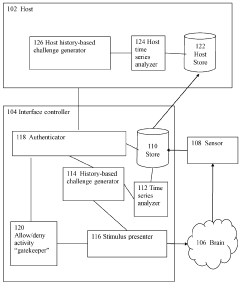
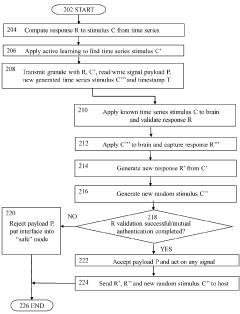
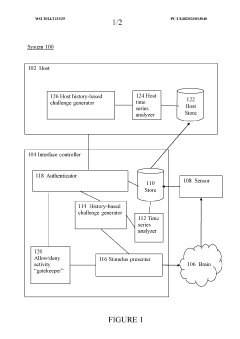
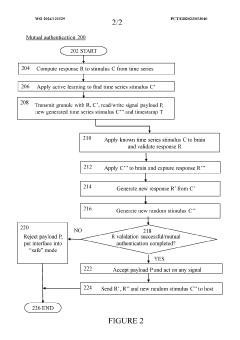
- A time-series authentication system using a long-short-term memory (LSTM) neural network and autoencoders to generate and verify stimulus-response pairs, providing a firewall-like protection between the brain and external entities, ensuring that only valid signals are processed and preventing replay attacks by using temporal authentication and biometric proof of life.
Privacy and Security Regulations for Public BCI Systems
The deployment of Brain-Computer Interface systems in public spaces necessitates a comprehensive regulatory framework addressing privacy and security concerns. Current privacy regulations, including GDPR in Europe and various state-level privacy acts in the United States, provide foundational principles but lack specific provisions for neural data protection. These regulations establish consent mechanisms, data minimization principles, and user rights that must be adapted for BCI applications where neural signals represent the most intimate form of personal data.
Neural data classification presents unique challenges requiring specialized regulatory approaches. Unlike traditional biometric data, brain signals can potentially reveal thoughts, emotions, and cognitive states, demanding heightened protection levels. Regulatory frameworks must distinguish between different types of neural data, from basic motor commands to complex cognitive patterns, establishing appropriate security classifications and handling protocols for each category.
Data retention and deletion policies for public BCI systems require careful consideration of operational needs versus privacy rights. Regulations should mandate automatic deletion of raw neural data after processing, while allowing temporary storage for system calibration and safety purposes. Clear timelines for data purging and strict limitations on data persistence help minimize privacy risks while maintaining system functionality.
Cross-border data transfer regulations significantly impact public BCI deployments, particularly for systems operated by multinational entities. Compliance with data localization requirements and international transfer restrictions necessitates careful system architecture planning. Organizations must implement appropriate safeguards, such as encryption and anonymization, when neural data crosses jurisdictional boundaries.
Enforcement mechanisms and compliance monitoring represent critical components of effective BCI regulation. Regulatory bodies require specialized technical expertise to audit neural data handling practices and assess security implementations. Regular compliance assessments, mandatory breach reporting, and standardized security audits ensure ongoing adherence to privacy and security requirements.
Emerging regulatory trends indicate movement toward more stringent neural data protection standards. Several jurisdictions are developing BCI-specific legislation addressing unique aspects of neural interface technology, including real-time monitoring restrictions, cognitive liberty protections, and enhanced consent requirements for neural data collection in public environments.
Neural data classification presents unique challenges requiring specialized regulatory approaches. Unlike traditional biometric data, brain signals can potentially reveal thoughts, emotions, and cognitive states, demanding heightened protection levels. Regulatory frameworks must distinguish between different types of neural data, from basic motor commands to complex cognitive patterns, establishing appropriate security classifications and handling protocols for each category.
Data retention and deletion policies for public BCI systems require careful consideration of operational needs versus privacy rights. Regulations should mandate automatic deletion of raw neural data after processing, while allowing temporary storage for system calibration and safety purposes. Clear timelines for data purging and strict limitations on data persistence help minimize privacy risks while maintaining system functionality.
Cross-border data transfer regulations significantly impact public BCI deployments, particularly for systems operated by multinational entities. Compliance with data localization requirements and international transfer restrictions necessitates careful system architecture planning. Organizations must implement appropriate safeguards, such as encryption and anonymization, when neural data crosses jurisdictional boundaries.
Enforcement mechanisms and compliance monitoring represent critical components of effective BCI regulation. Regulatory bodies require specialized technical expertise to audit neural data handling practices and assess security implementations. Regular compliance assessments, mandatory breach reporting, and standardized security audits ensure ongoing adherence to privacy and security requirements.
Emerging regulatory trends indicate movement toward more stringent neural data protection standards. Several jurisdictions are developing BCI-specific legislation addressing unique aspects of neural interface technology, including real-time monitoring restrictions, cognitive liberty protections, and enhanced consent requirements for neural data collection in public environments.
Universal Design Principles for Inclusive BCI Interfaces
Universal design principles serve as the foundational framework for creating Brain-Computer Interface systems that accommodate the broadest spectrum of users in public environments. These principles emphasize equitable use, ensuring that BCI interfaces can be operated effectively by individuals regardless of their cognitive abilities, physical limitations, or technological familiarity. The principle of equitable use becomes particularly critical in public spaces where diverse populations converge, requiring interfaces that do not segregate or stigmatize users based on their capabilities.
Flexibility in use represents another cornerstone principle, demanding that BCI systems accommodate varying user preferences, interaction speeds, and cognitive processing patterns. This flexibility manifests through adaptive calibration algorithms that adjust to individual neural signal characteristics and customizable interface elements that respond to different user needs. The system must seamlessly transition between different interaction modalities while maintaining consistent functionality across diverse user groups.
Simple and intuitive use principles guide the development of BCI interfaces that minimize cognitive load and learning curves. Public space implementations require interfaces that can be understood and operated with minimal instruction, incorporating familiar interaction paradigms and clear feedback mechanisms. This principle drives the integration of universal symbols, consistent navigation patterns, and predictable system responses that transcend cultural and linguistic barriers.
Perceptible information principles ensure that BCI systems communicate effectively with users through multiple sensory channels. Visual, auditory, and haptic feedback mechanisms must work in concert to provide redundant information pathways, accommodating users with sensory impairments. The interface design incorporates high contrast visual elements, clear audio cues, and tactile feedback systems that reinforce user actions and system status.
Tolerance for error becomes paramount in public BCI implementations, where user stress and environmental distractions can compromise interaction quality. Robust error detection and correction mechanisms must operate transparently, providing users with clear recovery pathways when misinterpretations occur. The system architecture incorporates fail-safe mechanisms that prevent unintended actions while maintaining user confidence and system reliability.
Low physical effort principles drive the development of BCI systems that minimize fatigue and strain during extended use. Neural signal acquisition techniques must operate efficiently with minimal user concentration requirements, while interface elements respond to subtle mental commands. This principle ensures that users with varying cognitive stamina can access BCI functionality without experiencing excessive mental fatigue or discomfort during public space interactions.
Flexibility in use represents another cornerstone principle, demanding that BCI systems accommodate varying user preferences, interaction speeds, and cognitive processing patterns. This flexibility manifests through adaptive calibration algorithms that adjust to individual neural signal characteristics and customizable interface elements that respond to different user needs. The system must seamlessly transition between different interaction modalities while maintaining consistent functionality across diverse user groups.
Simple and intuitive use principles guide the development of BCI interfaces that minimize cognitive load and learning curves. Public space implementations require interfaces that can be understood and operated with minimal instruction, incorporating familiar interaction paradigms and clear feedback mechanisms. This principle drives the integration of universal symbols, consistent navigation patterns, and predictable system responses that transcend cultural and linguistic barriers.
Perceptible information principles ensure that BCI systems communicate effectively with users through multiple sensory channels. Visual, auditory, and haptic feedback mechanisms must work in concert to provide redundant information pathways, accommodating users with sensory impairments. The interface design incorporates high contrast visual elements, clear audio cues, and tactile feedback systems that reinforce user actions and system status.
Tolerance for error becomes paramount in public BCI implementations, where user stress and environmental distractions can compromise interaction quality. Robust error detection and correction mechanisms must operate transparently, providing users with clear recovery pathways when misinterpretations occur. The system architecture incorporates fail-safe mechanisms that prevent unintended actions while maintaining user confidence and system reliability.
Low physical effort principles drive the development of BCI systems that minimize fatigue and strain during extended use. Neural signal acquisition techniques must operate efficiently with minimal user concentration requirements, while interface elements respond to subtle mental commands. This principle ensures that users with varying cognitive stamina can access BCI functionality without experiencing excessive mental fatigue or discomfort during public space interactions.
Unlock deeper insights with PatSnap Eureka Quick Research — get a full tech report to explore trends and direct your research. Try now!
Generate Your Research Report Instantly with AI Agent
Supercharge your innovation with PatSnap Eureka AI Agent Platform!