
Robust Methods for ICP-MS Polyatomic Ion Interference Control
SEP 19, 20259 MIN READ
Generate Your Research Report Instantly with AI Agent
Patsnap Eureka helps you evaluate technical feasibility & market potential.
ICP-MS Interference Control Background and Objectives
Inductively Coupled Plasma Mass Spectrometry (ICP-MS) has evolved as a cornerstone analytical technique since its commercial introduction in the 1980s. This powerful methodology offers exceptional sensitivity, multi-element detection capabilities, and wide dynamic range for elemental analysis across diverse fields including environmental monitoring, clinical diagnostics, food safety, and materials science. Despite these advantages, polyatomic ion interference remains one of the most significant challenges limiting the full potential of ICP-MS technology.
Polyatomic interferences occur when ions formed in the plasma combine with matrix components, argon gas, or solvent molecules to create molecular species with mass-to-charge ratios identical or similar to analytes of interest. These interferences can significantly compromise measurement accuracy, particularly for critical elements like arsenic, selenium, iron, and chromium in complex matrices.
The evolution of interference control methods has progressed through several generations of innovation. Early approaches relied primarily on mathematical corrections and sample preparation techniques. This was followed by the development of collision/reaction cells in the late 1990s, which represented a significant technological breakthrough. Recent advancements include high-resolution mass analyzers, triple quadrupole systems, and advanced collision/reaction cell chemistries.
Current market trends indicate growing demand for more robust interference control solutions, driven by increasingly stringent regulatory requirements in environmental monitoring, pharmaceutical analysis, and food safety. The global ICP-MS market, valued at approximately $1.2 billion in 2022, is projected to grow at a CAGR of 7.8% through 2028, with interference management technologies representing a significant driver of innovation and market differentiation.
The primary objectives of this technical research report are to comprehensively evaluate existing polyatomic interference control methodologies, identify their respective strengths and limitations, and explore emerging technologies that promise enhanced performance. Additionally, we aim to assess the practical implementation challenges of various interference control strategies across different application domains and sample matrices.
Furthermore, this report seeks to establish a technological roadmap for future developments in interference control, identifying key research priorities and potential breakthrough technologies. By analyzing patent landscapes and research publications, we will highlight promising innovation pathways and assess their commercial viability and technical feasibility. The ultimate goal is to provide strategic guidance for R&D investment decisions and technology acquisition strategies in this critical analytical domain.
Polyatomic interferences occur when ions formed in the plasma combine with matrix components, argon gas, or solvent molecules to create molecular species with mass-to-charge ratios identical or similar to analytes of interest. These interferences can significantly compromise measurement accuracy, particularly for critical elements like arsenic, selenium, iron, and chromium in complex matrices.
The evolution of interference control methods has progressed through several generations of innovation. Early approaches relied primarily on mathematical corrections and sample preparation techniques. This was followed by the development of collision/reaction cells in the late 1990s, which represented a significant technological breakthrough. Recent advancements include high-resolution mass analyzers, triple quadrupole systems, and advanced collision/reaction cell chemistries.
Current market trends indicate growing demand for more robust interference control solutions, driven by increasingly stringent regulatory requirements in environmental monitoring, pharmaceutical analysis, and food safety. The global ICP-MS market, valued at approximately $1.2 billion in 2022, is projected to grow at a CAGR of 7.8% through 2028, with interference management technologies representing a significant driver of innovation and market differentiation.
The primary objectives of this technical research report are to comprehensively evaluate existing polyatomic interference control methodologies, identify their respective strengths and limitations, and explore emerging technologies that promise enhanced performance. Additionally, we aim to assess the practical implementation challenges of various interference control strategies across different application domains and sample matrices.
Furthermore, this report seeks to establish a technological roadmap for future developments in interference control, identifying key research priorities and potential breakthrough technologies. By analyzing patent landscapes and research publications, we will highlight promising innovation pathways and assess their commercial viability and technical feasibility. The ultimate goal is to provide strategic guidance for R&D investment decisions and technology acquisition strategies in this critical analytical domain.
Market Demand Analysis for High-Precision Elemental Analysis
The global market for high-precision elemental analysis continues to experience robust growth, driven primarily by increasing demands across multiple industries for accurate trace element detection and quantification. ICP-MS (Inductively Coupled Plasma Mass Spectrometry) technology has emerged as the gold standard for elemental analysis due to its exceptional sensitivity, multi-element capability, and wide dynamic range.
The pharmaceutical sector represents one of the largest market segments, with stringent regulatory requirements necessitating precise elemental impurity testing in drug products. Recent regulatory frameworks such as ICH Q3D and USP <232>/<233> have established permitted daily exposure limits for elemental impurities, creating substantial demand for advanced ICP-MS solutions that can effectively manage polyatomic interferences.
Environmental monitoring constitutes another significant market driver, with government agencies worldwide implementing increasingly stringent regulations for heavy metal detection in soil, water, and air samples. The ability to accurately quantify trace elements at parts-per-trillion levels while eliminating false positives from polyatomic interferences has become critical for compliance and public safety monitoring.
The semiconductor industry presents perhaps the most demanding application environment, requiring ultra-trace elemental analysis for quality control in high-purity materials. As chip architectures continue to shrink, the tolerance for metallic contaminants approaches zero, creating demand for ICP-MS systems with enhanced interference management capabilities.
Food safety testing represents a rapidly expanding market segment, particularly in developed economies where consumers and regulators demand comprehensive testing for toxic elements. The complexity of food matrices creates significant analytical challenges, making robust polyatomic interference control methods essential for accurate results.
Market research indicates the global ICP-MS market was valued at approximately $1.2 billion in 2022, with projected annual growth rates of 7-8% through 2028. The segment specifically focused on advanced interference control technologies is growing at an even faster rate of 9-10% annually, highlighting the premium value placed on solutions addressing this technical challenge.
Regional analysis shows North America and Europe currently dominating market share, though Asia-Pacific represents the fastest-growing region, driven by expanding industrial bases, strengthening environmental regulations, and increasing investment in analytical infrastructure. China, in particular, has demonstrated significant market growth as domestic environmental protection policies have tightened.
Customer surveys consistently identify polyatomic interference management as a top priority when selecting ICP-MS instrumentation, with 78% of respondents rating it "extremely important" in recent industry polling. This underscores the substantial market opportunity for innovations that effectively address this persistent analytical challenge.
The pharmaceutical sector represents one of the largest market segments, with stringent regulatory requirements necessitating precise elemental impurity testing in drug products. Recent regulatory frameworks such as ICH Q3D and USP <232>/<233> have established permitted daily exposure limits for elemental impurities, creating substantial demand for advanced ICP-MS solutions that can effectively manage polyatomic interferences.
Environmental monitoring constitutes another significant market driver, with government agencies worldwide implementing increasingly stringent regulations for heavy metal detection in soil, water, and air samples. The ability to accurately quantify trace elements at parts-per-trillion levels while eliminating false positives from polyatomic interferences has become critical for compliance and public safety monitoring.
The semiconductor industry presents perhaps the most demanding application environment, requiring ultra-trace elemental analysis for quality control in high-purity materials. As chip architectures continue to shrink, the tolerance for metallic contaminants approaches zero, creating demand for ICP-MS systems with enhanced interference management capabilities.
Food safety testing represents a rapidly expanding market segment, particularly in developed economies where consumers and regulators demand comprehensive testing for toxic elements. The complexity of food matrices creates significant analytical challenges, making robust polyatomic interference control methods essential for accurate results.
Market research indicates the global ICP-MS market was valued at approximately $1.2 billion in 2022, with projected annual growth rates of 7-8% through 2028. The segment specifically focused on advanced interference control technologies is growing at an even faster rate of 9-10% annually, highlighting the premium value placed on solutions addressing this technical challenge.
Regional analysis shows North America and Europe currently dominating market share, though Asia-Pacific represents the fastest-growing region, driven by expanding industrial bases, strengthening environmental regulations, and increasing investment in analytical infrastructure. China, in particular, has demonstrated significant market growth as domestic environmental protection policies have tightened.
Customer surveys consistently identify polyatomic interference management as a top priority when selecting ICP-MS instrumentation, with 78% of respondents rating it "extremely important" in recent industry polling. This underscores the substantial market opportunity for innovations that effectively address this persistent analytical challenge.
Current Challenges in Polyatomic Ion Interference Mitigation
Polyatomic ion interference represents one of the most significant analytical challenges in Inductively Coupled Plasma Mass Spectrometry (ICP-MS). These interferences occur when molecular ions formed in the plasma have the same mass-to-charge ratio (m/z) as the analyte ions of interest, leading to signal overlap and compromised measurement accuracy. Despite decades of technological advancement, several persistent challenges continue to impede comprehensive interference control.
The formation mechanisms of polyatomic ions remain incompletely understood, particularly in complex matrices. While certain common interferences like ArO+ and ArCl+ are well-documented, the behavior of polyatomic species in varying sample matrices exhibits unpredictable patterns that complicate standardized correction approaches. This fundamental knowledge gap hinders the development of universally applicable interference mitigation strategies.
Current collision/reaction cell technologies, while effective for many applications, demonstrate limitations when dealing with multiple simultaneous interferences or when analyzing ultra-trace concentrations. The balance between interference removal and analyte sensitivity preservation represents a critical trade-off that has not been fully optimized. Additionally, the selection of appropriate cell gases remains largely empirical rather than theoretically driven, requiring extensive method development for each new application.
Mathematical correction methods suffer from propagation of uncertainties, especially when correction equations involve multiple terms. The accuracy of these approaches depends heavily on the stability of interference-to-analyte ratios, which can fluctuate with subtle changes in plasma conditions or sample introduction parameters. This inherent variability undermines the reliability of mathematical corrections in routine analytical workflows.
High-resolution mass spectrometry offers theoretical solutions but introduces practical challenges related to instrument complexity, cost, and reduced sensitivity. The resolution required to separate certain polyatomic interferences from analytes of interest often exceeds the capabilities of commercially available instruments, particularly for interferences with mass differences below 0.01 amu.
Sample preparation techniques designed to eliminate matrix components that contribute to interference formation add considerable time and complexity to analytical workflows. These approaches also introduce risks of contamination and analyte loss, potentially compromising measurement accuracy despite successful interference reduction.
The validation of interference control methods presents another significant challenge, as certified reference materials rarely address all potential interference scenarios. This validation gap creates uncertainty regarding method performance across diverse sample types and complicates regulatory compliance in fields such as environmental monitoring and food safety.
The formation mechanisms of polyatomic ions remain incompletely understood, particularly in complex matrices. While certain common interferences like ArO+ and ArCl+ are well-documented, the behavior of polyatomic species in varying sample matrices exhibits unpredictable patterns that complicate standardized correction approaches. This fundamental knowledge gap hinders the development of universally applicable interference mitigation strategies.
Current collision/reaction cell technologies, while effective for many applications, demonstrate limitations when dealing with multiple simultaneous interferences or when analyzing ultra-trace concentrations. The balance between interference removal and analyte sensitivity preservation represents a critical trade-off that has not been fully optimized. Additionally, the selection of appropriate cell gases remains largely empirical rather than theoretically driven, requiring extensive method development for each new application.
Mathematical correction methods suffer from propagation of uncertainties, especially when correction equations involve multiple terms. The accuracy of these approaches depends heavily on the stability of interference-to-analyte ratios, which can fluctuate with subtle changes in plasma conditions or sample introduction parameters. This inherent variability undermines the reliability of mathematical corrections in routine analytical workflows.
High-resolution mass spectrometry offers theoretical solutions but introduces practical challenges related to instrument complexity, cost, and reduced sensitivity. The resolution required to separate certain polyatomic interferences from analytes of interest often exceeds the capabilities of commercially available instruments, particularly for interferences with mass differences below 0.01 amu.
Sample preparation techniques designed to eliminate matrix components that contribute to interference formation add considerable time and complexity to analytical workflows. These approaches also introduce risks of contamination and analyte loss, potentially compromising measurement accuracy despite successful interference reduction.
The validation of interference control methods presents another significant challenge, as certified reference materials rarely address all potential interference scenarios. This validation gap creates uncertainty regarding method performance across diverse sample types and complicates regulatory compliance in fields such as environmental monitoring and food safety.
Current Robust Methods for Polyatomic Interference Elimination
01 Collision/reaction cell technology for polyatomic interference reduction
Collision/reaction cell technology is used in ICP-MS to reduce polyatomic ion interferences. These cells, positioned between the ion optics and mass analyzer, use collision gases (like helium) or reaction gases (like hydrogen, ammonia, or oxygen) to remove or transform interfering polyatomic species through collision-induced dissociation or chemical reactions, thereby improving detection limits and accuracy for challenging elements.- Collision/reaction cell technology for polyatomic interference reduction: Collision/reaction cell technology is used in ICP-MS to reduce polyatomic ion interferences. These cells are positioned between the ion source and the mass analyzer, where they introduce collision or reaction gases (such as helium, hydrogen, or ammonia) that selectively interact with polyatomic interferents. Through kinetic energy discrimination or chemical reactions, these gases help eliminate or reduce interfering species while preserving analyte ions, thereby improving detection limits and accuracy for challenging elements affected by polyatomic interferences.
- Mathematical correction methods for interference removal: Mathematical correction algorithms are employed to address polyatomic interferences in ICP-MS analysis. These methods include equation-based corrections that utilize measurements of interfering species at different masses to calculate and subtract their contributions from analyte signals. Advanced statistical approaches and machine learning algorithms can model complex interference patterns and automatically apply appropriate corrections. These mathematical techniques enable more accurate quantification of target elements without requiring hardware modifications to the ICP-MS system.
- Sample preparation techniques to minimize interferences: Specialized sample preparation methods can significantly reduce polyatomic interferences before ICP-MS analysis. These include chemical separation techniques to isolate analytes from matrix components that contribute to interferences, matrix matching to ensure calibration standards experience similar interference effects as samples, and digestion protocol optimization to minimize the formation of problematic molecular species. Chromatographic separation methods can also be integrated with ICP-MS to temporally separate analytes from potential interferents.
- High-resolution mass spectrometry for interference separation: High-resolution mass spectrometry techniques are employed in ICP-MS to physically separate polyatomic interferences from analyte ions based on their slight mass differences. These systems utilize specialized mass analyzers such as magnetic sector or time-of-flight instruments that provide significantly higher mass resolution than conventional quadrupole ICP-MS. By resolving the small mass differences between analyte ions and interfering polyatomic species with similar nominal masses, high-resolution ICP-MS can achieve accurate measurements without requiring chemical separation or reaction cell technology.
- Alternative plasma conditions and instrumental modifications: Modifications to standard ICP-MS operating conditions can help mitigate polyatomic interferences. These include adjustments to plasma parameters such as RF power, gas flow rates, and sampling depth to alter the formation of interfering species. Cool plasma techniques operate at reduced plasma temperatures to suppress certain oxide and argide interferences. Hardware modifications such as specialized interface designs, ion optics configurations, and detector systems can also enhance the instrument's ability to discriminate between analyte ions and polyatomic interferents, improving measurement accuracy for challenging elements.
02 Mathematical correction methods for interference elimination
Mathematical correction algorithms are employed to address polyatomic interferences in ICP-MS analysis. These methods include equation-based corrections that utilize known isotopic abundances, interference patterns, and measured signal intensities to calculate and subtract the contribution of interfering species from the analyte signal. Advanced statistical approaches and machine learning techniques are also being developed to model complex interference patterns and improve measurement accuracy.Expand Specific Solutions03 Sample preparation techniques to minimize interferences
Specialized sample preparation methods are developed to reduce polyatomic interferences before ICP-MS analysis. These include chemical separation techniques, matrix removal procedures, and chromatographic methods to isolate analytes from potential interfering species. Digestion protocols using specific acid combinations or closed-vessel microwave digestion can minimize the formation of problematic molecular ions, while sample dilution and matrix matching help reduce matrix-induced interferences.Expand Specific Solutions04 High-resolution mass spectrometry for interference separation
High-resolution mass spectrometry techniques are employed in ICP-MS to physically separate polyatomic interferences from analyte ions based on their slight mass differences. Sector field instruments with high mass resolution capabilities can distinguish between ions with very small mass differences, allowing for the separation of analyte peaks from interfering polyatomic species. This approach is particularly valuable for challenging elements that form interferences with similar masses to the analyte.Expand Specific Solutions05 Alternative plasma conditions and instrumental modifications
Modified plasma conditions and instrumental configurations are used to minimize the formation of polyatomic interferences in ICP-MS. These include cool plasma techniques that operate at lower temperatures to reduce certain oxide and argide interferences, shielded torch systems that minimize secondary discharge effects, and specialized sample introduction systems like desolvation nebulizers that reduce oxide formation. Additional hardware modifications such as improved ion optics and interface designs help to reduce the transmission of interfering species.Expand Specific Solutions
Leading Manufacturers and Research Institutions in ICP-MS
The ICP-MS polyatomic ion interference control market is currently in a growth phase, with increasing demand driven by expanding applications in environmental monitoring, pharmaceuticals, and food safety. The global market size for ICP-MS technologies is estimated to exceed $1 billion, growing at 7-8% annually. Leading players include established analytical instrument manufacturers Thermo Fisher Scientific, Agilent Technologies, and Shimadzu Corporation, who dominate with comprehensive solutions featuring collision/reaction cell technologies. Emerging competitors like Kimia Analytics and Ruilaipu Medical Technology are introducing innovative approaches to interference management. Academic institutions including Beihang University and Vanderbilt University contribute significant research advancements, while specialized software developers such as Cerno Bioscience enhance data processing capabilities. The technology continues to mature with developments in plasma source design, ion optics, and collision/reaction cell mechanisms.
Thermo Fisher Scientific (Bremen) GmbH
Technical Solution: Thermo Fisher Scientific has developed advanced collision/reaction cell technology for ICP-MS polyatomic interference control. Their Triple Quadrupole ICP-MS (ICP-MS/MS) systems utilize a dual mass filtering approach with an intermediate collision/reaction cell that enables highly selective interference removal[1]. The technology employs mass shift and on-mass measurement modes, where interfering polyatomic species are either converted to different masses or eliminated through selective reactions. Their patented QCell technology with flatapole design optimizes ion transmission while maintaining effective collision/reaction processes[2]. Additionally, Thermo Fisher has implemented kinetic energy discrimination (KED) mode using helium gas to reduce polyatomic interferences based on collision cross-section differences between analyte ions and polyatomic interferents[3]. Their systems also feature dynamic reaction cell (DRC) capabilities with multiple reaction gases (H2, O2, NH3, CH4) that can be automatically switched during analysis for optimal interference management across different elements.
Strengths: Superior selectivity through triple quadrupole design allowing for both pre-cell and post-cell mass filtering; comprehensive software integration for automated method development; multiple interference removal mechanisms available in a single platform. Weaknesses: Higher complexity and cost compared to single quadrupole systems; requires more specialized operator knowledge; increased gas consumption with multiple reaction modes.
Agilent Technologies, Inc.
Technical Solution: Agilent Technologies has pioneered the Octopole Reaction System (ORS) for polyatomic interference control in ICP-MS. Their latest generation implements a helium collision mode with kinetic energy discrimination (KED) that effectively removes polyatomic interferences without requiring reactive gases for many applications[1]. The octopole design provides superior ion focusing and transmission through the cell compared to quadrupole-based systems. Agilent's Triple Quadrupole ICP-MS (ICP-QQQ) technology employs MS/MS capability where the first quadrupole acts as a mass filter before ions enter the reaction cell, enabling highly selective reaction chemistry even for complex matrices[2]. Their systems utilize intelligent auto-tuning with pre-configured plasma conditions and cell parameters optimized for specific interference scenarios. Agilent has developed specialized reaction chemistry protocols using O2, H2, and NH3 gases that can convert analytes to product ions free from overlap or selectively eliminate interfering species[3]. Their Ultra High Matrix Introduction (UHMI) technology dilutes the sample aerosol with argon, reducing matrix loading and associated polyatomic formation while maintaining sensitivity for trace analysis.
Strengths: Exceptional sensitivity and interference removal with the octopole design providing better ion transmission; MS/MS capability enables highly selective reaction chemistry; comprehensive interference management solutions for virtually all elements. Weaknesses: Complex system requiring specialized training; higher gas consumption with multiple reaction modes; premium pricing compared to single quadrupole systems.
Key Technical Innovations in Collision/Reaction Cell Systems
Inductively coupled plasma-mass spectrometry (ICP-ms) with improved signal-to-noise and signal-to-background ratios
PatentActiveJP2023120229A
Innovation
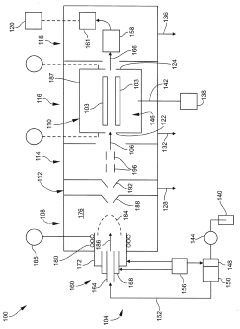
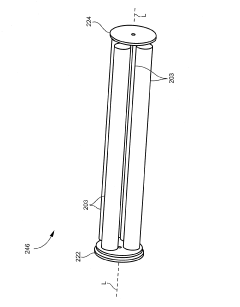
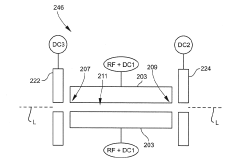
- A method and system utilizing a collision/reaction cell with controlled DC potential barriers and gas interactions to suppress interfering ions by converting them to non-interfering ions or neutral species, and confining ions axially and radially within the cell to enhance signal-to-noise and signal-to-background ratios.
Inductively coupled plasma mass spectrometry (ICP-MS) with improved signal-to-noise ratio and signal-to-background ratio
PatentPendingCN119170475A
Innovation
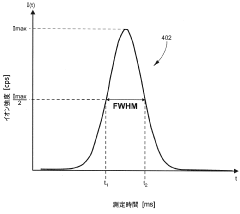
- By using the collision/reaction gas in the collision/reaction unit and applying a DC potential barrier, the interference ion signal is suppressed and the signal quality of the analyte ions is improved. Specific methods include interacting ions with the collision/reactive gas during a limiting period, slowing down and limiting ions, and then allowing the transfer of the analyte ions to the mass spectrometer through a pulse potential and counting during the measurement period.


Environmental and Regulatory Considerations for ICP-MS Applications
The environmental impact of ICP-MS technology has become increasingly important as regulatory frameworks evolve globally. Environmental considerations for polyatomic ion interference control methods must address the disposal of waste materials, particularly acids and solvents used in sample preparation and analysis. These chemicals, if improperly managed, can contribute to environmental contamination and pose risks to aquatic ecosystems. Modern laboratories implementing robust interference control methods must develop comprehensive waste management protocols that comply with local environmental protection standards.
Regulatory frameworks governing ICP-MS applications vary significantly across regions but generally follow similar principles regarding analytical quality and environmental protection. In the United States, the Environmental Protection Agency (EPA) has established Method 6020 for ICP-MS analysis, which includes specific requirements for interference control and validation procedures. Similarly, the European Union's Water Framework Directive imposes strict guidelines on analytical methods used for environmental monitoring, including specific performance criteria for managing polyatomic interferences.
The pharmaceutical industry faces particularly stringent regulations through ICH Q3D guidelines, which mandate thorough elemental impurity testing with appropriate interference mitigation strategies. These regulations directly impact how laboratories implement collision/reaction cell technologies and other interference control methods. Compliance with these frameworks requires documented validation of interference control effectiveness and regular performance verification.
Emerging global trends in environmental regulations are moving toward more comprehensive life cycle assessments of analytical technologies. This shift is prompting manufacturers to develop more environmentally sustainable interference control solutions, including gas management systems that minimize consumption and reduce laboratory carbon footprints. The environmental impact of gases used in collision/reaction cells (helium, hydrogen, ammonia) is receiving increased scrutiny, with emphasis on leak prevention and efficient utilization.
Laboratory accreditation standards such as ISO/IEC 17025 now incorporate environmental management components that directly affect how interference control methods are implemented and documented. These standards require laboratories to demonstrate not only analytical performance but also environmental responsibility in their operations, including the management of interference control systems.
As regulations continue to evolve, particularly regarding trace element analysis in environmental monitoring, food safety, and clinical applications, laboratories must maintain adaptive interference control strategies that can meet increasingly stringent detection limits while minimizing environmental impact. This regulatory landscape is driving innovation in green chemistry approaches to interference control, including the development of alternative reagents and sample preparation techniques that reduce hazardous waste generation.
Regulatory frameworks governing ICP-MS applications vary significantly across regions but generally follow similar principles regarding analytical quality and environmental protection. In the United States, the Environmental Protection Agency (EPA) has established Method 6020 for ICP-MS analysis, which includes specific requirements for interference control and validation procedures. Similarly, the European Union's Water Framework Directive imposes strict guidelines on analytical methods used for environmental monitoring, including specific performance criteria for managing polyatomic interferences.
The pharmaceutical industry faces particularly stringent regulations through ICH Q3D guidelines, which mandate thorough elemental impurity testing with appropriate interference mitigation strategies. These regulations directly impact how laboratories implement collision/reaction cell technologies and other interference control methods. Compliance with these frameworks requires documented validation of interference control effectiveness and regular performance verification.
Emerging global trends in environmental regulations are moving toward more comprehensive life cycle assessments of analytical technologies. This shift is prompting manufacturers to develop more environmentally sustainable interference control solutions, including gas management systems that minimize consumption and reduce laboratory carbon footprints. The environmental impact of gases used in collision/reaction cells (helium, hydrogen, ammonia) is receiving increased scrutiny, with emphasis on leak prevention and efficient utilization.
Laboratory accreditation standards such as ISO/IEC 17025 now incorporate environmental management components that directly affect how interference control methods are implemented and documented. These standards require laboratories to demonstrate not only analytical performance but also environmental responsibility in their operations, including the management of interference control systems.
As regulations continue to evolve, particularly regarding trace element analysis in environmental monitoring, food safety, and clinical applications, laboratories must maintain adaptive interference control strategies that can meet increasingly stringent detection limits while minimizing environmental impact. This regulatory landscape is driving innovation in green chemistry approaches to interference control, including the development of alternative reagents and sample preparation techniques that reduce hazardous waste generation.
Sample Preparation Strategies for Interference Reduction
Sample preparation represents a critical first line of defense against polyatomic interferences in ICP-MS analysis. Effective sample preparation strategies can significantly reduce or eliminate many common interferences before the sample even reaches the instrument, thereby enhancing analytical accuracy and reliability.
Acid digestion protocols must be carefully optimized based on sample matrix composition. For biological samples, a combination of nitric acid and hydrogen peroxide often proves effective, while geological samples may require hydrofluoric acid in combination with other mineral acids. The choice of acids directly impacts the formation of polyatomic species; for instance, chloride-based acids should be avoided when analyzing arsenic due to the formation of 40Ar35Cl+ that interferes with 75As+.
Dilution represents another straightforward yet effective approach for interference reduction. By decreasing the concentration of matrix elements, the formation of polyatomic species is proportionally reduced. However, this strategy must balance interference reduction against potential compromises in detection limits, particularly for trace element analysis.
Matrix separation techniques offer powerful solutions for complex samples. Solid phase extraction (SPE), liquid-liquid extraction, and precipitation methods can selectively remove matrix components that contribute to interference formation. For example, iron can be selectively removed using chelating resins, eliminating FeO+ and FeOH+ interferences that affect analysis of elements like manganese and nickel.
Chromatographic separation methods, including ion chromatography and HPLC, provide additional options for interference control. These techniques can be coupled directly to ICP-MS systems, allowing temporal separation of analytes from potential interferents. This approach has proven particularly valuable for speciation analysis and for separating isobaric interferences.
Pre-concentration techniques serve dual purposes by both reducing matrix effects and enhancing detection capabilities. Techniques such as cloud point extraction, co-precipitation, and electrodeposition can effectively isolate analytes of interest while leaving behind matrix components that contribute to polyatomic interferences.
Standardized sample preparation protocols must be developed and validated for specific applications. Method validation should include assessment of recovery rates, precision, and accuracy using certified reference materials that match the matrix composition of analytical samples. Rigorous quality control measures, including preparation blanks and spike recovery tests, are essential to ensure the effectiveness of interference reduction strategies.
Acid digestion protocols must be carefully optimized based on sample matrix composition. For biological samples, a combination of nitric acid and hydrogen peroxide often proves effective, while geological samples may require hydrofluoric acid in combination with other mineral acids. The choice of acids directly impacts the formation of polyatomic species; for instance, chloride-based acids should be avoided when analyzing arsenic due to the formation of 40Ar35Cl+ that interferes with 75As+.
Dilution represents another straightforward yet effective approach for interference reduction. By decreasing the concentration of matrix elements, the formation of polyatomic species is proportionally reduced. However, this strategy must balance interference reduction against potential compromises in detection limits, particularly for trace element analysis.
Matrix separation techniques offer powerful solutions for complex samples. Solid phase extraction (SPE), liquid-liquid extraction, and precipitation methods can selectively remove matrix components that contribute to interference formation. For example, iron can be selectively removed using chelating resins, eliminating FeO+ and FeOH+ interferences that affect analysis of elements like manganese and nickel.
Chromatographic separation methods, including ion chromatography and HPLC, provide additional options for interference control. These techniques can be coupled directly to ICP-MS systems, allowing temporal separation of analytes from potential interferents. This approach has proven particularly valuable for speciation analysis and for separating isobaric interferences.
Pre-concentration techniques serve dual purposes by both reducing matrix effects and enhancing detection capabilities. Techniques such as cloud point extraction, co-precipitation, and electrodeposition can effectively isolate analytes of interest while leaving behind matrix components that contribute to polyatomic interferences.
Standardized sample preparation protocols must be developed and validated for specific applications. Method validation should include assessment of recovery rates, precision, and accuracy using certified reference materials that match the matrix composition of analytical samples. Rigorous quality control measures, including preparation blanks and spike recovery tests, are essential to ensure the effectiveness of interference reduction strategies.
Unlock deeper insights with Patsnap Eureka Quick Research — get a full tech report to explore trends and direct your research. Try now!
Generate Your Research Report Instantly with AI Agent
Supercharge your innovation with Patsnap Eureka AI Agent Platform!