

Streamlining ICP-MS Processes for Effective Industrial Analyses
SEP 19, 20259 MIN READ
Generate Your Research Report Instantly with AI Agent
PatSnap Eureka helps you evaluate technical feasibility & market potential.
ICP-MS Technology Evolution and Objectives
Inductively Coupled Plasma Mass Spectrometry (ICP-MS) has evolved significantly since its commercial introduction in the early 1980s. This analytical technique combines the high-temperature ICP source with a mass spectrometer, enabling precise detection of metals and several non-metals at concentrations as low as one part per trillion. The evolution of ICP-MS technology has been driven by increasing demands for higher sensitivity, improved interference management, and enhanced sample throughput across various industrial applications.
The initial development phase of ICP-MS focused on establishing fundamental operational principles and overcoming basic technical challenges. Early systems suffered from significant limitations including matrix interferences, spectral overlaps, and limited dynamic range. By the 1990s, the second generation of ICP-MS instruments introduced collision/reaction cell technology, which represented a breakthrough in addressing polyatomic interferences that had previously limited analytical accuracy.
The 2000s witnessed the integration of advanced sample introduction systems, including laser ablation and chromatographic coupling, expanding the versatility of ICP-MS applications. Concurrently, the development of high-resolution magnetic sector instruments provided unprecedented sensitivity and selectivity, albeit at significantly higher costs compared to quadrupole-based systems.
Recent technological advancements have focused on miniaturization, automation, and integration with other analytical techniques. Modern ICP-MS systems feature improved vacuum systems, more efficient ion optics, and enhanced detector technologies that have collectively increased sensitivity while reducing maintenance requirements. The introduction of triple quadrupole ICP-MS represents the latest major innovation, offering superior interference removal capabilities through MS/MS operations.
The primary objective of current ICP-MS technology development is to streamline analytical processes while maintaining or improving analytical performance. This includes reducing sample preparation time, minimizing reagent consumption, increasing sample throughput, and enhancing data processing capabilities. Additionally, there is a growing emphasis on developing more user-friendly interfaces that require less specialized expertise to operate effectively.
Looking forward, the trajectory of ICP-MS technology is moving toward greater integration with automated sample handling systems, real-time data analytics powered by artificial intelligence, and more robust interference management strategies. The ultimate goal is to transform ICP-MS from a specialized analytical technique requiring significant expertise into a more accessible tool that can be routinely deployed across diverse industrial environments while maintaining the high analytical standards that have made it indispensable in modern elemental analysis.
The initial development phase of ICP-MS focused on establishing fundamental operational principles and overcoming basic technical challenges. Early systems suffered from significant limitations including matrix interferences, spectral overlaps, and limited dynamic range. By the 1990s, the second generation of ICP-MS instruments introduced collision/reaction cell technology, which represented a breakthrough in addressing polyatomic interferences that had previously limited analytical accuracy.
The 2000s witnessed the integration of advanced sample introduction systems, including laser ablation and chromatographic coupling, expanding the versatility of ICP-MS applications. Concurrently, the development of high-resolution magnetic sector instruments provided unprecedented sensitivity and selectivity, albeit at significantly higher costs compared to quadrupole-based systems.
Recent technological advancements have focused on miniaturization, automation, and integration with other analytical techniques. Modern ICP-MS systems feature improved vacuum systems, more efficient ion optics, and enhanced detector technologies that have collectively increased sensitivity while reducing maintenance requirements. The introduction of triple quadrupole ICP-MS represents the latest major innovation, offering superior interference removal capabilities through MS/MS operations.
The primary objective of current ICP-MS technology development is to streamline analytical processes while maintaining or improving analytical performance. This includes reducing sample preparation time, minimizing reagent consumption, increasing sample throughput, and enhancing data processing capabilities. Additionally, there is a growing emphasis on developing more user-friendly interfaces that require less specialized expertise to operate effectively.
Looking forward, the trajectory of ICP-MS technology is moving toward greater integration with automated sample handling systems, real-time data analytics powered by artificial intelligence, and more robust interference management strategies. The ultimate goal is to transform ICP-MS from a specialized analytical technique requiring significant expertise into a more accessible tool that can be routinely deployed across diverse industrial environments while maintaining the high analytical standards that have made it indispensable in modern elemental analysis.
Industrial Analysis Market Demand Assessment
The global market for industrial analysis technologies, particularly ICP-MS (Inductively Coupled Plasma Mass Spectrometry), has experienced substantial growth driven by increasing regulatory requirements across multiple sectors. Current market assessments indicate that the global analytical instrumentation market exceeds $60 billion, with ICP-MS systems representing a significant segment due to their versatility in elemental analysis.
Manufacturing industries, particularly semiconductor production, demonstrate the highest demand for streamlined ICP-MS processes. The semiconductor industry requires ultra-trace elemental analysis capabilities to ensure product quality and process control, with contamination detection needs at parts-per-trillion levels becoming standard. This demand is projected to intensify as chip manufacturing processes advance toward smaller node sizes.
Environmental monitoring represents another substantial market segment, with governmental regulations worldwide mandating increasingly stringent testing protocols for soil, water, and air quality assessment. The implementation of regulations such as the EU Water Framework Directive and similar policies in North America and Asia has created sustained demand for efficient analytical processes that can handle high sample throughput while maintaining detection accuracy.
The pharmaceutical and food safety sectors exhibit rapidly growing demand patterns, with compound annual growth rates exceeding general market averages. Pharmaceutical companies require streamlined analytical processes to support quality control throughout production cycles, while food safety concerns have intensified following several high-profile contamination incidents globally.
Market research indicates that end-users prioritize three key factors when evaluating ICP-MS solutions: analytical speed without compromising accuracy, reduced operational complexity, and lower per-sample analysis costs. Current systems often require significant technical expertise and time-consuming sample preparation protocols, creating substantial market opportunity for streamlined solutions.
Regional analysis reveals that North America and Europe currently represent the largest markets for advanced analytical instrumentation, though Asia-Pacific regions demonstrate the fastest growth rates, particularly in China, South Korea, and India. This growth correlates directly with expanding manufacturing capabilities and strengthening regulatory frameworks in these regions.
The market demonstrates increasing preference for integrated analytical solutions that combine hardware improvements with advanced software capabilities, particularly those incorporating machine learning for automated calibration and anomaly detection. This trend suggests that future market leaders will likely differentiate through comprehensive ecosystem offerings rather than hardware specifications alone.
Manufacturing industries, particularly semiconductor production, demonstrate the highest demand for streamlined ICP-MS processes. The semiconductor industry requires ultra-trace elemental analysis capabilities to ensure product quality and process control, with contamination detection needs at parts-per-trillion levels becoming standard. This demand is projected to intensify as chip manufacturing processes advance toward smaller node sizes.
Environmental monitoring represents another substantial market segment, with governmental regulations worldwide mandating increasingly stringent testing protocols for soil, water, and air quality assessment. The implementation of regulations such as the EU Water Framework Directive and similar policies in North America and Asia has created sustained demand for efficient analytical processes that can handle high sample throughput while maintaining detection accuracy.
The pharmaceutical and food safety sectors exhibit rapidly growing demand patterns, with compound annual growth rates exceeding general market averages. Pharmaceutical companies require streamlined analytical processes to support quality control throughout production cycles, while food safety concerns have intensified following several high-profile contamination incidents globally.
Market research indicates that end-users prioritize three key factors when evaluating ICP-MS solutions: analytical speed without compromising accuracy, reduced operational complexity, and lower per-sample analysis costs. Current systems often require significant technical expertise and time-consuming sample preparation protocols, creating substantial market opportunity for streamlined solutions.
Regional analysis reveals that North America and Europe currently represent the largest markets for advanced analytical instrumentation, though Asia-Pacific regions demonstrate the fastest growth rates, particularly in China, South Korea, and India. This growth correlates directly with expanding manufacturing capabilities and strengthening regulatory frameworks in these regions.
The market demonstrates increasing preference for integrated analytical solutions that combine hardware improvements with advanced software capabilities, particularly those incorporating machine learning for automated calibration and anomaly detection. This trend suggests that future market leaders will likely differentiate through comprehensive ecosystem offerings rather than hardware specifications alone.
Current ICP-MS Challenges and Limitations
Despite significant advancements in ICP-MS technology, several critical challenges continue to impede optimal performance in industrial analysis applications. Sample preparation remains one of the most time-consuming and error-prone aspects of the workflow, often requiring complex digestion procedures that can introduce contamination or result in incomplete analyte recovery. The manual nature of many sample preparation steps creates bottlenecks in high-throughput environments and increases the risk of human error.
Matrix effects present another significant limitation, particularly in complex industrial samples containing high dissolved solids or organic components. These matrices can cause signal suppression or enhancement, leading to inaccurate quantification. Current correction methods using internal standards or standard addition techniques are labor-intensive and may not fully compensate for all matrix interferences.
Instrument drift represents a persistent challenge that necessitates frequent recalibration, reducing overall system availability and throughput. Temperature fluctuations, deposit accumulation on sampling cones, and plasma instability all contribute to signal drift over time. While modern instruments incorporate various drift correction algorithms, these solutions often require additional quality control measures that extend analysis time.
Spectral interferences from polyatomic species, doubly charged ions, and isobaric overlaps continue to complicate accurate determination of certain elements. Although collision/reaction cell technologies have significantly improved interference management, they require careful optimization for specific analytical scenarios and may reduce sensitivity for some elements.
Data processing and interpretation remain challenging, particularly when handling large datasets from multi-element analyses across numerous samples. Current software solutions often lack seamless integration with laboratory information management systems (LIMS) and may require manual data transfer steps that introduce delays and potential transcription errors.
Consumable costs and maintenance requirements present ongoing operational challenges. Frequent replacement of sampling cones, nebulizers, and other components contributes significantly to the total cost of ownership. Additionally, the expertise required for proper system maintenance and method development represents a substantial investment in personnel training.
Regulatory compliance adds another layer of complexity, with different industries subject to varying analytical requirements and reporting standards. Method validation procedures are often time-consuming and resource-intensive, particularly when developing new applications for emerging industrial needs.
Matrix effects present another significant limitation, particularly in complex industrial samples containing high dissolved solids or organic components. These matrices can cause signal suppression or enhancement, leading to inaccurate quantification. Current correction methods using internal standards or standard addition techniques are labor-intensive and may not fully compensate for all matrix interferences.
Instrument drift represents a persistent challenge that necessitates frequent recalibration, reducing overall system availability and throughput. Temperature fluctuations, deposit accumulation on sampling cones, and plasma instability all contribute to signal drift over time. While modern instruments incorporate various drift correction algorithms, these solutions often require additional quality control measures that extend analysis time.
Spectral interferences from polyatomic species, doubly charged ions, and isobaric overlaps continue to complicate accurate determination of certain elements. Although collision/reaction cell technologies have significantly improved interference management, they require careful optimization for specific analytical scenarios and may reduce sensitivity for some elements.
Data processing and interpretation remain challenging, particularly when handling large datasets from multi-element analyses across numerous samples. Current software solutions often lack seamless integration with laboratory information management systems (LIMS) and may require manual data transfer steps that introduce delays and potential transcription errors.
Consumable costs and maintenance requirements present ongoing operational challenges. Frequent replacement of sampling cones, nebulizers, and other components contributes significantly to the total cost of ownership. Additionally, the expertise required for proper system maintenance and method development represents a substantial investment in personnel training.
Regulatory compliance adds another layer of complexity, with different industries subject to varying analytical requirements and reporting standards. Method validation procedures are often time-consuming and resource-intensive, particularly when developing new applications for emerging industrial needs.
Modern ICP-MS Streamlining Approaches
01 Automated sample preparation systems
Automated systems for ICP-MS sample preparation can significantly streamline the analytical process. These systems include automated sample introduction, dilution, and handling mechanisms that reduce manual intervention and potential contamination. The automation helps in maintaining consistency across multiple samples, reducing human error, and increasing throughput. These systems often integrate with data management software for seamless operation from sample preparation to result reporting.- Automated sample preparation systems for ICP-MS: Automated systems for sample preparation in ICP-MS analysis can significantly streamline the analytical process. These systems include automated sample introduction, dilution, and pretreatment mechanisms that reduce manual handling and improve throughput. The automation helps minimize contamination risks, increases reproducibility, and allows for more efficient processing of large sample batches. These systems often integrate with ICP-MS instruments to create a seamless workflow from sample preparation to analysis.
- Integrated microfluidic systems for ICP-MS analysis: Microfluidic platforms integrated with ICP-MS enable miniaturization and automation of sample processing. These systems incorporate microchannels, micromixers, and microreactors to handle small sample volumes with high precision. The integration of microfluidic technology with ICP-MS reduces reagent consumption, decreases analysis time, and improves detection limits. These platforms are particularly useful for high-throughput screening applications and when sample volumes are limited.
- Online coupling techniques for continuous ICP-MS monitoring: Online coupling techniques connect various separation or sample processing systems directly to ICP-MS instruments for continuous monitoring and analysis. These setups include hyphenated techniques such as LC-ICP-MS, GC-ICP-MS, and CE-ICP-MS that combine separation methods with mass spectrometry. The online coupling eliminates manual transfer steps, reduces contamination risks, and enables real-time analysis of complex samples. These systems are particularly valuable for environmental monitoring, process control, and speciation analysis.
- Data processing and automation software for ICP-MS: Specialized software solutions streamline ICP-MS data acquisition, processing, and interpretation. These software packages incorporate automated calibration, quality control monitoring, and intelligent data analysis algorithms. Advanced features include automated interference correction, isotope ratio calculations, and multivariate statistical analysis tools. The software can integrate with laboratory information management systems (LIMS) to create seamless workflows from sample logging to final reporting, significantly reducing manual data handling and interpretation time.
- Novel sample introduction systems for enhanced ICP-MS efficiency: Innovative sample introduction systems improve the efficiency and sensitivity of ICP-MS analysis. These include advanced nebulizers, spray chambers, and desolvation systems that enhance sample transport efficiency and reduce matrix effects. Some designs incorporate flow injection analysis, laser ablation, or electrothermal vaporization for specialized applications. These novel introduction systems can handle difficult matrices, reduce memory effects, and improve stability during long analytical runs, ultimately increasing sample throughput and analytical reliability.
02 Microfluidic and miniaturized ICP-MS systems
Miniaturized ICP-MS systems utilize microfluidic technology to reduce sample and reagent consumption while maintaining analytical performance. These systems feature smaller plasma chambers, reduced gas flow requirements, and integrated sample processing components. The miniaturization enables faster analysis times, lower operating costs, and reduced waste generation. These innovations make ICP-MS more accessible for on-site analysis and applications where space or resources are limited.Expand Specific Solutions03 Real-time data processing and analysis algorithms
Advanced algorithms for real-time data processing enhance the efficiency of ICP-MS analysis. These computational methods include automated peak detection, background correction, interference removal, and isotope ratio calculations. Machine learning approaches are increasingly being applied to improve calibration models and identify spectral interferences. These algorithms reduce post-processing time and enable faster decision-making based on analytical results.Expand Specific Solutions04 Multi-element detection optimization techniques
Techniques for optimizing multi-element detection in a single ICP-MS run improve analytical efficiency. These include collision/reaction cell technologies to reduce polyatomic interferences, optimized plasma conditions for simultaneous detection of elements with different ionization potentials, and rapid scanning methods across mass ranges. These approaches reduce the need for multiple analytical runs, saving time and resources while providing comprehensive elemental profiles.Expand Specific Solutions05 Integrated sample introduction and preparation devices
Integrated devices that combine sample introduction with preliminary preparation steps streamline the ICP-MS workflow. These systems incorporate functions such as online dilution, matrix removal, preconcentration, and speciation analysis directly into the sample introduction pathway. By reducing manual handling steps and transfer points, these integrated systems minimize contamination risks, improve reproducibility, and decrease the overall analysis time from sample to result.Expand Specific Solutions
Leading ICP-MS Manufacturers and Competitors
The ICP-MS technology market is currently in a growth phase, with increasing demand for streamlined industrial analysis processes. The market size is expanding due to applications in environmental monitoring, pharmaceuticals, and materials science. Technologically, the field is maturing with key players driving innovation. Agilent Technologies and Thermo Fisher Scientific (Bremen) lead with comprehensive solutions, while Shimadzu and PerkinElmer (Revvity) offer specialized systems with enhanced automation. Elemental Scientific focuses on sample introduction innovations, creating a competitive advantage in specific applications. Research institutions like KRISS and universities collaborate with these companies to advance analytical capabilities. The competitive landscape shows a balance between established analytical instrumentation leaders and specialized ICP-MS solution providers, with differentiation occurring through automation, sensitivity, and application-specific developments.
Agilent Technologies, Inc.
Technical Solution: Agilent has developed advanced ICP-MS systems featuring their proprietary High Matrix Introduction (HMI) technology that effectively dilutes sample matrices with argon gas before they enter the plasma, significantly reducing matrix effects without physical dilution of samples. Their ICP-MS instruments incorporate collision/reaction cell technology with helium mode for polyatomic interference removal and hydrogen/oxygen modes for specific element interferences. Agilent's latest systems integrate intelligent auto-optimization features that automatically adjust plasma conditions, ion lens voltages, and cell parameters based on sample types. Their Single Nanoparticle Application Module enables characterization of nanoparticles in complex industrial samples with high temporal resolution (down to 100 microseconds dwell time). Additionally, Agilent has implemented time-resolved analysis capabilities allowing for transient signal processing essential for laser ablation and chromatography coupling applications in industrial settings.
Strengths: Superior matrix tolerance allowing direct analysis of complex industrial samples with minimal preparation; excellent sensitivity (detection limits in ppt range) and wide dynamic range (up to 11 orders of magnitude); comprehensive interference management system. Weaknesses: Higher initial investment cost compared to some competitors; requires specialized training for optimal operation; consumable costs can be significant for high-throughput industrial applications.
Shimadzu Corp.
Technical Solution: Shimadzu has developed innovative ICP-MS systems featuring their Mini-Torch technology that significantly reduces argon consumption by up to 50% compared to conventional systems while maintaining analytical performance—a critical advantage for industrial settings where operating costs are a major concern. Their proprietary Eco-mode automatically adjusts plasma conditions during standby periods, further reducing gas consumption and extending component lifetimes. Shimadzu's systems incorporate advanced collision cell technology with a unique octopole design that provides superior kinetic energy discrimination for effective polyatomic interference removal across the mass range. Their latest instruments feature an improved ion optical system with off-axis lens configuration that substantially reduces background noise from photons and neutral species, enabling detection limits in the sub-ppt range even for challenging industrial matrices. Additionally, Shimadzu has implemented automated internal standard correction algorithms that compensate for matrix effects and signal drift in real-time, improving long-term stability during extended industrial analysis sequences.
Strengths: Exceptional cost-efficiency through reduced gas consumption and lower maintenance requirements; compact design requiring less laboratory space; intuitive software interface with industrial-specific templates for rapid method development. Weaknesses: Slightly lower sensitivity for some ultra-trace elements compared to top-tier competitors; more limited range of specialized accessories; less established presence in certain industrial sectors compared to market leaders.
Key Innovations in Sample Introduction Systems
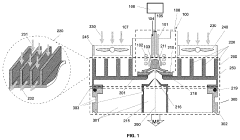
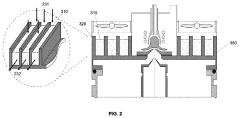
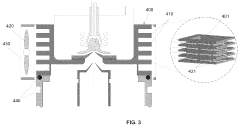
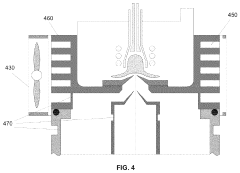
Air-cooled interface for inductively coupled plasma mass spectrometer (ICP-MS)
PatentActiveUS11864303B2
Innovation
- An air-cooled interface for ICP-MS systems using fins, open-cell metal foams, compact heat exchangers, or heat pipes to manage heat dissipation, with adjustable thermal resistors to direct heat away from sensitive components and prevent recombination, utilizing natural or forced convection to enhance cooling efficiency.
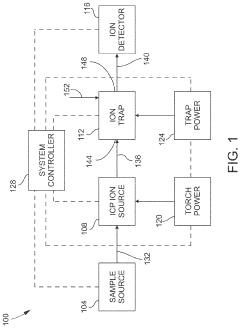
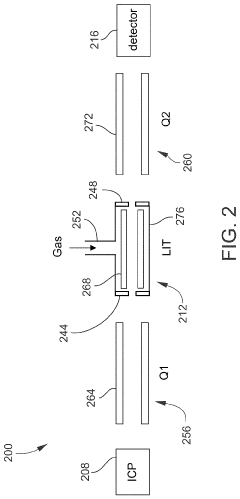
Inductively coupled plasma mass spectrometry (ICP-MS) with ion trapping
PatentActiveUS11443933B1
Innovation
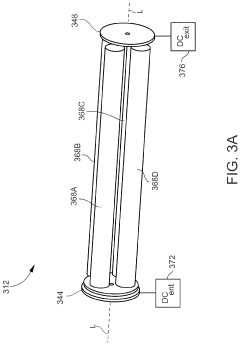
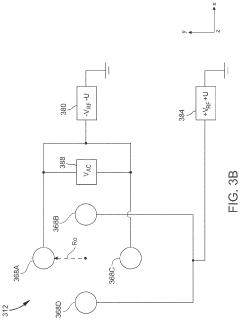
- Incorporating an ion trap, such as a linear ion trap, into the ICP-MS system to confine and mass-selectively eject ions, allowing for the simultaneous analysis of multiple elements from transient signals by preventing ion exit and entry during a confinement period and transmitting selected ions to a detector for measurement.
Environmental Compliance and Regulations
The regulatory landscape surrounding ICP-MS applications in industrial settings has become increasingly complex, with environmental protection agencies worldwide implementing stricter standards for emissions, waste management, and reporting requirements. Industries utilizing ICP-MS technology must navigate a multifaceted compliance framework that varies significantly across regions and sectors. In the United States, the Environmental Protection Agency (EPA) has established Method 6020 specifically for ICP-MS analysis, detailing protocols for sample preparation, instrument calibration, and quality control measures that must be adhered to for regulatory compliance.
European regulations, particularly under the REACH (Registration, Evaluation, Authorization and Restriction of Chemicals) framework, impose additional requirements for trace element analysis in various industrial products. These regulations necessitate highly sensitive and accurate analytical methods, positioning ICP-MS as a critical tool for compliance verification. The implementation of these standards has driven significant improvements in ICP-MS workflow efficiency, as laboratories seek to maintain compliance while optimizing operational costs.
Recent regulatory trends indicate a movement toward lower detection limits for toxic elements in environmental samples, particularly for heavy metals like mercury, lead, arsenic, and cadmium. This regulatory pressure has catalyzed innovations in sample introduction systems and collision/reaction cell technologies within ICP-MS instrumentation. Automated compliance reporting systems have emerged as essential components of modern ICP-MS workflows, enabling real-time monitoring and documentation of analytical results against regulatory thresholds.
The global harmonization of environmental standards presents both challenges and opportunities for ICP-MS applications. While divergent regional requirements can complicate analytical protocols, the push toward standardized testing methodologies has fostered international collaboration in developing reference materials and quality assurance procedures. Industry-specific regulations, such as those governing pharmaceutical manufacturing, semiconductor production, and food safety, have further specialized ICP-MS applications, necessitating tailored workflow solutions for different sectors.
Compliance with chain-of-custody requirements and data integrity regulations has become a critical aspect of ICP-MS operations. Electronic laboratory information management systems (LIMS) integrated with ICP-MS instrumentation now provide audit trails and data security features that satisfy regulatory scrutiny. These developments highlight the evolution of ICP-MS from purely analytical technology to a comprehensive compliance solution that addresses both scientific and regulatory demands in industrial settings.
European regulations, particularly under the REACH (Registration, Evaluation, Authorization and Restriction of Chemicals) framework, impose additional requirements for trace element analysis in various industrial products. These regulations necessitate highly sensitive and accurate analytical methods, positioning ICP-MS as a critical tool for compliance verification. The implementation of these standards has driven significant improvements in ICP-MS workflow efficiency, as laboratories seek to maintain compliance while optimizing operational costs.
Recent regulatory trends indicate a movement toward lower detection limits for toxic elements in environmental samples, particularly for heavy metals like mercury, lead, arsenic, and cadmium. This regulatory pressure has catalyzed innovations in sample introduction systems and collision/reaction cell technologies within ICP-MS instrumentation. Automated compliance reporting systems have emerged as essential components of modern ICP-MS workflows, enabling real-time monitoring and documentation of analytical results against regulatory thresholds.
The global harmonization of environmental standards presents both challenges and opportunities for ICP-MS applications. While divergent regional requirements can complicate analytical protocols, the push toward standardized testing methodologies has fostered international collaboration in developing reference materials and quality assurance procedures. Industry-specific regulations, such as those governing pharmaceutical manufacturing, semiconductor production, and food safety, have further specialized ICP-MS applications, necessitating tailored workflow solutions for different sectors.
Compliance with chain-of-custody requirements and data integrity regulations has become a critical aspect of ICP-MS operations. Electronic laboratory information management systems (LIMS) integrated with ICP-MS instrumentation now provide audit trails and data security features that satisfy regulatory scrutiny. These developments highlight the evolution of ICP-MS from purely analytical technology to a comprehensive compliance solution that addresses both scientific and regulatory demands in industrial settings.
Cost-Benefit Analysis of Advanced ICP-MS Solutions
When evaluating advanced ICP-MS (Inductively Coupled Plasma Mass Spectrometry) solutions for industrial applications, a comprehensive cost-benefit analysis is essential for making informed investment decisions. The initial capital expenditure for cutting-edge ICP-MS systems typically ranges from $150,000 to $500,000, depending on specifications, automation capabilities, and analytical features. This represents a significant investment that must be justified through tangible operational benefits.
Operational cost reductions present a compelling argument for advanced ICP-MS implementation. Modern systems demonstrate 30-40% lower argon gas consumption compared to previous generations, translating to annual savings of $5,000-$8,000 for facilities conducting regular analyses. Additionally, enhanced sample introduction systems reduce sample preparation time by up to 60%, allowing laboratories to process more samples with existing staff resources.
Maintenance expenses must be factored into the long-term cost equation. While advanced systems incorporate more sophisticated components, they often feature improved diagnostic capabilities and predictive maintenance algorithms that reduce downtime by approximately 25-35%. This translates to an estimated annual savings of $20,000-$30,000 in avoided production delays and emergency service calls.
Return on investment calculations indicate that most industrial facilities achieve full ROI within 3-5 years when upgrading to advanced ICP-MS solutions. This timeline shortens considerably for high-throughput operations where the volume of analyses directly impacts production decisions or quality control processes. Organizations processing more than 100 samples daily typically report ROI periods of 2-3 years.
Productivity enhancements represent another significant benefit area. Advanced collision/reaction cell technologies and improved detector systems enable multi-element analyses that previously required separate analytical runs. Studies indicate a 40-50% increase in analytical throughput, allowing laboratories to expand service offerings without proportional increases in staffing or equipment.
Quality improvements deliver less quantifiable but equally important benefits. Enhanced detection limits (often 10-100 times lower than previous generation instruments) enable more precise material characterization and contaminant detection. This translates to improved product quality, reduced rejection rates, and enhanced regulatory compliance—factors that significantly impact brand reputation and market position.
When evaluating vendor proposals, organizations should consider total cost of ownership rather than focusing exclusively on acquisition price. Factors including instrument lifetime (typically 8-10 years), upgrade pathways, service contract costs, and consumable requirements significantly impact the long-term value proposition of different ICP-MS solutions.
Operational cost reductions present a compelling argument for advanced ICP-MS implementation. Modern systems demonstrate 30-40% lower argon gas consumption compared to previous generations, translating to annual savings of $5,000-$8,000 for facilities conducting regular analyses. Additionally, enhanced sample introduction systems reduce sample preparation time by up to 60%, allowing laboratories to process more samples with existing staff resources.
Maintenance expenses must be factored into the long-term cost equation. While advanced systems incorporate more sophisticated components, they often feature improved diagnostic capabilities and predictive maintenance algorithms that reduce downtime by approximately 25-35%. This translates to an estimated annual savings of $20,000-$30,000 in avoided production delays and emergency service calls.
Return on investment calculations indicate that most industrial facilities achieve full ROI within 3-5 years when upgrading to advanced ICP-MS solutions. This timeline shortens considerably for high-throughput operations where the volume of analyses directly impacts production decisions or quality control processes. Organizations processing more than 100 samples daily typically report ROI periods of 2-3 years.
Productivity enhancements represent another significant benefit area. Advanced collision/reaction cell technologies and improved detector systems enable multi-element analyses that previously required separate analytical runs. Studies indicate a 40-50% increase in analytical throughput, allowing laboratories to expand service offerings without proportional increases in staffing or equipment.
Quality improvements deliver less quantifiable but equally important benefits. Enhanced detection limits (often 10-100 times lower than previous generation instruments) enable more precise material characterization and contaminant detection. This translates to improved product quality, reduced rejection rates, and enhanced regulatory compliance—factors that significantly impact brand reputation and market position.
When evaluating vendor proposals, organizations should consider total cost of ownership rather than focusing exclusively on acquisition price. Factors including instrument lifetime (typically 8-10 years), upgrade pathways, service contract costs, and consumable requirements significantly impact the long-term value proposition of different ICP-MS solutions.
Unlock deeper insights with PatSnap Eureka Quick Research — get a full tech report to explore trends and direct your research. Try now!
Generate Your Research Report Instantly with AI Agent
Supercharge your innovation with PatSnap Eureka AI Agent Platform!