

Turbine Engine Vs Piston Engine: Fuel Efficiency Analysis
SEP 23, 20259 MIN READ
Generate Your Research Report Instantly with AI Agent
PatSnap Eureka helps you evaluate technical feasibility & market potential.
Engine Technology Background and Objectives
The evolution of aircraft propulsion systems has been marked by continuous innovation since the Wright brothers' first powered flight in 1903. Piston engines dominated aviation for decades, providing reliable power for early aircraft through the conversion of reciprocating motion into rotational force. The introduction of turbine engines in the 1940s revolutionized aviation, enabling higher altitudes, greater speeds, and improved performance characteristics. This technological shift represents one of the most significant advancements in aerospace engineering history.
The fundamental operating principles of these engine types differ substantially. Piston engines operate through controlled combustion in cylinders, driving pistons connected to a crankshaft. In contrast, turbine engines generate thrust through continuous combustion, accelerating air through a series of compressors, combustion chambers, and turbines. These distinct mechanisms result in different performance profiles, particularly regarding fuel efficiency across various operating conditions.
Current industry trends indicate a renewed focus on optimizing engine efficiency due to increasing environmental concerns, regulatory pressures, and volatile fuel costs. The aviation sector contributes approximately 2.5% of global CO2 emissions, creating significant incentives for developing more fuel-efficient propulsion technologies. Both engine types continue to evolve through materials science advancements, computational fluid dynamics, and innovative combustion techniques.
The primary objective of this analysis is to conduct a comprehensive comparison of turbine and piston engine fuel efficiency across diverse operational parameters. This includes examining performance at various altitudes, speeds, power settings, and mission profiles. The assessment will consider both theoretical thermodynamic efficiency limits and practical real-world performance data from operational aircraft.
Secondary objectives include identifying specific operational niches where each engine type demonstrates optimal efficiency, analyzing the impact of technological advancements on efficiency improvements, and projecting future development trajectories. This analysis will also evaluate how emerging technologies such as electronic engine controls, advanced materials, and alternative fuels might influence the efficiency equation for both engine types.
The findings from this technical research aim to provide actionable insights for aircraft designers, operators, and regulatory bodies. By establishing a clear understanding of the efficiency characteristics of these competing technologies, stakeholders can make informed decisions regarding aircraft acquisition, fleet planning, and operational strategies. Additionally, this research will help identify promising areas for future research and development investments to further enhance aviation propulsion efficiency.
The fundamental operating principles of these engine types differ substantially. Piston engines operate through controlled combustion in cylinders, driving pistons connected to a crankshaft. In contrast, turbine engines generate thrust through continuous combustion, accelerating air through a series of compressors, combustion chambers, and turbines. These distinct mechanisms result in different performance profiles, particularly regarding fuel efficiency across various operating conditions.
Current industry trends indicate a renewed focus on optimizing engine efficiency due to increasing environmental concerns, regulatory pressures, and volatile fuel costs. The aviation sector contributes approximately 2.5% of global CO2 emissions, creating significant incentives for developing more fuel-efficient propulsion technologies. Both engine types continue to evolve through materials science advancements, computational fluid dynamics, and innovative combustion techniques.
The primary objective of this analysis is to conduct a comprehensive comparison of turbine and piston engine fuel efficiency across diverse operational parameters. This includes examining performance at various altitudes, speeds, power settings, and mission profiles. The assessment will consider both theoretical thermodynamic efficiency limits and practical real-world performance data from operational aircraft.
Secondary objectives include identifying specific operational niches where each engine type demonstrates optimal efficiency, analyzing the impact of technological advancements on efficiency improvements, and projecting future development trajectories. This analysis will also evaluate how emerging technologies such as electronic engine controls, advanced materials, and alternative fuels might influence the efficiency equation for both engine types.
The findings from this technical research aim to provide actionable insights for aircraft designers, operators, and regulatory bodies. By establishing a clear understanding of the efficiency characteristics of these competing technologies, stakeholders can make informed decisions regarding aircraft acquisition, fleet planning, and operational strategies. Additionally, this research will help identify promising areas for future research and development investments to further enhance aviation propulsion efficiency.
Market Demand Analysis for Efficient Propulsion Systems
The global propulsion systems market is witnessing a significant shift toward more efficient technologies, driven by stringent environmental regulations, rising fuel costs, and increasing awareness of carbon footprints. Current market analysis indicates that the demand for fuel-efficient propulsion systems has grown at an annual rate of 5.7% over the past five years, with projections suggesting acceleration to 7.2% through 2030.
Aviation and transportation sectors represent the largest market segments seeking advanced propulsion solutions. Commercial aviation alone accounts for approximately 2.5% of global CO2 emissions, creating substantial pressure for more efficient engine technologies. The market for fuel-efficient aircraft engines is expected to reach $168 billion by 2028, with efficiency improvements being the primary competitive differentiator.
Marine transportation presents another substantial market, with international shipping responsible for about 2.9% of global greenhouse gas emissions. Regulatory frameworks like the International Maritime Organization's emissions reduction targets are compelling vessel operators to seek more efficient propulsion alternatives, creating a market estimated at $42 billion for advanced marine propulsion systems.
Consumer preferences are increasingly influencing market dynamics, with 73% of travelers in a recent global survey expressing willingness to pay premium prices for more environmentally responsible transportation options. This consumer sentiment is translating into tangible market demand, particularly in developed economies where environmental consciousness is highest.
Regional analysis reveals varying market maturity levels. North America and Europe lead in adoption of fuel-efficient propulsion technologies, driven by stringent regulatory frameworks and higher fuel costs. The Asia-Pacific region represents the fastest-growing market, with 9.3% annual growth, fueled by rapid industrialization and expanding transportation networks.
Military applications constitute a specialized but significant market segment, where operational efficiency rather than environmental concerns drives demand. Defense departments worldwide are investing heavily in fuel-efficient propulsion systems to extend operational range and reduce logistical burdens, creating a market valued at approximately $29 billion.
The aftermarket and retrofit segment is emerging as a substantial opportunity, as operators seek to improve efficiency in existing fleets rather than commit to complete replacements. This market is projected to grow at 6.8% annually through 2027, offering significant opportunities for technologies that can be integrated into legacy systems.
Economic analysis indicates that fuel represents 20-30% of operating costs across transportation sectors, creating strong financial incentives for efficiency improvements. Even modest 5-10% gains in fuel efficiency can translate to millions in savings for large operators, establishing a clear return-on-investment case for advanced propulsion technologies.
Aviation and transportation sectors represent the largest market segments seeking advanced propulsion solutions. Commercial aviation alone accounts for approximately 2.5% of global CO2 emissions, creating substantial pressure for more efficient engine technologies. The market for fuel-efficient aircraft engines is expected to reach $168 billion by 2028, with efficiency improvements being the primary competitive differentiator.
Marine transportation presents another substantial market, with international shipping responsible for about 2.9% of global greenhouse gas emissions. Regulatory frameworks like the International Maritime Organization's emissions reduction targets are compelling vessel operators to seek more efficient propulsion alternatives, creating a market estimated at $42 billion for advanced marine propulsion systems.
Consumer preferences are increasingly influencing market dynamics, with 73% of travelers in a recent global survey expressing willingness to pay premium prices for more environmentally responsible transportation options. This consumer sentiment is translating into tangible market demand, particularly in developed economies where environmental consciousness is highest.
Regional analysis reveals varying market maturity levels. North America and Europe lead in adoption of fuel-efficient propulsion technologies, driven by stringent regulatory frameworks and higher fuel costs. The Asia-Pacific region represents the fastest-growing market, with 9.3% annual growth, fueled by rapid industrialization and expanding transportation networks.
Military applications constitute a specialized but significant market segment, where operational efficiency rather than environmental concerns drives demand. Defense departments worldwide are investing heavily in fuel-efficient propulsion systems to extend operational range and reduce logistical burdens, creating a market valued at approximately $29 billion.
The aftermarket and retrofit segment is emerging as a substantial opportunity, as operators seek to improve efficiency in existing fleets rather than commit to complete replacements. This market is projected to grow at 6.8% annually through 2027, offering significant opportunities for technologies that can be integrated into legacy systems.
Economic analysis indicates that fuel represents 20-30% of operating costs across transportation sectors, creating strong financial incentives for efficiency improvements. Even modest 5-10% gains in fuel efficiency can translate to millions in savings for large operators, establishing a clear return-on-investment case for advanced propulsion technologies.
Current State and Challenges in Engine Efficiency
The global engine market is witnessing a significant transformation driven by increasing demands for fuel efficiency and environmental sustainability. Currently, piston engines dominate numerous sectors including automotive, marine, and small aircraft applications, while turbine engines prevail in commercial aviation, power generation, and military applications. The efficiency landscape reveals that modern piston engines typically achieve thermal efficiencies between 25-30% in automotive applications, with advanced diesel variants reaching up to 45% in optimal conditions. Conversely, turbine engines operate at thermal efficiencies ranging from 35-40% for simple cycle gas turbines to over 60% for combined cycle power plants.
Despite these advancements, both engine types face substantial challenges in improving fuel efficiency. Piston engines contend with fundamental thermodynamic limitations, mechanical friction losses, and the inherent inefficiencies of reciprocating motion. The Otto cycle's theoretical maximum efficiency remains constrained by compression ratio limitations, while diesel engines face increasing emissions control requirements that often compromise their efficiency advantages.
Turbine engines, while offering higher power-to-weight ratios, struggle with efficiency at partial loads and lower power settings—a critical disadvantage in applications requiring variable operating conditions. Their performance is also more sensitive to ambient conditions, with efficiency degrading significantly at higher altitudes and extreme temperatures. Additionally, the complex aerodynamics of compressor and turbine blade design present ongoing optimization challenges.
Material constraints represent another significant hurdle for both engine types. Piston engines require materials that can withstand high cyclic stresses and temperatures, while turbine engines demand exotic alloys capable of enduring extreme thermal conditions, particularly in the hot section where temperatures can exceed 1,600°C. These material limitations directly impact maximum achievable efficiencies.
Geographically, engine efficiency research demonstrates distinct regional focuses. North American and European institutions lead in advanced combustion research for piston engines, while Asian manufacturers have made significant strides in hybrid technologies. For turbine engines, American and European aerospace companies maintain technological leadership, though emerging economies like China and India are rapidly expanding their capabilities.
Recent regulatory pressures have intensified the focus on efficiency improvements. Stringent emissions standards in Europe and North America have accelerated research into alternative combustion strategies, advanced materials, and hybrid powertrains. Meanwhile, the aviation industry faces mounting pressure to reduce its carbon footprint, driving innovation in turbine engine design and alternative fuels compatibility.
Despite these advancements, both engine types face substantial challenges in improving fuel efficiency. Piston engines contend with fundamental thermodynamic limitations, mechanical friction losses, and the inherent inefficiencies of reciprocating motion. The Otto cycle's theoretical maximum efficiency remains constrained by compression ratio limitations, while diesel engines face increasing emissions control requirements that often compromise their efficiency advantages.
Turbine engines, while offering higher power-to-weight ratios, struggle with efficiency at partial loads and lower power settings—a critical disadvantage in applications requiring variable operating conditions. Their performance is also more sensitive to ambient conditions, with efficiency degrading significantly at higher altitudes and extreme temperatures. Additionally, the complex aerodynamics of compressor and turbine blade design present ongoing optimization challenges.
Material constraints represent another significant hurdle for both engine types. Piston engines require materials that can withstand high cyclic stresses and temperatures, while turbine engines demand exotic alloys capable of enduring extreme thermal conditions, particularly in the hot section where temperatures can exceed 1,600°C. These material limitations directly impact maximum achievable efficiencies.
Geographically, engine efficiency research demonstrates distinct regional focuses. North American and European institutions lead in advanced combustion research for piston engines, while Asian manufacturers have made significant strides in hybrid technologies. For turbine engines, American and European aerospace companies maintain technological leadership, though emerging economies like China and India are rapidly expanding their capabilities.
Recent regulatory pressures have intensified the focus on efficiency improvements. Stringent emissions standards in Europe and North America have accelerated research into alternative combustion strategies, advanced materials, and hybrid powertrains. Meanwhile, the aviation industry faces mounting pressure to reduce its carbon footprint, driving innovation in turbine engine design and alternative fuels compatibility.
Current Technical Solutions for Fuel Efficiency
01 Fuel efficiency improvements in turbine engines
Various methods are employed to enhance the fuel efficiency of turbine engines, including optimized combustion chamber designs, improved fuel injection systems, and advanced cooling techniques. These innovations help to maximize energy extraction from fuel while minimizing losses, resulting in higher thermal efficiency and reduced fuel consumption. Additionally, modifications to turbine blade geometry and materials contribute to better aerodynamic performance and higher operating temperatures, further improving overall engine efficiency.- Fuel efficiency improvements in turbine engines: Various methods are employed to enhance the fuel efficiency of turbine engines, including optimized combustion chamber designs, improved air-fuel mixing techniques, and advanced cooling systems. These innovations reduce fuel consumption while maintaining or increasing power output. Additionally, modifications to turbine blade geometry and materials contribute to better thermal efficiency and reduced energy losses during operation.
- Piston engine fuel efficiency enhancements: Fuel efficiency in piston engines can be improved through various techniques such as optimized cylinder designs, advanced valve timing mechanisms, and friction reduction technologies. Innovations in piston ring configurations and cylinder wall treatments help minimize energy losses. Additionally, improvements in fuel injection systems and combustion chamber designs contribute to more complete fuel burning and reduced waste, resulting in higher overall efficiency.
- Hybrid and combined cycle systems: Combining turbine and piston engine technologies creates hybrid systems that leverage the advantages of both engine types. These combined cycle approaches utilize waste heat recovery from one engine to power another, significantly improving overall system efficiency. Such configurations can optimize performance across various operating conditions, allowing for better fuel utilization and reduced emissions compared to single-engine systems.
- Advanced fuel management systems: Sophisticated fuel management systems enhance engine efficiency through precise control of fuel delivery, timing, and mixture composition. These systems incorporate sensors and electronic controllers to optimize combustion processes in real-time based on operating conditions. Innovations include variable fuel injection timing, adaptive mixture control, and stratified charge techniques that ensure optimal fuel utilization across different power demands and environmental conditions.
- Thermal efficiency optimization techniques: Various methods are employed to maximize the thermal efficiency of both turbine and piston engines. These include advanced heat recovery systems, improved insulation materials, and innovative cooling techniques that reduce energy losses. Modifications to engine cycle parameters, such as compression ratios and expansion ratios, help extract more useful work from the same amount of fuel. Additionally, waste heat recovery systems capture and repurpose thermal energy that would otherwise be lost.
02 Piston engine fuel efficiency enhancements
Fuel efficiency in piston engines can be improved through various design modifications and operational strategies. These include optimized combustion chamber geometry, variable valve timing, direct fuel injection systems, and reduced friction components. Advanced electronic control systems enable precise fuel metering and ignition timing, while lightweight materials reduce overall engine weight. These technologies collectively improve the thermal efficiency of piston engines, resulting in better fuel economy and reduced emissions.Expand Specific Solutions03 Hybrid and combined cycle systems
Hybrid systems that combine turbine and piston engine technologies can achieve higher overall fuel efficiency by leveraging the strengths of each engine type. These systems often use waste heat recovery from one engine to power another, creating combined cycles that extract more energy from the same amount of fuel. Turbocompound arrangements, where exhaust gases from piston engines drive turbines, and combined gas turbine-reciprocating engine configurations represent innovative approaches to maximizing fuel efficiency across different operating conditions.Expand Specific Solutions04 Advanced fuel management and combustion control
Sophisticated fuel management and combustion control technologies significantly improve engine fuel efficiency. These include lean-burn combustion strategies, stratified charge techniques, and precise electronic fuel injection systems. Advanced sensors and control algorithms enable real-time optimization of air-fuel ratios and combustion timing based on operating conditions. Additionally, technologies such as variable compression ratio systems and cylinder deactivation allow engines to operate at their most efficient point across a wide range of power demands.Expand Specific Solutions05 Waste heat recovery and thermal management
Waste heat recovery systems capture thermal energy that would otherwise be lost through exhaust gases or cooling systems, converting it into useful work or electricity. Technologies such as Organic Rankine Cycles, thermoelectric generators, and regenerative heat exchangers can significantly improve overall engine system efficiency. Advanced thermal management strategies, including optimized cooling systems and insulation techniques, help maintain ideal operating temperatures and reduce energy losses, contributing to better fuel efficiency in both turbine and piston engines.Expand Specific Solutions
Key Industry Players and Manufacturers
The turbine engine versus piston engine fuel efficiency landscape is currently in a mature development stage, with a global market size exceeding $150 billion. Turbine engines dominate aerospace and large-scale power generation due to their higher power-to-weight ratio, while piston engines remain prevalent in automotive and small aircraft applications where fuel efficiency at lower speeds is critical. Leading players like General Electric, Rolls-Royce, and Pratt & Whitney (RTX) have established technological dominance in turbines, while companies such as Achates Power, Weichai Power, and Toyota are advancing piston engine efficiency through innovations like opposed-piston designs and hybrid systems. The competitive dynamics are shifting as environmental regulations drive both technologies toward greater efficiency and reduced emissions.
General Electric Company
Technical Solution: General Electric has developed advanced turbine engine technologies focusing on improving fuel efficiency through innovative aerodynamics and materials science. Their latest turbofan engines utilize a high bypass ratio design (up to 12:1) that significantly improves propulsive efficiency by accelerating a larger mass of air at lower velocities. GE's advanced turbine engines incorporate ceramic matrix composites (CMCs) that can withstand temperatures up to 2400°F (1316°C), allowing higher operating temperatures and improved thermodynamic efficiency. Their LEAP engine technology demonstrates up to 15% better fuel consumption compared to previous generation engines, achieved through 3D aerodynamic design of fan blades and compressor airfoils. GE has also pioneered additive manufacturing techniques for turbine components, reducing weight while maintaining structural integrity, contributing to overall system efficiency improvements.
Strengths: Superior power-to-weight ratio allowing for greater payload capacity; excellent performance at high altitudes where air density is lower; longer time between overhauls (typically 3,000-5,000 hours) compared to piston engines. Weaknesses: Higher initial acquisition costs; less fuel-efficient at low power settings and during ground operations; more complex maintenance requirements requiring specialized technicians.
Achates Power, Inc.
Technical Solution: Achates Power has developed an innovative opposed-piston engine architecture that fundamentally improves fuel efficiency in piston engines. Their design eliminates the cylinder head, valvetrain, and related components by using two pistons per cylinder working in opposition. This configuration significantly reduces heat losses by removing the cylinder head (typically responsible for 30-50% of heat rejection in conventional engines) and achieves a higher expansion ratio than compression ratio through asymmetric port timing. The opposed-piston design creates a more favorable surface-to-volume ratio during combustion, reducing heat transfer to cylinder walls by approximately 30%. Achates' engines demonstrate 30-50% better fuel efficiency compared to conventional diesel engines of similar output, with their 10.6L heavy-duty diesel achieving a brake thermal efficiency exceeding 50% - substantially higher than the 42-45% typical of conventional diesel engines. The architecture also enables effective two-stroke operation with uniflow scavenging, improving gas exchange efficiency.
Strengths: Exceptional thermal efficiency (exceeding 50%) due to reduced heat losses and improved combustion geometry; simpler mechanical design with fewer components; excellent power density; inherently balanced operation reducing vibration. Weaknesses: Requires specialized manufacturing infrastructure different from conventional engines; two-stroke operation necessitates careful management of oil consumption and emissions; market adoption faces challenges due to established conventional engine infrastructure.
Core Innovations in Engine Fuel Economy
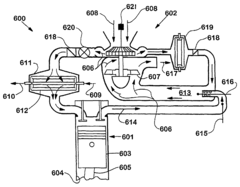
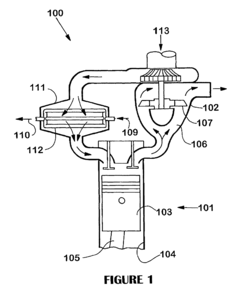
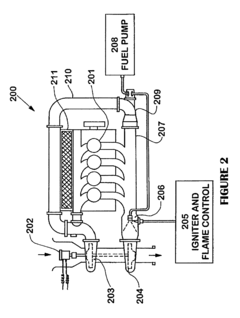
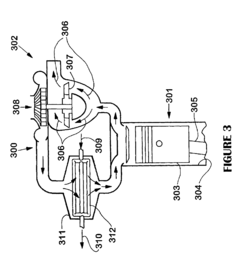
Staged combustion with piston engine and turbine engine supercharger
PatentWO2004027236A1
Innovation
- A staged combustion system that involves a first stage piston engine and a second stage turbine engine, where the piston engine operates fuel-rich to produce exhaust gases containing fuel, which are then combusted in the turbine engine to generate exhaust gases used for supercharging the piston engine, thereby increasing boost pressure, fuel efficiency, and reducing emissions.


Staged combustion with piston engine and turbine engine supercharger
PatentInactiveUSRE42875E1
Innovation
- A combustion engine system that employs a two-stage combustion process, where fuel is first combusted in a piston engine and then in a turbine engine, with the turbine engine exhaust gases used to supercharge the piston engine, utilizing nitrogen-enriched air to control combustion temperature and reduce NOx formation.
Environmental Impact Assessment
The environmental impact of aircraft engines represents a critical dimension in comparing turbine and piston propulsion systems. Turbine engines, while offering superior power-to-weight ratios and operational capabilities at higher altitudes, typically produce higher nitrogen oxide (NOx) emissions due to their elevated combustion temperatures. These emissions contribute significantly to atmospheric pollution and can catalyze the formation of tropospheric ozone, a potent greenhouse gas.
Piston engines, conversely, generally emit lower levels of NOx but produce greater amounts of carbon monoxide and unburned hydrocarbons, particularly during idle and low-power operations. This characteristic becomes especially relevant in general aviation applications where aircraft frequently operate at varying power settings during different flight phases.
Carbon dioxide emissions correlate directly with fuel consumption, positioning the more fuel-efficient engine type as environmentally advantageous from a greenhouse gas perspective. Modern turbine engines in commercial applications demonstrate remarkable efficiency at cruise conditions, though this advantage diminishes in smaller aircraft where the inherent thermodynamic benefits cannot fully offset the weight and complexity penalties.
Noise pollution constitutes another significant environmental consideration. Turbine engines typically generate higher-frequency noise that attenuates more rapidly with distance but can be more penetrating in the immediate vicinity. Piston engines produce lower-frequency sound signatures that may propagate further in certain atmospheric conditions, affecting larger geographical areas despite lower peak decibel levels.
Water vapor emissions from turbine engines, particularly at high altitudes, contribute to contrail formation and potential cirrus cloud development, which may influence global radiative forcing. This effect remains largely absent in piston-powered aircraft that typically operate at lower altitudes where water vapor emissions disperse more readily without persistent atmospheric effects.
Lifecycle assessment reveals additional environmental considerations beyond operational impacts. Manufacturing processes for turbine engines often require more specialized materials and energy-intensive production techniques. However, their longer service intervals and operational lifespans may partially offset these initial environmental costs when evaluated across the complete product lifecycle.
Emerging technologies in both engine categories aim to mitigate environmental impacts through advanced combustion techniques, alternative fuels compatibility, and improved thermal efficiency. Sustainable aviation fuels (SAFs) show particular promise for reducing the carbon footprint of both engine types, though their implementation faces challenges regarding production scale and economic viability.
Piston engines, conversely, generally emit lower levels of NOx but produce greater amounts of carbon monoxide and unburned hydrocarbons, particularly during idle and low-power operations. This characteristic becomes especially relevant in general aviation applications where aircraft frequently operate at varying power settings during different flight phases.
Carbon dioxide emissions correlate directly with fuel consumption, positioning the more fuel-efficient engine type as environmentally advantageous from a greenhouse gas perspective. Modern turbine engines in commercial applications demonstrate remarkable efficiency at cruise conditions, though this advantage diminishes in smaller aircraft where the inherent thermodynamic benefits cannot fully offset the weight and complexity penalties.
Noise pollution constitutes another significant environmental consideration. Turbine engines typically generate higher-frequency noise that attenuates more rapidly with distance but can be more penetrating in the immediate vicinity. Piston engines produce lower-frequency sound signatures that may propagate further in certain atmospheric conditions, affecting larger geographical areas despite lower peak decibel levels.
Water vapor emissions from turbine engines, particularly at high altitudes, contribute to contrail formation and potential cirrus cloud development, which may influence global radiative forcing. This effect remains largely absent in piston-powered aircraft that typically operate at lower altitudes where water vapor emissions disperse more readily without persistent atmospheric effects.
Lifecycle assessment reveals additional environmental considerations beyond operational impacts. Manufacturing processes for turbine engines often require more specialized materials and energy-intensive production techniques. However, their longer service intervals and operational lifespans may partially offset these initial environmental costs when evaluated across the complete product lifecycle.
Emerging technologies in both engine categories aim to mitigate environmental impacts through advanced combustion techniques, alternative fuels compatibility, and improved thermal efficiency. Sustainable aviation fuels (SAFs) show particular promise for reducing the carbon footprint of both engine types, though their implementation faces challenges regarding production scale and economic viability.
Cost-Benefit Analysis of Engine Technologies
When evaluating turbine engines versus piston engines, a comprehensive cost-benefit analysis reveals significant economic implications across multiple dimensions. Initial acquisition costs typically favor piston engines, which generally require 30-50% less capital investment than comparable turbine engines. However, this advantage diminishes when considering the complete lifecycle economics.
Operational costs present a more complex picture. While turbine engines demonstrate superior fuel efficiency at high power settings and altitudes, piston engines often maintain better efficiency during partial load operations. This translates to piston engines being more economical for intermittent-use applications, whereas turbines excel in continuous high-power scenarios. Maintenance economics further complicate the equation, with turbines requiring less frequent but more specialized and costly maintenance interventions.
Longevity factors significantly impact the total cost of ownership. Turbine engines typically offer time between overhaul (TBO) intervals of 3,000-5,000 hours compared to 1,500-2,000 hours for piston engines. This extended service interval partially offsets the higher initial acquisition costs of turbine technology, particularly in high-utilization environments.
Environmental compliance costs are increasingly relevant in today's regulatory landscape. Turbine engines generally produce fewer pollutants per unit of power output, potentially reducing emissions-related compliance costs. However, this advantage must be weighed against their typically higher fuel consumption in certain operational profiles.
Infrastructure requirements represent another significant cost consideration. Turbine engines often necessitate specialized handling equipment, training programs, and maintenance facilities. Organizations transitioning from piston to turbine technology must account for these additional infrastructure investments in their cost-benefit calculations.
Return on investment timelines vary dramatically based on application. Commercial aviation operations typically realize faster ROI with turbine engines due to their reliability and performance advantages. Conversely, general aviation and certain industrial applications may achieve better financial outcomes with piston engines due to lower upfront costs and simpler operational requirements.
The optimal engine selection ultimately depends on specific operational profiles, utilization rates, and organizational priorities. A thorough cost-benefit analysis must incorporate not only direct financial metrics but also reliability factors, operational flexibility, and strategic considerations to determine the most economically advantageous solution for a given application.
Operational costs present a more complex picture. While turbine engines demonstrate superior fuel efficiency at high power settings and altitudes, piston engines often maintain better efficiency during partial load operations. This translates to piston engines being more economical for intermittent-use applications, whereas turbines excel in continuous high-power scenarios. Maintenance economics further complicate the equation, with turbines requiring less frequent but more specialized and costly maintenance interventions.
Longevity factors significantly impact the total cost of ownership. Turbine engines typically offer time between overhaul (TBO) intervals of 3,000-5,000 hours compared to 1,500-2,000 hours for piston engines. This extended service interval partially offsets the higher initial acquisition costs of turbine technology, particularly in high-utilization environments.
Environmental compliance costs are increasingly relevant in today's regulatory landscape. Turbine engines generally produce fewer pollutants per unit of power output, potentially reducing emissions-related compliance costs. However, this advantage must be weighed against their typically higher fuel consumption in certain operational profiles.
Infrastructure requirements represent another significant cost consideration. Turbine engines often necessitate specialized handling equipment, training programs, and maintenance facilities. Organizations transitioning from piston to turbine technology must account for these additional infrastructure investments in their cost-benefit calculations.
Return on investment timelines vary dramatically based on application. Commercial aviation operations typically realize faster ROI with turbine engines due to their reliability and performance advantages. Conversely, general aviation and certain industrial applications may achieve better financial outcomes with piston engines due to lower upfront costs and simpler operational requirements.
The optimal engine selection ultimately depends on specific operational profiles, utilization rates, and organizational priorities. A thorough cost-benefit analysis must incorporate not only direct financial metrics but also reliability factors, operational flexibility, and strategic considerations to determine the most economically advantageous solution for a given application.
Unlock deeper insights with PatSnap Eureka Quick Research — get a full tech report to explore trends and direct your research. Try now!
Generate Your Research Report Instantly with AI Agent
Supercharge your innovation with PatSnap Eureka AI Agent Platform!