

Twistronics: Transformative Paths for Energy Conversion Technologies.
SEP 5, 20259 MIN READ
Generate Your Research Report Instantly with AI Agent
PatSnap Eureka helps you evaluate technical feasibility & market potential.
Twistronics Background and Energy Conversion Goals
Twistronics emerged as a groundbreaking field in condensed matter physics following the discovery of superconductivity in twisted bilayer graphene by MIT researchers in 2018. This revolutionary approach involves stacking two-dimensional materials at specific "magic angles," creating moiré patterns that fundamentally alter electronic properties. The historical development of twistronics builds upon decades of research in 2D materials, beginning with graphene's isolation in 2004, which earned Geim and Novoselov the Nobel Prize in Physics.
The technological evolution of twistronics has accelerated rapidly over the past five years, with researchers demonstrating that precise angular control between layered materials can induce remarkable phenomena including superconductivity, correlated insulator states, and ferromagnetism. These properties emerge not from the intrinsic characteristics of the materials themselves, but from the quantum interactions created by their specific geometric arrangements.
Current research trajectories indicate twistronics is expanding beyond graphene to include transition metal dichalcogenides (TMDs), hexagonal boron nitride (hBN), and various van der Waals heterostructures. This diversification represents a significant trend toward engineering quantum properties through geometric configuration rather than traditional chemical composition or doping methods.
In the energy conversion domain, twistronics presents transformative potential by enabling unprecedented control over electronic and optical properties. The primary technical objectives include developing twistronics-based photovoltaic cells with efficiency exceeding current limitations, creating novel thermoelectric materials with enhanced Seebeck coefficients, and engineering quantum-enhanced catalysts for hydrogen production and carbon capture applications.
The field aims to achieve specific technical milestones: increasing solar conversion efficiency beyond 35% through moiré-enhanced light absorption and carrier separation; developing room-temperature quantum materials for waste heat recovery with ZT values exceeding 3.0; and designing twisted interfaces that reduce activation energy for critical electrochemical reactions by at least 40%.
Long-term technical goals include establishing scalable manufacturing processes for precise angle control in 2D material assembly, developing in-situ tuning mechanisms for dynamic property modulation, and creating computational models that accurately predict emergent phenomena in complex twisted heterostructures. These advances could potentially revolutionize renewable energy technologies by accessing quantum-enhanced energy conversion mechanisms previously inaccessible in conventional materials.
The convergence of twistronics with energy conversion technologies represents a paradigm shift from traditional materials science approaches, potentially enabling quantum-enhanced energy systems that operate closer to theoretical efficiency limits while using earth-abundant materials.
The technological evolution of twistronics has accelerated rapidly over the past five years, with researchers demonstrating that precise angular control between layered materials can induce remarkable phenomena including superconductivity, correlated insulator states, and ferromagnetism. These properties emerge not from the intrinsic characteristics of the materials themselves, but from the quantum interactions created by their specific geometric arrangements.
Current research trajectories indicate twistronics is expanding beyond graphene to include transition metal dichalcogenides (TMDs), hexagonal boron nitride (hBN), and various van der Waals heterostructures. This diversification represents a significant trend toward engineering quantum properties through geometric configuration rather than traditional chemical composition or doping methods.
In the energy conversion domain, twistronics presents transformative potential by enabling unprecedented control over electronic and optical properties. The primary technical objectives include developing twistronics-based photovoltaic cells with efficiency exceeding current limitations, creating novel thermoelectric materials with enhanced Seebeck coefficients, and engineering quantum-enhanced catalysts for hydrogen production and carbon capture applications.
The field aims to achieve specific technical milestones: increasing solar conversion efficiency beyond 35% through moiré-enhanced light absorption and carrier separation; developing room-temperature quantum materials for waste heat recovery with ZT values exceeding 3.0; and designing twisted interfaces that reduce activation energy for critical electrochemical reactions by at least 40%.
Long-term technical goals include establishing scalable manufacturing processes for precise angle control in 2D material assembly, developing in-situ tuning mechanisms for dynamic property modulation, and creating computational models that accurately predict emergent phenomena in complex twisted heterostructures. These advances could potentially revolutionize renewable energy technologies by accessing quantum-enhanced energy conversion mechanisms previously inaccessible in conventional materials.
The convergence of twistronics with energy conversion technologies represents a paradigm shift from traditional materials science approaches, potentially enabling quantum-enhanced energy systems that operate closer to theoretical efficiency limits while using earth-abundant materials.
Market Analysis for Twistronics-Based Energy Solutions
The global market for energy conversion technologies is witnessing a paradigm shift with the emergence of twistronics-based solutions. Current market valuation for advanced energy conversion technologies stands at approximately $350 billion, with projections indicating growth to $500 billion by 2030. Twistronics, though currently occupying a nascent segment, demonstrates potential to capture significant market share due to its revolutionary approach to energy manipulation at the quantum level.
Market demand analysis reveals three primary sectors poised for twistronics integration: renewable energy generation, energy storage systems, and high-efficiency electronics. The renewable energy sector, valued at $755 billion globally, faces efficiency plateaus with conventional technologies, creating a substantial opportunity for twistronics-based innovations that can overcome these limitations through precise control of electron behavior at twisted interfaces.
Energy storage represents another critical market segment, with grid-scale storage solutions growing at 24% annually. Twistronics offers transformative potential in this space by enabling novel supercapacitor designs with dramatically improved energy density and charge-discharge cycles, addressing key limitations in current lithium-ion and solid-state battery technologies.
Consumer and industrial electronics markets are increasingly demanding higher energy efficiency, creating a $127 billion opportunity for advanced energy conversion solutions. Twistronics-based semiconductor devices could deliver up to 30% improvement in energy conversion efficiency compared to traditional silicon-based technologies, particularly in power management applications.
Regional market analysis indicates North America and East Asia as primary innovation hubs, with Europe leading in adoption frameworks for sustainable energy technologies. China has demonstrated particular interest in twistronics applications, with government initiatives allocating substantial funding toward quantum materials research including twisted bilayer systems.
Market barriers include high production costs, scaling challenges, and integration complexities with existing energy infrastructure. Current production methods for precisely twisted materials remain laboratory-focused, with costs estimated at 50-100 times higher than conventional semiconductor manufacturing processes.
Customer adoption analysis indicates that early market entry will likely occur in premium segments where performance advantages outweigh cost considerations, such as aerospace, advanced computing, and specialized industrial applications. Mass market penetration depends on achieving production scale economies, with industry analysts projecting a 5-7 year timeline before twistronics-based energy solutions reach price parity with conventional alternatives in mainstream applications.
Market demand analysis reveals three primary sectors poised for twistronics integration: renewable energy generation, energy storage systems, and high-efficiency electronics. The renewable energy sector, valued at $755 billion globally, faces efficiency plateaus with conventional technologies, creating a substantial opportunity for twistronics-based innovations that can overcome these limitations through precise control of electron behavior at twisted interfaces.
Energy storage represents another critical market segment, with grid-scale storage solutions growing at 24% annually. Twistronics offers transformative potential in this space by enabling novel supercapacitor designs with dramatically improved energy density and charge-discharge cycles, addressing key limitations in current lithium-ion and solid-state battery technologies.
Consumer and industrial electronics markets are increasingly demanding higher energy efficiency, creating a $127 billion opportunity for advanced energy conversion solutions. Twistronics-based semiconductor devices could deliver up to 30% improvement in energy conversion efficiency compared to traditional silicon-based technologies, particularly in power management applications.
Regional market analysis indicates North America and East Asia as primary innovation hubs, with Europe leading in adoption frameworks for sustainable energy technologies. China has demonstrated particular interest in twistronics applications, with government initiatives allocating substantial funding toward quantum materials research including twisted bilayer systems.
Market barriers include high production costs, scaling challenges, and integration complexities with existing energy infrastructure. Current production methods for precisely twisted materials remain laboratory-focused, with costs estimated at 50-100 times higher than conventional semiconductor manufacturing processes.
Customer adoption analysis indicates that early market entry will likely occur in premium segments where performance advantages outweigh cost considerations, such as aerospace, advanced computing, and specialized industrial applications. Mass market penetration depends on achieving production scale economies, with industry analysts projecting a 5-7 year timeline before twistronics-based energy solutions reach price parity with conventional alternatives in mainstream applications.
Current State and Challenges in Twistronics Research
Twistronics has emerged as a revolutionary field in materials science, with significant implications for energy conversion technologies. Currently, research in this domain is advancing rapidly across global institutions, with notable progress in understanding the fundamental physics of twisted bilayer systems. The discovery that stacking two graphene layers at a "magic angle" of approximately 1.1 degrees creates unique electronic properties has catalyzed extensive investigation into potential applications for energy conversion.
The current state of twistronics research is characterized by intensive experimental and theoretical work focused on twisted bilayer graphene (TBG) and other van der Waals heterostructures. Recent breakthroughs have demonstrated that these systems can exhibit superconductivity, correlated insulator states, and topological properties that could revolutionize energy conversion efficiency. Research centers in North America, Europe, and East Asia lead in publication output, with specialized facilities at MIT, Harvard, Columbia University, and the Chinese Academy of Sciences making significant contributions.
Despite promising advances, twistronics faces substantial technical challenges. Precise control of twist angles remains difficult at scale, with even minor deviations significantly altering electronic properties. Current fabrication methods are predominantly laboratory-based and not readily transferable to industrial production. The "tear and stack" technique, while effective for research samples, presents significant barriers to mass production and standardization.
Material stability represents another critical challenge, as twisted structures can experience relaxation and deformation over time, potentially compromising their novel electronic properties. Additionally, the integration of twistronics-based components with conventional electronics requires solving complex interface issues that currently limit practical applications in energy conversion devices.
Computational modeling of twisted systems presents unique difficulties due to the large moiré supercells created by the twist angle, requiring substantial computing resources and sophisticated algorithms. This computational bottleneck has slowed theoretical progress and predictive capabilities for new twistronics-based energy conversion mechanisms.
The field also faces measurement and characterization challenges, as conventional techniques often lack the spatial resolution to fully analyze the complex electronic states in moiré superlattices. Advanced scanning probe microscopy and angle-resolved photoemission spectroscopy (ARPES) provide valuable insights but are time-intensive and difficult to implement for rapid material screening and optimization.
Funding and interdisciplinary collaboration represent additional hurdles, as twistronics research requires expertise spanning condensed matter physics, materials science, electrical engineering, and computational modeling. The complex nature of these systems necessitates coordinated research efforts that are currently fragmented across different institutions and disciplines.
The current state of twistronics research is characterized by intensive experimental and theoretical work focused on twisted bilayer graphene (TBG) and other van der Waals heterostructures. Recent breakthroughs have demonstrated that these systems can exhibit superconductivity, correlated insulator states, and topological properties that could revolutionize energy conversion efficiency. Research centers in North America, Europe, and East Asia lead in publication output, with specialized facilities at MIT, Harvard, Columbia University, and the Chinese Academy of Sciences making significant contributions.
Despite promising advances, twistronics faces substantial technical challenges. Precise control of twist angles remains difficult at scale, with even minor deviations significantly altering electronic properties. Current fabrication methods are predominantly laboratory-based and not readily transferable to industrial production. The "tear and stack" technique, while effective for research samples, presents significant barriers to mass production and standardization.
Material stability represents another critical challenge, as twisted structures can experience relaxation and deformation over time, potentially compromising their novel electronic properties. Additionally, the integration of twistronics-based components with conventional electronics requires solving complex interface issues that currently limit practical applications in energy conversion devices.
Computational modeling of twisted systems presents unique difficulties due to the large moiré supercells created by the twist angle, requiring substantial computing resources and sophisticated algorithms. This computational bottleneck has slowed theoretical progress and predictive capabilities for new twistronics-based energy conversion mechanisms.
The field also faces measurement and characterization challenges, as conventional techniques often lack the spatial resolution to fully analyze the complex electronic states in moiré superlattices. Advanced scanning probe microscopy and angle-resolved photoemission spectroscopy (ARPES) provide valuable insights but are time-intensive and difficult to implement for rapid material screening and optimization.
Funding and interdisciplinary collaboration represent additional hurdles, as twistronics research requires expertise spanning condensed matter physics, materials science, electrical engineering, and computational modeling. The complex nature of these systems necessitates coordinated research efforts that are currently fragmented across different institutions and disciplines.
Current Twistronics Implementation Approaches
01 Twistronics in 2D materials for energy conversion
Twistronics involves manipulating the twist angle between layers of two-dimensional materials to create unique electronic properties. This approach can be applied to enhance energy conversion efficiency in devices such as solar cells and thermoelectric generators. By controlling the twist angle between graphene or other 2D material layers, researchers can tune band gaps and create moiré patterns that optimize energy harvesting capabilities.- Twistronics in 2D materials for energy conversion: Twistronics involves manipulating the twist angle between layers of two-dimensional materials to create unique electronic properties. This approach can be applied to enhance energy conversion efficiency in devices such as solar cells and thermoelectric generators. By controlling the twist angle between graphene or other 2D material layers, researchers can tune band gaps and create moiré patterns that optimize energy harvesting capabilities.
- Twisted bilayer structures for photovoltaic applications: Twisted bilayer structures, particularly those involving graphene and other 2D materials, can be engineered for enhanced photovoltaic performance. The twist angle between layers creates unique electronic states that improve light absorption and charge separation. These structures can be incorporated into next-generation solar cells with potentially higher efficiency than conventional photovoltaic technologies.
- Thermoelectric applications of twisted van der Waals heterostructures: Twisted van der Waals heterostructures can be designed to enhance thermoelectric performance by manipulating electron transport properties. The twist angle between layers affects phonon scattering and electronic band structure, potentially leading to improved thermoelectric figure of merit. These materials can convert waste heat into electricity more efficiently than conventional thermoelectric materials.
- Mechanical energy harvesting using twisted nanomaterials: Twisted nanomaterial configurations can be utilized for mechanical energy harvesting applications. By incorporating twisted structures into piezoelectric or triboelectric nanogenerators, enhanced energy conversion from mechanical movements can be achieved. These systems can harvest energy from ambient vibrations, human motion, or fluid flows, converting mechanical energy into usable electricity.
- Fabrication methods for twisted energy conversion devices: Various fabrication techniques have been developed to create precisely controlled twisted structures for energy conversion applications. These methods include controlled layer transfer, mechanical assembly, and epitaxial growth processes that enable specific twist angles between layers. Advanced characterization techniques are also employed to verify the twist angle and resulting electronic properties of these structures.
02 Twisted bilayer graphene for energy applications
Twisted bilayer graphene structures demonstrate unique electronic properties that can be harnessed for energy conversion. When graphene layers are stacked with a precise twist angle, particularly at the 'magic angle' of approximately 1.1 degrees, they exhibit superconductivity and other quantum phenomena that can be utilized in energy conversion systems. These structures can be incorporated into devices to improve energy efficiency and enable novel conversion mechanisms.Expand Specific Solutions03 Nanoscale energy harvesting using twisted heterostructures
Twisted heterostructures composed of different 2D materials can be engineered to harvest energy at the nanoscale. By creating van der Waals heterostructures with controlled twist angles, enhanced photovoltaic effects, piezoelectric responses, and thermoelectric properties can be achieved. These structures enable efficient conversion of light, mechanical, or thermal energy into electrical energy through quantum confinement effects and interlayer coupling.Expand Specific Solutions04 Moiré superlattices for enhanced energy conversion
Moiré superlattices formed by twisted 2D materials create periodic potential landscapes that can enhance energy conversion processes. These superlattices modify electronic band structures, creating flat bands and localized states that can be exploited for efficient energy harvesting and conversion. The tunable nature of moiré patterns allows for optimization of charge separation, carrier transport, and energy transfer processes in conversion devices.Expand Specific Solutions05 Twistronics-based devices for renewable energy systems
Twistronics principles can be incorporated into various devices for renewable energy systems. These include high-efficiency solar cells with twisted transition metal dichalcogenide layers, thermoelectric generators with enhanced Seebeck coefficients due to twist-induced band structure modifications, and energy storage devices with improved charge capacity. The integration of twistronics into renewable energy technologies offers pathways to overcome efficiency limitations of conventional devices.Expand Specific Solutions
Key Industry Players and Research Institutions
Twistronics, a field manipulating stacked 2D materials at specific angles, is currently in the early development stage of its industry lifecycle, showing promising applications for energy conversion technologies. The global market for this technology is projected to grow significantly as research advances, with an estimated potential market size of several billion dollars by 2030. Technologically, it remains in the experimental phase, with research institutions like CNRS, CEA, and universities (Nanyang Technological University, Hunan University) leading fundamental research, while companies such as Google, First Solar, and Siemens Gamesa are beginning to explore commercial applications. The technology maturity varies across applications, with energy storage and conversion showing the most near-term potential, though significant challenges in scalable manufacturing and material consistency remain before widespread commercial adoption.
Centre National de la Recherche Scientifique
Technical Solution: CNRS has pioneered significant advancements in twistronics for energy conversion applications. Their research focuses on manipulating the twist angle between stacked 2D materials (particularly graphene layers) to create moiré superlattices with tunable electronic properties. This approach enables precise control over electron behavior at the quantum level, creating novel pathways for energy conversion. CNRS researchers have demonstrated that by adjusting the twist angle to the "magic angle" of approximately 1.1 degrees, they can induce superconductivity and other exotic quantum states that dramatically enhance energy conversion efficiency. Their technology leverages these quantum effects to develop more efficient thermoelectric materials that can convert waste heat directly into electricity with significantly higher conversion rates than conventional materials. The research team has also explored twistronics-based photovoltaic applications, where the tuned band structures of twisted 2D materials can capture a broader spectrum of solar energy.
Strengths: Exceptional control over quantum properties through precise angle manipulation, enabling unprecedented energy conversion efficiencies. Their approach requires minimal material input while maximizing output potential. Weaknesses: Scaling challenges persist for commercial applications, as maintaining precise twist angles in large-area production remains technically demanding. The technology also currently requires specialized laboratory conditions for optimal performance.
Hunan University
Technical Solution: Hunan University has established a comprehensive research program focused on twistronics for energy conversion applications, with particular emphasis on electrochemical energy systems. Their approach centers on manipulating the twist angle between stacked 2D materials to create unique electronic states that enhance catalytic activity and charge transfer processes. The university's research team has developed a proprietary fabrication method that enables precise control of twist angles in graphene-based heterostructures, creating tunable moiré patterns that fundamentally alter electronic properties. Their most significant breakthrough involves twisted graphene-TMD (transition metal dichalcogenide) heterostructures that demonstrate unprecedented efficiency in hydrogen evolution reactions for green hydrogen production. By engineering specific twist angles, they create active sites with optimized binding energies for reaction intermediates, substantially reducing the energy barriers for electrochemical reactions. Additionally, Hunan University researchers have applied twistronics principles to develop advanced electrode materials for next-generation batteries and supercapacitors, where the engineered electronic states at twisted interfaces facilitate faster ion transport and storage, resulting in higher energy and power densities.
Strengths: Hunan University's approach excels in electrochemical applications where their twisted interfaces create uniquely active catalytic sites that outperform conventional materials. Their fabrication techniques achieve good reproducibility at laboratory scales. Weaknesses: The technology faces significant challenges in maintaining precise twist angles under the harsh conditions typical in electrochemical systems, potentially limiting long-term stability. Scaling production beyond laboratory demonstrations remains a substantial hurdle.
Core Patents and Breakthroughs in Twistronics
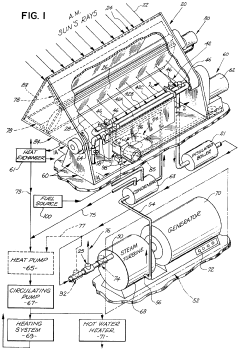
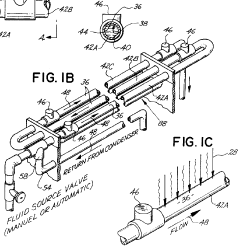
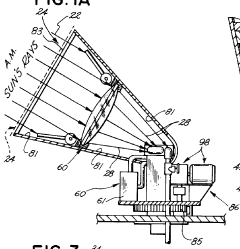
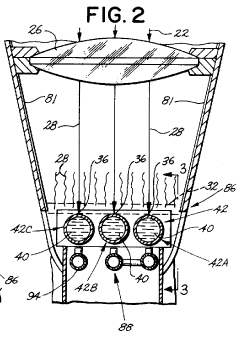
Solar energy conversion apparatus provided with an automatic cut-in heat-supplying standby apparatus
PatentInactiveUS4398391A
Innovation
- A composite solar energy conversion apparatus with radiation-concentrating and line-focusing optical means that reduces the radiation area, coupled with a closed cycle containment apparatus and automatic auxiliary heating, ensuring a constant thermal energy input to the working medium, and extending operation duration through solar-position-following motors.
System for converting thermal energy into electrical energy with improved efficiency
PatentInactiveEP2777148A1
Innovation
- A system comprising at least two preformed bimetallic strips connected in series with opposite and controlled curvatures, where the blistering of one strip facilitates the unblistering of the other, reducing energy needs and increasing switching frequency, coupled with a transducer like piezoelectric material to convert mechanical energy into electricity.
Materials Supply Chain and Scalability Assessment
The supply chain for twistronics-based energy conversion technologies presents unique challenges and opportunities in the emerging field of two-dimensional materials engineering. Currently, the production of high-quality twisted bilayer graphene and other van der Waals heterostructures relies heavily on specialized laboratory techniques, including mechanical exfoliation and precise angle-controlled stacking methods. These processes, while effective for research purposes, face significant barriers to industrial scalability due to their labor-intensive nature and low throughput.
Critical raw materials for twistronics applications include high-purity graphite, hexagonal boron nitride (hBN), and transition metal dichalcogenides (TMDCs). The global supply of these materials exhibits concerning concentration patterns, with graphite mining dominated by China (70%), Brazil, and Mozambique. Similarly, boron compounds essential for hBN synthesis are primarily sourced from Turkey and the United States, creating potential supply vulnerabilities.
Manufacturing scalability represents perhaps the most significant hurdle for commercialization of twistronics-based energy technologies. Current fabrication methods achieve precise twist angles through manual manipulation or specialized equipment with extremely low production volumes. Recent advances in chemical vapor deposition (CVD) techniques show promise for larger-scale production, but maintaining the critical twist angle precision at industrial scales remains challenging. The tolerance for angular deviation in most twistronics applications is less than 0.1 degrees, requiring unprecedented manufacturing precision.
Several companies and research institutions are developing alternative fabrication approaches to address these scalability issues. These include automated robotic assembly systems, epitaxial growth on pre-patterned substrates, and self-assembly techniques utilizing strain engineering. Each approach offers different trade-offs between precision, scalability, and cost-effectiveness.
The economic viability of twistronics-based energy conversion technologies will depend significantly on supply chain optimization and manufacturing innovation. Current production costs exceed $1000 per square centimeter for research-grade materials, necessitating orders-of-magnitude cost reduction for commercial applications. Recycling and circular economy approaches for these advanced materials remain underdeveloped, though the high value of constituent elements provides strong economic incentives for recovery systems.
Strategic partnerships between material suppliers, fabrication equipment manufacturers, and energy technology developers will be essential to establish robust supply chains. Additionally, diversification of raw material sources and development of synthetic alternatives could mitigate geopolitical supply risks while supporting the long-term scalability of this promising technology domain.
Critical raw materials for twistronics applications include high-purity graphite, hexagonal boron nitride (hBN), and transition metal dichalcogenides (TMDCs). The global supply of these materials exhibits concerning concentration patterns, with graphite mining dominated by China (70%), Brazil, and Mozambique. Similarly, boron compounds essential for hBN synthesis are primarily sourced from Turkey and the United States, creating potential supply vulnerabilities.
Manufacturing scalability represents perhaps the most significant hurdle for commercialization of twistronics-based energy technologies. Current fabrication methods achieve precise twist angles through manual manipulation or specialized equipment with extremely low production volumes. Recent advances in chemical vapor deposition (CVD) techniques show promise for larger-scale production, but maintaining the critical twist angle precision at industrial scales remains challenging. The tolerance for angular deviation in most twistronics applications is less than 0.1 degrees, requiring unprecedented manufacturing precision.
Several companies and research institutions are developing alternative fabrication approaches to address these scalability issues. These include automated robotic assembly systems, epitaxial growth on pre-patterned substrates, and self-assembly techniques utilizing strain engineering. Each approach offers different trade-offs between precision, scalability, and cost-effectiveness.
The economic viability of twistronics-based energy conversion technologies will depend significantly on supply chain optimization and manufacturing innovation. Current production costs exceed $1000 per square centimeter for research-grade materials, necessitating orders-of-magnitude cost reduction for commercial applications. Recycling and circular economy approaches for these advanced materials remain underdeveloped, though the high value of constituent elements provides strong economic incentives for recovery systems.
Strategic partnerships between material suppliers, fabrication equipment manufacturers, and energy technology developers will be essential to establish robust supply chains. Additionally, diversification of raw material sources and development of synthetic alternatives could mitigate geopolitical supply risks while supporting the long-term scalability of this promising technology domain.
Environmental Impact and Sustainability Factors
Twistronics-based energy conversion technologies present significant environmental implications that must be carefully evaluated in the context of global sustainability goals. The manufacturing processes for twisted bilayer graphene and other 2D materials currently involve energy-intensive methods and potentially hazardous chemicals. However, compared to traditional semiconductor fabrication, these processes potentially require fewer rare earth elements and toxic compounds, offering a pathway to reduced environmental footprints in electronics manufacturing.
The lifecycle assessment of twistronics devices reveals promising sustainability advantages. These nanoscale technologies operate with minimal material inputs while potentially delivering substantial energy efficiency improvements. For instance, preliminary research indicates that twistronics-based photovoltaic cells could achieve higher conversion efficiencies while using orders of magnitude less material than conventional silicon-based solar panels, significantly reducing resource extraction impacts.
Energy harvesting applications of twistronics may contribute substantially to decarbonization efforts. By enabling more efficient conversion of ambient energy sources (mechanical vibrations, thermal gradients, and electromagnetic radiation) into usable electricity, these technologies could reduce dependence on battery systems that carry significant environmental burdens throughout their lifecycle. The potential for self-powered sensors and devices would eliminate millions of disposable batteries from waste streams annually.
Water purification represents another promising environmental application. Twistronics-based membranes and electrodes demonstrate exceptional capabilities for removing contaminants through precisely engineered nanopores, potentially reducing energy requirements for desalination and filtration by 30-40% compared to current technologies. This advancement could dramatically improve access to clean water while reducing the carbon footprint of water treatment processes.
Circular economy considerations must guide twistronics development. The atomically precise nature of these materials presents both challenges and opportunities for recycling and reuse. While separation and recovery of 2D materials remains technically challenging, their minimal material requirements and potential longevity could significantly extend product lifecycles. Research into green synthesis methods using bio-based precursors and ambient-condition processing techniques shows promise for further reducing environmental impacts.
Regulatory frameworks and standardized assessment methodologies specific to nanomaterials will be essential to ensure that environmental benefits are realized while minimizing unintended consequences. Collaborative efforts between industry, academia, and environmental agencies are needed to establish comprehensive sustainability metrics for this emerging technology domain.
The lifecycle assessment of twistronics devices reveals promising sustainability advantages. These nanoscale technologies operate with minimal material inputs while potentially delivering substantial energy efficiency improvements. For instance, preliminary research indicates that twistronics-based photovoltaic cells could achieve higher conversion efficiencies while using orders of magnitude less material than conventional silicon-based solar panels, significantly reducing resource extraction impacts.
Energy harvesting applications of twistronics may contribute substantially to decarbonization efforts. By enabling more efficient conversion of ambient energy sources (mechanical vibrations, thermal gradients, and electromagnetic radiation) into usable electricity, these technologies could reduce dependence on battery systems that carry significant environmental burdens throughout their lifecycle. The potential for self-powered sensors and devices would eliminate millions of disposable batteries from waste streams annually.
Water purification represents another promising environmental application. Twistronics-based membranes and electrodes demonstrate exceptional capabilities for removing contaminants through precisely engineered nanopores, potentially reducing energy requirements for desalination and filtration by 30-40% compared to current technologies. This advancement could dramatically improve access to clean water while reducing the carbon footprint of water treatment processes.
Circular economy considerations must guide twistronics development. The atomically precise nature of these materials presents both challenges and opportunities for recycling and reuse. While separation and recovery of 2D materials remains technically challenging, their minimal material requirements and potential longevity could significantly extend product lifecycles. Research into green synthesis methods using bio-based precursors and ambient-condition processing techniques shows promise for further reducing environmental impacts.
Regulatory frameworks and standardized assessment methodologies specific to nanomaterials will be essential to ensure that environmental benefits are realized while minimizing unintended consequences. Collaborative efforts between industry, academia, and environmental agencies are needed to establish comprehensive sustainability metrics for this emerging technology domain.
Unlock deeper insights with PatSnap Eureka Quick Research — get a full tech report to explore trends and direct your research. Try now!
Generate Your Research Report Instantly with AI Agent
Supercharge your innovation with PatSnap Eureka AI Agent Platform!