

Using QNED for Enhanced Display Production Efficiency
JUN 18, 20259 MIN READ
Generate Your Research Report Instantly with AI Agent
Patsnap Eureka helps you evaluate technical feasibility & market potential.
QNED Technology Overview
QNED (Quantum Nano Emitting Diode) technology represents a significant advancement in display production, combining the strengths of quantum dot and mini-LED technologies. This innovative approach utilizes quantum dots as light-emitting materials, offering superior color performance and energy efficiency compared to traditional display technologies.
QNED displays are structured with a backlight unit consisting of mini-LEDs, which provide precise local dimming capabilities. These mini-LEDs excite a layer of quantum dots, which then emit light at specific wavelengths, resulting in highly accurate and vibrant colors. The quantum dots are typically made of semiconductor nanocrystals, carefully engineered to emit light at specific frequencies when stimulated by the mini-LED backlight.
One of the key advantages of QNED technology is its ability to achieve high brightness levels while maintaining excellent color accuracy and contrast. The combination of mini-LED backlighting and quantum dot color conversion allows for a wider color gamut and improved HDR performance compared to conventional LCD displays. Additionally, QNED displays can potentially offer better energy efficiency, as the quantum dots can convert light more efficiently than traditional color filters.
In terms of production efficiency, QNED technology presents several advantages. The use of quantum dots allows for a simpler manufacturing process compared to OLED displays, as it does not require the complex vapor deposition techniques used in OLED production. The mini-LED backlight can be produced using existing LED manufacturing processes, which are well-established and scalable.
However, QNED technology also faces some challenges. Ensuring uniform quantum dot distribution and maintaining consistent performance over time are critical aspects that require careful quality control during production. Additionally, optimizing the interaction between the mini-LED backlight and the quantum dot layer to achieve the desired color output and energy efficiency is an ongoing area of research and development.
As display manufacturers seek to improve production efficiency while delivering superior image quality, QNED technology offers a promising solution. It combines the benefits of quantum dot color performance with the controllability of mini-LED backlighting, potentially leading to more efficient production processes and higher-quality displays for various applications, including televisions, monitors, and mobile devices.
QNED displays are structured with a backlight unit consisting of mini-LEDs, which provide precise local dimming capabilities. These mini-LEDs excite a layer of quantum dots, which then emit light at specific wavelengths, resulting in highly accurate and vibrant colors. The quantum dots are typically made of semiconductor nanocrystals, carefully engineered to emit light at specific frequencies when stimulated by the mini-LED backlight.
One of the key advantages of QNED technology is its ability to achieve high brightness levels while maintaining excellent color accuracy and contrast. The combination of mini-LED backlighting and quantum dot color conversion allows for a wider color gamut and improved HDR performance compared to conventional LCD displays. Additionally, QNED displays can potentially offer better energy efficiency, as the quantum dots can convert light more efficiently than traditional color filters.
In terms of production efficiency, QNED technology presents several advantages. The use of quantum dots allows for a simpler manufacturing process compared to OLED displays, as it does not require the complex vapor deposition techniques used in OLED production. The mini-LED backlight can be produced using existing LED manufacturing processes, which are well-established and scalable.
However, QNED technology also faces some challenges. Ensuring uniform quantum dot distribution and maintaining consistent performance over time are critical aspects that require careful quality control during production. Additionally, optimizing the interaction between the mini-LED backlight and the quantum dot layer to achieve the desired color output and energy efficiency is an ongoing area of research and development.
As display manufacturers seek to improve production efficiency while delivering superior image quality, QNED technology offers a promising solution. It combines the benefits of quantum dot color performance with the controllability of mini-LED backlighting, potentially leading to more efficient production processes and higher-quality displays for various applications, including televisions, monitors, and mobile devices.
Display Market Trends
The display market has been experiencing significant growth and transformation in recent years, driven by technological advancements and changing consumer preferences. The global display market size reached $148 billion in 2021 and is projected to grow at a CAGR of 3.5% from 2022 to 2030. This growth is primarily fueled by the increasing demand for high-quality displays across various sectors, including consumer electronics, automotive, and healthcare.
One of the most notable trends in the display market is the shift towards advanced display technologies. OLED (Organic Light-Emitting Diode) displays have gained substantial market share, particularly in smartphones and high-end televisions, due to their superior picture quality and energy efficiency. However, the emergence of new technologies like QNED (Quantum Nano-Emitting Diode) is poised to disrupt the market further.
The demand for larger screen sizes in both the consumer and commercial sectors is another significant trend. Ultra-large displays, such as those used in digital signage and video walls, are seeing increased adoption in retail, hospitality, and corporate environments. This trend is driving innovations in display manufacturing processes to improve efficiency and reduce costs for larger panels.
Energy efficiency has become a crucial factor in display technology development. Consumers and regulators are increasingly focused on reducing power consumption, leading to the development of more energy-efficient display technologies. This trend aligns well with the potential benefits of QNED technology, which promises improved energy efficiency compared to traditional LCD and even OLED displays.
The automotive industry is emerging as a key growth driver for the display market. The increasing integration of advanced driver-assistance systems (ADAS) and infotainment systems in vehicles is creating a surge in demand for high-quality, durable displays. This sector requires displays that can withstand harsh environmental conditions while providing excellent visibility and touch responsiveness.
Flexibility and form factor innovation are also shaping the display market. Foldable and rollable displays are gaining traction, offering new possibilities for device design and user interaction. While these technologies are still in the early stages of mass adoption, they represent a significant area of research and development for display manufacturers.
The COVID-19 pandemic has accelerated certain trends in the display market, particularly the demand for larger home entertainment displays and increased adoption of remote work and learning technologies. This has led to a surge in demand for monitors and large-screen TVs, as well as displays for video conferencing equipment.
One of the most notable trends in the display market is the shift towards advanced display technologies. OLED (Organic Light-Emitting Diode) displays have gained substantial market share, particularly in smartphones and high-end televisions, due to their superior picture quality and energy efficiency. However, the emergence of new technologies like QNED (Quantum Nano-Emitting Diode) is poised to disrupt the market further.
The demand for larger screen sizes in both the consumer and commercial sectors is another significant trend. Ultra-large displays, such as those used in digital signage and video walls, are seeing increased adoption in retail, hospitality, and corporate environments. This trend is driving innovations in display manufacturing processes to improve efficiency and reduce costs for larger panels.
Energy efficiency has become a crucial factor in display technology development. Consumers and regulators are increasingly focused on reducing power consumption, leading to the development of more energy-efficient display technologies. This trend aligns well with the potential benefits of QNED technology, which promises improved energy efficiency compared to traditional LCD and even OLED displays.
The automotive industry is emerging as a key growth driver for the display market. The increasing integration of advanced driver-assistance systems (ADAS) and infotainment systems in vehicles is creating a surge in demand for high-quality, durable displays. This sector requires displays that can withstand harsh environmental conditions while providing excellent visibility and touch responsiveness.
Flexibility and form factor innovation are also shaping the display market. Foldable and rollable displays are gaining traction, offering new possibilities for device design and user interaction. While these technologies are still in the early stages of mass adoption, they represent a significant area of research and development for display manufacturers.
The COVID-19 pandemic has accelerated certain trends in the display market, particularly the demand for larger home entertainment displays and increased adoption of remote work and learning technologies. This has led to a surge in demand for monitors and large-screen TVs, as well as displays for video conferencing equipment.
QNED Challenges
QNED (Quantum Nano Emitting Diode) technology, while promising for enhanced display production efficiency, faces several significant challenges in its development and implementation. One of the primary obstacles is the complexity of manufacturing processes required to produce QNED displays at scale. The precise control needed for quantum dot placement and alignment demands highly sophisticated equipment and techniques, which can be both costly and time-consuming to develop and implement.
Another major challenge lies in the stability and longevity of QNED displays. Quantum dots are known to be sensitive to environmental factors such as heat, moisture, and oxygen, which can degrade their performance over time. Ensuring the long-term reliability of QNED displays under various operating conditions remains a critical hurdle that researchers and manufacturers must overcome.
Color accuracy and consistency present additional challenges for QNED technology. While quantum dots offer the potential for exceptional color reproduction, achieving uniform color performance across the entire display area and maintaining color stability over the device's lifetime requires advanced color management systems and quality control measures.
The integration of QNED technology with existing display manufacturing infrastructure also poses significant challenges. Many display manufacturers have invested heavily in LCD or OLED production lines, and transitioning to QNED may require substantial retooling and retraining of personnel, which can be both expensive and disruptive to current operations.
Energy efficiency is another area where QNED technology faces challenges. While quantum dots have the potential to improve energy efficiency in displays, optimizing the power consumption of QNED displays to compete with or surpass existing technologies like OLED remains a key focus for researchers and engineers.
Material sourcing and supply chain management present additional hurdles for QNED production. The rare earth materials often used in quantum dots can be subject to supply constraints and price volatility, potentially impacting the cost-effectiveness and scalability of QNED display production.
Regulatory compliance and environmental concerns also pose challenges for QNED technology. As with any new display technology, ensuring that QNED displays meet safety standards and environmental regulations across different markets will require rigorous testing and potentially design modifications.
Lastly, market acceptance and consumer education represent significant challenges for QNED adoption. As a relatively new technology, QNED must demonstrate clear advantages over existing display technologies to gain traction in the competitive display market. Educating consumers about the benefits of QNED and differentiating it from other quantum dot-enhanced displays will be crucial for its commercial success.
Another major challenge lies in the stability and longevity of QNED displays. Quantum dots are known to be sensitive to environmental factors such as heat, moisture, and oxygen, which can degrade their performance over time. Ensuring the long-term reliability of QNED displays under various operating conditions remains a critical hurdle that researchers and manufacturers must overcome.
Color accuracy and consistency present additional challenges for QNED technology. While quantum dots offer the potential for exceptional color reproduction, achieving uniform color performance across the entire display area and maintaining color stability over the device's lifetime requires advanced color management systems and quality control measures.
The integration of QNED technology with existing display manufacturing infrastructure also poses significant challenges. Many display manufacturers have invested heavily in LCD or OLED production lines, and transitioning to QNED may require substantial retooling and retraining of personnel, which can be both expensive and disruptive to current operations.
Energy efficiency is another area where QNED technology faces challenges. While quantum dots have the potential to improve energy efficiency in displays, optimizing the power consumption of QNED displays to compete with or surpass existing technologies like OLED remains a key focus for researchers and engineers.
Material sourcing and supply chain management present additional hurdles for QNED production. The rare earth materials often used in quantum dots can be subject to supply constraints and price volatility, potentially impacting the cost-effectiveness and scalability of QNED display production.
Regulatory compliance and environmental concerns also pose challenges for QNED technology. As with any new display technology, ensuring that QNED displays meet safety standards and environmental regulations across different markets will require rigorous testing and potentially design modifications.
Lastly, market acceptance and consumer education represent significant challenges for QNED adoption. As a relatively new technology, QNED must demonstrate clear advantages over existing display technologies to gain traction in the competitive display market. Educating consumers about the benefits of QNED and differentiating it from other quantum dot-enhanced displays will be crucial for its commercial success.
Current QNED Solutions
01 Quantum dot synthesis and integration
Improving the synthesis and integration of quantum dots into QNED structures is crucial for enhancing production efficiency. This involves optimizing the growth process of quantum dots, their size distribution, and their incorporation into the device structure. Advanced techniques for precise control over quantum dot properties and placement can significantly impact the overall efficiency of QNED production.- Quantum dot synthesis and integration: Improving the synthesis and integration of quantum dots into the QNED structure is crucial for enhancing production efficiency. This involves optimizing the growth process of quantum dots, their size distribution, and their incorporation into the device architecture. Advanced techniques for precise control over quantum dot properties and placement can significantly impact the overall performance and production yield of QNEDs.
- Nanostructure fabrication techniques: Developing efficient nanostructure fabrication techniques is essential for QNED production. This includes methods for creating nanoscale patterns, etching processes, and deposition techniques that allow for precise control over the device's quantum confinement regions. Advanced lithography and self-assembly techniques can be employed to improve the uniformity and scalability of QNED production.
- Electrode and contact optimization: Optimizing the design and fabrication of electrodes and electrical contacts is crucial for QNED efficiency. This involves developing materials and structures that enhance charge injection and extraction, reduce contact resistance, and improve overall device performance. Novel electrode configurations and materials can significantly impact the production efficiency and operational characteristics of QNEDs.
- Encapsulation and packaging techniques: Improving encapsulation and packaging methods is vital for protecting QNEDs from environmental factors and enhancing their longevity. This includes developing advanced sealing techniques, moisture barriers, and thermal management solutions. Efficient packaging processes can significantly increase production yield and device reliability, contributing to overall production efficiency.
- Quality control and characterization methods: Implementing advanced quality control and characterization methods is essential for improving QNED production efficiency. This involves developing high-throughput testing procedures, in-line monitoring techniques, and non-destructive evaluation methods. Accurate and efficient characterization tools can help identify defects early in the production process, reduce waste, and improve overall yield.
02 Nanostructure fabrication techniques
Developing and refining nanostructure fabrication techniques is essential for QNED production efficiency. This includes methods for creating nanoscale patterns, etching processes, and deposition techniques that allow for precise control over the device architecture. Improved nanostructure fabrication can lead to better device performance and higher production yields.Expand Specific Solutions03 Material selection and optimization
Selecting and optimizing materials for QNED production plays a crucial role in efficiency. This involves researching and developing new materials with enhanced optical and electrical properties, as well as optimizing existing materials for better performance. Careful material selection can improve quantum efficiency, color purity, and overall device stability.Expand Specific Solutions04 Manufacturing process automation
Automating various stages of the QNED manufacturing process can significantly improve production efficiency. This includes the development of advanced robotics, machine learning algorithms for process control, and integrated production systems. Automation can reduce human error, increase throughput, and ensure consistent quality in QNED production.Expand Specific Solutions05 Device structure optimization
Optimizing the overall device structure of QNEDs is crucial for enhancing production efficiency. This involves refining the layer stack, improving electron and hole transport layers, and optimizing the light extraction mechanisms. A well-designed device structure can lead to better performance, higher yields, and more efficient production processes.Expand Specific Solutions
Key QNED Manufacturers
The QNED (Quantum Nano Emitting Diode) technology for enhanced display production efficiency is in its early development stage, with significant potential for market growth. The global display market, valued at over $100 billion, is witnessing a shift towards advanced technologies like QNED. While not yet fully mature, QNED is gaining traction due to its promise of improved efficiency and image quality. Key players such as Samsung Display, LG Display, and BOE Technology Group are investing heavily in QNED research and development. These companies, along with others like Sharp and TCL, are competing to commercialize QNED technology, focusing on overcoming technical challenges and scaling up production capabilities to meet the growing demand for high-performance displays in various applications.
BOE Technology Group Co., Ltd.
Technical Solution: BOE has developed a QNED (Quantum Nano Emitting Diode) display technology that combines quantum dot and mini-LED technologies. Their approach involves using a blue mini-LED backlight with red and green quantum dots to produce highly efficient and color-accurate displays. BOE's QNED panels feature thousands of local dimming zones, offering improved contrast ratios and HDR performance compared to traditional LCD displays. The company has also optimized the manufacturing process to enhance production efficiency, including advanced quantum dot deposition techniques and precise mini-LED placement methods.
Strengths: Superior color accuracy and wider color gamut compared to conventional LCDs. Improved energy efficiency due to the use of quantum dots. Enhanced contrast ratios and HDR capabilities. Weaknesses: Higher production costs compared to traditional LCD manufacturing. Potential challenges in achieving uniform quantum dot distribution across large panels.
Samsung Display Co., Ltd.
Technical Solution: Samsung Display has been actively developing QNED technology as part of its next-generation display portfolio. Their approach focuses on integrating quantum dot color conversion layers with nanorod LED structures to create self-emissive displays. Samsung's QNED technology aims to combine the advantages of QLED and OLED, offering improved brightness, color volume, and longevity. The company has implemented advanced manufacturing techniques, including precise nanorod LED patterning and quantum dot inkjet printing, to enhance production efficiency. Samsung is also exploring the use of AI-driven quality control systems to optimize QNED panel yields and reduce production time.
Strengths: Potential for higher peak brightness compared to OLED displays. Improved color purity and expanded color gamut. Longer lifespan due to inorganic materials. Weaknesses: Complex manufacturing process requiring high precision. Potential for higher initial production costs compared to established display technologies.
QNED Core Innovations
Inkjet head and method of ejecting ink using the same
PatentActiveUS11845276B2
Innovation
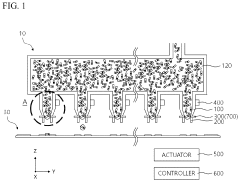
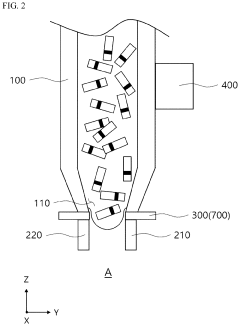
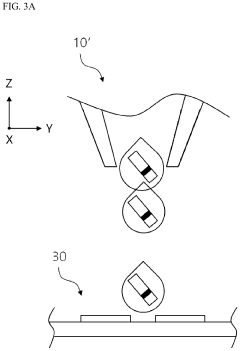
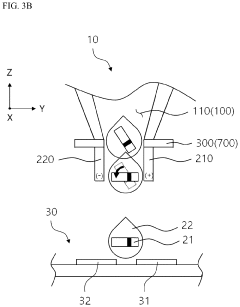
- An inkjet head with nozzles and pairs of electrodes that apply an electrode voltage to the light-emitting elements, including a first and second piezoelectric element, and a controller to independently control the electrode voltage, allowing for precise arrangement of light-emitting elements on a substrate with separate electrodes before and during the jetting process.
Display substrate, display device, and manufacturing method for display substrate
PatentPendingUS20230145503A1
Innovation
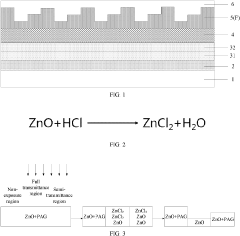
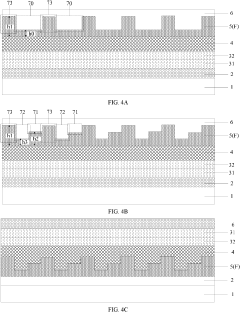
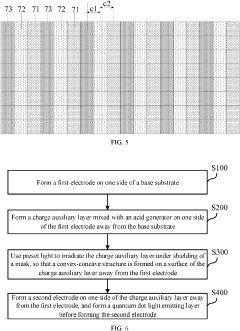
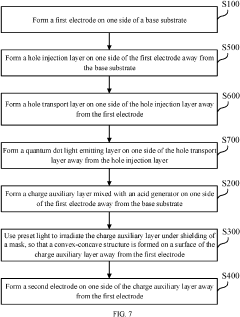
- A display substrate with a base substrate, a first electrode, a charge auxiliary layer featuring concave-convex structures and varying acid generator content, and a quantum dot light emitting layer, where the charge auxiliary layer is formed using a mask with different light transmittance regions to create periodic convex-concave structures that enhance light extraction by total reflection.
QNED Production Process
The QNED (Quantum Nano Emitting Diode) production process represents a significant advancement in display manufacturing technology. This innovative approach combines the benefits of quantum dot technology with mini-LED backlighting to create displays with superior color accuracy, contrast, and energy efficiency.
The QNED production process begins with the fabrication of the quantum dot layer. This involves the precise deposition of nano-scale semiconductor particles onto a substrate. These quantum dots are carefully engineered to emit specific wavelengths of light when excited, allowing for highly accurate color reproduction. The size and composition of the quantum dots are meticulously controlled to achieve the desired spectral output.
Following the quantum dot layer preparation, the mini-LED backlight array is manufactured. This process involves the production of thousands of miniature LED chips, typically measuring less than 200 micrometers in size. These mini-LEDs are then precisely arranged and mounted onto a circuit board to form the backlight unit. The high density of mini-LEDs allows for enhanced local dimming capabilities, resulting in improved contrast and black levels.
The integration of the quantum dot layer with the mini-LED backlight is a critical step in the QNED production process. This requires precise alignment and bonding techniques to ensure optimal light transmission and color conversion. Advanced optical films and diffusers may be incorporated to enhance light distribution and uniformity across the display surface.
The QNED panel assembly involves the integration of additional components such as the liquid crystal layer, color filters, and polarizers. These elements work in conjunction with the quantum dot and mini-LED layers to produce the final image. The assembly process requires stringent quality control measures to maintain consistency and performance across the entire display area.
To enhance production efficiency, manufacturers are implementing advanced automation and robotics systems throughout the QNED production process. These systems enable precise handling of delicate components, reduce human error, and increase throughput. Additionally, in-line quality control systems utilizing machine vision and spectral analysis ensure that each panel meets rigorous performance standards.
The QNED production process also incorporates innovative materials and techniques to improve yield rates and reduce manufacturing costs. This includes the development of more efficient quantum dot synthesis methods, improved mini-LED packaging techniques, and optimized optical designs to maximize light utilization.
As QNED technology continues to evolve, ongoing research and development efforts are focused on further refining the production process. This includes exploring new quantum dot materials with enhanced stability and efficiency, developing advanced mini-LED designs for improved light output and control, and investigating novel integration methods to simplify the overall manufacturing process.
The QNED production process begins with the fabrication of the quantum dot layer. This involves the precise deposition of nano-scale semiconductor particles onto a substrate. These quantum dots are carefully engineered to emit specific wavelengths of light when excited, allowing for highly accurate color reproduction. The size and composition of the quantum dots are meticulously controlled to achieve the desired spectral output.
Following the quantum dot layer preparation, the mini-LED backlight array is manufactured. This process involves the production of thousands of miniature LED chips, typically measuring less than 200 micrometers in size. These mini-LEDs are then precisely arranged and mounted onto a circuit board to form the backlight unit. The high density of mini-LEDs allows for enhanced local dimming capabilities, resulting in improved contrast and black levels.
The integration of the quantum dot layer with the mini-LED backlight is a critical step in the QNED production process. This requires precise alignment and bonding techniques to ensure optimal light transmission and color conversion. Advanced optical films and diffusers may be incorporated to enhance light distribution and uniformity across the display surface.
The QNED panel assembly involves the integration of additional components such as the liquid crystal layer, color filters, and polarizers. These elements work in conjunction with the quantum dot and mini-LED layers to produce the final image. The assembly process requires stringent quality control measures to maintain consistency and performance across the entire display area.
To enhance production efficiency, manufacturers are implementing advanced automation and robotics systems throughout the QNED production process. These systems enable precise handling of delicate components, reduce human error, and increase throughput. Additionally, in-line quality control systems utilizing machine vision and spectral analysis ensure that each panel meets rigorous performance standards.
The QNED production process also incorporates innovative materials and techniques to improve yield rates and reduce manufacturing costs. This includes the development of more efficient quantum dot synthesis methods, improved mini-LED packaging techniques, and optimized optical designs to maximize light utilization.
As QNED technology continues to evolve, ongoing research and development efforts are focused on further refining the production process. This includes exploring new quantum dot materials with enhanced stability and efficiency, developing advanced mini-LED designs for improved light output and control, and investigating novel integration methods to simplify the overall manufacturing process.
QNED vs. Competitors
QNED (Quantum Nano Emitting Diode) technology represents a significant advancement in display production, offering several advantages over its competitors in the market. When compared to traditional LCD and OLED technologies, QNED displays demonstrate superior performance in key areas such as brightness, color accuracy, and energy efficiency.
In terms of brightness, QNED displays outperform both LCD and OLED counterparts. The quantum dot technology used in QNED allows for higher peak brightness levels, resulting in more vibrant and lifelike images. This enhanced brightness capability is particularly beneficial in high dynamic range (HDR) content reproduction, where QNED displays can deliver more impactful visual experiences.
Color accuracy is another area where QNED excels. The precise control over individual nano-emitters enables QNED displays to produce a wider color gamut with more accurate color reproduction. This advantage is especially noticeable when compared to LCD technology, which often struggles with color accuracy due to limitations in backlight and color filter designs.
Energy efficiency is a crucial factor in display technology, and QNED shows promising results in this aspect. Compared to OLED displays, which can suffer from power consumption issues, especially when displaying bright content, QNED technology offers a more balanced approach to energy management. The ability to selectively activate nano-emitters allows for better power distribution across the display, resulting in improved overall efficiency.
Durability and longevity are additional areas where QNED technology demonstrates advantages over its competitors. Unlike OLED displays, which can be susceptible to burn-in issues over time, QNED displays are expected to maintain consistent performance throughout their lifespan. This increased durability translates to lower maintenance costs and longer product life cycles for consumers and businesses alike.
In the context of production efficiency, QNED technology offers several benefits. The manufacturing process for QNED displays is potentially more streamlined compared to OLED production, which often involves complex and costly vapor deposition techniques. QNED's approach, utilizing quantum dot technology, may allow for more efficient mass production methods, potentially reducing overall manufacturing costs.
However, it is important to note that QNED technology is still relatively new compared to established LCD and OLED technologies. As such, it faces challenges in terms of market penetration and economies of scale. Competitors in the LCD and OLED spaces benefit from years of refinement and established production infrastructures, which currently give them an edge in terms of cost-effectiveness and widespread availability.
In conclusion, while QNED technology demonstrates significant advantages in key performance areas and production efficiency potential, it must overcome the established market presence of its competitors to gain widespread adoption. As the technology matures and production processes are optimized, QNED displays are poised to become a formidable competitor in the display market, offering a compelling alternative to existing technologies.
In terms of brightness, QNED displays outperform both LCD and OLED counterparts. The quantum dot technology used in QNED allows for higher peak brightness levels, resulting in more vibrant and lifelike images. This enhanced brightness capability is particularly beneficial in high dynamic range (HDR) content reproduction, where QNED displays can deliver more impactful visual experiences.
Color accuracy is another area where QNED excels. The precise control over individual nano-emitters enables QNED displays to produce a wider color gamut with more accurate color reproduction. This advantage is especially noticeable when compared to LCD technology, which often struggles with color accuracy due to limitations in backlight and color filter designs.
Energy efficiency is a crucial factor in display technology, and QNED shows promising results in this aspect. Compared to OLED displays, which can suffer from power consumption issues, especially when displaying bright content, QNED technology offers a more balanced approach to energy management. The ability to selectively activate nano-emitters allows for better power distribution across the display, resulting in improved overall efficiency.
Durability and longevity are additional areas where QNED technology demonstrates advantages over its competitors. Unlike OLED displays, which can be susceptible to burn-in issues over time, QNED displays are expected to maintain consistent performance throughout their lifespan. This increased durability translates to lower maintenance costs and longer product life cycles for consumers and businesses alike.
In the context of production efficiency, QNED technology offers several benefits. The manufacturing process for QNED displays is potentially more streamlined compared to OLED production, which often involves complex and costly vapor deposition techniques. QNED's approach, utilizing quantum dot technology, may allow for more efficient mass production methods, potentially reducing overall manufacturing costs.
However, it is important to note that QNED technology is still relatively new compared to established LCD and OLED technologies. As such, it faces challenges in terms of market penetration and economies of scale. Competitors in the LCD and OLED spaces benefit from years of refinement and established production infrastructures, which currently give them an edge in terms of cost-effectiveness and widespread availability.
In conclusion, while QNED technology demonstrates significant advantages in key performance areas and production efficiency potential, it must overcome the established market presence of its competitors to gain widespread adoption. As the technology matures and production processes are optimized, QNED displays are poised to become a formidable competitor in the display market, offering a compelling alternative to existing technologies.
Unlock deeper insights with Patsnap Eureka Quick Research — get a full tech report to explore trends and direct your research. Try now!
Generate Your Research Report Instantly with AI Agent
Supercharge your innovation with Patsnap Eureka AI Agent Platform!