
Dual clutch transmission
A dual-clutch and transmission technology, which is applied to vehicle gearboxes, transmissions, transportation and packaging, etc., can solve the problems of increasing structural expenditure and cost expenditure, increasing weight, and the fact that separate transmissions are rarely beneficial, so as to achieve low structural space requirements and Effects of weight and manufacturing costs, short structural ends, efficient utilization of structural space
- Summary
- Abstract
- Description
- Claims
- Application Information
AI Technical Summary
Problems solved by technology
Method used
Image

Examples
Embodiment Construction
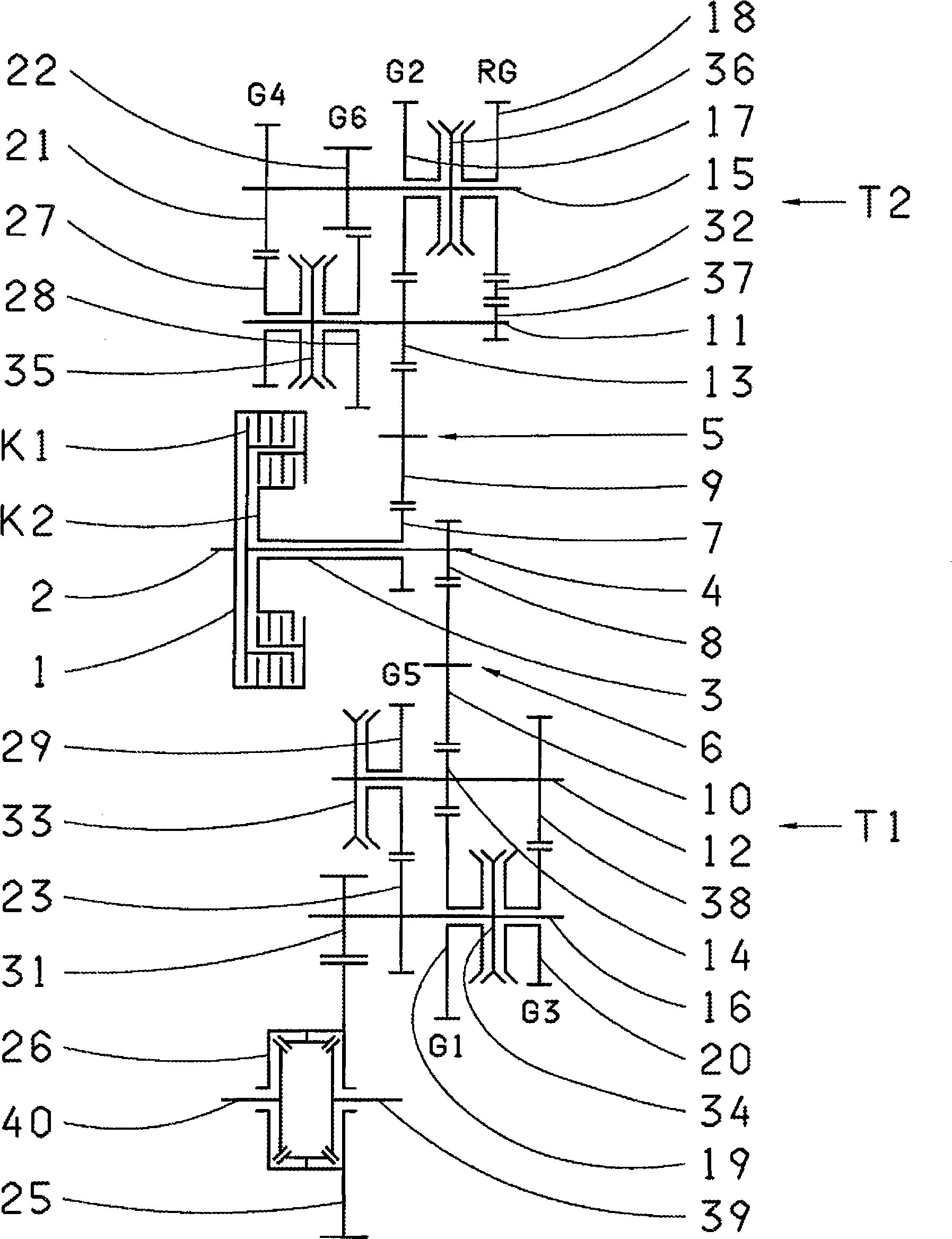
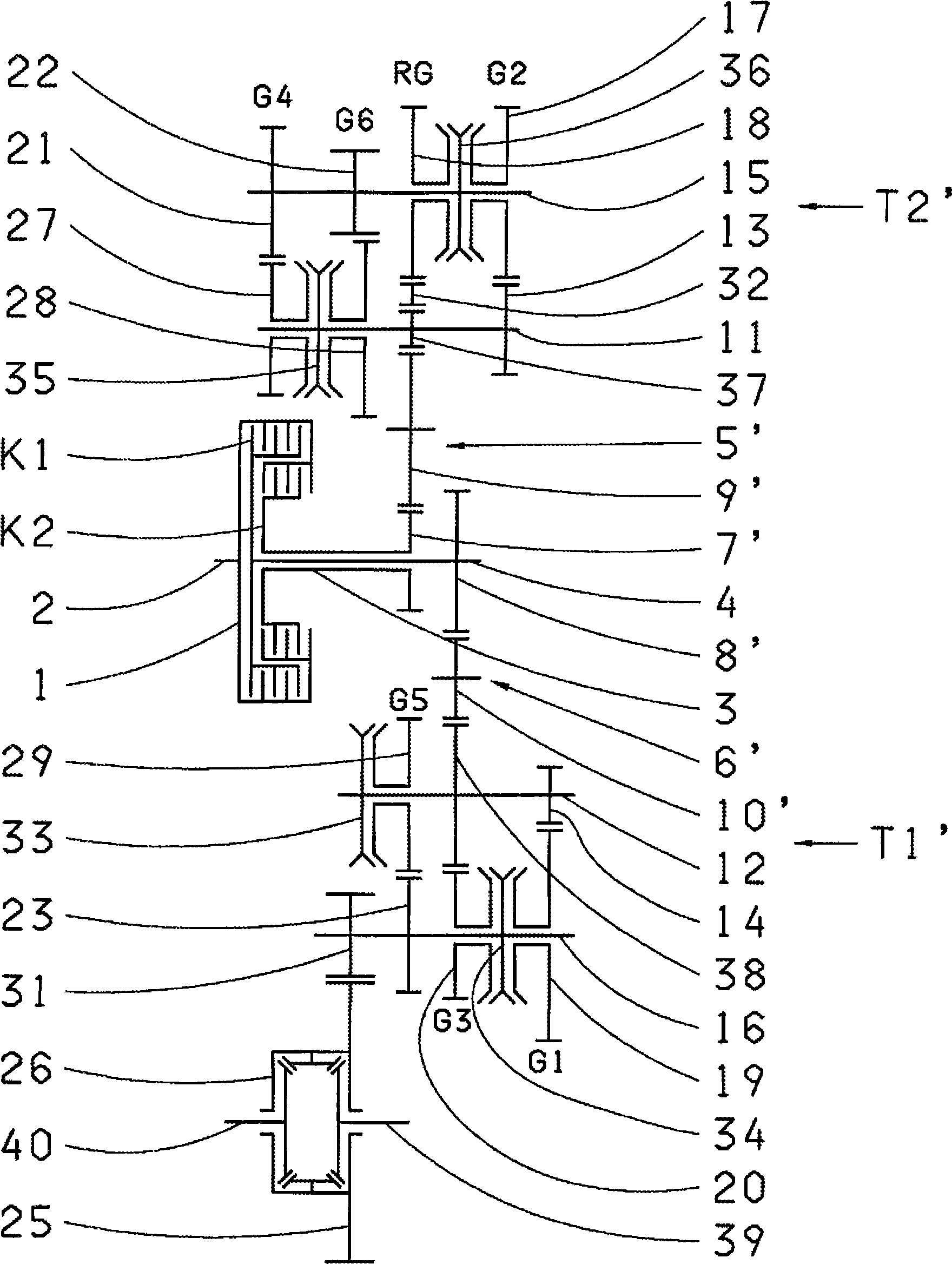
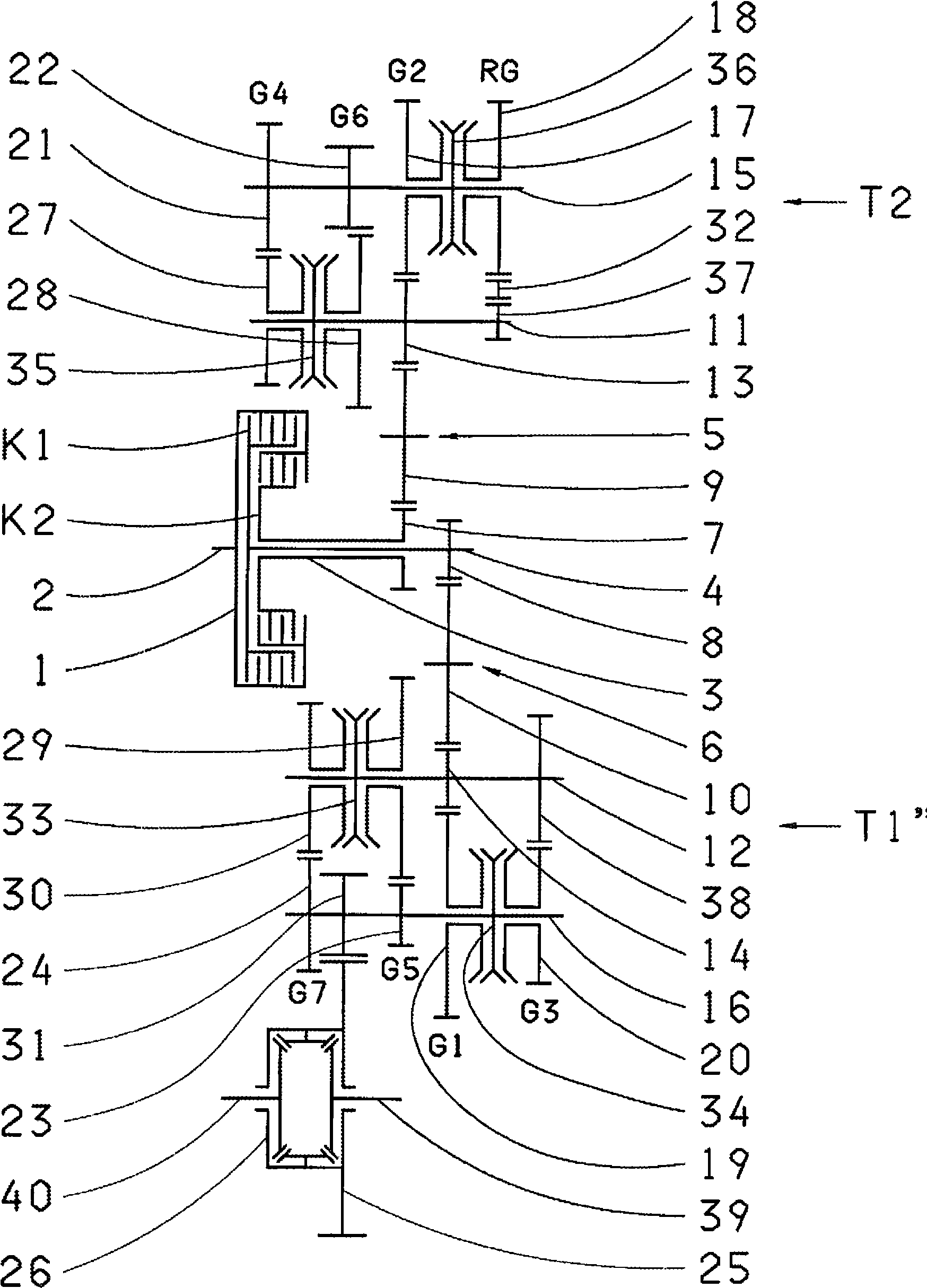
[0035] Accordingly, figure 1 A schematic diagram of a transmission for a six-speed dual-clutch transmission mounted on a front transverse motor vehicle is shown in . In this dual clutch transmission, the dual clutch 1 consisting of two starting clutches K1, K2 drives two coaxial transmission input shafts 3 and 4 according to the sequential control of the two clutches K1 and K2, the dual clutch or directly with The crankshaft 2 of the internal combustion engine (not shown) is connected or, for vibration damping, advantageously via a torsional vibration damper or a dual mass flywheel, to the crankshaft 2 of the internal combustion engine (not shown). Here, the input shaft 4, designed as an inner solid shaft, drives the group of odd gears G1, G3, G5, while the transmission input shaft 3, designed as an outer hollow shaft, drives the group of even gears G2, G4, G6 and the reverse gear RG. The reverse gear RG is advantageously always assigned to the even gear group G2 , G4 , G6 a...
PUM
 Login to View More
 Abstract
Description
Claims
Application Information
 Login to View More