
Offline map matching method and system based on complex trajectory network partition model
A network division and offline map technology, applied in directions such as road network navigators, can solve the problem of long time consumption, achieve the effect of balancing the relationship between efficiency and accuracy, and improving accuracy and high precision
Patent Information
- Authority / Receiving Office
- CN · China
- Patent Type
- Patents(China)
- Current Assignee / Owner
- Publication Date
- 2021-03-26
Smart Images
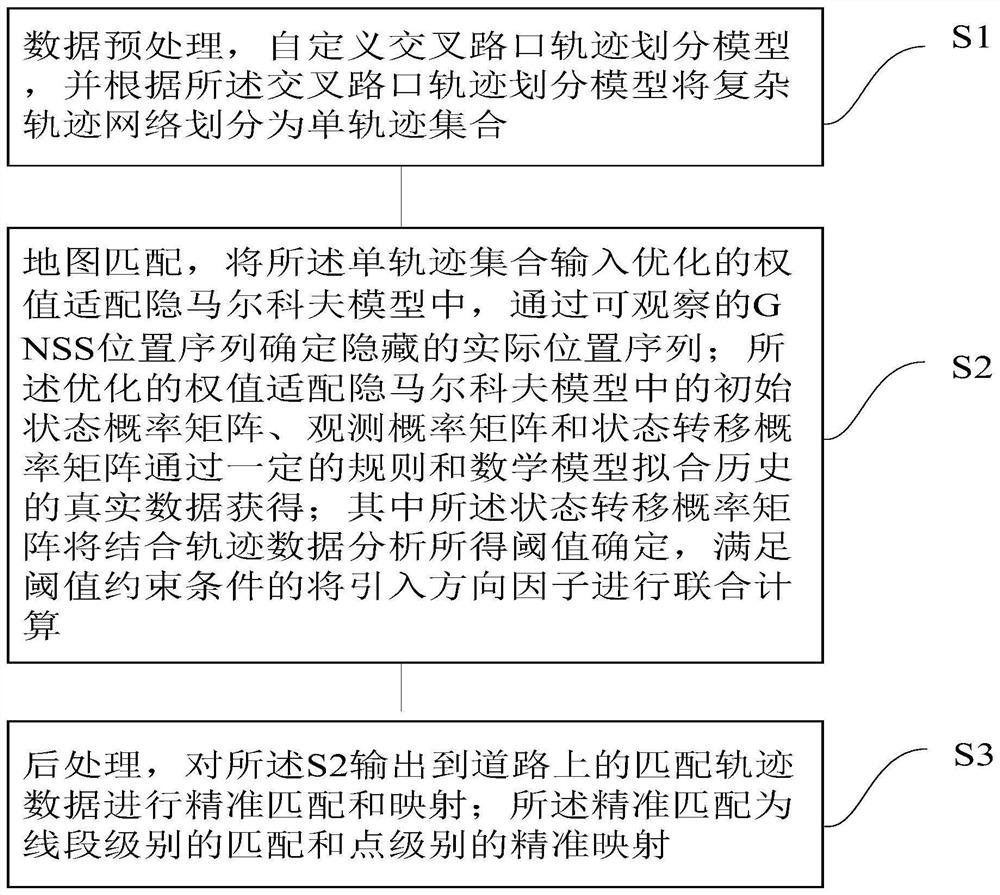
Figure 1 
Figure 2 
Figure 3
Abstract
Description
technical field
[0001] The invention relates to an offline map matching technology, in particular to an offline map matching method and system based on a complex trajectory network partition model. Background technique
[0002] Map matching is to map a series of GNSS trajectory points with time and space dimension information with loss of accuracy to the actual road, and assist in solving related problems in urban computing, such as intelligent transportation, user travel, trajectory depth understanding and other location-based services. The improvement of map matching accuracy is still a hot and difficult issue, which directly affects location-based data services. Offline map matching of complex trajectory networks requires higher precision and is often more time-consuming. It is necessary to balance the relationship between precision and time.
[0003] In recent years, with the rapid development of wireless networks and "Internet + sharing economy", the online travel ser...
Examples
Embodiment
[0062] Such as figure 1 As shown, the offline map matching method based on the complex road network division model of the present invention includes the following steps: S1: data preprocessing, custom intersection trajectory division model, and according to the intersection trajectory division model, the complex trajectory network is divided into Single track set; S2: map matching, the single track set is input into the optimized weight fitting hidden Markov model, and the hidden actual position sequence is determined through the observable GNSS position sequence; the optimized weight value adapts The initial state probability matrix, observation probability matrix and state transition probability matrix in the hidden Markov model are obtained by fitting historical real data through certain rules and mathematical models; the state transition probability matrix will be obtained by combining trajectory big data analysis The threshold is determined, and if the threshold constrain...