
Graph convolution drug pair interaction prediction method and system based on knowledge graph
A knowledge map and prediction method technology, applied in the field of drug pair interaction prediction, can solve problems such as the scarcity of multi-type label data, ignoring the potential relationship between drugs and other entities, and the difficulty of obtaining batch training of data samples with reasonable distribution. Short-term, high-accuracy effects
Patent Information
- Authority / Receiving Office
- CN · China
- Patent Type
- Applications(China)
- Current Assignee / Owner
- Publication Date
- 2020-08-21
Smart Images
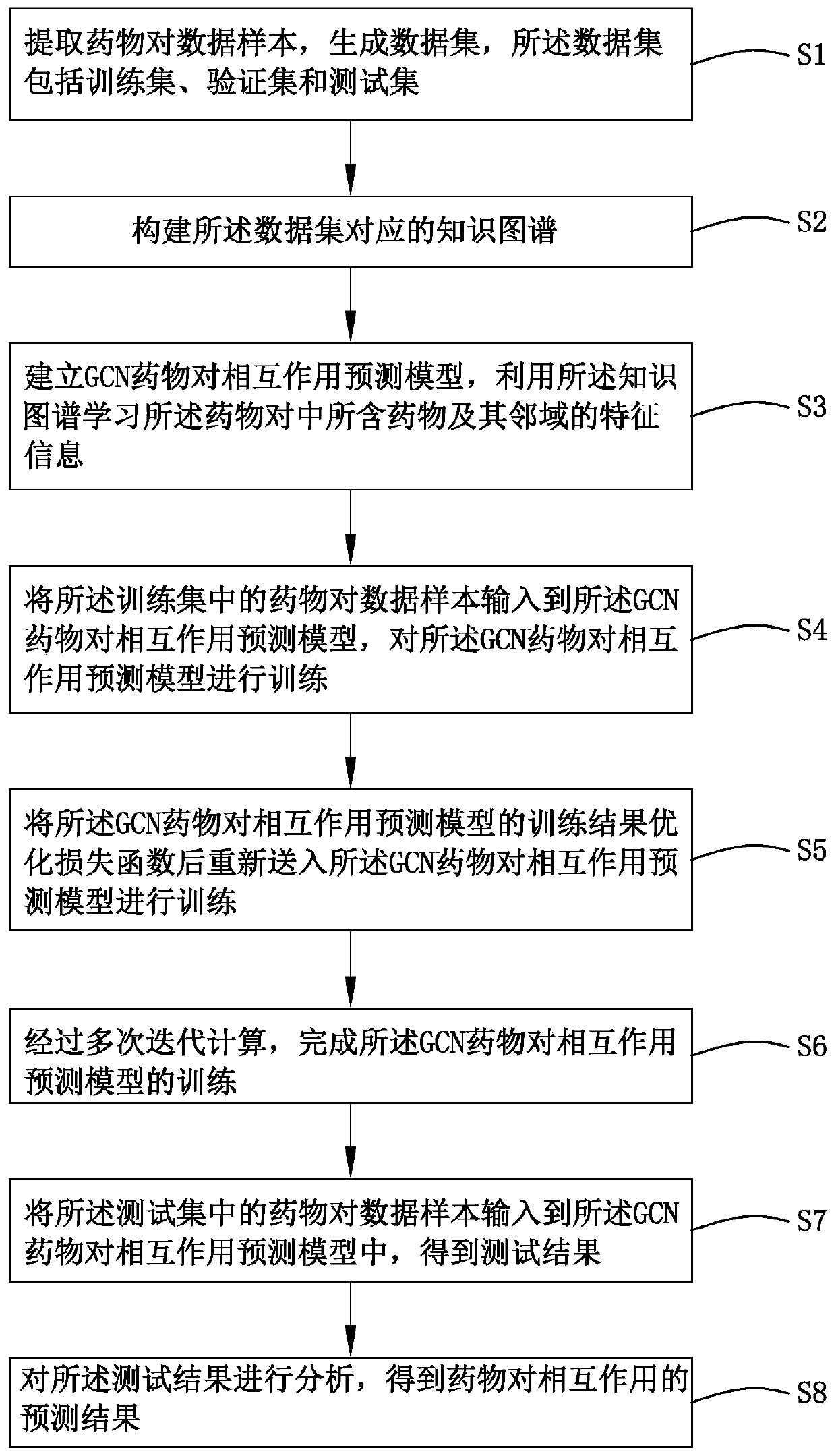
Figure 1 
Figure 2 
Figure 3
Abstract
Description
Technical field
[0001] The present invention relates to the technical field of drug pair interaction prediction, in particular to a knowledge map-based graph convolution drug pair interaction prediction method and system.
Background technique
[0002] Drug R&D is a high-investment and high-risk field. It takes an average of 10-15 years for a drug to go from R&D to marketing, with an average investment of about 2.6 billion US dollars, and on average, only one of every 5,000-10,000 molecules entering the R&D pipeline can Successfully developed. The use of computing methods can greatly reduce costs. Relying on data-driven machine learning methods, training models through a large number of open source experimental data and predicting downstream tasks has become a hot spot in the field of drug discovery as an auxiliary computing.
[0003] In related technologies, machine learning algorithms are widely used in the prediction of drug-drug interactions. Most of the existing ar...
Examples
Embodiment Construction
[0040] The following will clearly and completely describe the technical solutions in the embodiments of the present invention with reference to the accompanying drawings in the embodiments of the present invention. Obviously, the described embodiments are only some, not all, embodiments of the present invention. Based on the embodiments of the present invention, all other embodiments obtained by persons of ordinary skill in the art without making creative efforts belong to the protection scope of the present invention.
[0041] see figure 1 , the present invention provides a graph convolution drug pair interaction prediction method based on knowledge graph, comprising the following steps:
[0042] S1: Extract medicine pair data sample, generate data set, described data set comprises training set, verification set and test set.
[0043] The proportion of the training set in the data set is 80%, the proportion of the verification set is 10%, and the proportion of the test set i...