
Rotor rubbing acoustic emission signal denoising method
An acoustic emission signal and signal emission technology, which is applied in the direction of sound-emitting devices, measuring devices, instruments, etc., can solve the problems of not being able to reflect the rubbing state of rotating machinery, noise pollution of acoustic emission signals, etc., and achieve less multiplication and division operations and faster noise reduction fast, improve the effect of noise reduction effect
Patent Information
- Authority / Receiving Office
- CN · China
- Patent Type
- Patents(China)
- Current Assignee / Owner
- Publication Date
- 2012-05-30
- Estimated Expiration
- Not applicable · inactive patent
Smart Images
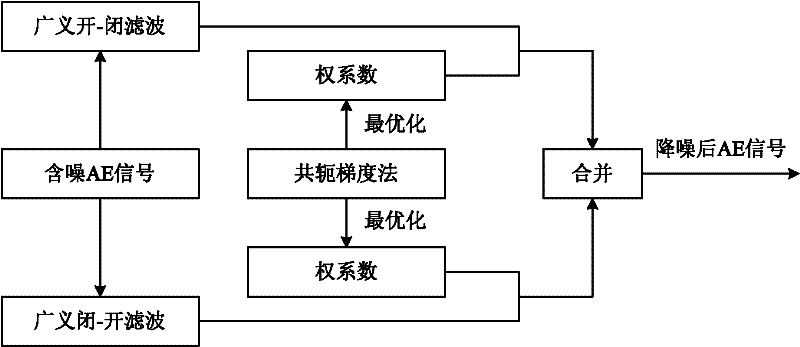
Figure 1 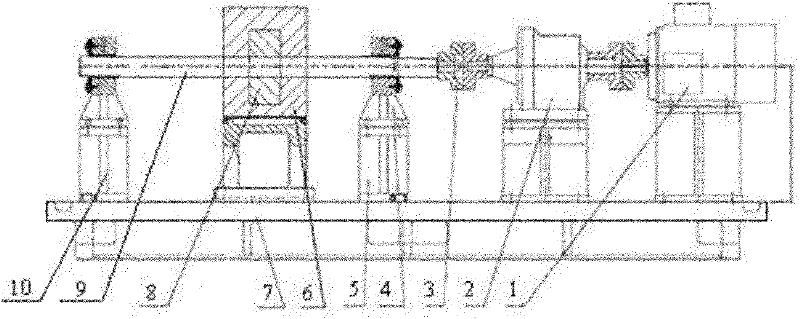
Figure 2 
Figure 3
Abstract
Description
technical field
[0001] The invention relates to an acoustic emission signal noise reduction method, in particular to a rotor rubbing acoustic emission signal noise reduction method based on a conjugate gradient method and an adaptive generalized morphological filter. Background technique
[0002] Rubbing between moving and static parts of rotating machinery due to factors such as unbalance, misalignment, and thermal bending during operation is a relatively common and typical fault. Acoustic Emission (AE) has become a method for rubbing fault detection of rotating machinery due to its high sensitivity and wide frequency response range. However, in actual engineering measurement, the acoustic emission signals collected on site are often polluted by various noises, especially the relatively harsh working environment of rotating machinery and the multi-source strong noise generated by the equipment itself during operation, so that the friction acoustic emission signals cannot re...
Examples
Embodiment Construction
[0019] Below in conjunction with accompanying drawing, the technical scheme of invention is described in detail:
[0020] figure 1 It is an overall flowchart of the method for noise reduction of rotor rubbing acoustic emission signal based on conjugate gradient method and adaptive generalized morphological filtering. The steps of this method are as follows:
[0021] (1) Using the rubbing acoustic emission experimental device to obtain the noise-containing rubbing acoustic emission signal;
[0022] (2) Carry out generalized open-close and close-open filtering to the noise-containing rubbing acoustic emission signal obtained in step 1, and obtain the output signals of generalized open-close and close-open filters respectively;
[0023] (3) The initial weight coefficients of the generalized open-close and close-open filters are set to be 0.5, and the weight coefficients of the generalized open-close and close-open filters are adaptively transformed to optimal values by using ...