
Synthesis method of 4-methoxymethyl-2,3,5,6-tetrafluorobenzyl alcohol
A technology of methoxymethyl and tetrafluorobenzyl alcohol is applied in chemical instruments and methods, preparation of organic compounds, organic chemistry, etc., and can solve the problems of expensive reducing agent, unsuitable for green synthesis, harsh reaction conditions, and the like, Achieve the effect of reducing the difficulty of product purification, reducing the generation of by-products, and shortening the reaction steps
Patent Information
- Authority / Receiving Office
- CN · China
- Patent Type
- Patents(China)
- Current Assignee / Owner
- Publication Date
- 2014-04-02
Smart Images
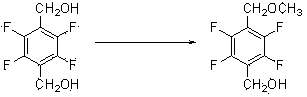
Figure 1 
Figure 2 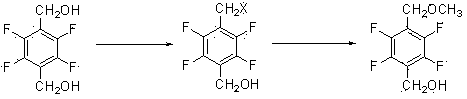
Figure 3
Abstract
Description
Technical field:
[0001] The present invention relates to a kind of synthetic method of 4-methoxymethyl-2,3,5,6-tetrafluorobenzyl alcohol, specifically, relate to a kind of 2,3,5,6-tetrafluorobenzyl alcohol as Raw material, method for synthesizing 4-methoxymethyl-2,3,5,6-tetrafluorobenzyl alcohol. Background technique:
[0002] 4-Methoxymethyl-2,3,5,6-tetrafluorobenzyl alcohol is a key intermediate in the synthesis of perfluthrin. Perfluthrin is a high-efficiency and low-toxic sanitary pyrethroid insecticide developed by Sumitomo Chemical Industry Co., Ltd. of Japan. It is mainly used for the control of sanitary pests and has a broad market prospect.
[0003] At present, the synthetic methods of 4-methoxymethyl-2,3,5,6-tetrafluorobenzyl alcohol reported in the literature mainly contain the following types:
[0004] 1. Using tetrafluoro-p-phenylenedimethanol as a raw material, under the action of a methylating reagent, undergo a selective methylation reaction to obt...
Examples
Embodiment 1
[0041] Add 50 grams of compound (I), 150 grams of concentrated hydrochloric acid, and 200 grams of toluene into a 500 ml four-neck flask equipped with mechanical stirring, a thermometer, and a condenser, and stir to heat up to 70 o C was reacted for 10 hours, the reaction system was cooled to room temperature, and the organic phase was separated, dried and precipitated to obtain 49.8 g of compound (II, X=Cl) with a purity of 98.3%.
Embodiment 2
[0043] Add 54 grams of compound (I), 130 grams of concentrated hydrochloric acid, and 250 grams of n-heptane into a 500 ml four-necked flask equipped with mechanical stirring, a thermometer, and a condenser, and stir to heat up to 75 o C was reacted for 8 hours, the organic phase was separated from the reaction system, cooled and crystallized, and filtered to obtain 50.3 g of compound (II, X=Cl) with a purity of 99.2%.
Embodiment 3
[0045] Add 30 grams of compound (I), 40 grams of concentrated hydrochloric acid, and 120 grams of n-heptane into a 500 milliliter pressure-resistant reactor. o C was reacted for 6 hours, the reaction system was cooled to room temperature, and filtered to obtain 31.0 g of compound (II, X=Cl) with a purity of 98.8%.