
Multi-feed-source double-frequency high-separation wide-beam high-stability phase centre antennae
A high isolation, phase center technology, applied in antennas, antenna coupling, antenna arrays, etc., can solve the problems of difficult adjustment, low phase center stability, narrow bandwidth, etc., to improve isolation, increase gain, and reduce mutual coupling. Effect
Patent Information
- Authority / Receiving Office
- CN · China
- Patent Type
- Patents(China)
- Current Assignee / Owner
- Publication Date
- 2014-12-17
Smart Images
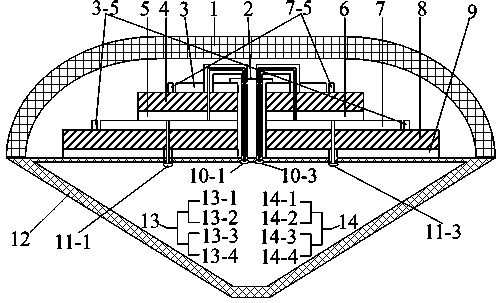
Figure 1 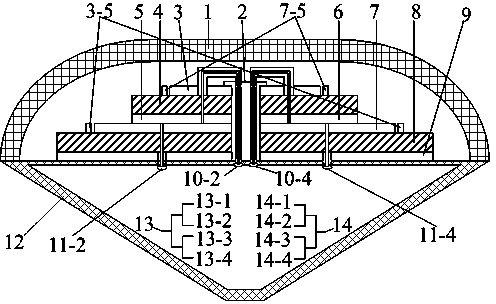
Figure 2 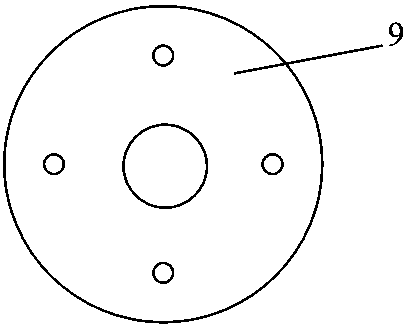
Figure 3
Abstract
Description
[0001] Multi-feed dual frequency high isolation wide beam high stable phase center antenna. technical field
[0002] The invention relates to a multi-feed dual-frequency high-isolation wide-beam high-stable phase center antenna suitable for geodetic satellite navigation ground receiving terminals and high-precision positioning and directional satellite navigation ground receiving terminals. The typical working frequency bands are L and S Frequency band, with significant advantages such as compact structure, small standing wave, small axial ratio, wide axial ratio bandwidth, high dual-frequency isolation, and ultra-stable phase center within a wide beam range. Mainly used in the US global satellite navigation system, China's Beidou, Russia's GLONASS and European Galileo satellite navigation and positioning systems, geodetic satellite navigation ground receiving terminals with millimeter-level positioning accuracy, short baselines and hundredth-level high precision In various hi...
Examples
Embodiment Construction
[0034] A multi-feed source dual-frequency high-isolation wide-beam high-stable phase center antenna includes: a radome 1 and a metal inverted cone base 12 for reflecting signals and suppressing multipath interference, and the radome 1 is arranged on a metal On the inverted cone base 12, a first power divider 13 and a second power divider 14 are provided in the metal inverted cone base 12, and mutual The first radiation antenna and the second radiation antenna stacked together are fixed on the metal inverted cone base 12 by the hollow short-circuit screw 2 passing through the center of the first radiation antenna and the second radiation antenna, and the first radiation antenna and the metal A first coaxial cable 11-1 is arranged between the inverted cone bases 12, and one end of the inner core of the first coaxial cable 11-1 is connected with the radiation sheet of the first radiation antenna, and the first coaxial cable 11-1 The other end of the inner core is connected to the...