
Confidence Dominance Relational Rough Set Model and Attribute Reduction Method
A technology of attribute reduction and rough set, applied in special data processing applications, instruments, electrical digital data processing, etc., can solve problems such as incomplete order information, under-consideration of "order" system characteristics, semantic contradictions, etc.
Patent Information
- Authority / Receiving Office
- CN · China
- Patent Type
- Patents(China)
- Current Assignee / Owner
- Publication Date
- 2017-01-18
Smart Images
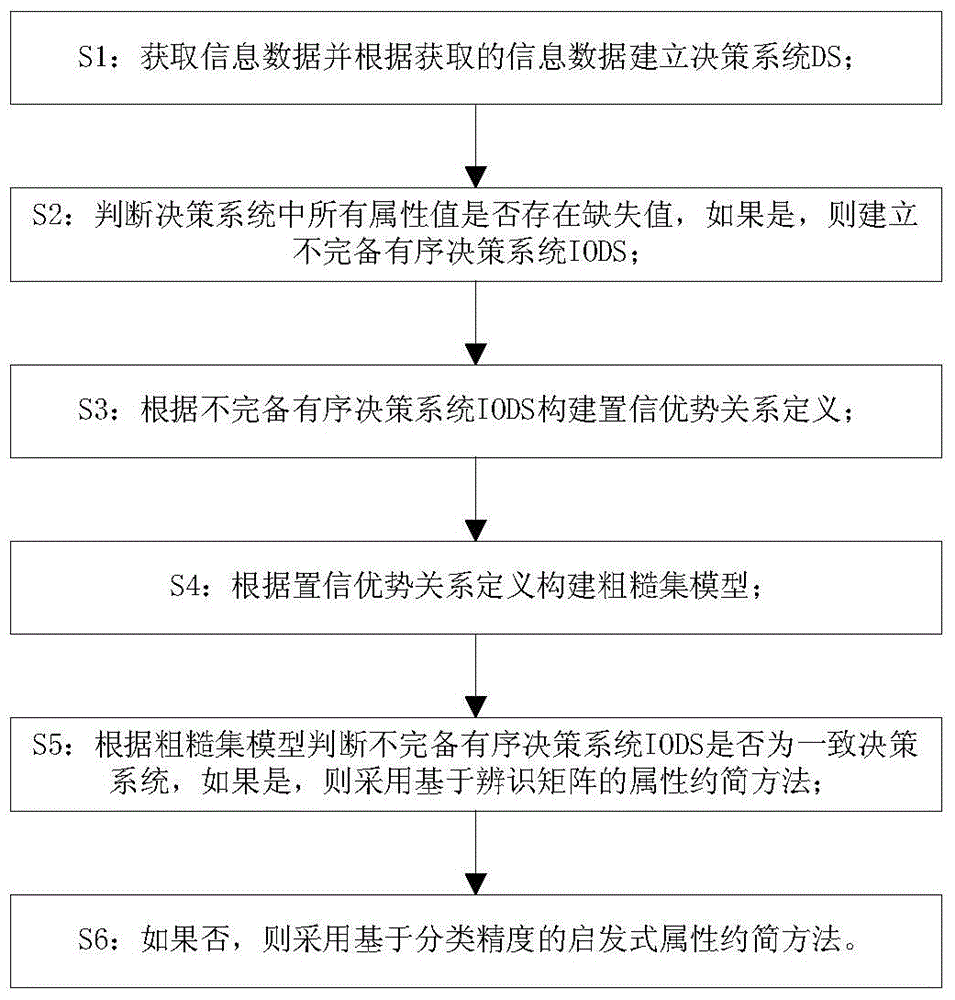
Figure 1 
Figure 2 
Figure 3
Abstract
Description
technical field
[0001] The invention relates to a data attribute reduction method, in particular to a confidence-dominant relation rough set model and an attribute reduction method. Background technique
[0002] With the rapid development of computer network technology, the amount of data in various fields increases rapidly. However, due to the limitations of data acquisition technology, transmission failures and some human factors, data defects and loss often occur. In the real world, due to the complexity and uncertainty of the environment, people will face decision-making problems with uncertain, incomplete and decision-preferred information.
[0003] Rough set theory is based on equivalence relation (satisfying reflexivity, symmetry and transitivity), and it is a new mathematical tool for dealing with uncertain and ambiguous information. Dominance-based Rough Set Analysis (DRSA) uses the dominance relation (satisfying reflexivity and transitivity) to replace the equival...
Examples
Embodiment 1
[0070] This example first introduces the existing extended advantage relationship:
[0071] Definition 12: Extended Dominance Relationship,
[0072] use express. The restricted dominance relation is a special form of Definition 12 that allows expansion only at the attribute maximum and minimum values.
[0073] Definition 13: Finite Extended Dominance Relation,
[0074]
[0075] use express.
[0076] Definition 14: Generalized Extended Dominance Relation
[0077]
[0078] use express. The k-degree extension characteristic dominance relation is a special form of Definition 14 that subdivides missing values into two cases for extension.
[0079] Definition 15: Similar Strengths Relationship
[0080] SDR + ( P ) = { ( x , y ) ∈ U 2 : ∀ q ∈ B P ...
Embodiment 2
[0095] figure 1 The flowchart of the confidence-dominant relation rough set model and the attribute reduction method provided by the embodiment of the present invention is as shown in the figure: The confidence-dominant relation rough set model and the attribute reduction method provided by the present invention include the following steps:
[0096] S1: Obtain information data and establish a decision-making system DS according to the obtained information data;
[0097] S2: Determine whether all attribute values in the decision-making system have missing values, and if so, establish an incomplete and ordered decision-making system IODS;
[0098] S3: Construct the definition of confidence advantage relationship according to the incomplete ordered decision system IODS;
[0099] S4: Build a rough set model according to the definition of the confidence dominance relationship;
[0100] S5: According to the rough set model, judge whether the incomplete ordered decision-making sy...
Embodiment 3
[0152] The difference between this embodiment and Embodiment 2 is only:
[0153] The confidence advantage relation rough set model and attribute reduction method provided by the embodiments of the present invention include the following steps:
[0154] S1: Definition of confidence advantage relationship;
[0155]S2: Rough set model based on confidence dominance relation;
[0156] S3: Attribute reduction method based on identification matrix in incomplete consistent information table.
[0157] S4: In the incomplete and inconsistent information table, a heuristic attribute reduction method based on classification accuracy.
[0158] The definition of Confidential Dominate Relation (CDR), which satisfies the characteristics of order relation, satisfies reflexivity, transitivity and order symmetry; the confidence dominance relation defines that the dominance class object of an object A should be better than the known attributes of A , and the amount of known information cannot b...