
Heterogeneous Small Cell Spatial Division Interference Coordination Method Based on Dynamic Beam Closing
A space division interference and small cell technology, applied in radio transmission systems, electrical components, transmission systems, etc., can solve problems such as difficulty in establishing high-speed and stable backhaul links, channel characteristic changes, etc.
Patent Information
- Authority / Receiving Office
- CN · China
- Patent Type
- Patents(China)
- Current Assignee / Owner
- Publication Date
- 2017-06-16
Smart Images
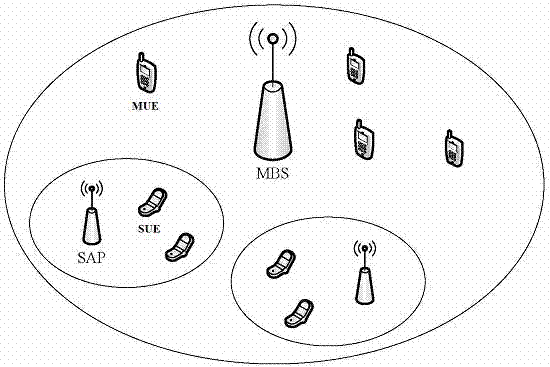
Figure 1 
Figure 2 
Figure 3
Abstract
Description
technical field
[0001] The present invention relates to the technical field of wireless communication, in particular to a space-division interference coordination method for heterogeneous small cells based on dynamic closing of beams. Background technique
[0002] With the popularization and application of smart terminals and the continuous growth of new mobile business demands, the demand for wireless transmission rate will increase exponentially in the next 10 years. 1000 times that of the camp system. Existing 4G technology will still be unable to meet the ultra-high transmission rate mobile Internet wireless communication needs ten years later. In the case of increasingly scarce spectrum resources, it is necessary to introduce transformative new technologies. While promoting the industrialization of 4G, countries around the world have begun to focus on the research of the fifth-generation wireless mobile communication technology (5G), striving to make a new leap in the ...
Examples
Embodiment Construction
[0021] Below in conjunction with specific embodiment, further illustrate the present invention, should be understood that these embodiments are only used to illustrate the present invention and are not intended to limit the scope of the present invention, after having read the present invention, those skilled in the art will understand various equivalent forms of the present invention All modifications fall within the scope defined by the appended claims of the present application.
[0022] Consider a downlink system scenario consisting of one macro base station (MBS) and K small cell base stations (SAP), including M macro base station service users (MUE), M s a SAP service user (SUE), such as figure 1 shown. The number of MBS antennas is N t , the number of SAP antennas is N t_small , the number of user antennas is 1, and the case of a single subcarrier is considered for simplicity, and other scenarios can be similarly promoted.
[0023] Consider the spectrum reuse gener...