
Automatic extraction method for character strokes of vector fonts
A technology of strokes and glyphs, applied in the field of non-rigid point set registration, can solve problems such as low efficiency
Patent Information
- Authority / Receiving Office
- CN · China
- Current Assignee / Owner
- Publication Date
- 2015-10-21
Smart Images
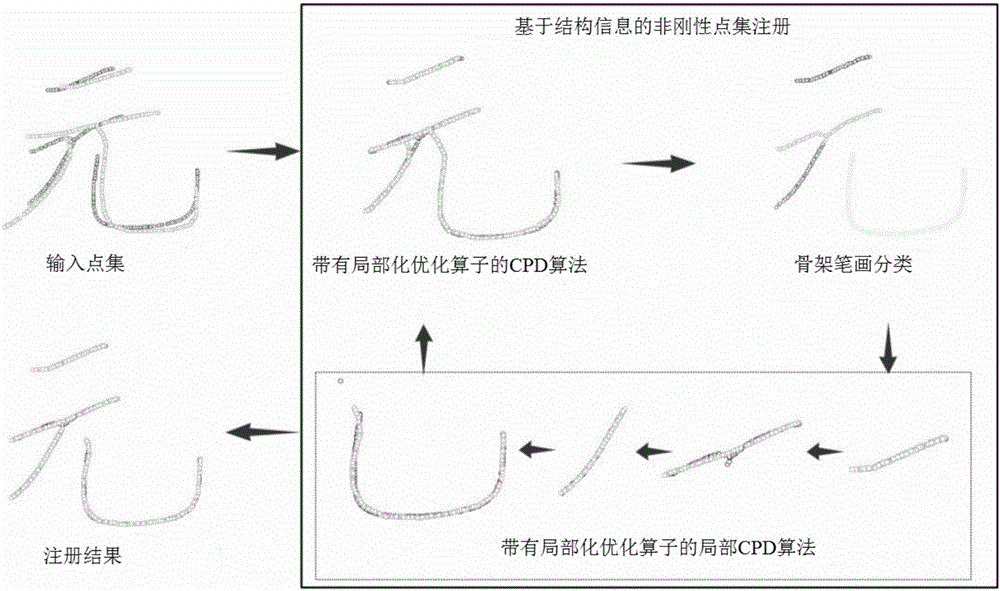
Figure 1 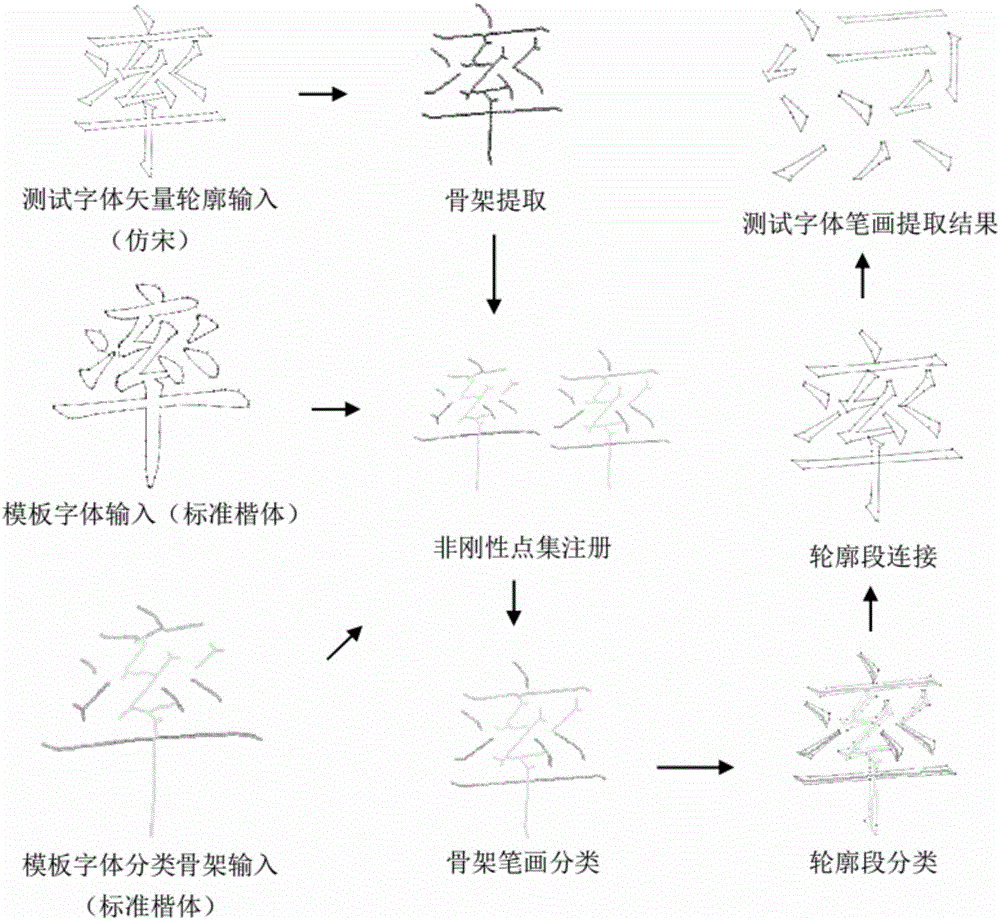
Figure 2 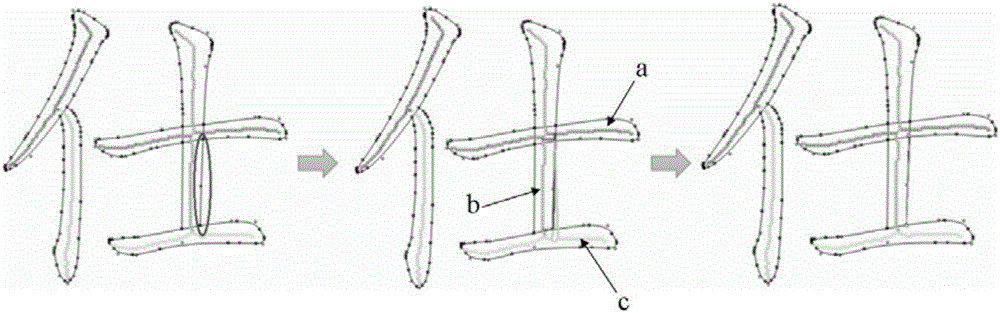
Figure 3
Abstract
Description
technical field
[0001] The invention relates to a method for automatically extracting Chinese character strokes of vector fonts. More specifically, it involves a non-rigid point set registration method, and uses the result of point set registration to propose an algorithm for extracting vector Chinese character strokes, thereby completing the automatic stroke extraction of vector glyphs, which belongs to computer graphics and image processing technology field. Background technique
[0002] Chinese characters are an ancient language with a history of nearly 5,000 years. During the development and evolution of Chinese characters, a variety of fonts appeared. In the early days of computer development, the Chinese character library only included a few limited fonts such as Hei Ti, Song Ti, Kai Ti, and Fang Song. With the development of computer technology and the popularization of the Internet, people's demand for different fonts is becoming more and more urgent.
[0003] At ...
Examples
Embodiment Construction
[0050] In order to make the above objects, features and advantages of the present invention more obvious and understandable, the present invention will be further described below through specific embodiments and accompanying drawings.
[0051] figure 1 It is the non-rigid point set registration flow chart based on structural information described in the present invention, which includes the following parts:
[0052] 1) Carry out CPD registration with a localized optimization operator for the two input point sets, and obtain the globally optimal point set correspondence after matching.
[0053] 2) Obtain the preliminary stroke classification result of the data point set according to the point set correspondence relationship obtained in step 1).
[0054] 3) After step 2) is executed, each stroke corresponds to a set of template points and a set of data points, and localized CPD registration is performed for these two sets corresponding to each stroke (that is, localized optimiz...