
End-tidal carbon dioxide-guided airway surface anesthesia tube combined with gastric tube dual-purpose tube
A carbon dioxide and surface anesthesia technology, applied in catheters and other directions, can solve problems such as unsatisfactory anesthesia effect, time-consuming, and inability to implement, and achieve the effect of increasing surface anesthesia effect, reducing plasma concentration, and large contact area
Patent Information
- Authority / Receiving Office
- CN · China
- Patent Type
- Patents(China)
- Current Assignee / Owner
- Publication Date
- 2018-06-15
Smart Images
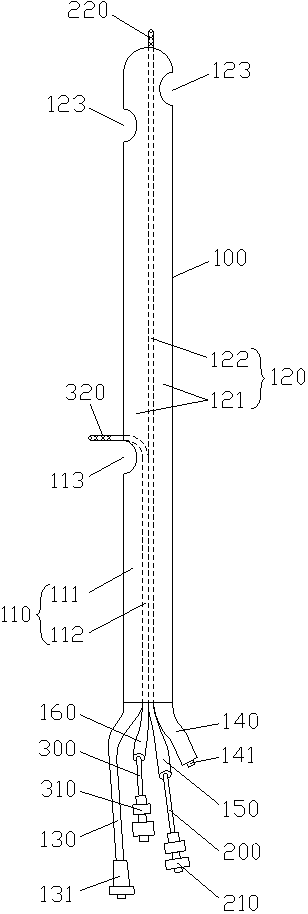
Figure 1
Abstract
Description
technical field
[0001] The invention relates to the field of medical devices, in particular to an end-tidal carbon dioxide-guided airway surface anesthesia tube combined with a gastric tube dual-purpose tube. Background technique
[0002] Awake tracheal intubation is one of the main measures of the American Society of Anesthesiologists' practical rules for the management of difficult airways. If it is estimated that it may be difficult to ensure effective ventilation and oxygenation after induction of surgical patients, and it is suspected that the patient is at risk of aspiration of gastric contents, the patient should be kept awake for tracheal intubation. As far as awake tracheal intubation is concerned, whether it is fiberoptic bronchoscopic guidance or blind tracheal intubation, the nasal route is easier, because the narrow nasal cavity has a certain support and guiding effect on the FOB or tracheal tube, and the FOB or tracheal tube It is also easier for the catheter ...
Examples
Embodiment Construction
[0017] In order to make the above-mentioned features and advantages of the present invention more comprehensible, the following specific embodiments are described in detail with reference to the accompanying drawings.
[0018] Such as figure 1 As shown, an end-tidal carbon dioxide-guided airway surface anesthesia tube combined with a gastric tube dual-purpose tube includes a large catheter 100, and the lumen of the large catheter 100 is divided into an end-tidal carbon dioxide channel cavity 110 by a diaphragm at the central axis and gastric lumen 120, the gastric lumen 120 is distributed along the entire length of the large catheter 100, the end-tidal carbon dioxide channel cavity 110 is distributed locally from the head end of the large catheter 100 to the end, the gastric lumen 120 and the respiratory The end-tidal carbon dioxide channel chamber 110 is divided into large lumens 121, 111 and small lumens 122, 112 by the diaphragms near the central axis of the large catheter ...