
Tunable short-pulse laser amplifier based on mode-locking autocorrelation
A short-pulse laser and autocorrelation technology, which is applied in the field of lasers, can solve the problems of low single-stage power amplification and untunable laser wavelength, and achieve the effects of peak power reduction, high power output, and damage prevention
Patent Information
- Authority / Receiving Office
- CN · China
- Current Assignee / Owner
- Publication Date
- 2017-07-04
- Estimated Expiration
- Not applicable · inactive patent
Smart Images
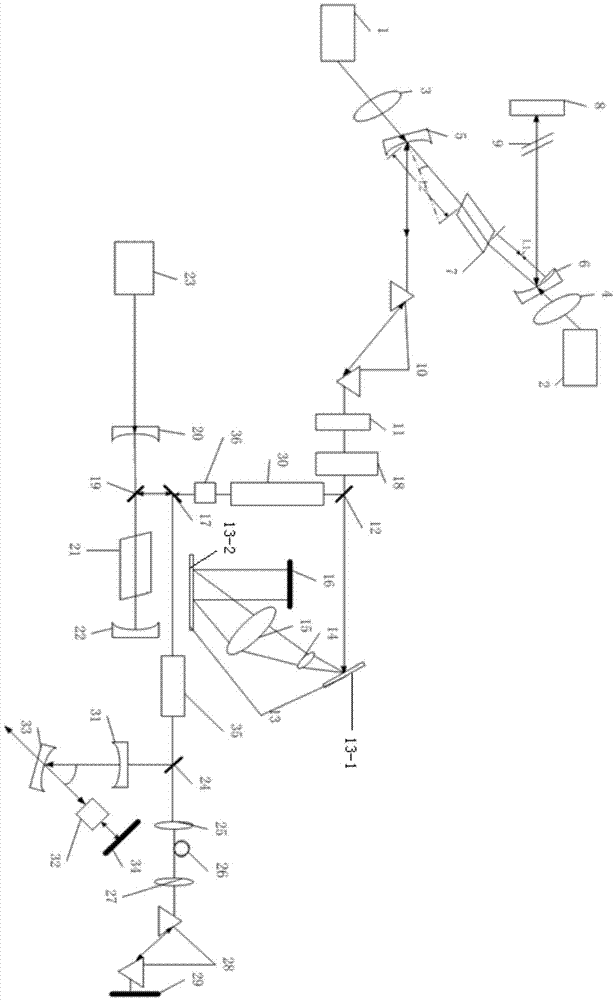
Figure 1
Abstract
Description
technical field
[0001] The invention relates to the field of lasers, in particular to a tunable short-pulse laser amplifier based on mode-locked autocorrelation. Background technique
[0002] Tunable lasers can be used as key components in optical communication systems. The output wavelength of the tunable laser is adjustable and has strong versatility. It can replace the distributed feedback laser with a fixed wavelength, and it can be adjusted to the working wavelength when used. Therefore, only a small number of tunable lasers are required to provide laser light sources in different working environments, equipment management is simplified, and utilization efficiency is improved. In addition, for the realization of optical pulse compression, power amplification, etc., the pulsed light output by the laser can be tuned.
[0003] The breadth of wavelength tuning and the level of output power of tunable lasers are very important in practical applications, and they are also i...
Examples
Embodiment
[0032] Examples of the present invention are figure 1 As shown, wherein the pumping light is the first Q-switched quasi-CW Nd:YAG laser 1, the second Q-switched quasi-CW Nd:YAG laser 2, and the third Q-switched quasi-CW Nd:YAG laser 23, all of which have a pulse width of 50ns, A laser with a repetition rate of 30KHz, a wavelength of 1064nm, a peak power of 8.6KW, and an output pump power of 5.2W. L1 is 138mm and L2 is 165mm. The thickness ratio of the four crystals of the birefringence interference filter 8 is 1:2:4:9. The angle of incidence for the first prism pair 10 is 40 o , The distance between the vertices of the two prisms is 57cm, and they are placed in parallel with a slight angle of 8 o , tap the concave spherical mirror 5, wherein the self-mode-locked correlation, and slightly adjust the placement angle of the birefringent interference filter 9 .
[0033] The wavelength of the laser output through the coupling output mirror is 1510nm, the output power here is 44...