
Ciphertext domain high-capacity image reversible data hiding method
A data hiding, high-capacity technology, applied in the field of data hiding, which can solve the problems of complex protocols, low embedding capacity, low distortion, etc.
Patent Information
- Authority / Receiving Office
- CN · China
- Patent Type
- Applications(China)
- Current Assignee / Owner
- Publication Date
- 2019-02-15
Smart Images
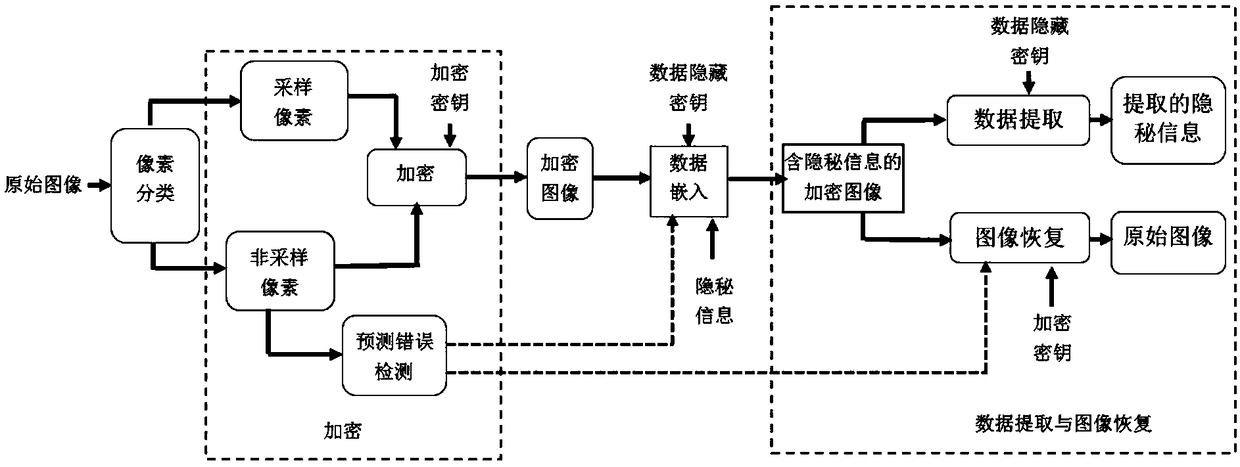
Figure 1
Abstract
Description
technical field
[0001] The invention relates to a data hiding technology, in particular to a method for reversible data hiding of a high-capacity image in a ciphertext domain. Background technique
[0002] Under the cloud computing platform, the provider of multimedia content does not have to be a storer and a processor at the same time. In this mode of work, user data is largely "out of control". One of the best ways to ensure the security of multimedia data is to encrypt the multimedia data. Users first encrypt sensitive content before uploading. All processing and calculations in the cloud are performed in the ciphertext domain, and the processing results are provided to the user. The user can only obtain the plaintext data after decryption.
[0003] In many application scenarios, some cloud service managers who do not have decryption authority need to embed some additional information in the encrypted carrier, such as annotation or authentication data, work source info...
Examples
Embodiment Construction
[0046] The present invention will be further described in detail below in conjunction with the accompanying drawings and embodiments.
[0047] A high-capacity image reversible data hiding method in the ciphertext domain proposed by the present invention, as shown in the figure, includes four parts: prediction error detection, image encryption, reversible data hiding in the ciphertext domain image, secret information extraction, and lossless restoration of the original image. In the prediction error detection part, all the pixels in the grayscale image to be processed are first divided into sampling pixels and non-sampling pixels; then the pixel values of all sampling pixels are used to calculate the predicted value; then according to the pixel values and predicted values of all non-sampled pixels, mark all non-sampled pixels as non-sampled pixels with wrong predictions and non-sampled pixels with accurate predictions, and obtain the marked Grayscale image. In the image ...