
Sunflower three-strut single-inclined-cable cable dome structure
A single oblique cable type and cable dome technology, applied in the field of architecture, can solve the problems of poor stability, insufficient torsional stiffness and stability, and achieve the effects of improving stability, reducing the amount of cable materials and reducing project cost.
Patent Information
- Authority / Receiving Office
- CN · China
- Patent Type
- Applications(China)
- Current Assignee / Owner
- Publication Date
- 2019-11-22
Smart Images
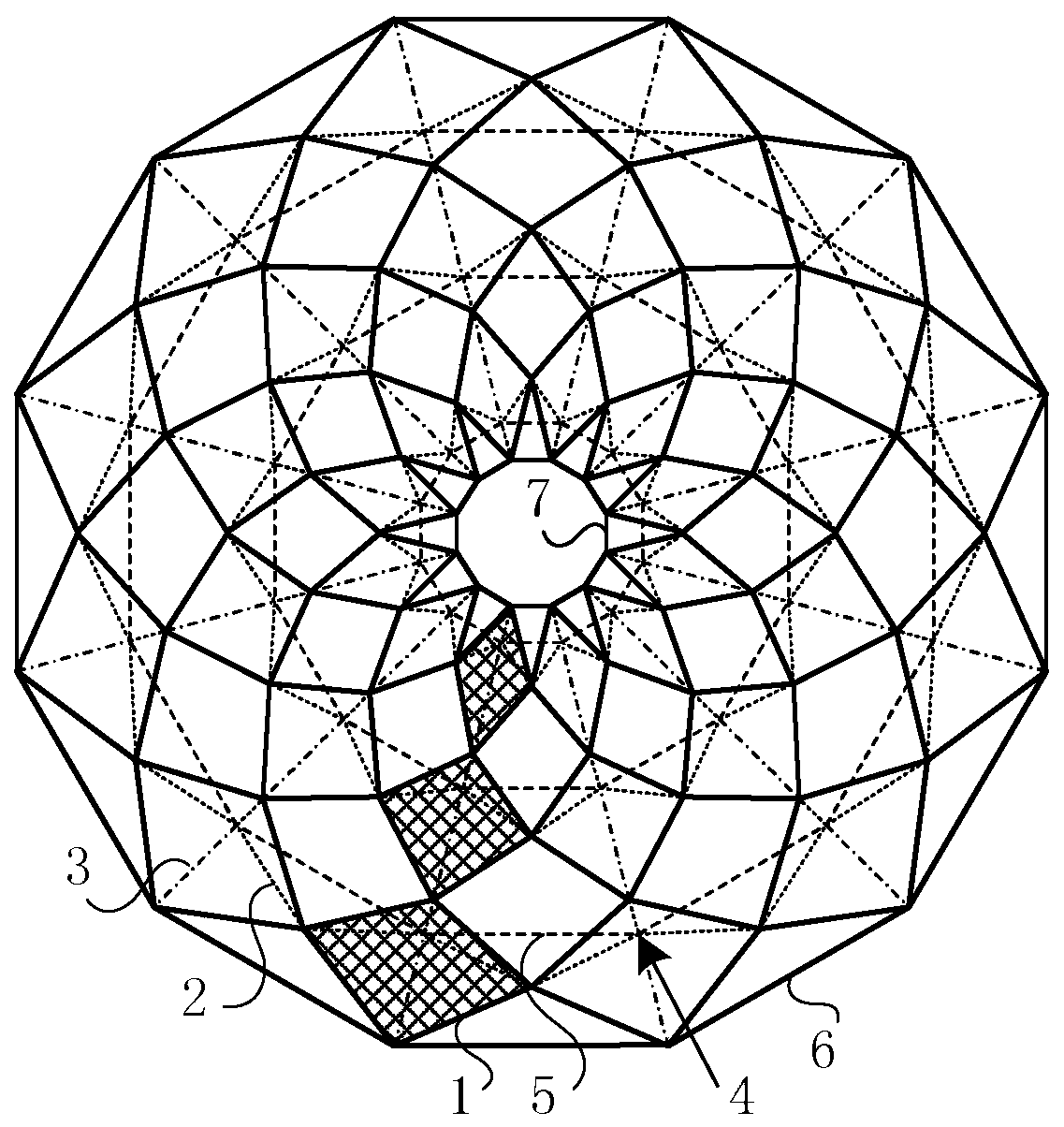
Figure 1 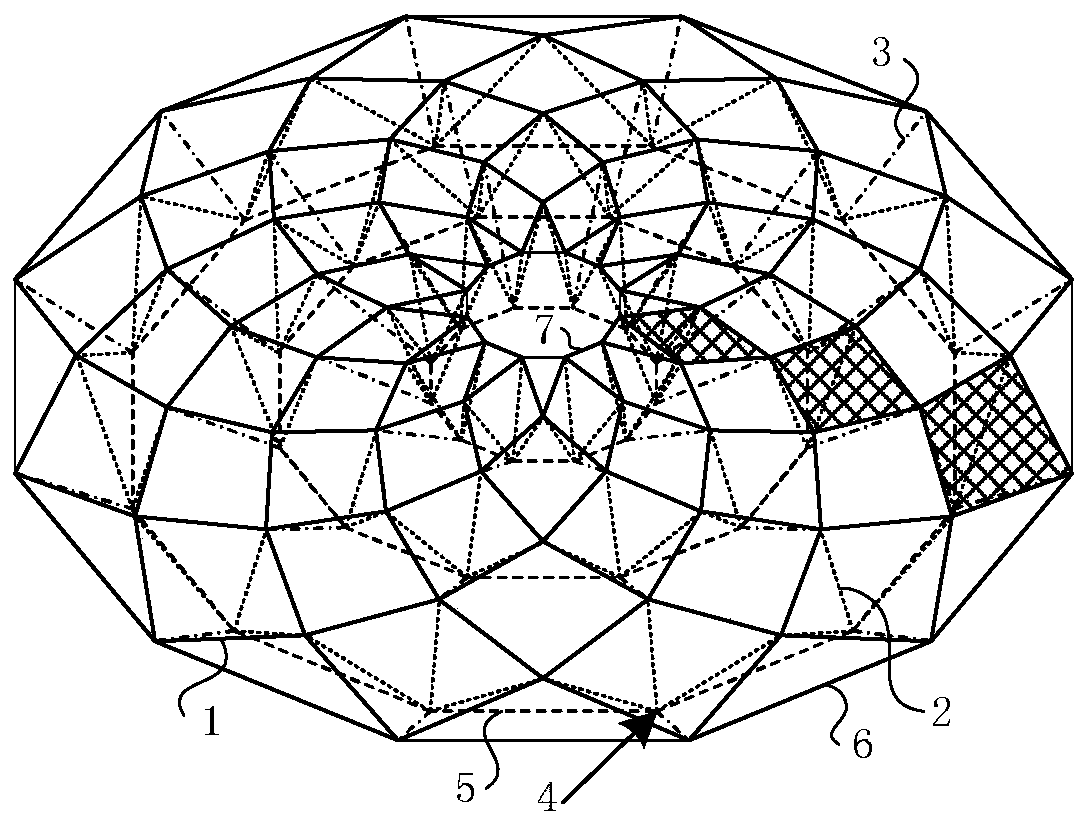
Figure 2 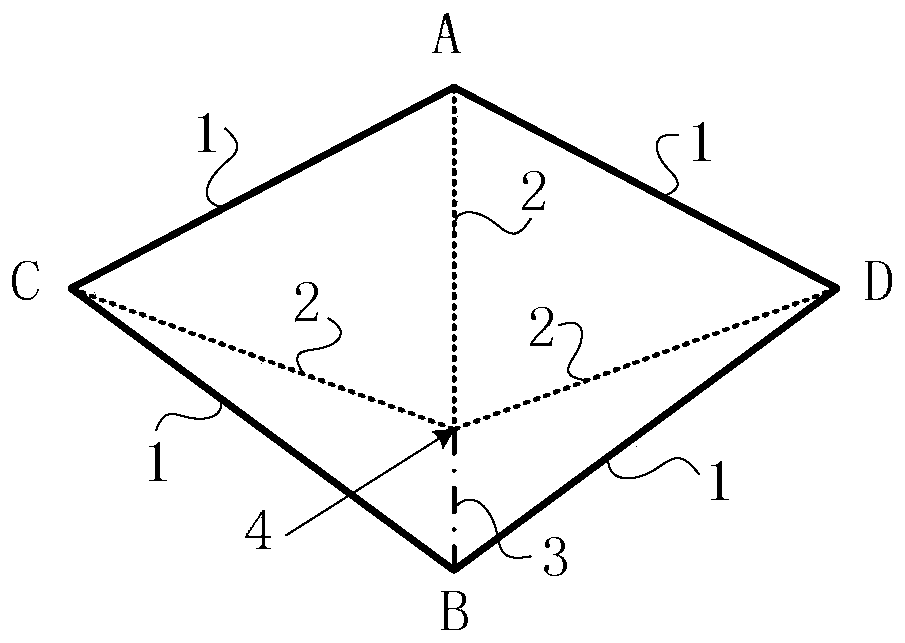
Figure 3
Abstract
Description
technical field
[0001] The invention belongs to the technical field of architecture, and in particular relates to a sunflower three-strut single-cable cable dome structure. Background technique
[0002] The cable dome structure has excellent mechanical performance, beautiful structural shape and outstanding economic indicators. The current research and practice are based on the Fuller concept of "an ocean of cables and an island of compression rods", that is, each upper and lower chord node in the cable dome is equipped with only one vertical compression rod to form a tension field pressure "islands" in Since the horizontal projection of the pressure rod is a point, the projection of the same ring of pressure rods forms a point ring, that is, the pressure rods are perpendicular to the horizontal plane and are not connected to each other, resulting in poor stability. Especially for the rib-ring cable dome structure, the upper chord node has no ring members to constrain it, ...
Examples
Embodiment Construction
[0026] like figure 1 and 2 As shown, a sunflower three-strut single-cable cable dome structure includes a symmetrical space basic unit ( figure 1 middle shaded part), lower chord ring cable, inner ring cable, outer ring beam.
[0027] like image 3 , 4 , 5, each symmetrical space basic unit includes four upper string notches 1 (solid lines in the figure), three struts 2 (dense dotted lines in the figure), and a diagonal cable 3 (dotted line in the figure).
[0028] The four upper-chord notochords 1 are connected end to end to form a three-dimensional quadrilateral in space. The horizontal projection of the three-dimensional quadrilateral in space is a free isosceles quadrilateral composed of two isosceles triangles with a common base, and its horizontal projection is a free isosceles quadrilateral composed of two isosceles triangles with a common base. isosceles quadrilateral. Two adjacent notochords 1 intersect at a notochord node, including a notochord top node A, a not...